What Is a Downdraft Paint Booth?
Definition and Concept
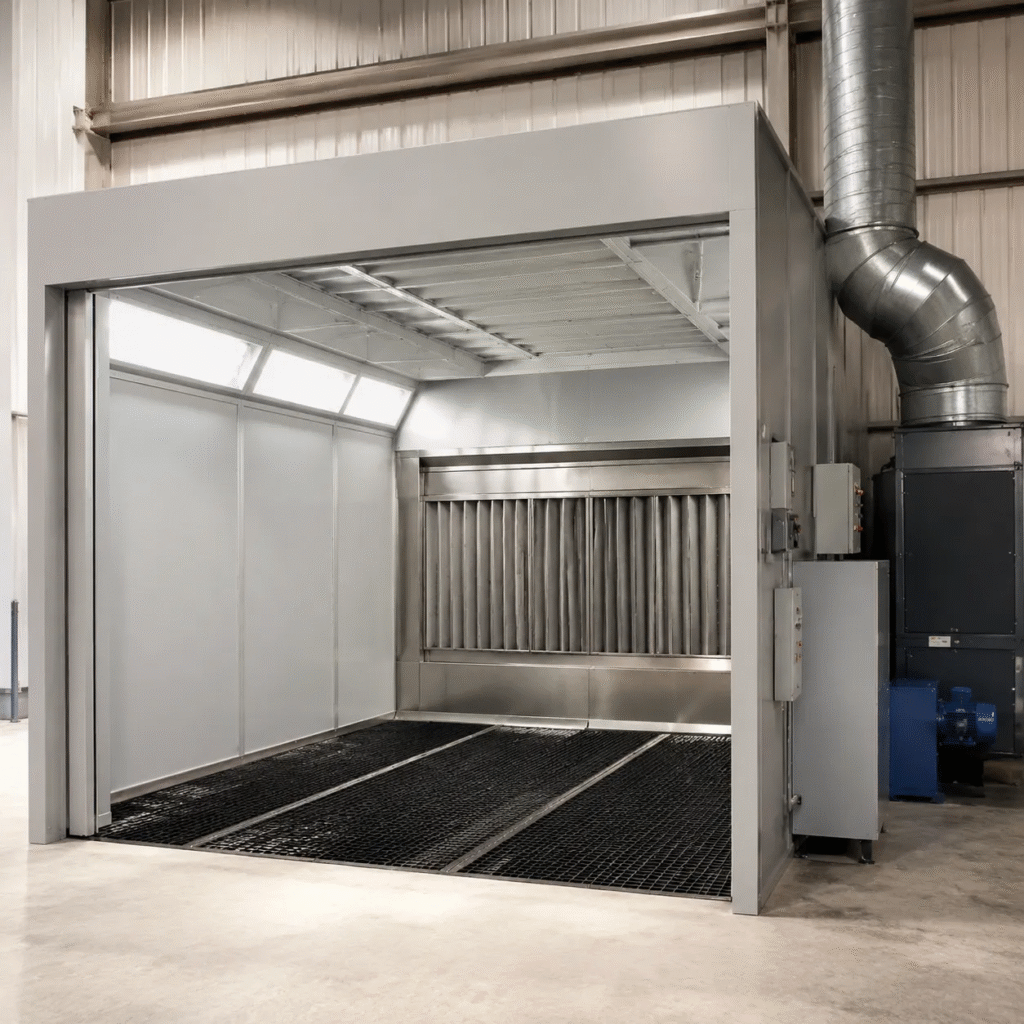
A downdraft paint booth is a specialized spray painting enclosure engineered to provide a clean, controlled environment for finishing applications. It features a vertical airflow pattern where filtered air is introduced from the ceiling and moves straight downward over the vehicle or part being painted. This design dramatically reduces airborne contaminants and overspray settling on wet surfaces, ensuring superior finish quality. Downdraft booths are ideal for automotive refinishing, industrial coatings, and aerospace painting where precision and cleanliness are critical.
How Downdraft Airflow Works
In a downdraft paint booth, air enters through high-efficiency intake filters mounted in the ceiling plenum. The air travels vertically in a straight downward path, carrying overspray and dust particles away from the painted surface toward the grated floor or pit exhaust system. This continuous, unidirectional airflow efficiently removes contaminants, creating a particle-free environment and preventing finish defects. The downward movement of air also directs fumes and overspray away from the operator’s breathing zone, enhancing safety.
Importance of Code Compliance and Performance Standards
Downdraft paint booths are meticulously designed to meet stringent performance and safety standards, including NFPA 33, NFPA 86, OSHA, and EPA regulations. Compliance ensures proper ventilation, fire safety, and environmental controls are maintained throughout operation. High-quality filtration systems with 98%+ efficient paint arrestors, Class I Division 2 lighting, and ETL/UL-listed components contribute to meeting these regulatory requirements. Adhering to these codes guarantees reliable booth performance, operator health protection, and long-term operational efficiency.
Key Features and Specifications of Downdraft Booths
Construction and Materials
Downdraft paint booths are built tough with heavy-gauge steel panels, typically 18-gauge or thicker. These panels may be single-skin galvanized steel or dual-skin insulated for added thermal efficiency and noise reduction. Precision CNC cutting ensures accurate assembly and airtight seams, essential for maintaining consistent vertical airflow. The structural design supports durability and withstands daily heavy use in busy industrial or automotive environments.
| Feature | Details |
|---|---|
| Panel Material | 18-gauge galvanized steel (single/dual skin) |
| Assembly | CNC precision-cut, airtight sealing |
| Insulation | Optional dual-skin insulated panels |
| Floor | Grated or pit exhaust chamber, heavy-duty steel |
Booth Lighting and Electrical Systems
Lighting is critical for clear visibility during painting. Downdraft booths use Class I, Division 2 LED fixtures installed flush in ceilings and sidewalls to provide bright, shadow-free illumination. These fixtures meet hazardous location safety standards, ensuring safe operation in flammable environments. Electrical controls include explosion-proof wiring and PLC-operated systems for fan speed and temperature regulation.
| Lighting Feature | Specification |
|---|---|
| Type | LED, Class I, Division 2 |
| Placement | Flush-mounted ceilings and sidewalls |
| Electrical Controls | Explosion-proof wiring, PLC fan controls |
Fans, Motors, and Air Solenoid Valves
High-performance centrifugal fans create the true vertical downdraft airflow, pulling air from the ceiling plenum straight down to the grated floor exhaust. Motors are TEFC (Totally Enclosed Fan Cooled) type, ensuring long life and reliability under continuous load. Air solenoid valves help regulate make-up air, maintaining booth pressure and temperature consistency essential for quality finishes and worker safety.
| Component | Description |
|---|---|
| Fan Type | Heavy-duty centrifugal, balanced for vibration reduction |
| Motor | TEFC motors, rated for continuous industrial use |
| Air Solenoid Valves | Controls make-up air, regulates booth pressure |
Optional Features and Energy-Efficient Bake Cycles
Many downdraft booths offer optional heated Air Makeup Units (AMUs) that provide energy-efficient bake cycles, speeding up drying and curing times for both waterborne and solvent-based paints. Programmable temperature controls optimize energy use without compromising finish quality. Additional options include remote monitoring systems, variable frequency drives for airflow tuning, and filtered return air recirculation for further utility savings.
| Optional Feature | Benefit |
|---|---|
| Heated AMUs | Faster bake/cure cycles, reduces flash time |
| Variable Frequency Drives | Precise airflow control, energy savings |
| Remote Monitoring | Real-time performance tracking |
| Filtered Recirculation | Lowers energy costs, maintains air quality |
These specifications ensure a downdraft paint booth delivers consistent, contamination-free finishes while maximizing operational efficiency and compliance with rigorous industrial standards. Detailed engineering and quality materials come together to support high-throughput finishing with superior environmental control. For deeper insights on booth types and features, exploring our comprehensive automotive paint booth guide can be very helpful.
Main Benefits of Using a Downdraft Paint Booth
Superior Cleanliness and Finish Quality
Downdraft paint booths excel at delivering consistently clean finishes by directing air vertically from the ceiling down through floor grates. This true downward airflow quickly removes airborne dust, overspray, and contaminants away from the painted surface. The result is a flawless, particle-free coating with minimal defects—a critical factor for high-end automotive, industrial, and aerospace paint applications. By minimizing surface irregularities caused by debris, downdraft systems enhance paint adhesion and ensure a professional-quality finish every time.
Enhanced Overspray Control and Airflow Efficiency
The efficient vertical airflow design forces overspray particles and volatile compounds immediately downward and out through the exhaust floor filters. This prevents overspray from circulating inside the booth, which greatly improves paint transfer efficiency and reduces paint waste. In comparison to crossdraft or semi-downdraft booths, the airflow pattern in a full downdraft booth optimizes drying times and flash cycles, supporting faster production throughput. Multi-stage filtration on intake and exhaust systems further boosts air quality and booth performance while maintaining steady pressure balance inside the workspace.
| Benefit Aspect | Advantage Description |
|---|---|
| Overspray Capture | Directs particles straight down for immediate removal |
| Airflow Efficiency | Promotes faster drying and consistent coating applications |
| Filtration | Multi-layer filters ensure clean intake and exhaust air |
Improved Operator Safety and Environmental Compliance
Downdraft paint booths are designed to move airborne contaminants away from the painter’s breathing zone instantly, helping exceed OSHA and EPA safety standards. By pulling air from the ceiling downward and exhausting it through the floor, these booths reduce the risk of inhaling hazardous fumes and minimize exposure to volatile organic compounds (VOCs). The controlled airflow also supports compliance with NFPA standards for fire safety and paint booth construction. In addition, energy-saving options such as heated air makeup units can be integrated to optimize curing cycles while reducing operational costs and overall environmental impact.
Reliable downdraft paint booth systems combine superior finish quality, advanced airflow management, and operator protection—all fundamental for efficient, safe, and compliant paint operations. For detailed insight into airflow design and safety, see our automotive paint booth airflow design and safety guide.
Types of Downdraft Paint Booths
Full Downdraft Spray Booths
Full downdraft paint booths feature a true vertical airflow, pulling air from the ceiling down through the entire booth and exhausting it through floor grates or pits. This setup ensures contaminants and overspray are immediately drawn away from the workpiece and operator, delivering the highest finish quality. These booths are ideal for automotive and industrial applications where finish cleanliness and consistent airflow are critical.
Side Downdraft Spray Booths
Side downdraft spray booths direct airflow either partially or fully from ceiling to side exhausts, rather than straight down. This can be a practical solution when floor pit installation is difficult or space is limited. While still effective at controlling overspray and contaminants, side downdraft designs generally offer slightly less efficient vertical airflow compared to full downdraft models but can be more adaptable for certain facility layouts.
Dry vs. Wet Downdraft Systems
Downdraft paint booths come with either dry or wet exhaust filtration systems. Dry systems use multi-stage paint arrestor filters at the exhaust to capture overspray particles, suitable for most standard painting operations. Wet downdraft booths utilize water curtains or scrubbers to trap paint particles, aiding in capturing volatile organic compounds (VOCs) and reducing dust. Choosing between dry and wet systems depends on the specific production needs, environmental regulations, and paint types in use.
For more detailed insights on selecting the right downdraft booth and airflow style, the comparison of airflow types in spray booths provides an in-depth resource.
Industrial Applications and Sizing
Automotive and Vehicle Finishing
Downdraft paint booths are essential in automotive refinishing environments where flawless finishes and contamination control are critical. They provide the vertical airflow needed to efficiently capture overspray and prevent dust from settling on freshly coated surfaces. These booths accommodate everything from compact cars to heavy-duty trucks, supporting both collision repair shops and custom automotive paint facilities. Their design ensures compliance with industry safety standards while maximizing productivity in high-throughput auto body shops. For more detailed sizing options tailored to larger vehicles, exploring standard sizes for buses and heavy-duty trucks can be valuable.
Aerospace and Large Parts Coating
In aerospace and industrial production, downdraft spray booths handle large, complex parts requiring uniform, precise coatings. The consistent downward airflow minimizes airborne particulates, which is vital for the high-quality surface finishes demanded by aerospace standards. These booths are constructed to manage large dimensions and heavy-duty workloads, enabling safe handling of oversized components such as aircraft fuselage sections or industrial machinery.
Conveyorized Painting Systems
For mass production environments, conveyorized downdraft paint booths enable continuous finishing processes. These systems integrate with automated painting lines where thorough overspray extraction and consistent airflow are essential to maintain product quality and minimize downtime. Conveyorized booths are engineered to fit specific manufacturing floor layouts and production speeds, ensuring rapid cycle times and energy-efficient baking.
Standard Sizes and Custom Configurations
Downdraft paint booths come in a wide range of sizes, from small single-vehicle units to expansive industrial configurations. Customization options allow for integration of heated air makeup units, multiple filtration stages, or specialized exhaust systems to meet unique operational needs. Whether for automotive refinishing or large-scale industrial applications, selecting the right size and configuration ensures optimal performance, compliance, and return on investment. For guidance on choosing booth dimensions and features that match your production demands, see detailed automotive paint booth equipment types and buying guides.
Downdraft vs. Other Airflow Styles
Downdraft vs. Crossflow Spray Booths
Full downdraft spray booths adopt vertical airflow, pushing air straight from the ceiling to grated floor exhaust outlets. This downward airflow efficiently carries overspray and contaminants away from the workpiece and operator, producing cleaner finishes and healthier work environments. In contrast, crossflow booths push air horizontally across the booth, entering from one side and exiting the opposite. While crossflow booths have simpler airflow patterns and lower installation costs, they are more prone to turbulence and airborne particles settling back onto freshly painted surfaces. The vertical airflow of downdraft booths consistently outperforms crossflow designs in delivering a contaminant-free environment ideal for high-quality finish applications.
Downdraft vs. Semi-Downdraft Spray Booths
Semi-downdraft booths combine aspects of both downdraft and crossflow designs, pulling air in from the ceiling but exhausting it out through the rear wall rather than the floor. While this offers some improvement over crossflow booths by better removing contaminants away from the painted item, it doesn’t provide the same level of overspray control or particulate removal as a full downdraft system. Downdraft booths maintain superior airflow balance by forcing all air downward, reducing paint particles and dust in the painter’s breathing zone. This makes them preferable for shops demanding higher finish quality and OSHA/EPA compliance.
Pros and Cons of Each Airflow Type
- Downdraft:
- Pros: Exceptional contamination control, ideal for critical finishing; optimal operator safety; helps reduce flash and curing times when combined with heated units.
- Cons: Often requires a pit or grated floor installation, which can increase upfront costs and complexity.
- Crossflow:
- Pros: Lower upfront cost and simpler installation; easier retrofit into existing facilities.
- Cons: Higher risk of airborne contaminants settling on wet paint; less efficient removal of overspray; operator exposed to more airborne particles.
- Semi-Downdraft:
- Pros: Balanced airflow improves on crossflow contamination control; no floor pit required.
- Cons: Still less effective than full downdraft systems; airflow can cause overspray buildup on rear walls.
Overall, a true downdraft paint booth remains the top choice for professionals seeking maximum control over airflow dynamics, air quality, and finish integrity. For detailed insights on airflow balance and installation specifics, reviewing our resources on downdraft paint booth airflow balance and downdraft booth pit installation is recommended.
Buying and Installation Considerations
Does a Downdraft Booth Need a Concrete Pit?
While traditional downdraft paint booths often use a recessed concrete pit to allow vertical airflow to exhaust beneath the floor, this is not always mandatory. Some modern designs employ raised grated floors or modular pit systems that simplify installation without extensive excavation. The need for a concrete pit depends on facility layout, budget, and local building codes. Concrete pits offer superior airflow control and exhaust efficiency but can add to installation time and cost. For shops seeking minimized disruption, pitless downdraft booths with engineered airflow solutions are a practical alternative.
Estimating the Cost of a Downdraft Paint Booth
Downdraft paint booth prices vary widely based on size, construction, features, and added systems such as heated Air Makeup Units (AMUs). Typical starting points include:
| Booth Type | Price Range (USD) | Notes |
|---|---|---|
| Entry-level non-heated pit | $20,000 – $25,000 | Basic vertical airflow, standard filtration |
| Mid-range heated packages | $40,000 – $60,000 | Includes energy-efficient bake cycles |
| Heavy-duty industrial sizes | $75,000 – $100,000+ | Custom configurations, advanced controls |
Additional costs can include engineering, permitting, and installation services. Considering total lifecycle costs, investing in energy-efficient and code-compliant systems reduces downtime and improves throughput for better ROI.
Installation Timeframe and Requirements
Downdraft paint booth installation typically spans 3 to 8 weeks, depending on booth size, customization, and site readiness. Key factors affecting timeline include:
- Site prep: concrete pit construction or floor modifications
- Electrical and ventilation hookups to meet NFPA and OSHA standards
- Installation of filtration, lighting, and control systems
- Final airflow testing and certification
Proper coordination with local inspectors and experienced installers ensures a smooth installation process while meeting all performance and safety regulations. Facility layout and existing infrastructure will influence scope and duration.
Warranty and Customer Support Selection
Selecting a downdraft paint booth manufacturer with robust warranty coverage and responsive customer support is critical for long-term reliability. Look for:
- Comprehensive warranties covering structural components, filtration, fans, and electrical systems
- Clear terms on labor and parts replacement timelines
- Accessible technical assistance and preventive maintenance options
- Proven track record of on-time service and spare parts availability
A solid warranty paired with proactive support protects your investment by minimizing downtime and ensuring the booth operates at peak efficiency throughout its service life.
For detailed installation guidance, consult specialized resources like this installation guide for paint baking booths to align project planning with best practices.
Frequently Asked Questions
Why Is Downdraft Airflow Preferred for Car Painting?
Downdraft airflow works best for automotive painting: it creates a straight vertical air path that carries contaminants and overspray off vehicle surfaces. This downward airflow instantly draws dust, dirt and paint particles into floor filters instead of letting them rest on fresh wet paint. The result is a cleaner, smoother finish with fewer imperfections—critical for achieving showroom-quality results in auto body shops. Additionally, the airflow moves away from the painter’s breathing zone, promoting a safer and more comfortable working environment.
Are Downdraft Booths Energy-Efficient?
Modern downdraft paint booths can be highly energy-efficient, especially when equipped with advanced features like heated air makeup units (AMUs) that improve temperature control during bake and cure cycles. Energy-saving LED lighting and insulated construction panels further reduce operational costs. While the vertical airflow and multi-stage filtration systems require consistent fan and exhaust operation, these booths are engineered to optimize air exchange rates and minimize wasted energy. Choosing a booth with dual-mode heating systems or integrated infrared technology can further enhance energy savings during complex finishing processes, like commercial vehicle coating.
How Often Do Downdraft Booth Filters Need to Be Changed?
Filter replacement frequency depends on paint volume, workflow intensity, and booth design but typically ranges from every 3 to 6 months for most shops. Intake ceiling filters capture airborne contaminants before they enter the booth, while multi-stage floor filters arrest paint overspray. Consistent filter maintenance is essential to preserve airflow efficiency and finish quality. Overused filters reduce suction power, increase energy consumption, and risk contamination. Shops with high production volumes or heavy-duty applications may require more frequent filter changes to maintain compliance and optimal performance. Regular inspections aligned with manufacturer guidelines guarantee the booth functions at peak levels.
For commercial automotive setups, exploring specialized downdraft paint booths designed for auto body shops can offer tailored filter solutions that extend service life and maximize efficiency. More details on these setups are available here.