Downdraft Paint Booth for Auto Body Shops: Choosing the Right Size
When we design a high-efficiency automotive refinishing enclosure, we cannot afford to guess the dimensions. A downdraft paint booth for auto body shops requires precise spatial math because the physical footprint directly dictates your shop’s airflow efficiency, safety compliance, and daily production capacity. If the calculations are off by even a few inches, you risk destroying your finish quality and choking your shop floor layout.
Page URL: https://sprayboothmanufacturer.com/product/
The Physics of Downdraft Airflow
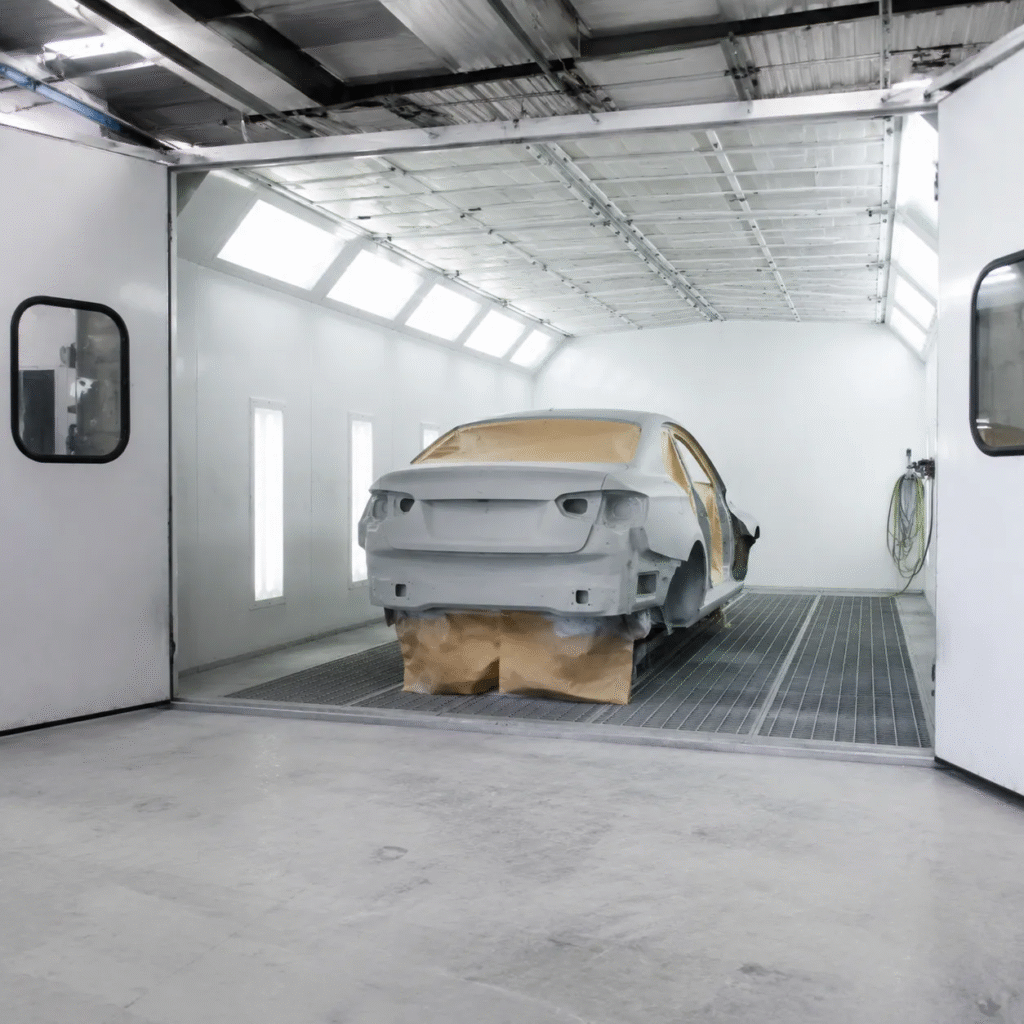
Downdraft configurations work by drawing clean, filtered air from the ceiling plenum straight down over the vehicle and pulling it through the floor filtration matrix. To maintain a true laminar airflow—typically around 0.25 to 0.3 meters per second—the cabin volume must perfectly match your fan capacity.
- Too Small: Oversized vehicles block the path, causing air to whip around the panels, creating turbulence and trapping overspray.
- Too Large: The air velocity drops, allowing airborne dust to settle on your wet clear coat, driving up your color-sand and buff times.
Downdraft Pit vs Raised Basement
Your shop’s architectural limits will dictate whether you install a subterranean pit or a raised metal basement. This choice alters your vertical clearance requirements and overall shop layout.
| Feature | Subterranean Concrete Pit | Raised Metal Basement |
|---|---|---|
| Excavation Requirement | Requires concrete cutting and trenching | Zero concrete work; sits on existing floor |
| Vertical Space Impact | Preserves full shop ceiling height | Consumes 300mm to 400mm of vertical height |
| Vehicle Access | Direct drive-in at shop floor level | Requires external drive-on ramps |
| Best Used For | New construction or long-term shop ownership | Rented facilities or low-clearance buildings |
Air Makeup Unit (AMU) Spatial Allowances
The booth cabin is only part of the equation. A high-performance mechanical setup requires a substantial footprint for the heating system and air makeup unit (AMU).
Whether you opt for a factory-direct automotive booth with a direct-fired gas burner or a high-end electric heating system, you must allocate an extra 1.5 to 2.5 meters of clearance either behind or on top of the booth. Neglecting this footprint during the initial auto body shop layout planning will create severe production bottleneck issues and compromise maintenance access.
Downdraft Paint Booth for Auto Body Shops: Choosing the Right Size
When we design a high-efficiency automotive refinishing enclosure, we don’t just measure the largest vehicle in the shop and call it a day. Precision planning requires adhering to foundational spatial rules to maintain peak airflow efficiency and ensure safety.
The Horizontal Clearance Rule for Width and Depth
To maintain a safe, productive workspace, a Downdraft Paint Booth for Auto Body Shops: Choosing the Right Size requires strict adherence to horizontal clearance rules. We enforce a minimum requirement of 3 feet (0.91 meters) of clear space between the vehicle panels and the cabin walls.
- Width Calculation: Vehicle width + 6 feet (3 feet per side). This prevents the painter’s body from blocking the overspray extraction path.
- Depth Calculation: Vehicle length + 6 feet (3 feet front and rear). This leaves adequate room to navigate around bumpers without making contact with wet clear coat.
The Vertical Clearance Rule for Laminar Airflow
Vertical spacing directly impacts your laminar airflow. For a true top-to-bottom draft to function perfectly, the vehicle roof needs sufficient overhead clearance from the ceiling filter plenum.
| Vehicle Profile | Minimum Ceiling Clearance | Primary Benefit |
|---|---|---|
| Standard Sedans / Coupes | 3.5 Feet (1.06m) | Eliminates turbulence, prevents clouding |
| SUVs & Light Trucks | 4.0 Feet (1.22m) | Ensures uniform downforce over tall roofs |
| Commercial Vans / High-Top Transits | 5.0 Feet (1.52m) | Maintains stable static pressure |
The Multi-Part Workspace Margin for Parts Carts
An auto body shop layout rarely involves spraying just a bare chassis. You are constantly painting detached bumpers, fenders, and mirror caps simultaneously.
- The 4-Foot Rule: Always factor in an extra 4 feet of cabin depth if you plan to utilize parts carts at the front or rear of the vehicle.
- Overspray Mitigation: Proper spacing ensures that overspray from loose components does not drift onto the main vehicle body, protecting your production bottleneck prevention strategy.
- Ergonomic Flow: Technicians must be able to seamlessly transition from the vehicle to the parts racks without stepping through the direct exhaust stream of another painted surface.
Downdraft Paint Booth for Auto Body Shops: Choosing the Right Size
When we manufacture automotive refinishing enclosures for our global clients, we always start by analyzing the vehicle profile. Choosing the wrong footprint directly chokes your vehicle throughput volume. Here is how we break down the standard sizing options to help you match your shop’s specific workflow.
6-Meter Booths for Compact and Specialized Work
The 6-meter booth is a specialized, space-saving solution designed for tight shop footprints.
- Best Suited For: Motorcycles, compact city cars, individual panels, and parts painting.
- Key Advantage: Rapid cycle times and lower energy consumption from the air makeup unit (AMU).
- Limitation: It will quickly become a production bottleneck if you attempt to fit standard sedans or crossovers.
7-Meter Booths as the Global Industry Standard
The 7m luxury electric paint booth is the undisputed sweet spot for mainstream auto body shop layout planning.
| Dimension | Standard Measurement | Target Vehicle Types |
|---|---|---|
| Length | 7.0 Meters (Approx. 23 ft) | Sedans, SUVs, Light Trucks |
| Width | 4.0 Meters (Approx. 13 ft) | Full door extensions & parts carts |
| Height | 2.8 Meters (Approx. 9 ft) | Standard roofs & high-top crossovers |
This size guarantees optimal airflow efficiency. It leaves just the right amount of horizontal and vertical shop clearance requirements for painters to move freely around 95% of consumer vehicles on the road today.
8-Meter and Custom Industrial Paint Booth Enclosures
For shops servicing heavy duty commercial accounts, standard car paint booth size options simply won’t cut it.
- Extended 8-Meter Footprints: Necessary for long-wheelbase delivery vans, dual-rear-wheel trucks, and extended sprinters.
- Custom Industrial Paint Booth Options: We engineer custom heights and widths to accommodate specialized transit vehicles or agricultural equipment.
- Airflow Considerations: Larger cabins require upgraded AMU configurations to maintain the strict downward laminar airflow needed to pull overspray away from the finish.
Maximizing Shop Floor Layout and Vehicle Throughput
When you operate an auto body shop, space is money. Choosing the right Downdraft Paint Booth for Auto Body Shops: Choosing the Right Size isn’t just about fitting the equipment inside your walls—it is about optimizing your entire vehicle throughput volume. If your booth is sized incorrectly for your floor plan, it creates a massive logistics headache that slows down your entire team.
Analyzing Daily Vehicle Volume and Cycle Times
To maximize your profitability, you must align your automotive refinishing enclosure with your daily vehicle volume. A booth that is too small limits the types of vehicles you can accept, while an oversized booth wastes energy and increases cycle times due to unnecessary air volume management.
We look at shop efficiency through these key metrics: Target Cycle Time: How fast a vehicle moves from prep, to spray, to bake, and out the door. Booth Utilization Rate: Aim for continuous operation where prep bays feed the booth without interruption. Energy Efficiency: Matching your air makeup unit (AMU) performance directly to the chamber size to prevent utility bill spikes.
Workflow Dynamics and Avoiding Production Bottleneck Issues
A poorly planned auto body shop layout turns your paint booth into a parking lot. To ensure smooth workflow dynamics and achieve total production bottleneck prevention, we recommend a linear or U-shaped shop flow.
| Layout Type | Vehicle Flow Direction | Best Suited For | Bottleneck Risk |
|---|---|---|---|
| Linear Flow | Straight through (In front, out back) | High-volume production shops | Very Low |
| U-Shaped Flow | Enter and exit from the same side facing the shop | Narrow or square shop footprints | Medium (Requires disciplined staging) |
By calculating your exact physical footprint and vehicle mix before installation, you ensure that parts carts, prep technicians, and painters move independently without blocking the booth entrance.
Commercial Realities: Logistics, Compliance, and Container Optimization
When we manufacture a high-performance downdraft paint booth for auto body shops, engineering excellence is only half the battle. If the equipment doesn’t clear local regulatory hurdles or arrives with bloated shipping bills, your return on investment plummets. Choosing the right size requires balancing shop floor footprints with the harsh realities of global supply chains.
Ensuring Compliance with CE-Certified Spray Booth Standards
Safety and legality are non-negotiable. Every automotive refinishing enclosure we build adheres strictly to global safety benchmarks. Selecting a CE-certified spray booth guarantees that the structural integrity, electrical systems, and filtration setups meet rigorous European and international health and safety directives.
- Airflow Integrity: Ensuring the structural sizing maintains legal air velocity limits.
- Component Safety: Guaranteeing all explosion-proof fans and control boxes comply with strict safety mandates.
- Environmental Oversight: Matching filtration capacity to booth volume to keep emissions within legal thresholds.
The Financial Blueprint of Global Freight and Shipping Sizes
Shipping large industrial machinery across borders demands smart logistics. The physical dimensions of your booth components dictate your freight class and overall transport expenses.
| Booth Component | Standard Packaging Profile | Shipping Impact |
|---|---|---|
| Wall & Roof Panels | Flat-packed high-density rockwool | Maximizes floor space, minimizes damage |
| Air Makeup Units (AMU) | Pre-assembled mechanical pods | Requires high-cube vertical clearance |
| Plenum & Basement Steel | Heavy structural framework | Dictates total weight distribution limits |
The Smart Buyer’s Container Math for Freight Cost Optimization
To deliver a factory-direct automotive booth without breaking the bank, we optimize our product dimensions specifically for ocean freight containers. Freight cost optimization comes down to designing the booth panels and components to fit perfectly inside standard shipping containers, completely eliminating wasted volumetric space.
- The 40ft HQ Standard: We engineer our standard 7m luxury electric paint booth setups to pack tightly into a single 40-foot High Cube container.
- No Loose Cargo Penalties: Proper modular design prevents the need for open-top containers or less-than-container load (LCL) fees.
- Damage Prevention: Tight, calculated packing sequences eliminate component shifting during transit, saving you from costly project delays on delivery day.
Frequently Asked Questions About Choosing the Right Paint Booth Size
When investing in a downdraft paint booth for auto body shops: choosing the right size comes down to balancing your current workload with your shop’s physical limits. We get asked these questions every day by shop owners looking to optimize their layout.
What is the standard car paint booth size for an auto body shop?
The global industry standard for a passenger vehicle cabin is 7 meters long, 4 meters wide, and 2.7 to 2.8 meters high (roughly 23′ x 13′ x 9′). This standard car paint booth size comfortably accommodates everything from compact cars to full-size SUVs, leaving painters enough room to move freely.
How much shop clearance is required around a downdraft booth?
You need a minimum of 3 feet (approx. 0.9 meters) of clear space on all sides of the booth enclosure. This shop clearance requirement ensures compliance with local fire codes, allows routine maintenance access, and leaves adequate room for mechanical components like the air makeup unit (AMU) and exhaust ducting.
Should I choose a downdraft pit or a raised basement layout?
Your decision directly impacts your concrete work, ceiling height requirements, and budget.
| Feature | Downdraft Pit Layout | Raised Basement Layout |
|---|---|---|
| Installation | Requires excavating concrete pits | Installed directly on concrete floor |
| Ceiling Height | Ideal for lower ceilings | Requires high ceilings (adds 1–1.5 ft) |
| Vehicle Entry | Flush with shop floor; easy drive-in | Requires external ramps for entry |
| Best Used For | Permanent facilities, new builds | Rented spaces, high water tables |
How do booth dimensions affect air makeup unit AMU sizing?
Booth volume directly dictates your airflow requirements. A larger automotive refinishing enclosure holds more cubic meters of air, which means the air makeup unit (AMU) must move more cubic feet per minute (CFM) to maintain proper airflow efficiency. If you expand booth dimensions without upgrading the AMU, you drop the air velocity below code mandates, creating overspray pockets and ruined finishes.
Related Sources
- https://rttsolutions.com/products/paint-booths/automotive/ez-pit-downdraft/
- https://www.paintbooth.com/wp-content/uploads/2024/05/buyers_guide-1.pdf
- https://wesellfans.com/ventilation-resource/paint-booth-cfm-calculator-air-flow-design-measurement/
- Bus Spray Booth Design Guide → https://sprayboothmanufacturer.com/transit-coach-spray-booth-requirements/
- Truck Paint Booth Guide → https://sprayboothmanufacturer.com/truck-paint-booth-semi-truck-spray-booth-specifications-buying-guide/
- Other related products → https://www.autokemanufacture.com/product
- Contact our sales Team → https://sprayboothmanufacturer.com/contact-us/
✅ CE Certified | ✅ ISO 9001:2015 | ✅ Factory Direct | ✅ Ships to 60+ Countries | ✅ 1-Year Warranty | 🔒 HTTPS Secured