
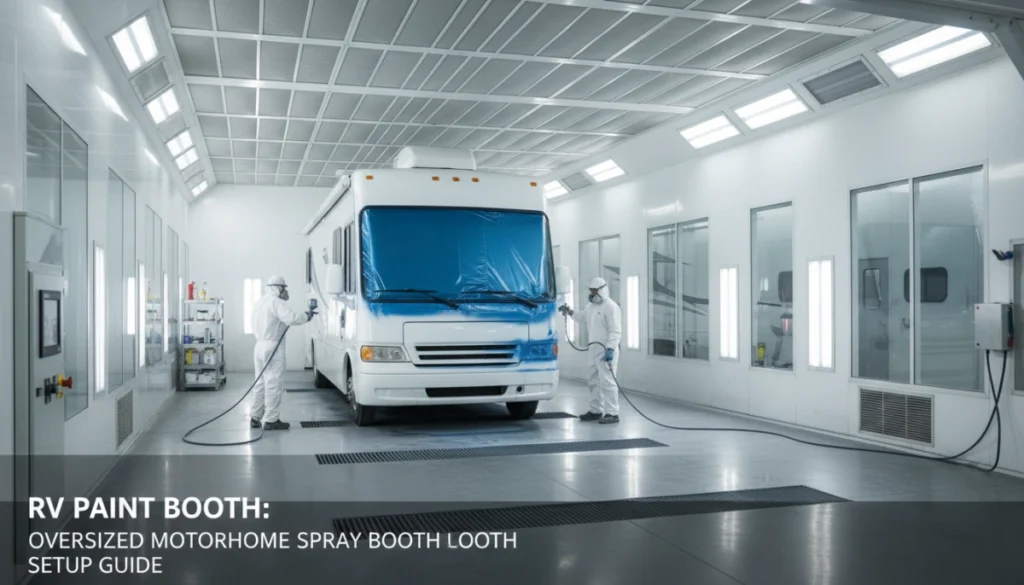
Setting up an RV paint booth for motorhomes? This guide covers dimensions, airflow, lighting, compliance, and what standard booths get wrong when it comes to oversized vehicle finishing.
Page URL: https://sprayboothmanufacturer.com/product/
RV Paint Booth: Oversized Motorhome Spray Booth Setup Guide
Painting a Class A motorhome in a standard automotive paint booth doesn’t work. The vehicle simply doesn’t fit — not in terms of physical space, and not in terms of what the ventilation system can actually handle.
Most standard booths top out at 3–3.5 meters of ceiling height. A modern RV with roof-mounted AC units, satellite domes, and vent fans often needs 5 meters or more. The ventilation systems in standard booths are designed for passenger car cabin volumes, not the interior of a space that needs to manage airflow around a 14-meter motorhome. The lighting doesn’t reach the right areas. And the door openings aren’t wide enough to bring the vehicle in without risking damage to mirrors and bodywork.
This guide covers how to set up an RV paint booth correctly: the dimensions you actually need, how airflow works at this scale, what the lighting requirements look like, and what compliance involves.
Why Standard Booths Fail for RVs
It’s worth being specific about the failure points, because they’re not just about size.
Clearance
Standard booths don’t provide the 1–1.5 meters of side clearance that painters need to maintain proper spray gun distance and angle on a large vehicle. Once an RV is inside a standard booth, there’s no room to work properly. The result is an inconsistent finish and painters forced into awkward positions for hours.
Airflow dead zones
A large motorhome acts as a baffle inside the booth. Standard ventilation systems are designed to move air around a small cabin volume — when you introduce a vehicle the size of a bus, air currents get disrupted. Overspray hangs in suspension rather than being pulled into the filtration system, and flat surfaces like the sides of an RV cause turbulence that pushes overspray back onto wet paint.
Lighting blind spots
Standard ceiling fixtures are too low to illuminate the top of an RV properly. Without lighting at multiple heights, the lower panels and undercarriage are in shadow, painters can’t accurately judge coating thickness or color consistency, and defects that should be caught before the vehicle leaves the booth get missed.
Dimensions: Getting the Size Right
This is the most important decision in an RV paint booth setup. Here are the minimum dimensions to work from:
| Vehicle Type | Recommended Booth Length | Recommended Booth Width |
|---|---|---|
| Class C Motorhome | 12–14m (40–45ft) | 5.5–6m (18–20ft) |
| Class A Motorhome | 15–18m (50–60ft) | 6–7.3m (20–24ft) |
| Super C / Bus Conversion | 18m+ (60ft+) | 7.3m+ (24ft+) |
These are minimum working dimensions — not just the vehicle footprint. The extra length and width accounts for painters needing to walk around the full perimeter with spray equipment, ladders, and rolling platforms, and for extended mirrors and slide-outs that add to the effective width.
For height, the ceiling needs to clear the tallest point of the vehicle — which is rarely the roofline itself. Roof-mounted AC units typically add 30–45cm. Satellite domes and antennas can add more. Then you need at least 60–90cm of open space above the highest point for airflow distribution and lighting. For a standard Class A motorhome, a minimum internal ceiling height of 5–5.5 meters (16–18 feet) is the practical baseline.
The entry doors need to be at minimum 4.3 meters wide and 4.3–4.9 meters tall, with heavy-duty reinforced frames to prevent sagging over time and industrial-grade seals to maintain the pressurized environment inside the booth.
Airflow: Three Options and How They Compare
Crossdraft moves air horizontally from intake filters at the front to an exhaust bank at the rear. The most affordable and simplest to install for a large-format booth. On a 14-meter motorhome, air carrying overspray has to travel the full length of the vehicle before exiting, which creates contamination risk on surfaces that were just painted. Works for operations where cost is the primary driver and a perfect finish isn’t the main goal.
Side-downdraft brings air in through ceiling filters and exits through exhaust vents at the base of the side walls. No floor pit required. The downward component of the airflow does a much better job of managing overspray on large flat vertical surfaces than a purely horizontal system. For most professional RV finishing operations, this is the most practical configuration — better results than crossdraft without the concrete work of full downdraft.
Full downdraft pulls air straight down from the ceiling into a floor pit. The cleanest configuration and the best choice for high-end custom paint work on motorhomes. Overspray falls directly away from the vehicle at every point rather than traveling horizontally. Requires concrete pit excavation, which adds significant cost and construction time. Worth it for operations where finish quality justifies the investment.
CFM: How Much Airflow Does an RV Booth Need
The air volume requirement scales with the booth’s cross-sectional area. For an RV booth, you’re typically looking at 15,000–30,000+ CFM to maintain safe vapor concentrations and consistent airflow velocity across the full working area.
The target air velocity across the working area is 50–100 feet per minute. Below this and overspray doesn’t clear fast enough. Above this on a large vehicle and you risk disturbing the wet paint surface.
An Air Makeup Unit (AMU) is essential at this scale. When the booth is exhausting 20,000+ CFM of air, that air has to be replaced with something. Without an AMU, the booth creates significant negative pressure in the building, pulling unfiltered air in through gaps and door seals. The AMU also heats and conditions the incoming air — critical for consistent curing temperatures on a vehicle with the thermal mass of a large motorhome.
Lighting: How to Cover a Vehicle This Size
A three-level lighting approach is the standard for RV booths:
Ceiling fixtures provide primary overhead illumination for the roof cap and upper sections. These alone are insufficient for a full-size motorhome but are the starting point.
Upper side-wall fixtures bridge the gap between the ceiling lights and the main vehicle sides, ensuring the upper corners and transition areas are properly lit without shadows.
Lower side-wall fixtures are where standard booths fail completely. Without lighting at this level, the lower panels, trim, and undercarriage are in shadow. Painters can’t see what they’re doing on a significant portion of the vehicle’s surface area, and defects at lower heights are almost impossible to catch before the RV leaves the booth.
All fixtures inside the spray zone must be explosion-proof, rated for Class I Division 2 hazardous locations. High-CRI LEDs that replicate natural daylight are the practical choice for accurate color matching — this matters especially on large custom paint jobs where color consistency across 40 feet of surface area is part of what the customer is paying for.
Compliance: What You Need to Meet
NFPA 33 is the primary standard. Explosion-proof electrical components throughout the spray zone, integrated fire suppression systems, and proper clearance zones around the booth exterior are all mandatory. Because of the volume of flammable materials involved in coating a full-size motorhome, the fire suppression system needs to be professionally engineered to cover the entire interior and exhaust ductwork — a standard extinguisher doesn’t satisfy this requirement.
OSHA requires minimum airflow velocity (100 feet per minute is the standard), adequate breathing air quality for workers inside the booth, and appropriate PPE requirements. Maintenance logs showing the booth is operating correctly are part of ongoing OSHA compliance.
EPA 6H Rule requires filtration efficiency of at least 98% for hazardous air pollutants before air is exhausted outside. For a high-volume RV finishing operation, this means properly specified multi-stage exhaust filtration and documented filter management.
Local permitting for an oversized booth typically involves building and electrical permits, fire marshal approval for the fire suppression system, and potentially an air quality permit. Your local Authority Having Jurisdiction (AHJ) will need to review the mechanical, electrical, and plumbing plans. Safety interlock systems — which automatically shut off spray equipment if the ventilation fans fail — are required in most jurisdictions.
Installation: What the Setup Process Actually Involves
Site preparation comes first. A large motorhome can weigh 15,000+ kg. The floor needs to be a reinforced concrete slab, typically at least 150mm thick, to prevent cracking under the vehicle load. Ceiling height should be confirmed at 5.5–6 meters minimum to accommodate the booth structure plus ductwork. And there needs to be adequate workspace buffer on all sides of the booth footprint for technician access and utility connections.
Utility infrastructure needs to be in place before the booth goes up. Three-phase power is typically required for high-CFM exhaust fans and lighting arrays. If the booth has a heated AMU, the gas supply needs to be sized for the high BTU output required to heat the volume of air involved. Compressed air drops should be planned at locations where painters can access them without dragging hoses across wet work.
Structural assembly uses interlocking tongue-and-groove steel panels for an airtight seal. Extra-wide or extra-tall booths need integrated structural steel supports to prevent the roof from sagging under the weight of the ventilation equipment over time.
Ventilation and heating installation — keep duct runs as short and straight as possible to maintain CFM efficiency. High-capacity intake and exhaust filters installed at this stage need to be matched to the actual overspray volumes of large-scale commercial painting.
Testing and calibration before the booth is put into service: pressure balance adjustment to achieve slight positive pressure, airflow mapping using smoke tracers to verify no dead zones, and lighting verification to confirm shadow-free coverage from lower skirts to roofline.
Maintenance for High-Volume RV Operations
Filters — monitor the manometer daily. Intake and exhaust filters in a busy RV painting operation load faster than in automotive applications because of the larger coating volumes. Pre-filters typically need changing every 2–4 weeks for active shops. Exhaust filters should be changed based on spray hours rather than calendar time.
Lighting fixtures — wipe down the glass covers regularly. Paint film buildup on the covers reduces illumination, which is a particular problem on a booth where multi-level lighting is what makes the difference between catching defects and missing them.
Door seals — check monthly. The positive pressure inside a properly functioning RV booth means door seals take continuous load. A leaking seal on a booth this size lets in enough unfiltered air to affect finish quality.
AMU and burner — have the heating system serviced annually by a qualified technician. Check gas supply connections and verify temperature accuracy. Consistent curing temperature across the full interior volume of a motorhome depends on the AMU working correctly.
Common Questions
What’s the minimum ceiling height for a motorhome booth? 5–5.5 meters (16–18 feet) for a standard Class A motorhome. This accounts for the vehicle height, roof-mounted accessories, clearance above the vehicle for airflow, and overhead fixture placement.
How much CFM does an RV booth need? Typically 15,000–30,000+ CFM depending on booth size. The calculation is based on the cross-sectional area of the booth multiplied by your target air velocity (50–100 FPM). Your ventilation supplier should confirm this calculation for your specific dimensions.
Can a truck booth be converted for RV use? In some cases yes, but height is usually the limitation — most truck booths are only 4.3 meters (14 feet) high, which is insufficient for modern RVs with roof accessories. Lighting and length may also need upgrading. In many cases, the cost of a full conversion gets close to the cost of a purpose-built booth.
Do I need a heated AMU for RV painting? For professional operation in most US climates, yes. A large motorhome has significant thermal mass — without a heated AMU, curing is slow and inconsistent. The AMU also controls humidity, which affects waterborne coatings, and significantly reduces the time between coats.
Is fire suppression mandatory? Yes. NFPA 33 and most local codes require an integrated fire suppression system for any industrial-sized spray booth. The system needs to cover the full interior and exhaust ductwork, and should be professionally engineered for the booth’s specific volume.
Tell Us What You’re Working With
Share your motorhome types, maximum vehicle dimensions, facility ceiling height, and production volume. Our engineering team will design the right booth and provide a detailed proposal with layout drawings — usually within 48 hours.
Related Pages
- Bus Spray Booth Design Guide →https://sprayboothmanufacturer.com/transit-coach-spray-booth-requirements/
- Truck Paint Booth Guide →https://sprayboothmanufacturer.com/truck-paint-booth-semi-truck-spray-booth-specifications-buying-guide/
- Other related products→https://www.autokemanufacture.com/product
- Contact our sale Team →https://sprayboothmanufacturer.com/contact-us/
✅ CE Certified | ✅ ISO 9001:2015 | ✅ Factory Direct | ✅ Ships to 60+ Countries | ✅ 1-Year Warranty | 🔒 HTTPS Secured