
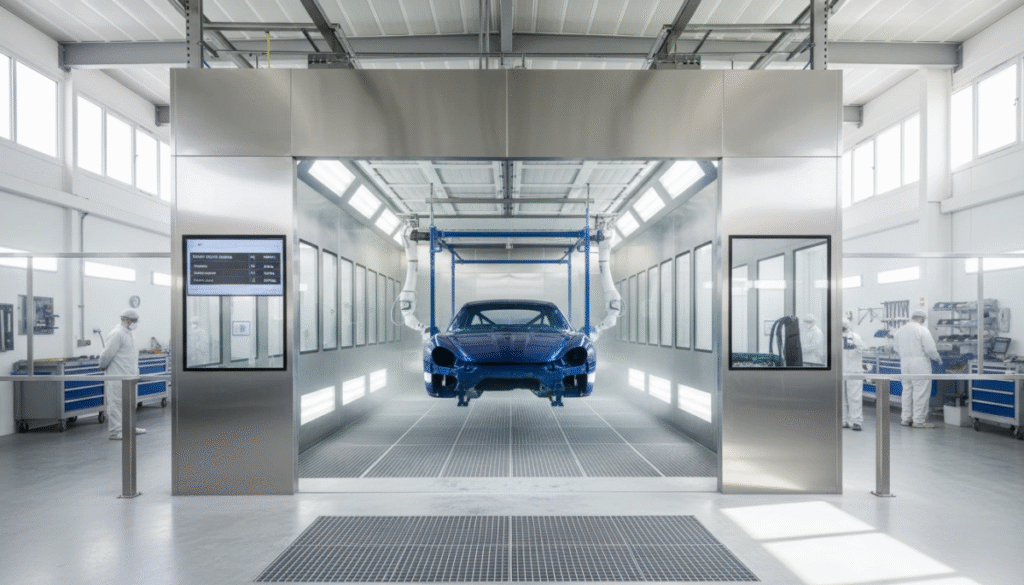
Comparing open face and enclosed industrial paint booths? This guide covers the key differences, airflow types, sizing, compliance, and what to look for before you buy.
Page URL: https://sprayboothmanufacturer.com/product/
Industrial Paint Booth: Open Face vs Enclosed & Complete Setup Guide
Choosing an industrial paint booth isn’t just about finding something to contain overspray. The booth you pick affects your finish quality, your production speed, how safe your painters are, and whether you pass your next compliance inspection.
The open face vs enclosed decision is often the first real fork in the road — and it’s a meaningful one. This guide walks through both options, how airflow configurations factor in, what sizing actually involves, and what compliance requires before you can start spraying.
What an Industrial Paint Booth Actually Does
A paint booth is a controlled environment where airflow, contamination, and temperature are actively managed rather than left to chance. Inside a properly built booth, clean filtered air enters, flows across the part being coated, picks up overspray and fumes, and exits through the exhaust filtration system before reaching the outside air.
Three things happen simultaneously when this is working correctly: the wet paint surface stays free of airborne contamination; hazardous fumes and VOCs are continuously pulled away from the painter’s breathing zone; and flammable vapor concentrations stay well below ignition levels.
When any one of these fails — usually because of undersized fans, blocked filters, or the wrong airflow configuration — you get defects in the finish, health risks for painters, or a compliance problem. Often all three.
Open Face Paint Booth vs Enclosed: How to Choose
This is the most common decision people face when specifying an industrial paint booth, and the right answer depends on what you’re coating and what finish quality you need.
Open Face Paint Booth
Three walls and an open front. Ambient shop air is drawn in through the opening, moves across the workspace, and exits through a back filter bank. No doors to open and close, easy access for loading and unloading parts, and a smaller footprint than an enclosed booth.
This works well for woodworking, furniture finishing, and basic metal fabrication — applications where you need to move parts in and out quickly and where the finish standard doesn’t require a completely sealed, controlled environment.
The limitation is contamination control. Because the front is open, airborne dust from the surrounding shop can enter the spray area. For high-gloss or precision finishes, this is a real problem. If a speck of dust landing on a wet panel would require rework, an open face booth isn’t the right tool.
Enclosed Paint Booth
Fully sealed with dedicated doors, positive pressure, and a complete ventilation system. Air enters through ceiling or front intake filters, flows across the part in a controlled direction, and exits through the exhaust system. Shop dust stays outside because the booth maintains slight positive pressure.
Best for automotive refinishing, aerospace components, high-volume commercial manufacturing — any application where contamination control matters and finish quality is a core part of what you’re delivering.
The tradeoffs are upfront cost and floor space. An enclosed booth is a larger investment and takes up more dedicated square footage. For operations where finish quality justifies it, the reduction in rework and the consistency of results make the economics straightforward.
| Open Face | Enclosed | |
|---|---|---|
| Finish quality | Good for standard finishes | Superior, high-gloss capable |
| Contamination control | Low to moderate | Maximum |
| Best for | Woodworking, basic fabrication | Automotive, aerospace, high-volume |
| Initial cost | Lower | Higher |
| Production volume | Low to medium | Medium to high |
Airflow Configurations: Which One Fits Your Operation
Whether you go open face or enclosed, the airflow configuration inside the booth determines how overspray is managed and how clean the working environment is.
Crossdraft
Air enters through front intake filters and moves horizontally to an exhaust bank at the rear. The most affordable and simplest to install — no floor work required. The limitation on larger parts is that overspray travels the full length of the workspace before exiting, which increases contamination risk. Works well for general manufacturing and parts finishing where the priority is cost and throughput.
Full Downdraft
Air enters through a full-length ceiling filter bank and moves straight down to a floor pit or raised exhaust system. Overspray falls away from the part at every point rather than drifting horizontally across it. This is the cleanest configuration and the right choice for high-precision coating work. Requires either concrete pit excavation or a raised floor structure.
Semi-Downdraft
Air enters through the ceiling at the front and exits through the lower rear wall. A diagonal airflow pattern that clears overspray better than crossdraft without the floor pit requirement. A solid middle-ground option that costs less than full downdraft while delivering meaningfully better finish quality than crossdraft.
Side-Downdraft
Air enters through ceiling filters and exits through ducts at the base of the side walls. Near-downdraft finish quality without any floor modification. Good for facilities where excavation isn’t possible. Provides consistent wrap-around airflow that works particularly well for large, bulky equipment with irregular shapes.
| Airflow Type | Direction | Best For | Pit Required |
|---|---|---|---|
| Crossdraft | Horizontal | General industrial | No |
| Full downdraft | Vertical | High-end finishes | Yes |
| Semi-downdraft | Diagonal | Mid-sized shops | No |
| Side-downdraft | Ceiling to side walls | Quality without pit | No |
Key Components Worth Understanding
Intake filters and plenums distribute incoming air evenly across the booth. Uneven distribution creates turbulence and dead zones — both cause finish defects.
Exhaust fans are the system’s engine. They need to be sized to maintain adequate air velocity across the booth’s cross-sectional area. Too weak and vapor concentrations build up; too strong and you disrupt the wet paint surface.
Air Makeup Units (AMU) replace the air being exhausted with fresh, filtered, temperature-controlled air. Without an AMU, the booth creates negative pressure in the building, which pulls unfiltered workshop air in through gaps. The AMU also heats incoming air for bake cycles — essential for consistent cure times with industrial coatings.
Dry filter vs water wash systems is a choice that comes down to production volume. Dry filter booths use disposable media — straightforward to maintain, lower upfront cost, right for low to medium volume operations. Water wash booths use a continuous water curtain to capture overspray — better for high-volume heavy-coating applications, but they require water treatment and sludge disposal management.
Explosion-proof lighting and controls are non-negotiable in the spray zone. The interior of a paint booth is a Class I Division 1 hazardous environment. Every light fixture, switch, and motor must be rated for it.
Sizing: Getting the Dimensions Right
The starting point is always your largest part — not your average part. Size for the biggest piece you’ll ever need to coat, then add working clearance around it.
The standard rule is at least 1 meter (roughly 3 feet) of clear space on all sides of the largest part. Painters need this to move with spray equipment, angle the gun correctly on complex surfaces, and work safely without backing into the walls.
Don’t just think about the part itself. Think about how it gets in and out. If a forklift or overhead crane is bringing equipment into the booth, the door opening needs to accommodate that with clearance to spare. If a conveyor is running parts through continuously, the booth layout needs to support that flow without creating bottlenecks.
For vertical clearance, measure the actual overhead requirement for any lifting rigging, hoists, or tall parts suspended from tracks. This is easy to overlook and difficult to fix after installation.
For calculating airflow requirements, the basic formula for a crossdraft booth is: width × height × target air velocity = CFM required. For most industrial applications, 100 feet per minute is the target velocity. Downdraft calculations use floor area rather than cross-section. Get this confirmed in writing from your ventilation supplier before finalizing the booth specification.
Compliance: What You Actually Need
NFPA 33 covers fire safety. All electrical components inside the spray zone must be explosion-proof. Fire suppression integration is mandatory. The booth must be built from non-combustible materials, and clearance zones around the exterior must be maintained.
OSHA covers worker protection. Adequate air velocity to keep overspray and fumes below dangerous concentrations in the breathing zone is the core requirement. Maintenance logs showing the system is operating correctly are an OSHA requirement, not optional record-keeping.
EPA covers what exits the building. Multi-stage filtration capturing paint solids before they reach the exhaust stack is required. Depending on your state and annual coating volume, permits and emission tracking may also be required.
Before installation: building permits, electrical permits, and fire marshal approval are the baseline. An air quality permit may also be needed. Starting this process before you order equipment is the right approach — permit timelines vary significantly by jurisdiction.
Maintenance: What to Stay On Top Of
Filters — use the manometer, not the calendar. When pressure rises above the clean baseline, change the filters. Pre-filters typically need changing every 2–4 weeks for a busy shop. Exhaust filters every 50–100 operating hours. Ceiling diffusion media lasts longer but should be checked monthly for sagging or breakthrough.
Interior walls — peelable booth coating makes overspray management on interior walls straightforward. When buildup accumulates, peel and reapply rather than scraping. Brighter interior walls also reflect more light onto the workpiece.
Fan belts and motors — check weekly for fraying, slack, or unusual noise. A slipping belt immediately reduces airflow. Unusual vibration from a motor is an early warning of bearing failure — catch it early and it’s a minor repair; ignore it and it’s an unplanned shutdown.
Door seals — check monthly. A leaking door seal disrupts the pressure balance the whole system depends on, pulling unfiltered shop air into the spray zone.
Manometer — check it daily. If pressure is too high, overspray is not clearing properly. If it’s too low, contaminants are being pulled in. It’s the simplest diagnostic tool in the booth and the most important one to actually use.
Common Questions
Open face or enclosed — which one do I need? If contamination control matters for your finish quality, go enclosed. If you’re doing standard industrial parts finishing or woodworking and need fast access to move parts in and out, open face is a practical and cost-effective choice.
Do I need a heated AMU? If you’re operating in a cold climate or need to run bake cycles to speed up curing, yes. The AMU replaces exhausted air with tempered, filtered air and allows you to control the cabin temperature for consistent coating results. Without it, cold incoming air disrupts paint viscosity and extends cure times.
How do I calculate the CFM I need? For crossdraft: width × height × 100 FPM = required CFM. A booth 3 meters wide and 3 meters tall needs approximately 9,700 CFM. For downdraft, use floor area × target velocity. Confirm the calculation with your ventilation supplier and ask for it in writing.
Is NFPA 33 compliance mandatory? Yes, for any operation spraying flammable finishes. It covers explosion-proof electrical components, fire suppression integration, clearance zones, and construction materials. A properly built booth meets these requirements by design — ask any supplier for the relevant documentation before you buy.
What’s the difference between a spray booth and a paint booth? The terms are used interchangeably in the industry. Technically a spray booth refers to the enclosure itself while a paint booth refers to the full system including lighting, heating, and controls. In practice they mean the same thing.
Watch: Industrial Paint Booth in Operation
[Embed responsive video — use embedresponsively.com to generate embed code]
Enclosed industrial paint booth running a full production cycle — airflow testing, filter inspection, AMU bake cycle, and manometer monitoring walkthrough.
Video title attribute: industrial-paint-booth-open-face-vs-enclosed-ventilation-setup-guide
Tell Us What You Need
Share your part dimensions, coating type, production volume, and facility details. We’ll recommend the right configuration and send a detailed quote with layout drawings — usually within 48 hours.
Related Pages
- Bus Spray Booth Design Guide →https://sprayboothmanufacturer.com/transit-coach-spray-booth-requirements/
- Truck Paint Booth Guide →https://sprayboothmanufacturer.com/truck-paint-booth-semi-truck-spray-booth-specifications-buying-guide/
- Other related products→https://www.autokemanufacture.com/product
- Contact our sale Team →https://sprayboothmanufacturer.com/contact-us/
✅ CE Certified | ✅ ISO 9001:2015 | ✅ ATEX Available | ✅ Factory Direct | ✅ Ships to 60+ Countries | ✅ 1-Year Warranty | 🔒 HTTPS Secured