
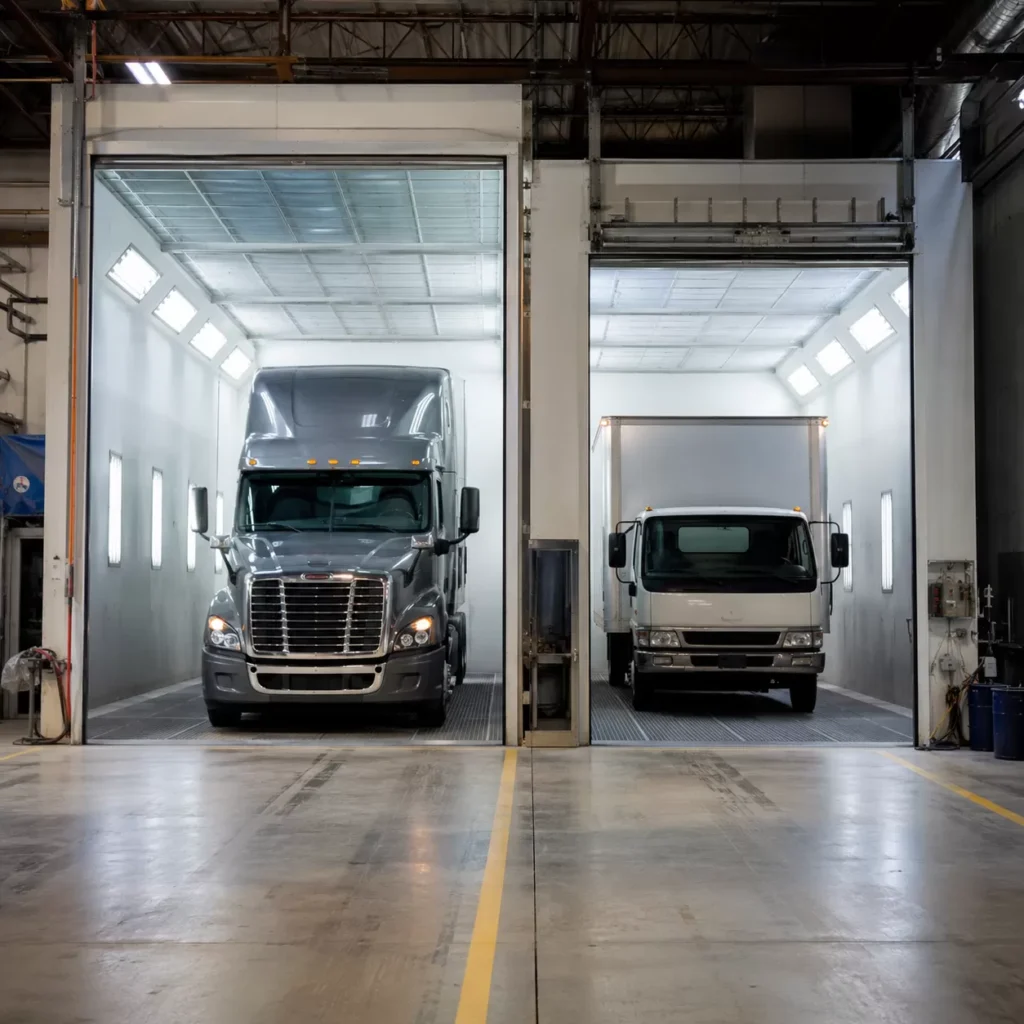
Transitioning from standard auto body work to heavy-duty fleet refinishing is a massive revenue driver—but it’s an absolute logistics minefield if you get your dimensions wrong.
If your finishing enclosure is even a few inches too small, you’re locked out of lucrative commercial contracts. Buy an oversized unit without a strategic plan, and you’ll bleed capital on wasted CFM, soaring utility bills, and massive Air Makeup Unit (AMU) heating costs.
When you are engineering a space for oversized vehicle refinishing, the spatial math changes entirely. A standard medium-duty fleet vehicle demands a completely different layout than a multi-axle class 8 rig.
If you want to know the exact commercial vehicle paint booth dimensions required to safely and efficiently coat a semi-truck vs. a box truck, this engineering guide is for you.
Let’s dive right in.
Page URL: https://sprayboothmanufacturer.com/product/
The Golden Rules of Large Vehicle Paint Booth Sizing
When you are investing in a commercial vehicle paint booth, guessing the dimensions is a recipe for disaster. If the booth is too small, your painters can’t work safely, and your airflow will suffer. If it is too large, you are wasting money on utility bills and oversized equipment. To get the perfect fit, you must follow three non-negotiable footprint rules.
The 3-Foot Clearance Rule
The most critical factor in heavy-duty spray booth sizing is the working clearance around the vehicle. You must maintain a minimum of 3 feet of empty space between the vehicle and the booth walls or doors on all sides.
- Workspace: Gives painters enough room to move freely, maintain the correct gun distance, and achieve a flawless finish.
- Industrial Spray Booth Airflow Requirements: Keeps the air moving smoothly around the vehicle profile, preventing overspray from swirling back onto the fresh paint.
Internal vs. External Footprints
Do not mistake the dimensions of the vehicle for the dimensions of the building space you need. There is a major difference between internal working dimensions and the external footprint.
- Wall Thickness: Heavy-duty booths use dual-skin insulated panels that add several inches to the outer dimensions.
- Support Frames: External structural steel support frames are required for tall and wide structures to handle wind and weight loads.
- Total Calculation: Always add at least 1 to 2 feet to your internal width and length calculations to account for the physical structure of the booth itself.
Mechanical Footprint Clearances
Your booth needs support equipment to run, and this hardware requires significant shop floor space beyond the cabin walls.
- Exhaust Plenums: Rear or side exhaust chambers can add 3 to 6 feet to the total length or width of the system.
- Ductwork: Vertical and horizontal exhaust ducts need clear routing to the roof.
- Air Makeup Unit (AMU) Space Requirements: An AMU can be roof-mounted, side-mounted, or placed on a stand. You must allocate a massive clear zone around the intake and mechanical panels for proper maintenance access and code compliance.
Box Truck Paint Booth Requirements for Medium-Duty Fleets
When sizing a commercial vehicle paint booth, medium-duty fleets require precision to balance shop space with daily utility. Choosing a booth for box trucks means looking closely at the specific vehicle profiles you service to ensure efficient, safe operations.
Classifying the Vehicle Profile
Medium-duty fleets typically encompass Class 4 through Class 6 vehicles. In the United States, this includes the standard delivery trucks, step vans, and box trucks frequently used for local logistics, moving services, and regional distribution.
- Class 4: 14,001–16,000 lbs. (e.g., city delivery box trucks)
- Class 5: 16,001–19,500 lbs. (e.g., large step vans, bucket trucks)
- Class 6: 19,501–26,000 lbs. (e.g., single-axle beverage trucks, school buses)
Standard Interior Dimension Requirements
To determine what size truck paint booth do you need for a semi vs a box truck, you must establish the baseline for the smaller of the two profiles. A medium-duty booth must comfortably house the vehicle while leaving adequate working clearance around vehicles in spray booths for technicians and paint equipment.
The table below outlines the standard interior dimensions required for a dedicated box truck paint booth:
| Dimension | Minimum Requirement | Recommended for Versatility | Purpose |
|---|---|---|---|
| Interior Width | 14 Feet | 16 Feet | Allows for a 3-foot box truck paint booth clearance on both sides of the vehicle. |
| Interior Height | 14 Feet | 16 Feet | Accommodates standard box heights and roof-mounted refrigeration units. |
| Interior Length | 30 Feet | 40 Feet | Fits standard 14-foot to 26-foot boxes with room to move around front and rear bumpers. |
Optimal Door Opening Clearance
Maneuvering damage is a costly but preventable headache. If the product entry doors are too narrow, side mirrors and corner caps will eventually catch the frame.
- Minimum Door Width: 12 feet. This ensures drivers have a comfortable margin when backing the vehicle into the enclosure.
- Minimum Door Height: 14 feet. This matches or exceeds the maximum legal bridge clearance heights for medium-duty trucks, protecting overhead roll-up doors and cooling pods from structural impact.
Semi-Truck Paint Booth Requirements for Heavy-Duty Fleets
When handling Class 7 and Class 8 heavy-duty vehicles, a standard spray enclosure will not cut it. Heavy-duty fleet operations demand precise commercial vehicle paint booth dimensions to accommodate everything from compact day cabs and extended sleepers to massive 53-foot trailers.
Classifying the Heavy-Duty Vehicle Profile
To choose the right booth size, you must first classify the specific footprint of the heavy-duty rigs in your service rotation.
- Class 7-8 Day Cabs: Typically require less length but full height and width clearances for roof fairings and wide mirrors.
- Sleeper Tractors: Extended wheelbases require a longer enclosure to allow technicians to comfortably spray the back of the cab.
- 53-Foot Trailers: The largest common highway profile, requiring maximum booth length and specialized airflow management.
Sizing Scenarios: Tractor-Only vs. Full Rig Enclosures
Shop owners must choose between two primary setups based on space constraints and workflow:
- Tractor-Only Enclosures: Designed strictly for spraying the truck cab. These setups save shop floor space and reduce initial capital expenditure.
- Full Rig Enclosures: Designed to house a complete tractor-trailer combination. This eliminates the need to uncouple the rig, maximizing turnaround time for fleet graphics and full refinishing jobs.
Standard Interior Dimension Requirements
To safely spray heavy-duty equipment while maintaining proper working clearance around vehicles in spray booths, use these standard interior dimensions as your baseline:
| Vehicle Setup | Target Length | Target Width | Target Height |
|---|---|---|---|
| Tractor-Only (Day Cabs / Sleepers) | 30 ft to 40 ft | 16 ft to 18 ft | 16 ft |
| Full Rig (Tractor + 53′ Trailer) | 60 ft to 70 ft | 16 ft to 18 ft | 16 ft to 18 ft |
Optimal Door Opening Clearance for Heavy-Duty Rigs
Achieving the correct semi-truck spray booth length and width is useless if the rig cannot safely enter the enclosure. Large commercial vehicles need wider and taller door openings to account for backing maneuvers and high-clearance exhaust stacks.
- Minimum Door Width: 14 feet to provide comfortable clearance for wide-set mirrors and dual rear wheels.
- Minimum Door Height: 14 feet to 16 feet to prevent overhead collision damage from high-top sleeper roofs, air deflectors, and trailer headers.
Side-by-Side Sizing Comparison: Semi Booth vs. Box Truck Booth
When deciding what size truck paint booth do you need for a semi vs a box truck, a direct comparison of the physical footprints and airflow dynamics is essential. Medium-duty box trucks and heavy-duty semi-trucks have vastly different spatial requirements that dictate both the enclosure size and the mechanical setup of your shop.
The Dimensional Matrix
Managing a commercial fleet refinishing operation requires a clear understanding of interior working dimensions versus actual shop floor consumption. The table below breaks down the standard specifications for both vehicle classes.
| Vehicle Type | Average Vehicle Dimensions (L x W x H) | Recommended Interior Booth Dimensions | Required Exterior Footprint | Minimum Door Opening Clearance |
|---|---|---|---|---|
| Box Truck (Class 4-6) | $22′ times 8.5′ times 10’$ | $30′ times 16′ times 14’$ | $34′ times 18′ times 16.5’$ | $12′ times 12’$ |
| Semi-Tractor Only | $20′ times 8.5′ times 11’$ | $30′ times 16′ times 16’$ | $34′ times 18′ times 18.5’$ | $14′ times 14’$ |
| Full Semi Rig / Trailer | $70′ times 8.5′ times 13.5’$ | $80′ times 16′ times 16’$ | $85′ times 18′ times 18.5’$ | $14′ times 14’$ |
Airflow Pattern Matching
Choosing the right cabin size is only half the battle; you also need to match it with the correct downdraft vs. crossdraft truck booths configuration to ensure a flawless finish.
- Crossdraft Configurations: Air enters through the front doors and flows horizontally over the vehicle to the exhaust plenum at the back. This setup is highly cost-effective and ideal for medium-duty fleet paint booths housing box trucks, where the shorter vehicle length minimizes overspray accumulation.
- Side-Downdraft Configurations: Air comes in through the ceiling and pulls down and out through side exhaust plenums along the floor. This provides an excellent balance for semi-tractors, offering cleaner finishes without the need for concrete floor excavation.
- Full-Pit Downdraft Configurations: Air flows straight down from the ceiling into a concrete pit drafted beneath the vehicle. This is the gold standard for full 53-foot semi-trailers. It completely eliminates overspray wrapping around these massive zones, ensuring strict industrial spray booth airflow requirements are met across the entire surface area.
Critical Technical and Regulatory Factors Beyond Physical Size
Choosing the right commercial vehicle paint booth dimensions is only half the battle. To keep your shop running safely and legally, you must account for strict federal regulations, precise airflow metrics, and your shop’s existing utility setup.
CFM and Airflow Calculations
A heavy-duty spray booth requires massive air movement to clear overspray and protect painters. OSHA mandates a minimum air velocity of 100 linear feet per minute (LFPM) across the cross-sectional area of the working space. This directly dictates your total CFM requirements for truck booths.
To calculate the necessary Cubic Feet per Minute (CFM), we use the following formulas based on the airflow configuration:
- Crossdraft Booths: $text{CFM} = text{Width} times text{Height} times 100$
- Downdraft/Side-Downdraft Booths: $text{CFM} = text{Width} times text{Length} times 100$
NFPA 33 and OSHA Compliance
Safety enforcement is strict when operating an oversized vehicle refinishing enclosure. You must design the workspace with local and national safety codes in mind to avoid heavy fines or shutdowns.
- NFPA 33 Regulations: This standard governs spray application using flammable or combustible materials. It mandates a clear working clearance around vehicles in spray booths of at least 3 feet from the vehicle to any wall, filter bank, or light fixture.
- OSHA 1910.107: Dictates mechanical ventilation requirements and electrical interlocking systems. The paint booth’s spray guns must automatically shut off if the exhaust fans fail.
- Fire Suppression: Automatic dry chemical or wet sprinkler systems must be integrated directly into the booth structure.
Utility Infrastructure Constraints
Before purchasing a booth, ensure your facility can handle the heavy physical demands of the equipment.
| Utility Component | Minimum Requirement for Large Booths | Impact on Shop Infrastructure |
|---|---|---|
| Electrical Service | 3-Phase power (208V, 230V, or 460V) | Required to run large horsepower exhaust fans and AMU blowers. |
| Gas Pressure Lines | 1 to 5 PSI dedicated natural gas/propane line | Crucial for the Air Makeup Unit (AMU) to maintain baking temperatures. |
| Compressed Air | 90–120 PSI with high-volume CFM | Necessary for continuous multi-gun spraying on large fleets. |
Future-Proofing Your Investment with AUTOKE Modular Solutions
Investing in an oversized vehicle refinishing enclosure is a massive step for your shop. If you only look at your current fleet, you might box yourself into a corner. We design our systems to grow alongside your business, ensuring you never outgrow your footprint.
The Expansion Argument: Scaling from Box Trucks to Semi-Truck Fleets
Your volume might be Class 4 through 6 delivery vans today, but standard commercial vehicle paint booth dimensions shouldn’t lock you out of future heavy-duty revenue.
- Modular Growth: AUTOKE engineering utilizes a modular bolt-together panel design. If you start with a standard 30-foot booth for medium-duty fleet paint booths, we can expand the length later to accommodate a full 53-foot semi-trailer.
- Adaptable Airflow: Our mechanical systems are engineered with variable frequency drives (VFDs). This means your initial Air Makeup Unit (AMU) and exhaust systems can adjust to increased CFM requirements for truck booths when the cabin cabin length expands.
- Capital Protection: Instead of demolishing an old booth and buying a new one when you win a heavy-duty contract, you simply add extension modules.
Custom Industrial Spray Booth Engineering for Restrictive Facility Footprints
Every shop floor in the United States has its own structural bottlenecks—whether it’s low ceiling joists, support pillars, or tight property lines.
- Tailored External Footprints: When a standard semi-truck spray booth length won’t fit your layout, we custom-engineer the external support frames and skin to maximize your interior working clearance around vehicles in spray booths without compromising structural integrity.
- Flexible Component Placement: We can remote-locate your AMU, exhaust plenums, and ductwork. If you don’t have side clearance, we can design a top-mount or outdoor wrap-around mechanical configuration.
- Compliance-First Layouts: We alter the booth geometry to maintain the exact NFPA 33 compliance for large spray booths and OSHA-mandated three-foot boundary lines, even in awkwardly shaped shops.
Frequently Asked Questions
Can you paint a box truck in a semi-truck paint booth?
Yes, you absolutely can. A semi-truck booth gives you more than enough commercial vehicle paint booth dimensions to handle smaller Class 4-6 vehicles. While it provides excellent working clearance around vehicles in spray booths, keep in mind that you will be heating and moving air through a much larger space, which can increase your operational costs per job.
What is the minimum ceiling height needed for a semi-truck booth installation?
You will generally need a minimum shop ceiling height of 18 to 22 feet. While the semi-truck spray booth length and interior height must accommodate 13.5-foot-tall trailers, the external footprint requires extra overhead clearance for the intake plenums, exhaust ductwork, and roof-mounted support structures.
How much extra shop floor space is required for the Air Makeup Unit (AMU)?
An AMU typically requires an additional 5 to 10 feet of clearance either behind or next to the booth, depending on whether it is ground-mounted or top-mounted. For heavy-duty setups with high CFM requirements for truck booths, you must factor this Air Makeup Unit (AMU) space requirements matrix into your total shop layout to ensure proper maintenance access and intake airflow.
What airflow configuration is best for long semi-trailers?
A side-downdraft or modified downdraft configuration is ideal for long semi-trailers. When comparing downdraft vs. crossdraft truck booths for oversized vehicles, crossdraft setups can pull overspray across the length of the entire vehicle. A side-downdraft pattern pulls air down and out the sides, maintaining the consistent velocity needed for flawless oversized vehicle refinishing enclosures while meeting strict NFPA 33 compliance for large spray booths.
Related Pages
- Bus Spray Booth Design Guide → https://sprayboothmanufacturer.com/transit-coach-spray-booth-requirements/
- Truck Paint Booth Guide → https://sprayboothmanufacturer.com/truck-paint-booth-semi-truck-spray-booth-specifications-buying-guide/
- Other related products → https://www.autokemanufacture.com/product
- Contact our sales Team → https://sprayboothmanufacturer.com/contact-us/
✅ CE Certified | ✅ ISO 9001:2015 | ✅ Factory Direct | ✅ Ships to 60+ Countries | ✅ 1-Year Warranty | 🔒 HTTPS Secured