
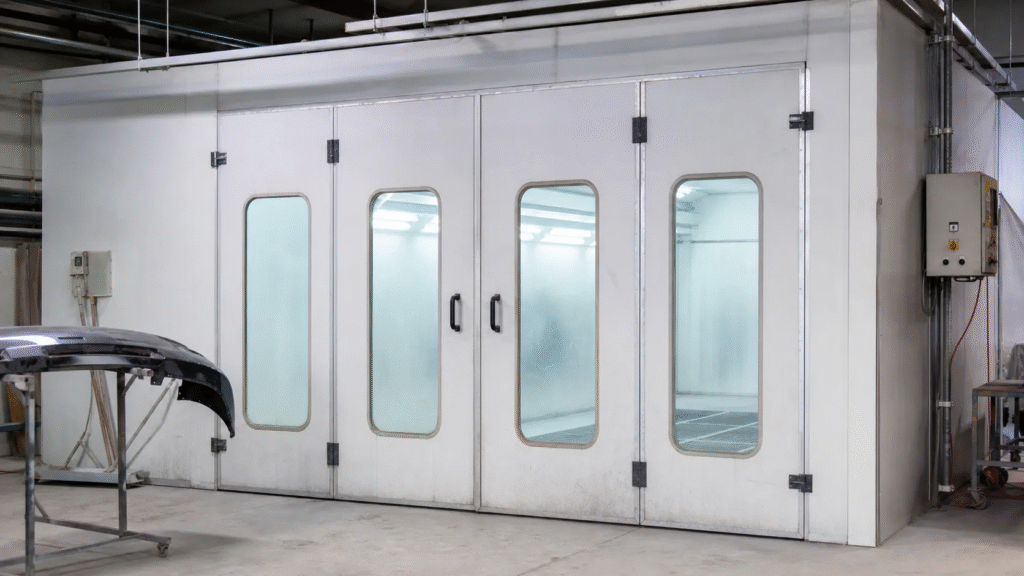
Overview of Paint Booth Doors
Role in Airflow and Contamination Control
Paint booth doors are critical components in maintaining precise airflow and static pressure control within spray booths. Properly designed doors help sustain the ideal airflow velocity, typically between 0.25 to 0.3 meters per second, ensuring a steady laminar flow that minimizes airborne contaminants. This controlled environment prevents dust, debris, and overspray from entering the painting area, safeguarding finish quality and reducing rework. An airtight seal around these doors is essential to maintain consistent pressure differentials, usually ranging from 10 to 80 Pascals, which keeps contaminants out and improves both product consistency and worker safety.
Importance in Safety and Code Compliance
Safety and regulatory compliance are paramount when selecting paint booth doors. Doors manufactured with non-combustible materials such as steel panels paired with fire-resistant insulation meet stringent fire codes, including NFPA 33 and OSHA guidelines. Explosion relief latches integrated into door systems provide an essential safety mechanism by automatically releasing pressure during surge events, preventing structural damage. Additionally, dedicated personnel access doors ensure emergency egress without compromising cabin pressure or door seals. Meeting these safety standards protects both personnel and facility assets while ensuring compliance with industry regulations.
Main Types of Paint Booth Doors
Swing Doors
Swing doors are the most common and cost-effective option for paint booth access. Typically designed with two or three outward-swinging leaves, they provide a reliable airtight seal essential for maintaining proper static pressure and preventing contamination. The main consideration with swing doors is the need for sufficient clearance outside the booth equal to the door width, which may limit their use in tighter spaces. Their robust construction and straightforward operation make them ideal for many automotive refinishing and industrial spray environments.
Roll-Up and Overhead Doors
Roll-up doors retract vertically above the booth opening, creating a zero-floor footprint. This design saves valuable shop space and allows for fast cycling, minimizing the risk of dust and debris entering the paint booth. Insulated panels commonly make up roll-up doors, providing excellent heat retention for baking cycles. Their speed and compact footprint suit high-volume production lines and facilities where contamination control and workflow efficiency are priorities.
Bi-Fold and Compact Folding Doors
Bi-fold doors fold in the center, halving the required frontal swing room compared to traditional swing doors. This space-saving feature is particularly useful in body shops or facilities with limited exterior clearance. Besides reducing footprint, bi-fold doors preserve a clean, uninterrupted interior surface, supporting optimal laminar airflow and finish quality. These doors combine convenience with reliable static pressure control and are adaptable to various booth sizes.
Sliding Doors
Sliding doors operate on a horizontal track system ideal for wide-span openings such as those needed for aerospace, rail, or heavy machinery paint booths. Because they move parallel to the booth wall, sliding doors eliminate the need for swing clearance and ceiling retraction, making them suitable where vertical or outward space is limited. Their durable design supports efficient access while maintaining booth integrity and compliance with airflow requirements.
For a detailed comparison of door types and their applications, explore the automotive paint booth guide on types, features, and benefits.
Product Doors vs. Personnel Service Doors
Solid Vehicle Doors
Solid vehicle doors form the main barrier between the paint booth interior and the outside environment. Constructed with heavy-gauge steel panels and insulated cores, these doors provide exceptional airtight sealing to maintain static pressure and prevent overspray contamination. Their robust design ensures durability through repeated bake cycles and continuous usage while limiting energy loss during curing. Solid doors are ideal for larger vehicles and commercial spraying operations where full enclosure and environmental control are critical.
Filtered Vehicle Doors
Filtered vehicle doors integrate high-efficiency filters into the door panels to enhance clean airflow while still providing a sealed environment. These filtered doors are particularly useful in applications demanding extra protection from airborne dust and overspray particles without compromising booth pressure balance. The filtration media is designed to withstand high temperatures, supporting bake cycles and maintaining airflow speeds between 0.25 to 0.3 m/s. This type of door is often favored in precision automotive refinishing booths and specialty industrial spray lines.
Personnel Service Doors
Personnel service doors serve as dedicated entry and emergency egress points, separate from the main vehicle doors. Available either as integrated panels within primary doors or standalone units on side or rear walls, these doors preserve the booth’s seal and pressure integrity by reducing the need to open large vehicle doors for individual access. Constructed with heat-resistant materials and fitted with advanced gasket seals, personnel doors comply with NFPA 33 and OSHA safety requirements, ensuring safe, quick exit options while minimizing contamination risks. Their strategic placement supports workflow efficiency and safety compliance in busy facilities.
For large scale or specialty vehicle spraying, reliable door options can be matched with comprehensive paint booth solutions such as the commercial vehicle spray booths designed for controlled environments and optimized throughput.
Key Features and Technical Specifications
Automated Drive Systems
Modern paint booth doors come equipped with reliable automated drive systems designed for smooth, quiet operation. These electric or hydraulic drives enable quick opening and closing, reducing cycle times and minimizing contamination risks during painting. Automated systems feature adjustable speed controls and fail-safe mechanisms to ensure consistent performance and user safety. Integration with booth controls allows seamless door operation aligned with airflow and lighting sequences.
| Feature | Benefit |
|---|---|
| Electric/Hydraulic Drives | Fast, controlled door cycling |
| Adjustable Speeds | Customizable operation for specific needs |
| Safety Interlocks | Prevents door operation during unsafe conditions |
| Remote/Panel Control | Convenient and synchronized access |
Advanced Seal Technology
High-performance paint booth doors incorporate advanced EPDM or silicone rubber gaskets that provide a tight, air-tight seal critical for maintaining the booth’s controlled environment. These seals resist hardening or cracking under high temperatures encountered during baking cycles (up to 80°C). Superior gasket design prevents overspray infiltration and dust contamination, preserving paint finish quality. Durable, heat-resistant sealing materials ensure long-term service life with minimal maintenance.
| Seal Material | Heat Resistance | Durability | Purpose |
|---|---|---|---|
| EPDM Rubber | Up to 80°C | High | Air-tight, dust prevention |
| Silicone Rubber | Up to 120°C | Very High | Maintains flexibility during bake cycles |
Heat Resistance and Thermal Insulation
Paint booth doors are engineered with insulated cores such as EPS foam or high-density rock wool between steel skins to minimize heat loss and improve energy efficiency. Insulation thickness typically ranges from 50mm to 75mm, providing optimal thermal barrier performance. Heat-resistant tempered glass windows maintain visibility while resisting thermal shocks during intense baking. This insulation reduces the energy required for temperature control inside the booth, boosting operational cost savings.
| Specification | Description |
|---|---|
| Door Core Material | EPS foam or 100 kg/m³ rock wool core |
| Panel Thickness | 50–75mm |
| Steel Skin Thickness | 0.46mm cold-rolled steel |
| Glazing | Tempered safety glass, heat-resistant |
| Temperature Range | Operates reliably between 20°C to 80°C |
These key features and specifications ensure that paint booth doors perform efficiently, maintain stringent airflow controls, and meet safety and compliance demands for high-quality spray finishing environments. For detailed paint booth configurations, explore our high-performance automotive paint booth guide and features.
Paint Booth Door Applications
Automotive Refinishing
Paint booth doors for automotive refinishing are designed to maintain strict airflow and contamination control essential for flawless paint jobs. Doors like swing and bi-fold types provide airtight seals that prevent dust and overspray infiltration, ensuring a clean environment for color matching and finish quality. Their reliable insulation supports high-temperature baking cycles, improving curing efficiency. These doors help body shops meet safety and environmental standards while delivering consistent, high-quality refinishing results. For detailed guidance on suitable booth equipment and airflow design, explore our automotive paint booth equipment types and buying guide.
Industrial Equipment Spraying
Industrial spray booths often handle larger parts and harsher coatings, requiring robust door systems that withstand heavy use and maintain pressure balance. Roll-up and sliding doors are common here, providing quick access while minimizing floor space usage. Their heavy-duty construction and advanced seals resist overspray buildup and thermal cycling during curing. Explosion relief latches and fire-resistant insulation integrated into these doors comply with NFPA 33 and OSHA codes, supporting safe operations in demanding industrial environments.
Aerospace and Commercial Vehicles
For aerospace and commercial vehicle spray booths, paint booth doors must accommodate oversized openings without compromising airflow or safety. Wide-span sliding doors and bi-fold doors excel in these scenarios by offering smooth operation and minimal obstruction to large aircraft, buses, or trucks entering the booth. Their precision sealing systems help preserve laminar airflow and cabin pressure critical to preventing contamination in highly regulated aerospace finishing processes. High-performance insulation also aids energy efficiency across long bake cycles and variable temperature ranges typical of commercial vehicle painting projects.
Key Considerations for Choosing Paint Booth Doors
Space and Dimensional Constraints
Selecting the right paint booth doors starts with assessing the available space and clearance around your booth opening. Swing doors, for example, need full outward clearance equal to the door width, which may not work in tight shop layouts. Bi-fold or compact folding doors reduce front clearance by folding inward, making them ideal for confined areas. Roll-up and sliding doors offer zero or minimal floor footprint, perfect for maximizing space in busy or small body shops. Accurately measuring your floor plan and ceiling height ensures your door system fits without interfering with workflow or ventilation components.
Airflow Type and Ventilation Integration
Paint booth doors directly impact airflow patterns and pressure stability inside the booth. Doors must maintain the proper static pressure range (10–80 Pa) and laminar airflow speeds (around 0.25–0.3 m/s) to prevent dust ingress and ensure finish quality. The door design should integrate seamlessly with your booth’s ventilation system, whether downdraft, crossdraft, or semi-downdraft. Features like airtight gaskets and tight panel insulation support consistent airflow and reduce energy loss. For guidance on airflow design and booth ventilation integration, see detailed insights on industrial paint booths and downdraft airflow systems.
Safety, Fire, and Regulatory Compliance
Compliance with NFPA 33, OSHA, and local fire codes is non-negotiable when choosing paint booth doors. Doors must be constructed from non-combustible materials such as steel skins with fire-resistant insulation cores to withstand bake cycles and potential hazards. Explosion relief latches that automatically release during pressure surges ensure operator safety and facility protection. Dedicated personnel doors should provide emergency egress while preserving cabin pressure and preventing overspray leaks. Prioritizing doors with tested seals and fire ratings not only meets regulations but supports long-term operational safety and reliability.
Frequently Asked Questions About Paint Booth Doors
What is the difference between solid and filtered paint booth doors?
Solid paint booth doors are designed as sealed barriers without built-in filtration. They offer strong static pressure control and durability, ideal for keeping dust and debris out during spraying and baking cycles. These doors typically feature heavy-duty insulation and heat-resistant seals but rely on the booth’s overall ventilation system for air quality.
Filtered paint booth doors, on the other hand, incorporate integrated filtration media allowing air to pass through while trapping overspray and contaminants. These doors improve airflow quality by filtering intake or exhaust air directly at the door opening. Filtered doors are often used in applications where enhanced air cleanliness is critical, such as in automotive refinishing or aerospace paint booths.
Choosing between the two depends on your booth’s ventilation setup and contamination control goals. For more on matching doors and airflow, see our guide on auto body shop paint booth requirements.
How do space-saving roll-up doors benefit small shops?
Roll-up paint booth doors retract vertically and do not require floor space for swinging clearance. This design reduces the door’s footprint to virtually zero on the shop floor, ideal for cramped or high-traffic areas typical in small body shops.
Benefits include:
– Maximized workspace: Frees up room for vehicle movement and equipment placement.
– Fast cycling: Quick open/close speeds reduce contamination risks by limiting open-door time.
– Enhanced seal integrity: Insulated panels maintain booth temperature and pressure without gaps common in swinging doors.
– Reduced maintenance: No external swinging parts means fewer hinges to lubricate or repair.
Because of these advantages, roll-up doors are a practical choice for small shops needing efficient traffic flow and solid environmental control. For additional tips, see our article on how a truck paint booth saves time and labor.
What maintenance do paint booth door seals require?
Keeping paint booth door seals in good shape is crucial for maintaining an airtight environment and consistent spray quality. Key maintenance steps include:
| Maintenance Task | Frequency | Purpose |
|---|---|---|
| Inspect seals for damage | Weekly | Detect cracks, hardening, or gaps |
| Clean seals of overspray | Weekly | Remove dry paint build-up for proper sealing |
| Lubricate hinges/tracks | Quarterly | Ensure smooth door operation and prevent wear |
| Check explosion relief latches | Monthly | Verify latch operation for safety compliance |
| Test door closure pressure | Daily | Confirm consistent booth pressure and airflow |
Use heat-resistant EPDM or silicone-based seal conditioners to prevent hardening during bake cycles. Regular upkeep extends seal life and protects booth performance over time.
Proper door seal care supports your overall paint quality and helps meet safety standards such as NFPA 33.