
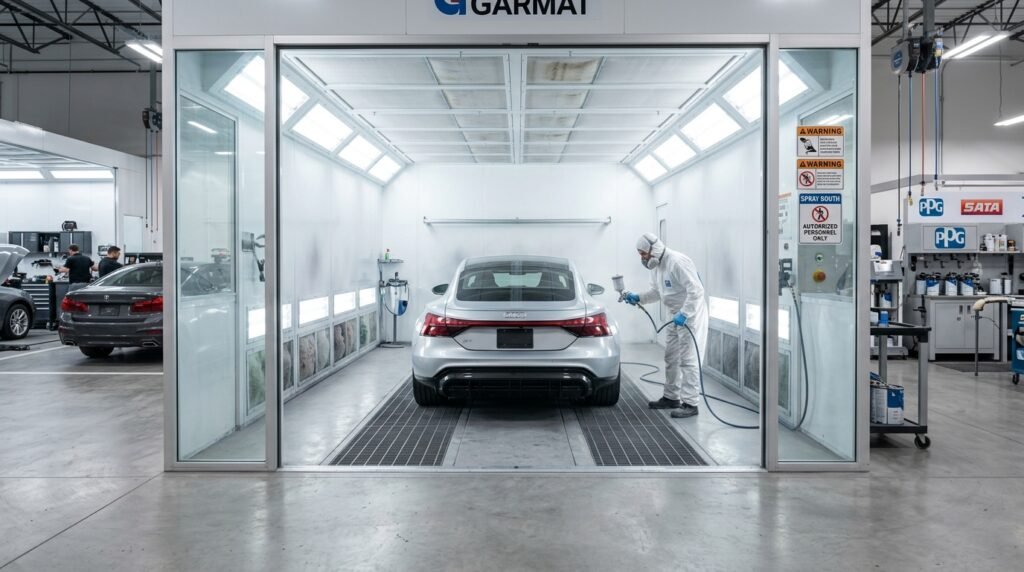
Everything auto body shops need to know about automotive paint booths — airflow types, compliance requirements, key specs, and what to look for before you buy.
Page URL: https://www.autokemanufacture.com/
Automotive Paint Booth: A Practical Guide for Auto Body Shops
If you’ve ever spent an hour buffing out dust nibs on a fresh clear coat, you already know why a proper automotive paint booth matters.
Open-air painting doesn’t work at a professional level. Dust, debris, humidity swings — they all find their way into the wet paint. A booth eliminates those variables. It gives you a controlled, pressurized space where the air coming in is clean, the temperature is stable, and overspray goes where it’s supposed to go — out of the cabin, not back onto the car.
This guide covers how paint booths actually work, what the main types are, what auto body shop paint booth requirements look like in practice, and what to look for when you’re buying one.
How an Automotive Paint Booth Works
The core idea is simple: control the air.
A paint booth is a sealed enclosure with a ventilation system that does two things at once. It supplies filtered air into the cabin, and it pulls overspray, fumes, and VOCs out. The result is a continuous flow of clean air moving through the space in a controlled direction — keeping contaminants away from the wet paint surface.
The main components that make this happen:
Intake filters catch dust and debris before the incoming air enters the cabin. These are what keep the environment clean on the way in.
Exhaust fans and filters pull contaminated air out. The exhaust filters capture overspray solids before the air is vented outside — this is where environmental compliance comes in.
The air makeup unit (AMU) replaces the air being exhausted and regulates the cabin temperature. Temperature control is what makes proper bake cycles possible.
Explosion-proof lighting is non-negotiable. Paint fumes are flammable, and the lighting inside the booth has to be rated for that environment. Good lighting also means your painters can actually see what they’re doing — color matching and spotting defects before the car leaves the booth.
The Four Airflow Types
The way air moves through the booth has a bigger effect on finish quality than most people expect. Here’s how the main configurations compare:
Crossdraft — air enters through the front doors and exits through the rear. The most affordable option and the simplest to install. The downside is that air moves across the vehicle, which means overspray can pass over a freshly painted surface on its way out. Fine for general repair work and lower-volume shops.
Semi-downdraft — air enters from the ceiling at the front and exits toward the lower rear. A solid middle-ground option. Better finish quality than crossdraft, more affordable than a full downdraft, and no floor pit needed.
Side-downdraft — air comes down from the ceiling and exits through vents along the lower side walls. Good finish quality without requiring concrete excavation. A popular choice for shops that want near-downdraft performance without the installation cost.
Full downdraft — air flows straight down from the ceiling and exits through grates in the floor. This is the best configuration for finish quality. Gravity and airflow work together to pull overspray straight down and away from the vehicle. It requires either a floor pit or a raised floor system, which adds to installation cost — but for high-end refinishing work, the results justify it.
Auto Body Shop Paint Booth Requirements
This is the part a lot of shop owners underestimate when they’re planning a booth installation. Running a compliant spray booth in the US means dealing with three main regulatory bodies, and each one covers something different.
NFPA 33 covers fire safety. It governs how the booth is built, where fans are placed, how electrical components are protected, and what fire suppression systems are required. Most jurisdictions require an integrated dry chemical suppression system. Spark-proof motors and explosion-proof lighting are standard requirements.
OSHA covers worker safety. The focus is on keeping hazardous fumes — including isocyanates from two-part paints — below dangerous levels in the breathing zone. This comes down to adequate air exchange rates and proper ventilation performance.
EPA regulations (including the 6H Rule) cover environmental impact, specifically VOC emissions. Shops spraying coatings that contain hazardous air pollutants need to meet filtration efficiency standards and document their compliance. HVLP spray guns are part of this — they transfer more paint to the surface and produce less overspray, which reduces emissions.
On top of these, local building codes add their own requirements around permits, ducting height, clearance around the booth, and zoning. You’ll need sign-off from your local fire marshal before you start spraying.
The practical checklist:
| Requirement | Who Sets It | What It Covers |
|---|---|---|
| Fire safety | NFPA 33 | Explosion-proof components, suppression systems |
| Worker health | OSHA | Ventilation rates, fume exposure limits |
| Air quality | EPA | Filtration efficiency, VOC management |
| Building and zoning | Local authority | Permits, ducting, clearances |
A well-made booth with proper certifications takes most of this off your plate — the specs are already documented. But you still need to pull the right permits and get local approval before installation.
What a Paint Booth Does for Your Shop
Beyond compliance, here’s the practical case for investing in a proper booth:
Better finish quality. A controlled environment eliminates the dust nibs and orange peel that eat into your labor time. When the airflow is right and the air is clean, paint jobs come out smoother with less buffing.
Faster turnaround. Integrated heating means you can run proper bake cycles. Faster curing means more cars through the shop each week. That has a direct effect on revenue.
Healthier working conditions. VOCs and isocyanates are serious health risks over time. A booth that properly exhausts these keeps your technicians safe and reduces long-term liability.
Compliance protection. A certified booth with documented specs keeps inspectors satisfied, satisfies your insurance requirements, and protects you from fines that can be significant for non-compliant spray operations.
What to Look For When Buying
Airflow configuration — pick the type that matches your production level and budget. If you’re doing high-end work regularly, downdraft pays for itself in quality. If you’re doing general repair, crossdraft or semi-downdraft does the job at a lower cost.
Heating system — gas burners are the standard for most shops. Electric systems work well if you don’t have a gas line or prefer a cleaner setup. Either way, make sure the system can reach and hold 60–80°C for proper bake cycles.
Filtration — intake filtration, ceiling filtration, and exhaust filtration should all be clearly specified. Exhaust filters should be rated to capture at least 98% of paint overspray solids to meet EPA standards.
Build quality — galvanized steel panels, proper insulation (75mm is the standard for heat retention), copper-core motors, and non-slip floor grating. These aren’t upgrades — they’re what a professional booth should come with.
Controls — a manometer (pressure gauge) tells you when filters need changing based on actual pressure drop, not guesswork. Digital temperature controls let you set and maintain bake cycle temperatures accurately. These are standard on any well-made booth.
Lighting — high-CRI explosion-proof LEDs, positioned at both the ceiling and side walls. Shadow-free lighting isn’t optional if you want to catch defects before the car leaves the booth.
Maintenance: What Keeps a Booth Running Well
A booth that’s maintained properly will last years without major issues. The main things to stay on top of:
Filters — use your manometer as the guide, not the calendar. When pressure drop across the filters exceeds the recommended range, change them. As a rough baseline: exhaust filters every 2–4 weeks for a busy shop, intake filters every 6–12 months.
Interior walls — overspray buildup darkens the cabin and can introduce contamination into future paint jobs. Peelable coatings applied to interior walls make this easy to manage — when they’re covered in overspray, peel and reapply.
Lighting glass — wipe it down regularly. Dimmed lighting from overspray on the covers is a direct cause of missed defects.
Fan belts and motors — check belts monthly for wear. A slipping belt drops airflow immediately. Listen for unusual noise from the motors — catching a problem early is a lot cheaper than a breakdown mid-job.
Common Questions
How much does an automotive paint booth cost? Entry-level crossdraft booths run from around $10,000 to $15,000. A full downdraft system with a curing oven and AMU can range from $40,000 to over $100,000. Factory-direct pricing from China is typically 30–50% lower than buying through a local distributor for comparable specs. Installation, electrical work, and shipping add to the total regardless of where you buy.
Do I need permits to install a booth? Yes. You’ll need building and electrical permits, and approval from your local fire marshal. This applies whether you’re installing a new booth or replacing an old one. Start this process before you order — permit timelines vary significantly by location.
What’s the difference between crossdraft and downdraft? Crossdraft moves air horizontally across the vehicle. It’s affordable and simple, but overspray can drift across fresh paint. Downdraft moves air straight down from the ceiling and out through the floor — overspray falls away from the vehicle, giving you a cleaner finish. The tradeoff is higher installation cost due to the floor pit requirement.
How do I know when to change filters? Install a manometer and use it. When the pressure reading shows restricted airflow, it’s time to change filters — don’t wait for the finish quality to drop before you notice. For a high-volume shop, exhaust filters typically need changing every 2–4 weeks.
Ready to Find the Right Booth for Your Shop?
Tell us your shop size, what vehicles you paint, and what airflow type you’re considering. We’ll put together a quote with a layout drawing and let you know what makes sense for your setup.
[Get a Free Quote] [Download Spec Sheet] [Contact us]
Related Pages
- Downdraft vs Crossdraft Spray Booth →https://sprayboothmanufacturer.com/which-one-should-you-choose/
- Spray Booth Manufacturer in China →https://www.autokemanufacture.com/spray-booth
- Contact Our Sales Team →https://www.autokemanufacture.com/contact-us.html
✅ CE Certified | ✅ ISO 9001:2015 | ✅ Factory Direct | ✅ Ships to 60+ Countries | ✅ 1-Year Warranty | 🔒 HTTPS Secured