
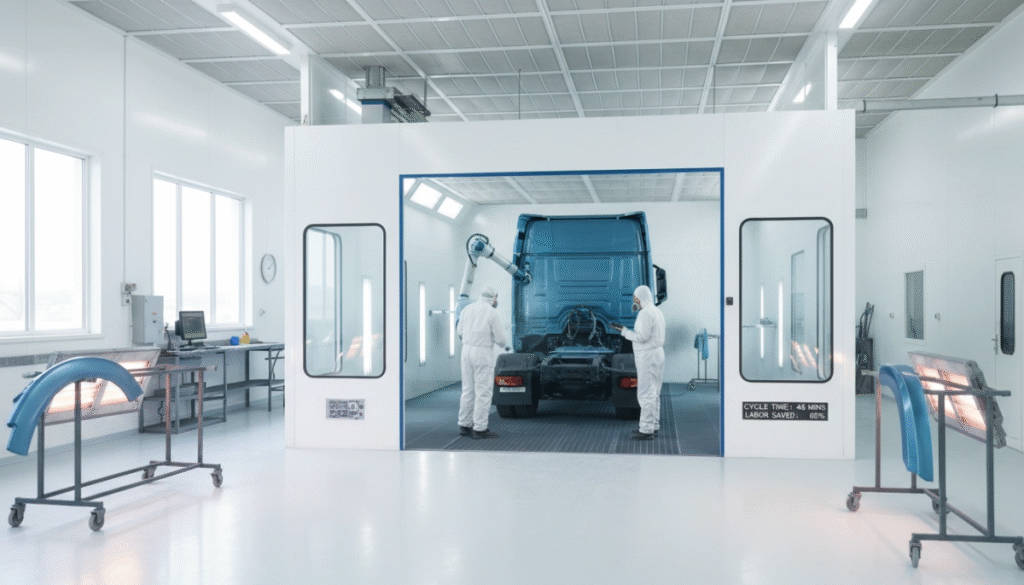
Running a commercial fleet operation means every hour a truck spends in the shop is an hour it isn’t on the road making money. This guide covers how a professional truck paint booth cuts rework, speeds up drying, reduces labor overhead, and pays for itself faster than most shop owners expect.
Choosing the Right Booth Type for Your Operation
Before getting into the time and cost benefits, it’s worth understanding how different booth configurations affect your results — because the booth type you choose directly shapes how much time you spend on each job.
Downdraft booths pull air straight down from the ceiling through floor grates, using gravity to carry overspray and contaminants away from the vehicle at every point along its length. This produces the cleanest possible finish on large commercial vehicles, minimizes time spent on post-paint correction, and is the right choice for high-volume operations where quality is non-negotiable.
Semi-downdraft systems bring air in through the ceiling but exhaust it through the rear wall. The airflow is better than a crossdraft setup, and it doesn’t require a floor pit, which makes it a practical middle option for mid-size fleets with space or budget constraints.
Crossdraft booths move air horizontally from front to back. They’re the most affordable entry point and work fine for basic priming or lower-volume utility painting, but the horizontal airflow means overspray travels across the entire vehicle before exiting — which affects finish quality on larger trucks.
| Booth Type | Best For | Airflow Direction | Installation Cost |
|---|---|---|---|
| Downdraft | High-volume, premium finishes | Top to Bottom | Higher (requires pit) |
| Semi-Downdraft | Mid-size fleets, general refinishing | Top to Back | Moderate |
| Crossdraft | Budget-conscious, utility painting | Front to Back | Lower |
If your goal is to eliminate rework and push trucks out the door faster, a downdraft or solid semi-downdraft system gives you the best long-term return. The booth type is the foundation — everything else builds on it.
How a Booth Eliminates Rework
Rework is the single biggest drain on a shop’s profitability. When a truck comes out with dust nibs, fish eyes, or orange peel, you’re not just losing time — you’re burning through expensive coatings and doubling your labor hours on a job you’ve already sprayed once.
A professional truck paint booth creates a sealed, pressurized environment that stops these problems before they start.
Contamination Control
On an open shop floor, microscopic particles are everywhere. Even a tiny speck of dust ruins a high-end finish on a trailer or cab. A proper booth runs multi-stage filtration to trap contaminants before they ever reach the vehicle surface. Positive pressure inside the booth keeps unfiltered shop air from pushing in through door gaps. High-efficiency intake filters handle the rest.
The practical result is that you spend far less time color sanding and buffing after the job is done. For high-volume operations, that difference adds up to hours per week.
Temperature and Humidity Control
Paint chemistry is sensitive to the environment. Too much humidity and the paint won’t flash off cleanly. Too cold and you get runs and sags. A climate-controlled booth lets you dial in the exact conditions the paint manufacturer specifies, regardless of what the weather is doing outside.
Stable atmospheric conditions mean predictable flash times, better flow and leveling, and a consistent finish quality from job to job — whether you’re spraying in July or January.
| Rework Factor | Without a Professional Booth | With a Professional Booth |
|---|---|---|
| Material Waste | 20–30% higher from re-sprays | Minimal waste, precise application |
| Labor Hours | Doubled for sanding and prep | Single-pass efficiency |
| Shop Throughput | Stalled by corrections | Fast, predictable turnaround |
Getting the finish right the first time eliminates the hidden costs that don’t show up on an invoice but absolutely show up on your payroll.
Faster Drying Means More Trucks Out the Door
The biggest throughput bottleneck in most shops isn’t the spraying — it’s the waiting. If the truck can’t leave the booth, the next one can’t come in. A professional booth addresses this directly.
Accelerated Curing with Integrated Heat
Standard air-drying on a large commercial vehicle can take hours, especially in cold or humid conditions. A booth with an integrated heating system turns that wait into a fast, predictable bake cycle. Consistent heat drives solvents out of the coating quickly, produces a harder and more durable finish, and gets the truck road-ready sooner.
The time savings here are significant. With a heated Air Makeup Unit running a proper bake cycle, a job that would air-dry over several hours is done in a fraction of that time. That’s not a marginal improvement — it effectively increases your booth capacity without adding space or shifts.
Airflow That Pulls Solvents Away Actively
Heat alone isn’t the whole picture. High-volume airflow is what actively pulls moisture and solvents away from the vehicle surface, preventing solvent pop and hazy finishes. When airflow and heat work together properly, drying times drop significantly and the finish quality improves at the same time.
When you can move a truck out and bring the next one in while a shop without a booth is still waiting for a panel to become tack-free, the competitive advantage is obvious.
Direct Labor Cost Savings
Payroll is one of the biggest overhead expenses in any commercial shop. A professional booth setup cuts labor hours in several direct ways.
Prep and masking time drops significantly. Without a dedicated booth, your team wastes time taping off the surrounding shop area to contain overspray. A contained environment isolates the job, so technicians get the vehicle prepped and into the spray stage faster.
Painters work faster in a well-designed space. Shadow-free lighting, accessible controls, and enough clearance to walk around a full-size commercial truck without squeezing past equipment makes a real difference to how quickly a painter can work. Cramped spaces and poor visibility slow everything down.
Fewer people needed per job. Because the process becomes more streamlined and predictable, a job that previously required three technicians can often be handled by one or two. You put more volume through the shop without adding overtime or a second shift.
The result is that you stop paying your crew to fight inefficiencies and start paying them to actually paint.
The ROI Breakdown
When shop owners ask whether the investment makes sense, the answer comes down to looking at the full picture — not just the purchase price.
Energy Costs
Modern booths use variable frequency drives (VFDs) on fan motors so they ramp up only when actively spraying or curing rather than running at full power all day. LED lighting cuts electrical consumption significantly compared to older fluorescent setups. Heat recirculation during bake cycles reuses warm air instead of exhausting it and pulling in cold outside air, which reduces gas costs substantially on high-volume operations.
Material Savings
When airflow is properly calibrated for the vehicle size, transfer efficiency improves — more coating lands on the truck and less gets pulled into the exhaust filters. Over the course of a year, the difference in paint consumption on a busy fleet operation is measurable. Fewer reworks also mean less material wasted on re-sprays and correction work.
Compliance and Risk
Operating without proper VOC capture and code-compliant equipment exposes a shop to EPA and OSHA fines that can be severe enough to shut down a small operation entirely. A properly built booth with advanced exhaust filtration keeps you compliant and keeps regulators off your radar. The cost of a fine compared to the cost of proper equipment is not a close comparison.
Maintenance That Protects Your Investment
A booth that isn’t running at peak performance is a booth that’s costing you money. Maintenance is what keeps the time and cost savings working over the long term.
Filter replacement is the most important routine task. Clogged intake filters restrict incoming air and affect finish quality. Saturated exhaust filters throw off cabin pressure and force fans to work harder. Use your manometer to track when airflow is dropping rather than guessing based on a calendar — the gauge tells you exactly when it’s time.
Routine cleaning keeps the environment doing its job. Wall coatings or peelable film prevent dried overspray from flaking into fresh paint. Clean floor grates maintain unobstructed airflow through the pit. Clean light fixtures give painters accurate visibility for color matching.
Preventive mechanical checks catch problems before they cause unplanned downtime.
| Component | Maintenance Action | Frequency |
|---|---|---|
| Fans and Motors | Check belt tension, lubricate bearings | Monthly |
| Burner System | Inspect combustion efficiency, clean intake | Seasonally |
| Door Seals | Check for gaps and air leaks | Weekly |
| Compressed Air | Drain moisture traps | Daily |
A motor or burner failing mid-shift doesn’t just cost the repair — it costs the entire production day that stops with it.
Common Questions
How much time does a booth actually save per job? On average, a professional commercial truck paint booth cuts total job time by 30% to 50%. Most of that comes from two places: eliminating rework because the environment is sealed and filtered, and faster curing because of the heated air system. Both of those have a direct impact on how many trucks you can turn in a week.
How fast does the investment pay off? Faster than most people expect. When you factor in lower labor costs per job, higher weekly volume from faster cycle times, and avoided fines from compliance violations, most operations see a meaningful return within months rather than years. The cost comparison isn’t just the booth price against nothing — it’s the booth price against what inefficiency and rework are already costing you.
What’s the most important maintenance task to stay on top of? Filter changes, tracked by your manometer rather than by a fixed schedule. When airflow drops, everything downstream suffers — finish quality, drying times, and energy consumption all get worse. Keeping filters fresh is the simplest and most direct way to protect the efficiency you bought.
Can I use a truck booth for smaller vehicles too? Yes, but running a full-scale heating and ventilation system to paint a sedan wastes energy. If your shop handles a mix of vehicle sizes, look for a booth with zoned airflow controls that let you run only the sections of the system you actually need for the job at hand.
Tell Us What You’re Working With
Share your fleet vehicle types, facility dimensions, weekly volume, and any workflow constraints you’re dealing with. We’ll spec out the right truck paint booth for your operation and send a detailed quote with layout drawings — usually within 48 hours.
Related Pages
- Bus Spray Booth Design Guide → https://sprayboothmanufacturer.com/transit-coach-spray-booth-requirements/
- Large Vehicle Paint Booth Size Guide → https://sprayboothmanufacturer.com/large-vehicle-paint-booth-sizing-guide/
- Other related products → https://www.autokemanufacture.com/product
- Contact our sales Team → https://sprayboothmanufacturer.com/contact-us/
✅ CE Certified | ✅ ISO 9001:2015 | ✅ Factory Direct | ✅ Ships to 60+ Countries | ✅ 1-Year Warranty | 🔒 HTTPS Secured