
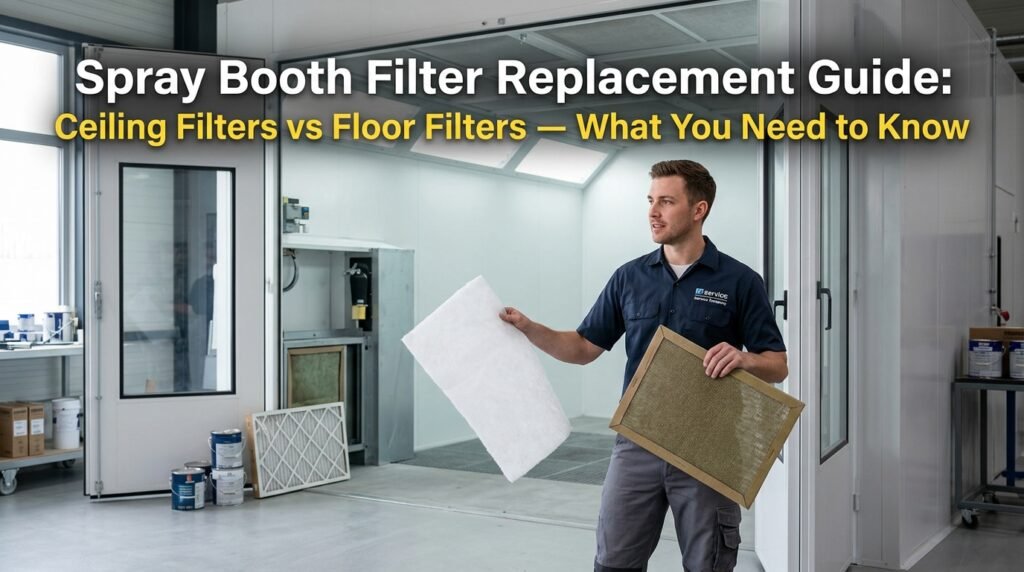
Not sure when to replace your spray booth filters — or which ones actually need changing? This guide covers ceiling filters vs floor filters, replacement schedules, and what to watch for before problems show up.
Page URL:https://www.autokemanufacture.com/
Spray Booth Filter Replacement Guide: Ceiling Filters vs Floor Filters — What You Need to Know
Most finish problems in a spray booth come down to one thing: filters that are overdue for a change.
It sounds simple, but a lot of shops either change them too late, change the wrong ones, or don’t track the schedule at all. Then the finish quality drops, the booth starts behaving strangely, and the cause isn’t obvious because the filters look okay from the outside.
This guide walks through how ceiling filters and floor filters work, what happens when each one fails, how to know when it’s time to replace them, and what the compliance side of this looks like if you’re operating in the US.
Start Here: Airflow Is Everything
Before getting into filters specifically, it helps to understand what they’re actually doing inside a working booth.
A spray booth moves a serious amount of air — typically between 25,000 and 30,000 m³/h in a standard automotive booth. That constant airflow is what clears overspray from the cabin, pulls fumes away from the painter, and keeps the finish environment stable.
The filters are in the path of all that air. They’re catching contaminants while the air passes through. When they start to clog, the airflow drops — and everything downstream of that gets worse. Finish quality, fume clearance, fan load, and compliance all get affected at the same time.
The other thing worth knowing is that how air moves through your booth determines where the filters sit and how fast they load up.
In a downdraft booth, air comes in through ceiling filters and exits through floor filters. Both sets are always working, and the floor filters tend to get loaded faster because they’re catching wet overspray on the way out.
In a crossdraft booth, air enters through filters at the front and exits through filters at the rear. The rear exhaust filters take most of the overspray load in this setup.
Knowing which type of booth you have is the starting point for getting your maintenance schedule right.
Ceiling Filters: What They Do and When to Replace Them
Ceiling filters are intake filters. Their job is to clean the air coming into the booth before it reaches the vehicle or parts being painted.
The main thing they’re stopping is dust — microscopic particles that would otherwise land on a wet paint surface and cause contamination. If you’ve ever had dust nibs or debris showing up in a fresh clear coat, overloaded ceiling filters are usually the first thing to check.
What to Look For in a Ceiling Filter
The most common and effective material is tackified polyester — polyester media with a sticky surface treatment that grabs fine particles and holds them in place. Without the tackifier, particles can be trapped and then vibrate loose when airflow increases, ending up in your paint job anyway.
Beyond material, the two specs that matter most are:
Loft (thickness) — A thicker, multi-layered filter holds more dirt before it starts to restrict airflow. Thin, cheap filters load up faster and need more frequent changes.
MERV rating — This tells you the filter’s efficiency at capturing particles of different sizes. For spray booths, you want a rating high enough to catch fine dust without being so restrictive that it chokes your airflow. Your booth manufacturer or filter supplier can tell you the right range for your system.
When to Replace Ceiling Filters
Ceiling filters last longer than floor filters because they’re handling dry particles rather than wet overspray. As a baseline:
- Standard use: Every 6 to 12 months
- High-volume shops: Based on operating hours, or whenever your manometer shows a pressure drop outside the normal range
Don’t wait until they look dirty. By the time a ceiling filter is visibly caked, it’s already been restricting airflow for a while.
Floor Filters: What They Do and When to Replace Them
Floor filters are exhaust filters. They sit beneath the floor grating in a downdraft booth, and their job is to capture wet overspray before the air exits the booth through the exhaust system.
This is a harder job than what ceiling filters do. Wet paint is sticky, it loads up filter media fast, and once a floor filter is saturated, it stops filtering and starts blocking. At that point your exhaust fans are working against a choked filter, your cabin pressure is off, and the booth isn’t clearing overspray properly.
Material Options
Spun fiberglass is the most common choice. It handles wet, sticky overspray well without immediately restricting airflow, and it’s durable enough for the volume most shops run.
Synthetic polyester media is an alternative that offers consistent filtration, but it can restrict airflow faster if you’re running heavy coatings at high volume. It’s often a better fit for lower-volume applications.
When to Replace Floor Filters
Floor filters load up much faster than ceiling filters. The standard replacement schedule is:
- By time: Every 3 to 4 weeks
- By spray hours: Every 80 to 100 hours of actual spraying
The hour-based schedule is more reliable than the calendar if your spray volume varies week to week. When a floor filter hits capacity, it’s not doing its job anymore — and running overloaded floor filters puts unnecessary strain on your exhaust motors.
Side-by-Side: Ceiling vs Floor Filters
| Ceiling Filters | Floor Filters | |
|---|---|---|
| Role | Intake — cleans air entering the booth | Exhaust — captures overspray leaving the booth |
| What they catch | Dry dust and microscopic airborne particles | Wet overspray and paint VOCs |
| Typical material | Tackified polyester | Spun fiberglass or synthetic polyester |
| Replacement interval | Every 6–12 months | Every 80–100 spray hours (roughly 3–4 weeks) |
| Unit cost | Higher — but replaced less often | Lower — but replaced frequently |
| What happens when they fail | Dust contamination in the finish | Pressure backup, fan strain, poor fume clearance |
These are two completely separate maintenance tasks. Treating them the same way — or skipping one because you recently changed the other — is how shops end up with problems that are hard to trace back to the actual cause.
How to Tell When Filters Need Changing
You don’t have to guess. Your booth will tell you when something’s wrong — you just need to know what to look for.
Problems With the Finish
Dust nibs or debris in the clear coat — This is almost always ceiling filter contamination. The intake filter is overloaded and letting particles through into the cabin.
Overspray staying in the air too long — If the booth stays foggy or cloudy well after spraying stops, the floor filters are saturated. They’re not pulling the overspray out of the air fast enough.
Pressure Readings on the Manometer
Your manometer is the most reliable tool for monitoring filter condition. It measures the static pressure inside the booth, and any change from the baseline tells you something specific.
Pressure dropping below baseline — Your ceiling filters are restricting incoming air. The booth isn’t getting enough fresh air in.
Pressure rising above baseline — Your floor filters are restricted. Air is backing up because it can’t exit fast enough.
The right way to use the manometer: note the reading immediately after installing fresh filters. That’s your clean baseline. When the reading drifts outside the acceptable range, it’s time to change whichever filter is responsible.
Log your readings daily if you’re running a busy shop. It takes a minute and it gives you an accurate record of when things changed — which is useful both for maintenance planning and for compliance documentation.
Compliance: What US Shops Need to Know
Keeping up with filter replacements isn’t just about finish quality. In the US, it’s also a legal requirement.
NESHAP Rule 6H — The EPA’s National Emission Standards for Hazardous Air Pollutants require that automotive surface coating operations maintain exhaust filtration systems capable of capturing at least 98% of airborne overspray. If your floor filters are saturated and not functioning properly, you’re not meeting this requirement regardless of what else your booth is doing right.
OSHA compliance — Beyond air quality, proper airflow prevents the buildup of flammable vapor concentrations inside the booth. This is a worker safety requirement, not just an environmental one.
What inspectors look for — When an inspector visits your shop, they’re not just checking the current state of your filters. They’re looking for documented evidence that you’ve been maintaining your system properly over time. A shop with no maintenance records is a shop that looks non-compliant even if it’s actually been running fine.
What to Keep on Record
- Date of every filter change (ceiling and floor separately)
- Hour count at time of each change
- Daily or weekly manometer readings
- Filter purchase receipts showing the media type and specification
This takes almost no time to maintain, and it’s the difference between a clean inspection and a fine that wipes out a month of profit.
When New Filters Don’t Fix the Problem
If you’ve just put in fresh filters and your manometer readings are still off, the filters aren’t the bottleneck. Something else in the system is restricting airflow.
Common causes include a failing exhaust fan motor, partially blocked ductwork, worn fan belts, or damaged intake baffles. These problems present the same way as overloaded filters — reduced airflow, pressure fluctuations, longer booth clearance times — but swapping filters won’t fix them.
If fresh filters don’t bring your pressure readings back to baseline within a few hours of operation, it’s time to check the mechanical components.
What We Supply
As a spray booth filter replacement supplier, we stock ceiling and floor filter media for a wide range of booth configurations — automotive, truck, and industrial.
We also supply full booth systems, ventilation components, and replacement hardware for shops that are ready to upgrade beyond filter maintenance. If your booth is consistently underperforming despite proper filter changes, we can help you figure out whether a component upgrade or a full system replacement makes more sense for your situation.
Filter media we carry:
- Tackified polyester ceiling intake filters (various MERV ratings and dimensions)
- Spun fiberglass floor arrestors
- Synthetic polyester exhaust media
- Pre-cut rolls and standard panel sizes
Frequently Asked Questions
How do I know which filter size I need? Your booth’s documentation should list the filter dimensions. If you don’t have the original docs, measure the filter frame openings directly — width, length, and depth for ceiling filters; width, length, and thickness for floor filters. If you’re not sure, send us the booth make and model and we’ll confirm the right spec.
Can I use generic filters instead of branded ones? Yes, as long as the dimensions and MERV rating match your booth’s requirements. The key specs are physical size, filtration efficiency, and media type — not the brand name. Make sure any filter you use meets the efficiency requirements for NESHAP compliance.
What happens if I run the booth with clogged floor filters? Your exhaust fans work harder against the restriction, which shortens motor life. Overspray clearance slows down, which affects finish quality and fume exposure for your painters. And if your filters aren’t capturing 98% of overspray, you’re outside NESHAP compliance even if nothing is visibly wrong.
Do I need to replace ceiling and floor filters at the same time? No. They have very different replacement intervals and should be tracked separately. Replacing both at once when only one needs changing wastes money on the filter that still has life left in it.
We run two shifts. Does that change the schedule? Yes. The 80–100 hour replacement interval for floor filters is based on actual spray hours, not calendar days. If you’re running two shifts, you may be hitting that threshold in two weeks instead of four. Track by hours, not by the calendar.
Need Filters or Help Choosing the Right Spec?
Tell us your booth type, size, and what you’re spraying. We’ll confirm the right filter media and get you a quote for what you need — ceiling, floor, or both.
[Get a Filter Quote] [Download Maintenance Schedule Template] [Talk to Our Technical Team]
Related Pages
- Water Curtain vs Dry Filter Booth →https://sprayboothmanufacturer.com/which-filtration-system-should-you-choose/
- Industrial Paint Booth Manufacturer →https://sprayboothmanufacturer.com/industrial-paint-booth-manufacturer-heavy-duty-booths-with-forced-ventilation-constant-temperature-baking-for-large-scale-finishing/
- Automotive Paint Booth for Sale →https://www.autokemanufacture.com/spray-booth
- Contact Our Sales Team →https://www.autokemanufacture.com/contact-us.html
✅ CE Certified | ✅ ISO 9001:2015 | ✅ NESHAP Compliant Media Available | ✅ Factory Direct | ✅ Ships to 60+ Countries | 🔒 HTTPS Secured