
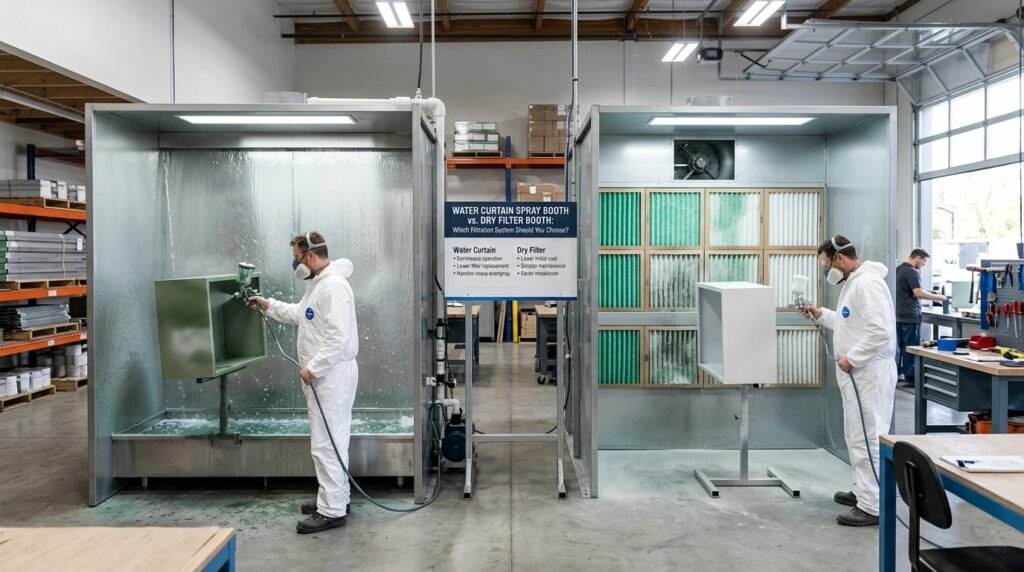
Trying to decide between a water curtain spray booth and a dry filter booth? As a professional water curtain spray booth supplier, we break down the real differences in cost, maintenance, and uptime so you can pick the right system for your facility.
Water Curtain Spray Booth vs Dry Filter Booth: Which Filtration System Should You Choose?
If you’re comparing a water curtain spray booth and a dry filter booth, you’re probably already past the basics. You know you need to deal with overspray. The question is which system makes more sense for your facility — and the answer isn’t the same for everyone.
Both systems work. Both are used in real production environments every day. But they work differently, cost differently, and require different things from you day to day.
This page walks through how each one actually functions, where each one makes sense, and what the ongoing reality looks like once it’s installed and running.
How a Dry Filter Booth Works
A dry filter booth pulls overspray-laden air through layers of filter media — usually fiberglass, paper, or polyester — which physically trap the paint particles. The cleaned air then exits through the exhaust. That’s the whole system. No water, no chemicals, no plumbing.
Where it makes sense:
- Shops running less than 20 hours of spray time per week
- Operations that switch between colors or paint types frequently
- Facilities without heavy plumbing infrastructure
What’s good about it:
- Lower upfront cost — cheaper to buy and simpler to install
- No wastewater to deal with — none of the regulatory headache that comes with liquid disposal
- Straightforward setup — if your facility doesn’t have the infrastructure for a wet system, this is the practical choice
What to be ready for:
- Filters need to be replaced regularly — how often depends on your spray volume, but heavy daily use means every one to two weeks
- Every filter change means stopping production — not a big deal for lower-volume shops, but it adds up if your line runs constantly
- You need to actually track filter condition — waiting too long causes airflow to drop and finish quality to suffer with it
How a Water Curtain Spray Booth Works
A water curtain booth uses a continuous flow of water instead of dry filter media. Overspray-laden air gets drawn through a waterfall of water, which captures the paint particles. The water is treated with chemicals called detackifiers that neutralize the paint and turn it into solid sludge, which floats to the surface and gets skimmed off. The water keeps circulating.
Where it makes sense:
- High-volume, continuous production lines
- Heavy industrial finishing operations
- Automated spraying environments where stopping for filter changes isn’t an option
What’s good about it:
- Airflow stays consistent — no filters clogging up means no gradual airflow loss over time
- Minimal production stops — you’re not pulling down the line every few weeks to swap filters
- Better fire safety — the continuous water wall significantly reduces fire risk when spraying flammable coatings
What to be ready for:
- Higher upfront cost — plumbing, water supply, drainage, and a more complex installation
- Ongoing chemical costs — you need to dose the water regularly with detackifiers to keep the system working
- Wastewater disposal — the sludge and chemically treated water are classified as hazardous waste, and disposal has to follow EPA and local regulations. You can’t put it down a standard drain
Side-by-Side: How They Compare
| Dry Filter Booth | Water Curtain Spray Booth | |
|---|---|---|
| Upfront cost | Lower | Higher |
| Installation | Simple — no plumbing needed | Complex — needs plumbing and drainage |
| Ongoing cost | Replacement filter media | Chemical detackifiers + disposal services |
| Maintenance type | Swap out physical filters | Skim sludge, manage water chemistry |
| Production downtime | Yes — stops for filter changes | Minimal — runs continuously |
| Best fit | Low to medium volume shops | High-volume, continuous production |
| Environmental compliance | Air emissions focus | Wastewater and hazardous sludge regulations |
The Four Things That Should Drive Your Decision
1. How Many Hours a Week Do You Actually Spray?
This is the most important question. Everything else follows from it.
If you’re spraying less than 20 hours a week, a dry filter system is almost always the better choice. The maintenance is manageable, the costs are lower, and you don’t need the infrastructure a wet system requires.
If you’re running a continuous production line — spraying most of the day, most of the week — a water curtain system pays for itself in uptime. The cost of stopping your line repeatedly to change filters adds up faster than most people expect.
2. What’s Your Real Budget?
Not just the purchase price — the full picture.
Dry filter systems cost less to buy and install. But you’re buying replacement filter media on an ongoing basis. Depending on your spray volume, that’s a regular line item in your operating costs.
Water curtain systems cost more upfront and have ongoing chemical costs. But if they’re eliminating costly production stops, the math can work out in their favor over time at high volumes.
Run the numbers for your actual situation rather than picking based on purchase price alone.
3. What Does Your Facility Actually Have?
A water curtain system needs plumbing, a reliable water supply, and drainage infrastructure. If your building doesn’t have that, adding it is a significant additional cost before you even get to the booth itself.
A dry filter system can go into almost any facility with a standard concrete floor and an exhaust path. If your infrastructure is limited, this isn’t just the cheaper option — it’s often the only practical one.
4. Are You Ready for the Compliance Side of a Wet System?
This one catches people off guard. The wastewater from a water curtain system is classified as hazardous waste. You can’t treat it like regular wastewater. You need a licensed disposal contractor, you need to follow EPA guidelines, and the rules vary by state and county.
If you’re already set up for this kind of compliance work, it’s manageable. If you’re not, it’s a real ongoing obligation to take seriously before you commit to a wet system.
What About Converting Later?
It comes up a lot: can you start with a dry filter booth and convert to a water curtain system if your volume grows?
Technically yes, but in practice it’s rarely worth it. Converting means adding plumbing, catch basins, and a completely different exhaust design into an existing structure. The cost of the conversion usually gets close to the cost of buying a purpose-built wet system from the start.
If you think your production is going to scale significantly, it’s worth building for that now rather than retrofitting later.
Filtration Is Just One Part of the System
Whichever filtration type you choose, it works together with the rest of the booth. A few things worth knowing:
Airflow: Large industrial systems move 25,000–30,000 m³/h of air. The fan motors need to be matched to your filtration type — wet and dry systems have different airflow demands.
Heating: Both system types work with gas burners and electric heating options. Your heating choice should be matched to your curing requirements and what energy sources your facility has available.
Booth size: Custom sizing is available for both types. If your parts or vehicles don’t fit standard dimensions, the filtration system can be built into a custom footprint.
Common Questions
Which system is cheaper to maintain over time? At low to medium volume, dry filter is almost always cheaper — you’re just buying replacement filters. At high volume, the water curtain system often wins because the cost of production downtime for filter changes outweighs the chemical and disposal costs.
How often do dry filters need to be replaced? Heavy daily use: every 1–2 weeks. Moderate use: every 3–4 weeks. Light use: every 1–2 months. The real answer is to watch your airflow pressure — when it drops, change the filters, regardless of the calendar.
What regulations apply to water curtain wastewater? In the US, the EPA and local authorities treat it as hazardous waste. You need to contract with a licensed disposal service. You cannot put the sludge or chemically treated water into a standard drain. Check your specific state and county requirements — they vary.
Can the booth handle both waterborne and solvent-based paints? Yes, both system types can handle both paint types. If you’re switching to waterborne, let us know upfront — the airflow and humidity management specs are slightly different.
Watch: Water Curtain vs Dry Filter — How Each System Works
[Embed responsive video — use embedresponsively.com to generate embed code]
Side-by-side footage of both systems in operation, including filter change process for dry systems and sludge management for water curtain systems.
Video title attribute: water-curtain-spray-booth-vs-dry-filter-booth-filtration-comparison
Not Sure Which One Fits Your Facility?
Tell us your weekly spray hours, your facility setup, and your production type. We’ll give you a straight answer on which system makes more sense — and a quote if you want one.
[Get a Free Quote] [Download Comparison Guide] [Contact us]
Related Pages
- Paint Booth China Wholesale →https://www.autokemanufacture.com/spray-booth
- Automotive Paint Booth for Sale →https://www.autokemanufacture.com/Autoke-car-spray-booth
- Industrial Spray Booth Specifications →https://www.autokemanufacture.com/Autoke-Truck-Bus-Spray-Booth
- Contact Our Sales Team →https://www.autokemanufacture.com/contact-us.html
✅ CE Certified | ✅ ISO 9001:2015 | ✅ Factory Direct | ✅ Ships to 60+ Countries | ✅ 1-Year Warranty | 🔒 HTTPS Secured