
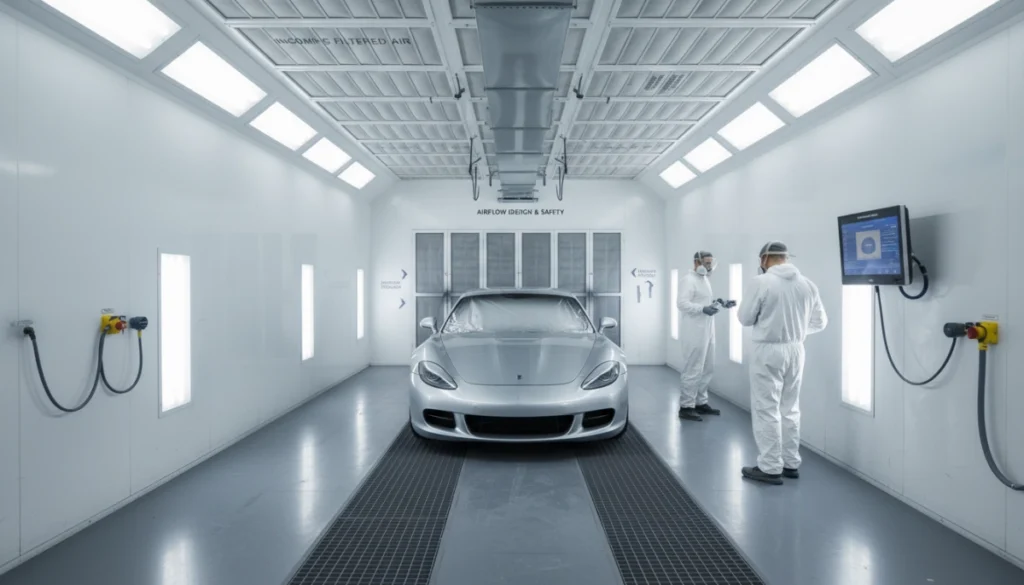
Looking for an industrial paint booth manufacturer? We build heavy-duty booths with forced ventilation and constant-temperature baking systems for large-scale industrial finishing. Factory direct, CE certified, custom sizes available.
Industrial Paint Booth Manufacturer: Heavy-Duty Booths with Forced Ventilation & Constant-Temperature Baking for Large-Scale Finishing
If you’re sourcing equipment for an industrial finishing line, you already know that an automotive paint booth won’t cut it.
Industrial coating work is a different job. The parts are bigger, the coatings are heavier, the production hours are longer, and the environment inside the booth needs to be controlled with a lot more precision. A booth that works fine for a car repair shop will underperform, overheat, or fail compliance checks when you push it into a real industrial workflow.
We build booths specifically for this. As an industrial paint booth manufacturer with over 15 years of production experience, we supply heavy-duty finishing systems to metal fabricators, machinery manufacturers, rail and transit facilities, aerospace suppliers, and large-scale OEM production lines worldwide.
This page covers what makes an industrial paint booth different, what the core specifications actually mean in practice, and what to look for when comparing manufacturers.
What Makes an Industrial Paint Booth Different
The gap between an automotive booth and an industrial booth isn’t just size. It comes down to three things: airflow capacity, temperature control, and structural build.
Airflow capacity
Industrial finishing involves larger surface areas, heavier coating materials, and often more toxic fumes. The ventilation system needs to move significantly more air than an automotive booth — and maintain that airflow consistently across a large working volume, not just at the center of the booth.
Temperature control
Many industrial coatings require precise curing temperatures held within a tight range for a set period of time. A system that runs hot in one zone and cool in another will give you inconsistent cure quality. Constant-temperature baking means the whole booth reaches and holds the target temperature — not approximately, but accurately.
Structural build
Industrial booths deal with heavier equipment moving in and out, tracked vehicles, overhead cranes, forklifts, and parts that weigh several tonnes. The floor, frame, and door system all need to be built for this, not just scaled up from a lighter design.
Forced Ventilation: What It Is and Why It Matters
Forced ventilation means the airflow is actively driven — not passive. Intake fans push fresh filtered air into the booth, and exhaust fans pull contaminated air out. The two work together to maintain a controlled, consistent airflow through the working area at all times.
In a large industrial booth, this matters for several reasons:
Overspray control
Without consistent forced airflow, overspray drifts and settles on surfaces before the coating has cured. In a large booth with heavy industrial coatings, this is a serious quality problem.
Fume extraction
Industrial coatings often produce higher concentrations of volatile compounds than automotive paints. The ventilation system needs to clear these fast enough to keep the working environment safe and within compliance limits.
Finish consistency
If airflow varies across the booth — faster near the fans, slower in the middle — coating thickness and finish quality will vary with it. Forced ventilation systems are designed to distribute airflow evenly across the full working area.
Our industrial booth ventilation systems are sized to the booth volume and the coating application. For large-format booths, airflow typically runs between 30,000 and 60,000 m³/h depending on the interior dimensions and the type of work being done.
Constant-Temperature Baking: What It Means in Practice
A lot of booths claim temperature control. What matters is how accurate that control actually is and how evenly the temperature is maintained across the full booth volume.
For industrial coatings, curing specifications are real requirements — not rough guidelines. A two-part epoxy coating, a powder topcoat, or an aerospace primer all have specific time-at-temperature requirements. If part of the booth runs 10°C cooler than the target, that section of the coating won’t cure properly.
Our constant-temperature baking systems use:
Riello gas burners or electric heating elements
matched to the booth size and the power infrastructure available at your facility. Gas is the most common choice for large industrial booths because of the heat output required and the running cost.
Recirculating heated airflow
rather than exhausting all the heated air and replacing it with cold outside air, recirculating systems keep the heat inside the booth during the bake cycle. This cuts fuel consumption significantly while maintaining stable temperatures.
Digital temperature controllers
with real-time monitoring across multiple zones inside the booth. The system adjusts the burner output automatically to keep the temperature within the specified range from floor to ceiling and end to end.
Automatic safety systems
flame-out protection, over-temperature shutoff, and pressure sensors are standard. In an industrial environment, these aren’t optional features.
Our Industrial Booth Product Range
Large-Format Metal Fabrication Booths
For steel fabricators, equipment manufacturers, and heavy machinery producers. These booths handle parts ranging from structural steel sections to complete machine assemblies.
Standard configurations: 10m to 20m long, 5m to 8m wide, 4m to 6m tall. Custom dimensions available for oversized components.
Airflow: Full downdraft or crossdraft depending on part geometry and coating type. Forced intake and exhaust with high-capacity centrifugal fans.
Rail and Transit Finishing Booths
Purpose-built for railway carriages, locomotive bodies, and transit vehicle components. These booths need extra length and careful lighting placement to cover the full surface of a 20+ meter vehicle body evenly.
Door systems: Bi-fold or tri-fold for wide, unobstructed vehicle entry. Rail track integration available for rolling stock.
Aerospace Component Booths
Precision finishing for aerospace parts requires tighter airflow tolerances and cleaner filtration than most industrial applications. We build booths with enhanced filtration stages and tighter temperature control specifications for this sector.
Certifications available: CE, ATEX for explosive atmosphere compliance.
Powder Coating Booths with Curing Oven Integration
Complete powder coating lines including spray booth, recovery system, and curing oven — all engineered to work together. Cyclone recovery systems reduce powder waste by up to 95%, which matters when you’re running high-volume production with expensive materials.
Custom Industrial Enclosures
For parts or production workflows that don’t fit a standard configuration. We work from your part dimensions, coating specifications, and facility layout to design the booth around your process — not the other way around.
Key Specifications: What to Check When Comparing Manufacturers
When you’re evaluating industrial paint booth manufacturers, these are the numbers and specs that actually tell you something:
Airflow volume (m³/h) — Make sure it’s sized for your booth’s interior volume and your coating application, not just listed as a high number.
Air velocity at work level — Should be 0.3–0.5 m/s for most industrial applications. Too slow and overspray accumulates. Too fast and it disturbs the wet coating.
Temperature range and accuracy — Most industrial curing applications require 60–120°C. Ask for the accuracy tolerance — ±2°C is good, ±5°C or more is a problem for precision coatings.
Heating system type and output (kW or BTU) — Sized to reach operating temperature in a reasonable time and maintain it under load. Ask for heat-up time data for the specific booth size.
Insulation panel specification — 75mm high-density rock wool is the standard for industrial booths. Thinner panels or foam-core alternatives lose heat faster and raise running costs.
Filtration stages — Intake and exhaust filtration should both be specified. For industrial applications, three-stage filtration is standard: pre-filter, primary filter, and exhaust filter.
Structural load rating — If forklifts or overhead cranes are used inside or around the booth, the floor and frame need to be rated for the load. Ask for the structural specification, not just a general statement about “heavy-duty construction.”
Certifications — CE marking is the baseline for European markets. ATEX certification is required for booths used with flammable coatings in explosive atmosphere classifications. NFPA 33 compliance is the relevant standard for US buyers.
Who Uses Our Industrial Paint Booths
Our booths are in use across a wide range of industries:
| Industry | Typical Application |
|---|---|
| Steel and metal fabrication | Structural components, frames, machine housings |
| Agricultural machinery | Tractor bodies, harvester components, implements |
| Construction equipment | Excavator arms, dump truck bodies, crane components |
| Rail and transit | Carriage bodies, bogies, locomotive shells |
| Aerospace and defense | Airframe sections, structural components |
| Shipbuilding | Deck equipment, interior sections, pipe assemblies |
| Industrial machinery | Production line equipment, pump housings, gearboxes |
| Wind energy | Turbine nacelles, hub components |
How We Work With Industrial Buyers
Industrial finishing equipment is a significant purchase. The process looks different from buying a standard automotive booth, and we design our sales and engineering process around that.
Step 1 — Technical inquiry Send us your part dimensions, coating specifications, production volume, and facility details. The more specific you are, the faster we can give you something useful.
Step 2 — Engineering proposal We provide a CAD layout of the proposed booth within 48 hours, including airflow calculations, heating system sizing, and facility integration notes. No generic proposals — the drawing reflects your actual space and requirements.
Step 3 — Review and revision You review the proposal with your team. We handle changes to layout, dimensions, door placement, or mechanical specifications at this stage before production begins.
Step 4 — Production and quality testing Every booth is fully assembled and tested at our factory before shipment. Airflow, heating, temperature uniformity, and filtration are all verified and documented.
Step 5 — Shipment and installation support We handle all export documentation. Installation support is provided via detailed technical manuals, step-by-step video guides, and direct remote support for your installation team. On-site installation is available in select regions.
Step 6 — After-sales support A dedicated technical contact is assigned to your account. Spare parts are stocked and available for fast dispatch. Warranty covers structural components for 2 years.
Certifications and Standards
As an industrial paint booth manufacturer supplying global markets, our products are built and tested to meet:
- CE Marking — EU Machinery Directive 2006/42/EC
- ISO 9001:2015 — Quality management system covering full production
- ATEX Directive — Explosive atmosphere safety certification, available on request
- NFPA 33 — US standard for spray finishing operations, available on request
- RoHS-compliant electrical components throughout
Full documentation packages are provided with every order for customs clearance and compliance records.
Frequently Asked Questions
What’s the difference between an industrial paint booth and an automotive booth? Size is part of it, but the bigger differences are in airflow capacity, temperature control precision, structural strength, and filtration requirements. We design industrial booths for heavier coatings, larger parts, longer production hours, and more demanding compliance environments.
Can you build a booth for parts that are oversized or unusually shaped? Yes. Custom sizing is standard for industrial applications. We design around your largest part dimensions and production workflow — including booths for crane sections, wind turbine components, ship sections, and other equipment that doesn’t fit any standard template.
What heating fuel types do you support? Natural gas, LPG, and diesel are all available. Electric infrared heating is also an option for specific applications. We’ll recommend the right system based on your curing requirements and what’s available at your facility.
How long does it take to produce and deliver an industrial booth? Standard industrial configurations: 35–50 days. Custom-engineered projects: 50–75 days depending on complexity. Sea freight to most major ports adds 20–35 days.
Do you provide installation support? Yes. We provide full technical documentation, video installation guides, and remote engineering support for your local installation team. On-site support can be arranged in select regions — ask us when you inquire.
What warranty do you offer? 2-year structural warranty on all booths. We stock spare parts including filters, gaskets, burner components, and control system parts for fast dispatch. We assign a technical support contact to each order.
Tell Us What You’re Finishing
Send us your part dimensions, production volume, coating type, and facility details. Our engineering team will design the right booth for your line and get you a proposal within 48 hours.
[Request a Technical Proposal] [Download Industrial Booth Catalog] [Contact us]
Related Pages
- Spray Booth Manufacturer in China →https://www.autokemanufacture.com/spray-booth
- Contact Our Export Sales Team →https://www.autokemanufacture.com/contact-us.html
✅ CE Certified | ✅ ISO 9001:2015 | ✅ ATEX Available | ✅ Factory Direct | ✅ Ships to 60+ Countries | ✅ 1-Year Warranty | 🔒 HTTPS Secured