
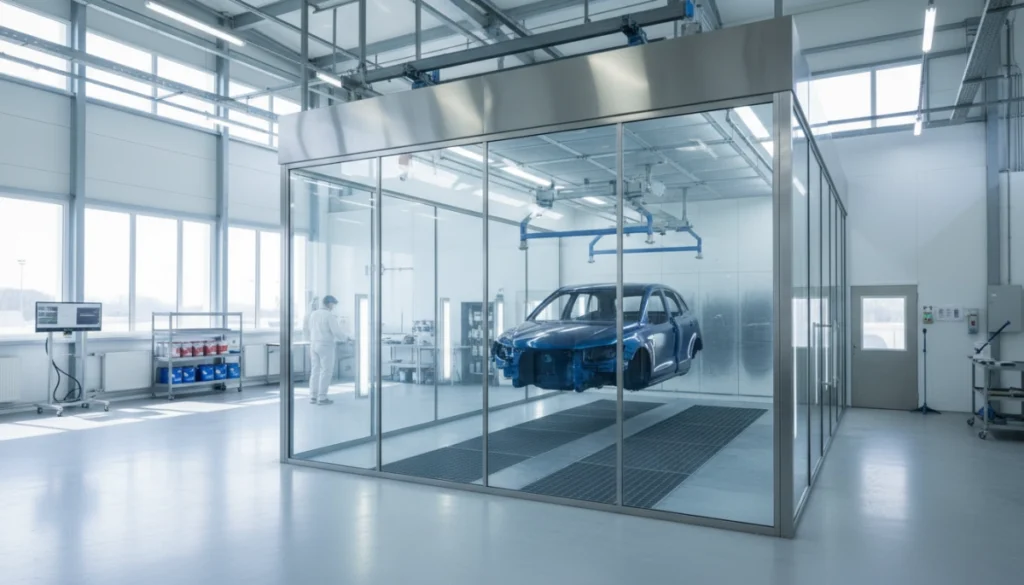
Switching from solvent-based to water-borne coatings isn’t just a product change — it’s a fundamentally different drying process. Water doesn’t evaporate the same way chemical solvents do, and a booth designed for high-VOC solvent systems won’t handle modern water-based paints without real performance problems. This guide covers why the physics are different, what your booth needs to handle it properly, and how to run the process efficiently once the right equipment is in place.
Page URL: https://sprayboothmanufacturer.com/product/
Why Your Old Solvent Booth Struggles With Water-Based Paint
Chemical solvents are volatile — they evaporate quickly regardless of what the surrounding air is doing. Water is stubborn. It requires specific conditions to leave the paint film: moving air, controlled humidity, and enough heat to lower the moisture content of the surrounding environment. In a booth that wasn’t designed for these requirements, flash-off times can double or triple. What used to take 20 minutes takes an hour. That bottleneck compounds across every job, every day.
There’s also a material problem with older booths. Most are built from galvanized steel, which holds up fine against solvent-based coatings. Water-borne systems are a different story — constant moisture exposure accelerates oxidation of the zinc coating. Once that galvanized layer starts to degrade, rust particles enter the airflow and land on wet paint. A booth that’s been running water-based coatings for a few years without stainless steel construction will eventually produce contamination problems that can’t be solved by better spray technique.
| Feature | Solvent-Based Paint | Water-Based Paint |
|---|---|---|
| Evaporation Trigger | Chemical volatility | Airflow and humidity control |
| Drying Speed | Fast — relatively passive | Slow — requires active air movement |
| Environmental Impact | High VOC | Low VOC, compliant |
| Recommended Booth Material | Galvanized steel | Stainless steel interior |
The finish quality case for water-borne coatings is real — better metallic flake orientation, cleaner OEM color matching, less mottling and tiger striping in heavy metallic finishes. But capturing that quality requires a booth that can handle the moisture properly. In a standard solvent booth without the right engineering, the advantages of water-based paint don’t show up in the finished work.
The Three Factors That Control Water-Based Drying
Getting water-borne coatings to dry efficiently comes down to managing three things simultaneously: airflow, heat, and humidity. If any one of them is off, the others can’t compensate.
Airflow: Breaking the Boundary Layer
When water evaporates from a painted surface, it creates a thin layer of saturated air sitting right on top of the panel. If that layer of wet air just sits there, evaporation stops. The paint stays wet, metallic flakes can shift, and you’re stuck waiting.
High-velocity airflow is what physically removes that saturated layer. The air has to be moving fast enough across the panel surface to displace the wet air and replace it with dry air that can absorb more moisture. Standard downdraft airflow often passes over the boundary layer rather than through it — which is why water-based paint spray booths need dedicated air agitation systems, not just the baseline exhaust and intake fans.
Corner blowers and ceiling-mounted jet nozzles direct high-velocity air specifically at panel surfaces, targeting exactly the areas where moisture accumulates. The difference in flash-off time between a booth with proper air agitation and one without is not subtle — it can cut drying time by 50% or more.
Humidity: The Biggest Variable Most Shops Underestimate
If the air inside the booth is already heavy with moisture, it can’t absorb any more from the paint. Flash-off slows to a crawl, and in high enough humidity, it stops almost entirely. The target is keeping relative humidity inside the booth below 50% during flash-off. Above that threshold, you’re fighting the drying process rather than managing it.
Humidity control also affects finish quality directly. When metallic flakes are suspended in wet paint for too long because the moisture won’t leave, they have more time to shift from their sprayed orientation. The clean metallic look that water-borne coatings are capable of requires the water to leave the film quickly and cleanly.
Heat: Not Just for Baking
In a water-based paint spray booth, heat serves a function during flash-off that it doesn’t need to in a solvent booth. Warm air holds more moisture than cold air — so raising the temperature inside the booth allows the air to pull water out of the coating much faster. This is a different use of heat than simply baking the clear coat at 140°F. During flash-off, even moderate heat — maintaining 75°F or higher — makes a meaningful difference in how fast the paint transitions from wet to matte.
| Drying Factor | Impact on Water-Borne Paint | Solution |
|---|---|---|
| High humidity | Stops evaporation, causes sagging | Increase heat to lower relative humidity |
| Low airflow | Traps moisture on panel surface | Engage air agitation blowers |
| Cold temperature | Slows flash-off and curing | Maintain 75°F+ during flash stage |
Managing all three together is what turns a water-based paint spray booth into a production tool rather than a bottleneck. Shops that get this right typically cut their drying times by 30% or more compared to running waterborne coatings in an unoptimized environment.
What a Proper Water-Based Paint Spray Booth Needs
Stainless Steel Construction
This is the material requirement that separates booths built for water-borne coatings from those that aren’t. Constant moisture exposure degrades galvanized steel — it’s a slow process, but it’s consistent and inevitable. Once the galvanized coating is compromised, rust particles enter the booth air. In a downdraft system, those particles fall exactly where you don’t want them: onto wet paint.
Stainless steel interiors don’t corrode under moisture exposure. The investment is higher upfront, but it’s what keeps the booth interior clean for the long term and prevents the contamination problems that eventually follow galvanized construction in a water-borne environment.
Integrated Flash-Off Systems
Standard exhaust and intake airflow isn’t enough to break the boundary layer efficiently across a full vehicle. Dedicated flash-off systems — corner blowers positioned at the lower angles of the booth, ceiling-mounted jet nozzles aimed at key panel areas — direct high-velocity air specifically where moisture accumulates. These are the difference between a water-based booth that performs and one that just technically accepts water-based paint.
The nozzles and blowers need to be positioned to move air across panel surfaces, not just above them. Getting the angle right is what actually displaces the saturated boundary layer rather than passing over it.
Variable Frequency Drives (VFDs)
VFDs allow the airflow speed to be adjusted to exactly what’s needed at each stage of the job. During flash-off, you want high-velocity air moving aggressively across the vehicle. During curing, lower and more controlled airflow is appropriate. Running the fans at full speed throughout the entire cycle wastes energy and can actually cause problems during certain application stages.
Being able to dial in the CFM for each phase of the job — rather than running a fixed airflow setting throughout — is what allows a water-based booth to operate efficiently without unnecessary energy cost.
High-Efficiency Filtration
Water-borne coatings produce finer particulates than solvent systems. Multi-stage filtration is what keeps those particles out of the finished work and maintains environmental compliance on the exhaust side. Standard single-stage filtration from an older booth often isn’t adequate for the finer particle size that water-based overspray generates.
Running the Process: Day-to-Day Operations
Cleanliness Standards
Water-borne coatings stay wet longer than solvent-based paints during the flash-off stage. That extended open window means they’re more likely to catch airborne debris. A shop environment that was “clean enough” for solvent work may not be clean enough for water-based.
Use anti-static guns and wipes before every job — water-based systems are more susceptible to static-attracted dust than solvent coatings. Keep the floor area near the booth entrance damp-mopped to trap dust before it gets drawn into the intake. Lint-free paint suits are not optional for water-borne work — fabric from regular clothing is one of the most common contamination sources.
Reading the Flash
The most common mistake when running water-borne coatings is rushing the flash-off stage. With a water-based paint spray booth, you’re not waiting for a specific number of minutes — you’re waiting for a specific visual change in the paint surface.
The transition from wet to ready is visible: the paint goes from a glossy, reflective wet appearance to a flat, uniform matte. Flash-off typically starts at the edges and corners of panels and works toward the center. Wait until the center of the largest panel is fully matte before applying the next coat or starting the clear. Catching this transition correctly is what prevents water trap under the clear coat.
Keep the air agitation blowers directed at the right height during this phase — aimed at the panel surface, not above it.
Maintenance Schedule
If airflow drops, drying times climb. Keeping the booth components in good condition is what keeps the drying cycle predictable.
| Component | Task | Frequency |
|---|---|---|
| Pre-filters | Inspect for heavy loading | Weekly |
| Ceiling filters | Check manometer readings | Monthly |
| Exhaust filters | Replace to maintain airflow | Every 50–100 hours |
| Jet nozzles and blowers | Clean overspray buildup from tips | Every two weeks |
The blower nozzles deserve specific attention. Even a small amount of overspray buildup on the tips disrupts the airflow direction and creates dead zones where the boundary layer doesn’t get cleared. Keep them clean and the system performs as designed. Let them accumulate buildup and the drying inconsistency is hard to diagnose because it looks like a paint or technique problem rather than an airflow issue.
Common Questions
Can I run water-based paint through my existing solvent booth? You can, but you’ll run into two consistent problems. First, galvanized steel construction will begin corroding under sustained moisture exposure, eventually producing rust contamination in finished work.Second, most older solvent booths’ airflow systems fail to break the boundary layer as water-borne coatings require. Without dedicated air agitation, you will experience longer flash times and inconsistent results. It can work as a short-term solution, but it’s not a long-term answer for a shop doing serious volume with water-based materials.
Why does humidity matter so much for water-based paint? The air inside the booth can only absorb moisture up to its saturation point. If relative humidity inside the booth is already high, the water in the coating has nowhere to go. Flash-off slows or stops, metallic flakes have more time to shift from their sprayed position, and in extreme cases you can get moisture trapped under the clear. Keeping humidity below 50% during flash-off is what produces the consistent, fast drying that water-borne coatings are capable of in the right environment.
How do air agitation blowers speed up the process? They physically remove the saturated air layer sitting on the panel surface. Standard downdraft airflow tends to move over that layer rather than into it. Corner blowers and ceiling jet nozzles direct high-velocity air across the panel surface at angles that displace the wet boundary layer, letting drier air reach the paint and pull the moisture out. The visual result is a faster transition from wet to matte — which means faster coat-to-coat and faster clear application.
Does water-based paint actually need more heat than solvent? Not necessarily more heat in terms of bake temperature, but more strategic use of heat during flash-off. Raising the booth temperature during the flash stage allows the air to hold more moisture, which accelerates how fast water leaves the coating. The bake cycle temperature for water-borne clear is similar to solvent — but the booth has to work harder during flash to ensure all the water is out of the film before the heat cycle starts. Baking a water-borne clear before the base has fully flashed is a reliable way to create defects.
Tell Us What You’re Working With
Share your current booth setup, the coatings you’re running, your production volume, and any facility constraints. We’ll spec out the right water-based paint spray booth configuration for your operation and send a detailed quote with layout drawings — usually within 48 hours.
Related Pages
- Bus Spray Booth Design Guide → https://sprayboothmanufacturer.com/transit-coach-spray-booth-requirements/
- Truck Paint Booth Guide → https://sprayboothmanufacturer.com/truck-paint-booth-semi-truck-spray-booth-specifications-buying-guide/
- Other related products → https://www.autokemanufacture.com/product
- Contact our sales Team → https://sprayboothmanufacturer.com/contact-us/
✅ CE Certified | ✅ ISO 9001:2015 | ✅ Factory Direct | ✅ Ships to 60+ Countries | ✅ 1-Year Warranty | 🔒 HTTPS Secured