If you’re planning a full vehicle respray for your truck, you’re likely asking one critical question: How long am I going to be without my ride?
Googling around will give you wildly different answers—some shops claim a “one-day turnaround,” while others quote a full business week.
Here is the quick, unvarnished truth: A flawless, professional truck paint job takes 3 to 7 business days from start to finish, even though the vehicle only spends about 1 to 2 days inside a controlled automotive paint booth.
Any shop promising to prep, spray, and cure a heavy-duty truck in 24 hours is cutting corners that will inevitably lead to peeling, solvent trapping, or a nasty “orange peel” texture.
At AUTOKE, we don’t believe in shortcuts. Achieving a factory-grade finish requires a meticulous balance of temperature, timing, and technology. If you want to know exactly what happens behind those closed spray booth ventilation doors—and why the curing process cannot be rushed—you are in the right place.
Let’s dive right into the actual timeline breakdown.
Page URL: https://sprayboothmanufacturer.com/product/
How Many Days Does It Take to Paint a Truck in a Paint Booth?
When you ask how many days it takes to paint a truck in a paint booth, you are likely looking at your calendar and worrying about vehicle downtime. If your truck is sitting in a shop, it isn’t on the road making you money. The short answer is that a professional, full-vehicle respray typically takes 5 to 7 days from start to finish. However, a common point of confusion for many fleet owners and truck enthusiasts is mistaking the physical spraying time for the actual time the vehicle spends tied up in the shop.
Actual Gun-in-Hand Time
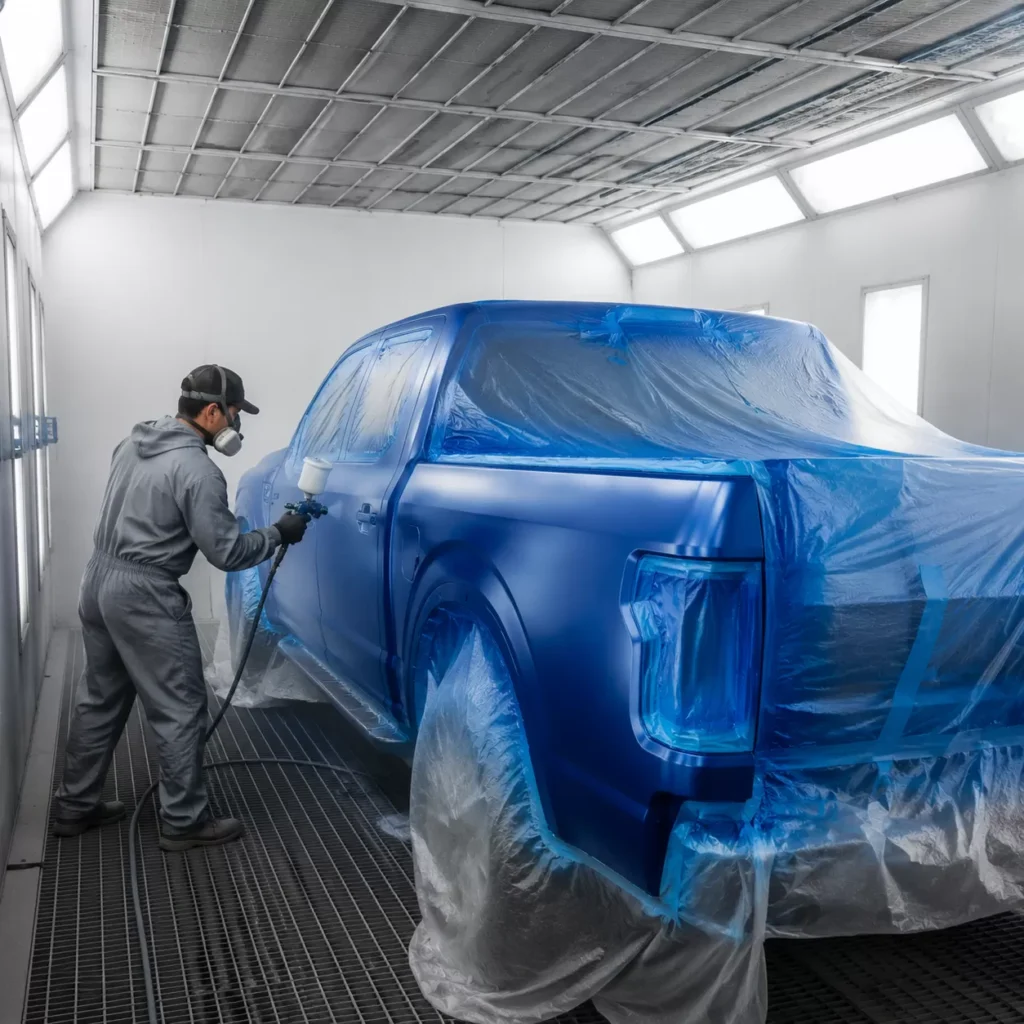
If we isolate the exact moments a technician is holding a spray gun and applying coatings inside an automotive paint booth, the clock ticks surprisingly fast. The actual gun-in-hand time for a standard truck averages only 2 to 4 hours. This tight window includes the clear coat application, the primer, and the base coat layers. Modern high-efficiency spray guns allow us to lay down material quickly and evenly, but this rapid-fire application represents only a tiny fraction of the overall timeline.
The Paint Booth Cycle
The reason your truck spends days at our facility instead of hours comes down to the strict physics of the paint booth bake cycle. An advanced automotive paint booth does not just house the truck while it gets sprayed; it actively controls the environment to ensure a flawless finish.
Between every single layer of paint, we must account for precise flash-off periods where solvents evaporate. If you rush this step, you trap gasses, leading to micro-blisters and a ruined finish. Once the final clear coat is applied, the booth switches to a high-heat bake cycle—often running between 140°F and 160°F—to accelerate the initial chemical hardening. This controlled ventilation and baking process safely eats up a massive portion of the in-booth schedule.
Timeline Snapshot Matrix
To give you a clear, no-nonsense look at how this time breaks down, we have mapped out the operational reality versus what the clock shows.
| Process Stage | Active Labor Time | Actual Clock Time Required | Primary Purpose |
|---|---|---|---|
| Surface Preparation | 12 – 16 Hours | 2 Full Days | Sanding, body repair, masking, and degreasing. |
| Stage Setup & Taping | 2 – 3 Hours | 0.5 Days | wipe-down and critical masking checks. |
| Base Coat Drying Time | 1 Hour | 2 – 3 Hours | Spraying color coats and waiting for proper flash-off. |
| Clear Coat Application | 45 Minutes | 1.5 Hours | Applying the protective, glossy top layers. |
| Paint Booth Bake Cycle | 5 Minutes (Controls setup) | 1 – 2 Hours | High-heat curing to bake the finish to a handleable state. |
| Sanding and Buffing | 4 – 8 Hours | 1 Full Day | Wet sanding imperfections and bringing out the deep shine. |
The Step-by-Step Chronology of a Professional Truck Paint Job
Getting a truck through a professional automotive paint booth isn’t a quick spray-and-go operation. It requires a disciplined, multi-day schedule to ensure the finish bonds correctly and lasts for years on the road. Here is the day-by-day breakdown of how we manage a full vehicle respray timeline.
Phase 1: Deep Prep Work (Out of the Booth – Days 1–2)
Great auto body refinishing is 80% preparation and 20% spraying. Before the truck even catches a glimpse of the spray booth ventilation system, it undergoes intensive surface preparation in the main shop zone.
- Teardown: We remove trim, door handles, lights, and mirrors to avoid ugly tape lines.
- Body Repair & Sanding: Technicians pull dents, apply filler, and block-sand the surfaces smooth.
- De-greasing & Masking: The entire truck is washed with wax and grease remover, then meticulously taped off to protect windows and exposed chassis parts.
Phase 2: The Booth Controlled Environment (Days 3–4)
Once the prep work is flawless, the truck moves into the cleanroom environment of the automotive paint booth. This is where the actual application happens under strict climate controls.
- First Stage Priming: A sealing primer is applied to create a uniform foundation and prevent corrosion.
- Base Coat Application: We spray multiple layers of color. Every layer requires specific flash-off periods to let solvents evaporate before the next coat goes on.
- Clear Coat Application: Two to three layers of premium clear coat are applied to deliver high-gloss depth and UV protection, adhering strictly to factory paint thickness (mil specs).
Phase 3: The Curing & Hardening Window (Day 5)
After the final clear coat is on, the truck stays locked inside the booth for the baking phase. This step is critical to kickstart the chemical cross-linking of the paint.
- Paint Booth Bake Cycle: The booth runs a high-temperature cycle—typically around 140°F to 160°F—for 40 to 60 minutes.
- Infrared Curing Lamps: For heavy-duty fleet trucks or thicker target zones, we deploy localized infrared curing lamps to heat the paint from the inside out.
- Cool Down: The truck rests in a dust-free environment as the curing time settles, allowing the surface to harden enough for safe handling.
Phase 4: Post-Booth Refinishing (Days 6–7)
Even after a successful bake cycle, a premium truck paint job requires final detailing out of the booth before it hits the American highways.
- Unmasking & Reassembly: All protective paper is pulled off, and the removed body components, lights, and trim are carefully bolted back on.
- Sanding and Buffing: We wet-sand the clear coat with ultra-fine grit sandpapers to eliminate any minor dust nibs or orange peel texture.
- Polish: A multi-stage machine polish brings out a flawless, mirror-like reflection.
| Phase | Main Location | Key Activities | Est. Time Required |
|---|---|---|---|
| Phase 1: Deep Prep | Prep Bay | Disassembly, dent repair, block sanding, masking | 1–2 Days |
| Phase 2: Booth Spraying | Paint Booth | Primer, base coat, clear coat application, flash times | 1–2 Days |
| Phase 3: Curing | Paint Booth | Paint booth bake cycle, infrared heating, stabilization | 1 Day |
| Phase 4: Post-Refinishing | Detail Bay | Reassembly, sanding and buffing, final inspection | 1–2 Days |
Key Variables That Can Extend or Shorten Your Truck’s Timeline
When calculating how many days does it take to paint a truck in a paint booth, a standard timeline is a great baseline. However, real-world auto body refinishing doesn’t happen in a vacuum. Several critical factors can either fast-track your truck through the shop or add extra days to the process.
Truck Size & Configuration
A standard light-duty pickup is a completely different project than a heavy-duty commercial vehicle or a fleet truck painting timeline.
- Standard Pickups: Smaller surface areas mean faster surface preparation, shorter clear coat application times, and quicker turnarounds.
- Extended Cabs & Long Beds: Added body panels mean more masking, more sanding, and extra time inside the automotive paint booth.
- Commercial & Fleet Trucks: Large box trucks or semi-tractors often require specialized spray booth ventilation setups and multiple booth cycles just to handle the sheer physical size.
Paint System Type
The chemical makeup of your chosen product directly alters the base coat drying time and overall schedule.
- Single-Stage Paint: Mixes the color and catalyst together. It goes on in fewer passes, speeding up the process, but offers less depth.
- Two-Stage Paint: Requires a dedicated base coat followed by a clear coat application. This is the industry standard for modern durability, but requires precise flash-off periods between coats.
Color Changes vs. Factory Color Matching
Staying with your original factory color is always the fastest route. Changing the color completely rewrites the timeline.
- Factory Match: We only need to prep and spray the exterior visible panels.
- Complete Color Change: This demands spraying the door jams, inside the engine bay, and under the hood. The extra masking and disassembly work easily adds two to three days to the auto body refinishing schedule.
Paint Booth Technology
The type of equipment being used dictates how fast the chemical cross-linking happens. Modern tech cuts down wait times dramatically.
| Paint Booth Tech | Curing Efficiency | Impact on Timeline |
|---|---|---|
| Crossdraft / Downdraft (Air Dry) | Relies entirely on ambient air temperature and spray booth ventilation. | Adds 12–24 hours of passive drying time. |
| Paint Booth Bake Cycle | Uses forced heat (typically $140^circtext{F}$ to $160^circtext{F}$) to bake the finish. | Bakes the coating dry to the touch in 40–60 minutes. |
| Infrared Curing Lamps | Uses targeted infrared waves to cure the paint thickness (mil specs) from the inside out. | Cuts the curing time down to minutes per panel, minimizing total booth days. |
Post-Paint Care: Drying vs. Curing
The Crucial Distinction
When we hand over the keys to your truck, the surface might feel completely dry to the touch, but it is not fully cured. Understanding how many days it takes to paint a truck in a paint booth involves looking past the spray booth bake cycle. Drying happens fast—it is just the solvents evaporating from the clear coat application so the truck can leave the shop. Curing, on the other hand, is a deeper chemical fusing process. The auto body refinishing layers are still actively hardening underneath, and interrupting this process can ruin a flawless full vehicle respray.
The 30-to-90 Day Window
Your fresh automotive paint booth finish needs time to breathe. For the first 30 to 90 days after your truck leaves our facility, the new paint system undergoes its final hardening phase to reach its target paint thickness (mil specs). During this critical timeline, you must follow strict care guidelines to protect your investment:
- Skip the Commercial Car Wash: Avoid automatic car washes completely. The rigid brushes can easily scratch the tender clear coat before it reaches maximum hardness.
- No Waxing or Polishing: Putting wax or sealant on the truck traps the escaping solvents. This can cause solvent popping, which leaves tiny, permanent blisters in the finish.
- Wash with Care: Hand-wash your truck using cool water, a mild automotive soap, and a soft microfiber mitt.
- Park Strategically: Avoid parking under trees to protect the surface from bird droppings and sap, which can eat right through uncured clear coat. If your truck gets hit, rinse it off immediately.
Why Choosing an AUTOKE-Standard Refinishing Process Matters
When you are figuring out how many days does it take to paint a truck in a paint booth, the equipment and protocol you choose make all the difference. We built our entire refinishing system around the AUTOKE standard to eliminate guesswork, slash booth cycle times, and deliver a factory-grade finish without wasting your time.
A standard automotive paint booth keeps dust out, but an AUTOKE-standard process optimizes every single minute the truck spends inside the environment.
Here is exactly what our process guarantees for your truck’s timeline and finish:
- Advanced Spray Booth Ventilation: Engineered airflow accelerates flash-off periods between coats. You don’t have to wait around for hours just for the base coat drying time.
- Precision Bake Cycles: Our advanced paint booth bake cycle forces the cross-linking of molecules in the clear coat application. This cuts down the final curing time from days to mere minutes.
- Strict Paint Thickness Specs: We monitor paint thickness (mil specs) in real-time. Getting the thickness right on the first pass means no re-dos, keeping your full vehicle respray strictly on schedule.
- Uniform Energy Distribution: High-efficiency heating elements eliminate cold spots in the booth, ensuring that every body panel cures at the exact same rate.
In the United States, your truck is your livelihood or your passion. A botched job or a dragged-out timeline costs you money and peace of mind. By adhering to a strict, professional refinishing workflow, we optimize every stage—from initial surface preparation to the final sanding and buffing. You get your truck back faster, the paint holds up against harsh road conditions, and the time spent inside the booth is cut down to the absolute minimum.
Frequently Asked Questions: Truck Painting Timelines
Can a truck be prepped, painted, and cured in a single day?
No. A proper commercial truck paint job cannot be done right in 24 hours. Even if a shop cuts corners, surface preparation alone takes a full day or two to handle rust, sanding, and masking. Anyone promising a one-day turnaround on a full vehicle respray is skipping critical flash-off periods and bake cycles, which leads to peeling and clear coat failure down the road.
How long after a professional booth paint job can I drive my truck in the rain?
You should wait at least 24 to 48 hours after the truck leaves the automotive paint booth before driving in the rain. While the paint booth bake cycle makes the clear coat dry to the touch, the chemical curing time continues for days. Heavy rain, road salt, or water pressure on fresh paint can disrupt this bonding process and dull the final finish.
Does the truck bed liner affect the overall painting timeline?
Yes, adding or working around a bed liner changes your fleet truck painting timeline. If we are spraying over a factory bed liner, masking it off takes extra precision and time. If you are getting a spray-in liner added as part of the auto body refinishing process, it adds an extra day to the project since the truck bed requires separate surface preparation and a completely different chemical application.
Why do custom paint jobs take weeks compared to standard collision repairs?
Standard collision repairs usually involve replacing a panel and blending the factory color matching across a small area. A custom full vehicle respray takes weeks because it requires complete disassembly, multiple rounds of block sanding to ensure perfect paint thickness (mil specs), custom masking for graphics or stripes, and multiple clear coat application and sanding and buffing cycles to achieve a show-quality, mirror finish.
Related Pages
- Bus Spray Booth Design Guide → https://sprayboothmanufacturer.com/transit-coach-spray-booth-requirements/
- Truck Paint Booth Guide → https://sprayboothmanufacturer.com/truck-paint-booth-semi-truck-spray-booth-specifications-buying-guide/
- Other related products → https://www.autokemanufacture.com/product
- Contact our sales Team → https://sprayboothmanufacturer.com/contact-us/
✅ CE Certified | ✅ ISO 9001:2015 | ✅ Factory Direct | ✅ Ships to 60+ Countries | ✅ 1-Year Warranty | 🔒 HTTPS Secured