
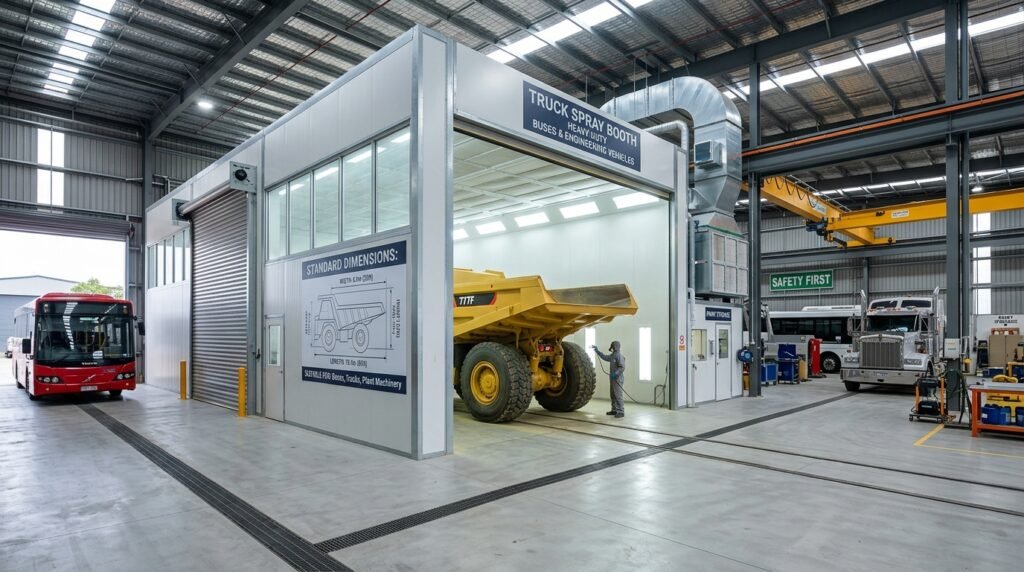
Need the right truck spray booth dimensions for your fleet? This guide covers standard sizes for heavy-duty trucks, buses, and engineering vehicles — including no-pit options and custom configurations.If you’re buying a spray booth for trucks, buses, or heavy equipment, getting the dimensions wrong is an expensive mistake.
Too small and your painters can’t move properly. Airflow gets uneven. Finish quality drops. Too large and you’re heating space you don’t need and paying for it every month.
This page walks through the standard sizes for different vehicle types, what the specs actually mean in practice, and what to think about if your vehicles don’t fit a standard configuration.
The First Thing to Understand: It’s Not Just About the Vehicle Size
A lot of buyers look at their truck dimensions and assume they just need a booth a little bigger than that. In reality, there are two things you need to account for:
The vehicle envelope — the actual length, width, and height of your largest vehicle.
The functional workspace — the extra space needed around the vehicle for painters to move, spray guns to reach every panel, and airflow to work properly.
The industry standard is at least 1 meter (about 3 feet) of clear space on every side of the vehicle. That’s not a comfort preference — it’s a working requirement.
Here’s why each side matters:
- Side clearance — room to move the spray gun along the full length of panels without cramping
- End clearance — access to front grilles and rear corners that are easy to miss in a tight booth
- Vertical clearance — enough height for air to distribute evenly across the roof without creating dark spots or dead zones
If any of these are too tight, you’ll see it in the finish.
Standard Truck Spray Booth Dimensions by Vehicle Type
Light-Duty Trucks and Delivery Vans — 8m to 10m (26ft to 33ft)
This size covers most last-mile delivery vehicles and light commercial fleets.
Typical vehicles: Ford Transits, Mercedes Sprinters, standard box trucks.
It’s a practical size — big enough to work comfortably around these vehicles, small enough to keep heating and energy costs reasonable. If your shop mainly handles this class of vehicle, there’s no reason to go larger.
Heavy-Duty Trucks and Semi-Tractors — 12m to 15m (40ft to 50ft)
This is the most common size for heavy-duty shops doing fleet maintenance or body repair on Class 8 trucks.
At this length, you can comfortably fit a full-size tractor with a large sleeper cab and still have working space on all sides. Most semi-trucks currently on the road fit within this range.
Standard internal height for this category is 5m to 5.5m (16ft to 18ft). That gives you enough clearance above a standard 4.1m trailer while still leaving room for ceiling filters and lighting to function properly.
Transit Buses and Motorcoaches — 15m to 18m (50ft to 60ft)
Buses need significantly more length than trucks, and the height requirements stay similar — but the width often needs to go up too.
City transit buses, tour coaches, and articulated models all fall in this range. The extra length also matters for equipment: at this size, painters often use man-lifts or rolling platforms to reach the upper panels, and those need room to move along the side of the vehicle without running into the walls.
Engineering and Construction Vehicles — Custom
Excavators, dump trucks, mobile cranes, and similar equipment don’t follow standard dimensions. These vehicles are often wider or taller than they are long, and they come in combinations that no standard booth is built for.
For this category, custom sizing is almost always the right answer. Key differences from standard booths include extra-wide door openings (often bi-fold or tri-fold to handle the width), reinforced flooring to handle the weight of tracked vehicles, and airflow systems scaled to the actual interior volume.
Quick Reference: Standard Sizes by Vehicle Type
| Vehicle Type | Recommended Length | Typical Use |
|---|---|---|
| Delivery vans / light trucks | 8m – 10m | Last-mile fleets, box trucks |
| Semi-tractors / heavy-duty | 12m – 15m | Class 8 trucks, sleeper cabs |
| Buses / motorcoaches | 15m – 18m | Transit, tour, articulated buses |
| Engineering vehicles | Custom | Excavators, cranes, mining equipment |
No-Pit Design: Why Most Truck Booths Don’t Use a Floor Pit
For passenger car booths, a floor pit for downdraft exhaust is fairly common. For truck booths, it’s usually not practical — and often not necessary.
Here’s why:
Heavy vehicles are heavy. Getting a 30-tonne piece of construction equipment over a pit safely is a real structural and logistics problem. Most large truck booths use a no-pit (raised floor or flat slab) design instead, with side-wall or rear-wall exhaust rather than floor exhaust.
This approach works well because:
- No excavation needed — the booth can be installed on an existing concrete slab
- No ramp angle issues for low-clearance vehicles
- Easier to maintain the exhaust system
- Simpler to relocate if your facility changes
The tradeoff is that side-exhaust airflow isn’t quite as clean as a full downdraft pit system. But for most truck and bus applications, the difference in finish quality is manageable — and the installation savings are significant.
If you’re doing very high-end refinishing work and finish quality is the top priority, a pit-based downdraft system is still an option. Just factor in the excavation and foundation costs from the start.
Door Types: Getting Vehicles In and Out
The door is the most-used part of the booth, and the wrong door type creates daily frustration.
Bi-fold and tri-fold doors give you a wide, clear opening with no vertical obstruction. They’re reliable and work well for most truck-sized openings. The one thing to plan for is swing radius — when the door panels fold out, they take up floor space in front of the booth. Make sure that space is available before you commit to this type.
Roll-up doors move vertically and take up almost no floor space in front of the booth. If your facility is tight on space or you’re moving vehicles in and out frequently, roll-up doors are usually the better choice for truck-sized booths.
For engineering vehicles with unusual width, custom-built bi-fold doors with wider-than-standard openings are typically the only option.
Airflow and Heating: What Changes at Truck Scale
A larger booth isn’t just a bigger box — the mechanical systems have to scale with it.
Airflow: A standard car booth might move 8,000–12,000 m³/h of air. A large truck booth typically needs 15,000–30,000+ m³/h to maintain the right air velocity across the full working area. The target air velocity at work level is around 0.25–0.35 m/s — enough to carry overspray away from the vehicle without disturbing the wet paint surface.
Heating: Reaching and holding 60–80°C for bake cycles in a large volume requires a properly sized burner. Gas burners (natural gas, LPG, or diesel) are the most common choice for truck booths because of running cost and heat output. The heating system should include automatic temperature control and flame-out protection as standard.
Insulation: Wall panels should use 75mm high-density rock wool. It’s not the cheapest option, but it holds heat significantly better than foam-core panels, which matters a lot when you’re heating a 15-meter booth multiple times a day.
Lighting: Lighting an 18-meter bus evenly is harder than it sounds. Ceiling-mounted LED arrays alone aren’t enough — you also need side-wall lighting to eliminate shadows on vertical panels. Aim for at least 1,000 lux at work level across the entire booth.
Standard Booth or Custom: How to Decide
Standard sizes work well for most truck and bus applications. If your vehicles fit within the length and height ranges above, a standard configuration is usually faster to produce, easier to source parts for, and less expensive overall.
Custom sizing makes sense when:
- Your vehicles exceed standard width or height limits
- You’re working with tracked or oversized construction equipment
- Your facility layout requires an unusual booth shape or door placement
- You need modular sections that can be reconfigured as your fleet changes
One option worth knowing about for large facilities is zonal airflow control — the ability to heat and ventilate only the section of the booth where work is happening. For a 60-foot booth doing a 20-foot repair job, this makes a real difference in monthly energy bills.
What to Tell Your Supplier Before Getting a Quote
The more specific you are upfront, the faster you’ll get a useful quote. Before you reach out, have these details ready:
- The make, model, and dimensions of your largest vehicle (length, width, height including any attachments)
- How many vehicles you need to fit at once — one at a time or multiple simultaneously
- Your building’s floor type — existing concrete slab or new construction
- Whether a floor pit is possible or ruled out
- Your power supply setup — gas type available, electrical capacity
- Any certification requirements for your region (CE, NFPA 33, ATEX, etc.)
- Your expected weekly booth usage hours
What Does a Truck Spray Booth Cost?
Pricing varies a lot depending on size, configuration, and where you’re buying from. Here’s a rough range:
| Booth Type | Price Range (USD, factory direct) |
|---|---|
| Light-duty truck booth (8–10m) | $15,000 – $35,000 |
| Heavy-duty truck booth (12–15m) | $35,000 – $80,000 |
| Bus / coach booth (15–18m) | $60,000 – $120,000+ |
| Custom engineering vehicle booth | Quote on request |
Local dealer pricing is typically higher. Installation, foundation work, and shipping are usually additional costs.
Always get a full landed cost before comparing quotes — the booth price alone doesn’t tell you what you’ll actually spend.
Common Questions
What’s the standard internal height for a semi-truck booth? Most heavy-duty truck booths are built with an internal height of 5m to 5.5m (16–18 feet). This gives enough clearance above a standard 4.1m trailer while leaving room for ceiling filters and lighting.
How much space do I need around the vehicle inside the booth? At least 1 meter (3 feet) on all sides — sides, front, rear, and above. Less than this and you’ll have airflow problems and restricted painter movement.
Can I get a booth for a vehicle that’s wider than standard? Yes. Oversized construction equipment and wide-load vehicles almost always need a custom configuration with wider door openings and adjusted airflow design.
Do I need a fire-rated wall panel? For heavy-duty booths, yes. 75mm rock wool panels meet NFPA 33 and OSHA requirements for fire rating in hazardous coating environments. Standard foam-core panels don’t meet these standards for heavy-duty applications.
Can the booth be installed on my existing floor? In most cases, yes — especially with a no-pit side-exhaust design. If you want a full downdraft pit system, concrete excavation is required. We’ll confirm what your slab needs before production starts.
How long does production and delivery take? Standard configurations: 30–45 days. Custom-engineered booths: 45–70 days depending on complexity. Shipping to most major ports adds 20–30 days by sea.
Tell Us Your Vehicle — We’ll Size the Booth
Send us the dimensions of your largest vehicle and what you’re trying to do with it. Our engineering team will come back with a layout drawing and a detailed quote — usually within 24–48 hours.
[Request a Free Quote] [Download Size Guide] [Contact us]
Related Pages
- https://www.autokemanufacture.com/Autoke-Truck-Bus-Spray-Booth
- https://www.autokemanufacture.com/Case-show
- https://www.autokemanufacture.com/contact-us.html
✅ CE Certified | ✅ ISO 9001:2015 | ✅ Factory Direct | ✅ Ships to 60+ Countries | ✅ 1-Year Warranty | 🔒 HTTPS Secured