
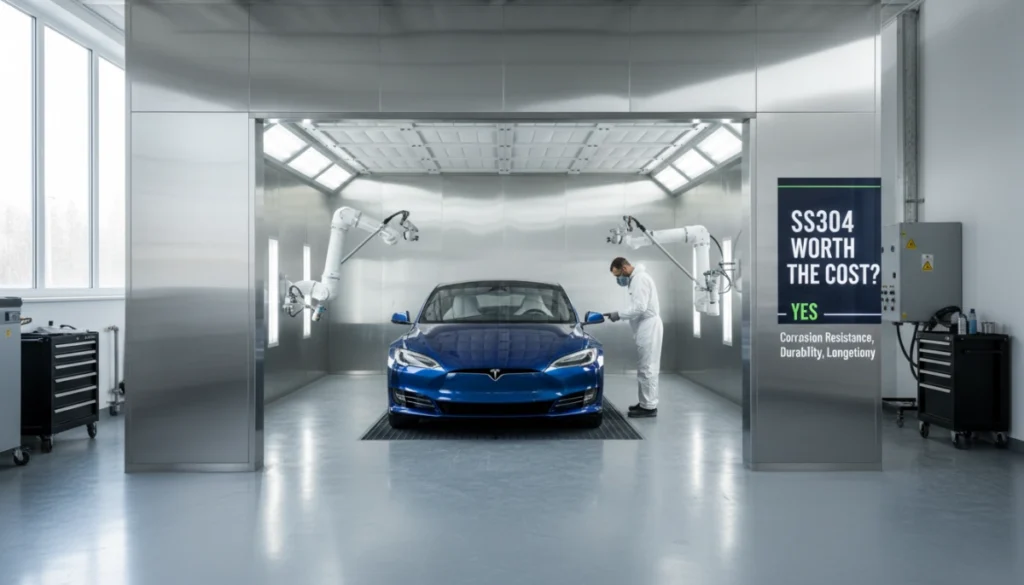
An SS304 stainless steel paint booth costs two to three times more than a standard galvanized booth upfront. For some shops, that price difference is hard to justify on a budget. For others, it’s the only choice that makes sense for the long term. This guide covers what makes SS304 different at a material level, where it genuinely outperforms galvanized steel, how the total cost of ownership compares, and when the upgrade is a business necessity rather than a preference.
Page URL: https://sprayboothmanufacturer.com/product/
What Makes SS304 Different
The Material Chemistry
SS304 is an austenitic grade of stainless steel built around a chromium-nickel alloy structure. Those two elements are what give it the properties that matter in a paint booth environment.
| Element | Percentage | Function |
|---|---|---|
| Chromium | 18–20% | Forms the protective oxide layer that resists rust |
| Nickel | 8–10.5% | Maintains structural ductility under thermal cycling |
| Manganese | 2% | Adds structural strength |
| Silicon | 0.75% | Deoxidizing agent during fabrication |
The chromium content is the key. When the surface of SS304 is exposed to oxygen, it forms a thin, non-porous layer of chromium oxide. That layer is what prevents rust from developing — and if the surface gets scratched, the oxide layer reforms on its own. There’s no coating to chip, no underlying metal to expose. The protection is built into the material itself.
How It Handles the Paint Booth Environment
Modern finishing environments are hard on booth materials. Waterborne coatings introduce sustained moisture exposure. Solvent-based paints bring aggressive chemical contact. Bake cycles put the structure through repeated thermal expansion and contraction. SS304 handles all three without degrading.
Galvanized steel has a zinc coating applied to the surface. That coating can handle moderate exposure, but once it’s scratched or compromised — by a tool, a parts rack, or repeated chemical contact — the underlying steel is exposed. From there, moisture and oxygen get in, and rust begins working its way outward from the damaged point. In a paint booth running waterborne coatings, that process happens faster than most shop owners expect.
SS304 also tolerates the heat of bake cycles without warping or developing stress cracks. The nickel content keeps the material ductile through repeated heating and cooling, which is what prevents the panel fatigue that eventually causes alignment problems in cheaper alternatives.
SS304 vs. Galvanized: The Real Comparison
Performance Side by Side
| Feature | Galvanized Steel Booth | SS304 Stainless Booth |
|---|---|---|
| Expected Lifespan | 8–12 years | 25+ years |
| Waterborne Compatibility | Poor — accelerates rust | Excellent — fully corrosion resistant |
| Maintenance Needs | High — scraping, repainting | Low — basic wipe-down |
| Surface Porosity | High — holds contaminants | Non-porous — easy to clean |
| Resale Value | Minimal | Strong asset retention |
The Contamination Problem With Galvanized Booths
This is the part that affects paint quality directly. As a galvanized booth ages, oxidation on the interior panels eventually produces rust flakes and zinc particles. Those particles fall. In a booth with ceiling filtration and a bake cycle, the air movement carries them exactly where you don’t want them — onto a wet base coat or fresh clear coat. Once rust contamination starts showing up in finished work, the source is often the booth walls themselves.
SS304 doesn’t have this problem. The surface doesn’t oxidize, doesn’t flake, and doesn’t generate particulate. The booth stays as clean inside as the day it was installed.
The Cleaning Difference
Non-porous surfaces don’t hold overspray the way galvanized panels do. In a stainless booth, dried paint sits on the surface rather than bonding into microscopic pores. That makes deep cleaning faster, means chemical strippers don’t damage the walls, and ensures contamination doesn’t accumulate in surface texture over time. For shops running high-volume production, the time saved on cleaning maintenance over years of use is real.
Total Cost of Ownership: Looking Past the Sticker Price
The upfront price of an SS304 booth is higher. That’s straightforward. What’s less obvious is what a galvanized booth actually costs to operate over its service life.
Within the first three years of heavy use — especially in facilities using waterborne coatings or operating in humid climates — galvanized booths typically start requiring active rust management. That means labor hours for sanding and repainting interior panels, periodic panel replacement as corrosion advances, downtime while maintenance work is underway, and material costs for rework caused by contamination from degrading walls.
| Expense Category | Galvanized Steel Booth | SS304 Stainless Booth |
|---|---|---|
| Initial Investment | Lower | Higher |
| Annual Maintenance | High — rust removal, recoating | Minimal — wipe-down only |
| Expected Lifespan | 7–10 years | 25+ years |
| Resale Value | Low — depreciates quickly | High — retains material value |
| Chemical Resistance | Poor | Excellent |
When you spread the total cost across the actual service life of each option, a galvanized booth that needs significant maintenance every few years and gets replaced after a decade often costs more over 25 years than an SS304 booth that requires essentially none. The stainless option is more expensive to buy once. The galvanized option is cheaper to buy but you’re buying it again.
When SS304 Is the Only Practical Choice
For some operations, this isn’t really a budget decision — it’s a technical requirement.
Waterborne Coating Systems
Environmental regulations in the United States are pushing more and more shops toward water-based paints. Waterborne coatings carry substantially more moisture than solvent-based systems, and that moisture accelerates the breakdown of galvanized zinc coatings. If your shop has made the switch to waterborne — or is planning to — running those materials through a galvanized booth means accepting significantly accelerated corrosion. SS304 handles the moisture without any degradation.
Aerospace and Medical Applications
These industries don’t tolerate contamination from the finishing environment. Galvanized surfaces can develop microscopic oxidation that sheds particles into the booth air. In aerospace painting or medical device finishing, that kind of contamination is unacceptable. SS304’s non-porous, non-flaking surface is what these applications require, and the ability to chemically sanitize the booth without damaging the walls is a practical necessity in clean-room style environments.
Coastal and High-Humidity Facilities
Salt air is aggressive toward most metals. Standard galvanized booths in coastal or Gulf Coast facilities show structural rust in a fraction of the time they would in a dry inland climate. SS304’s chromium oxide layer holds up against salt-laden air where galvanized steel doesn’t. If your facility is in a high-humidity region or near the coast, the corrosion resistance of stainless isn’t a premium — it’s what makes the equipment viable for its intended service life.
Food-Grade and Cleanroom Applications
Where hygiene requirements mandate regular chemical sanitization and zero bacterial growth on surfaces, SS304 is the industry standard. The material doesn’t harbor bacteria, doesn’t react with harsh cleaning agents, and maintains its structural integrity under repeated deep-clean cycles.
SS304 vs. Other Material Options
SS304 vs. SS316
SS316 adds molybdenum to the alloy, which provides additional resistance to chlorides and acids. It’s commonly called marine-grade steel. For facilities located directly on the coast or working with highly acidic industrial coatings, SS316 is worth considering. For the vast majority of automotive and industrial finishing operations in North America, SS304 provides more than sufficient corrosion resistance, and the 30% to 40% price premium for SS316 doesn’t return measurable value. If you’re not dealing with heavy chloride exposure or highly aggressive acids, SS304 is the right call.
SS304 vs. Powder-Coated Galvanized
Powder-coated galvanized steel looks professional when new. The coating must stay intact to provide full protection, and shop bumps from parts racks, tools and cleaning equipment easily scratch it. Once scratched, oxygen and moisture reach the underlying galvanized steel, and rust begins spreading outward from the damage point. Keeping a powder-coated galvanized booth in good condition means constant monitoring for scratches and regular touch-up work.
SS304 is a consistent alloy through its full thickness. Scratch it and you expose more stainless steel. There’s no coating to fail, no underlying vulnerable layer, no rust creep. The protection doesn’t depend on surface treatment — it’s what the metal is.
| Feature | SS304 Stainless | Powder-Coated Galvanized |
|---|---|---|
| Scratch Resistance | High — same material throughout | Low — coating chips and peels |
| Chemical Tolerance | Excellent | Moderate — depends on coating integrity |
| Long-Term Maintenance | Minimal | High — rust monitoring and touch-ups |
| Structural Lifespan | 25+ years | 10–15 years depending on environment |
Build Quality Matters as Much as Material Grade
Specifying SS304 is only part of the equation. How the booth is fabricated from that material determines whether it actually delivers 25-year performance.
Welding is where SS304 can be compromised. Poor welding technique burns out the chromium in the alloy at the joint, which removes the corrosion resistance at exactly the point where moisture is most likely to accumulate. Contamination-free welds that preserve the chromium oxide layer are what keep every seam as resistant as the rest of the panel.
Smooth internal seams matter for contamination control. Trap points where overspray or moisture can collect create pockets where localized corrosion develops even in stainless steel, and where paint contamination accumulates over time. Precision-fabricated panels that eliminate those trap points are what keep the interior genuinely clean.
For shops that can’t fit a full SS304 enclosure into the current budget, a targeted hybrid approach makes sense. The highest-risk areas in most booths are the exhaust plenums and ductwork where moisture collects, the lower wall panels exposed to chemical splashes, and any water-wash filtration sections. Upgrading those specific components to SS304 while using standard construction elsewhere addresses the most likely failure points without the full upfront cost of a complete stainless enclosure.
Common Questions
Does SS304 resist all chemical corrosion? It handles the vast majority of chemicals found in automotive and industrial finishing environments — solvents, waterborne carriers, most cleaning agents. It’s not impervious to everything. High concentrations of chlorides or aggressive acids can challenge it, in which case SS316 is worth discussing. For standard finishing work, SS304 provides more than enough protection.
How much longer does stainless actually last compared to galvanized? In heavy-use finishing environments, galvanized steel typically shows structural degradation within 7 to 10 years. SS304 runs 25 years or more with basic maintenance. The practical difference is that a galvanized booth gets replaced at least twice over the service life of one stainless booth.
Do I need SS304 for waterborne paints? You don’t technically need it, but using a galvanized booth for waterborne coatings will greatly speed up corrosion. The moisture content in water-based paints is aggressive toward zinc coatings. The booth that seemed fine for solvent-based work starts showing rust problems faster once waterborne coatings are introduced. SS304 is the reliable answer if waterborne is your workflow.
Can I upgrade parts of the booth rather than the whole unit? Yes. If a full stainless build doesn’t fit the budget right now, focus the upgrade on the areas that face the most moisture and chemical exposure — exhaust plenums, lower wall panels, and water-wash filtration sections. Those are the points that fail first in a galvanized booth, and addressing them specifically provides meaningful corrosion protection at a lower initial cost than a complete enclosure replacement.
Tell Us What You’re Working With
Share your coating types, facility environment, current booth situation, and production volume. We’ll help you determine whether a full SS304 enclosure or a targeted hybrid upgrade makes the most sense for your operation — and send a detailed quote usually within 48 hours.
Related Pages
- Bus Spray Booth Design Guide → https://sprayboothmanufacturer.com/transit-coach-spray-booth-requirements/
- Truck Paint Booth Guide → https://sprayboothmanufacturer.com/truck-paint-booth-semi-truck-spray-booth-specifications-buying-guide/
- Other related products → https://www.autokemanufacture.com/product
- Contact our sales Team → https://sprayboothmanufacturer.com/contact-us/
✅ CE Certified | ✅ ISO 9001:2015 | ✅ Factory Direct | ✅ Ships to 60+ Countries | ✅ 1-Year Warranty | 🔒 HTTPS Secured