
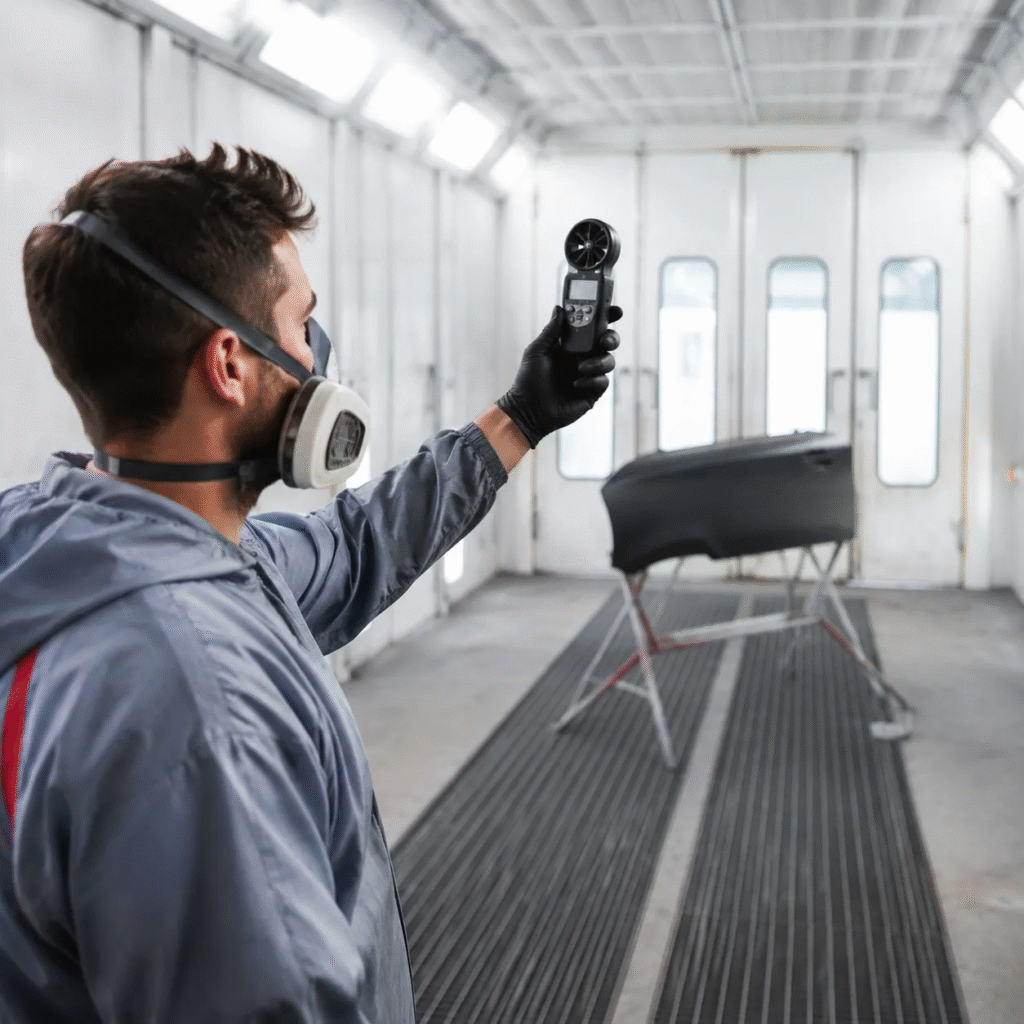
Dealing with a hazy booth, lingering chemical odors, or dust ruining your fresh clear coat?
When your ventilation acts up, your entire production grinds to a halt.
But you don’t need to call a costly technician just yet.
In this guide, you’ll get a straightforward blueprint for Spray Booth Ventilation Troubleshooting to pinpoint exactly why your airflow is not working right.
Let’s get your shop’s ventilation back on track.
Page URL: https://sprayboothmanufacturer.com/product/
Spray Booth Ventilation Troubleshooting: Why Your Airflow Is Not Working Right
Is your shop suddenly filling with haze, or are you fighting constant dirt nibs in your clear coat? When your airflow drops, your finish quality and shop safety go down with it. Recognizing the early warning signs of bad ventilation saves you from costly redos and equipment downtime.
Visual Indicators of Poor Airflow
You can usually see a ventilation failure before you hear it. Pay close attention to how overspray behaves during a shoot.
- Lingering Overspray Clouds: Paint mist should clear out of the cabin almost instantly. If a foggy haze hangs in the air for minutes after you release the gun trigger, your exhaust velocity is choking.
- Escaping Paint Mist: Check your door gaskets. If you see paint mist puffing out through the door seals into the main shop, your booth is over-pressurized.
- Contaminated Finishes: When dust and airborne lint settle directly onto wet clear coats, it means the extraction system isn’t pulling contaminants away fast enough.
Mechanical and Spatial Warning Signs
When visual cues aren’t obvious, mechanical symptoms and physical changes inside the shop will tell you exactly where the system is failing.
| Symptom | Direct Cause | Immediate Impact |
|---|---|---|
| Rattling or grinding noises | Worn exhaust tower bearings or loose fan belts | Reduced fan blade RPMs and sudden total airflow failure |
| Chemical odor buildup | Poor spray booth ventilation balance | Toxic fumes backdrafting into the technician’s breathing zone |
| Uneven pressure differentials | Clogged filters or blocked exhaust ducts | Turbulent air current zones that trap overspray inside the cabin |
If you notice a strong solvent smell outside the booth or hear strange vibrations coming from the fan stack, your ventilation system is struggling to maintain the correct spray booth static pressure. Addressing these red flags immediately keeps your shop code-compliant and your paint jobs flawless.
Spray Booth Ventilation Troubleshooting: Why Your Airflow Is Not Working Right
When your airflow drops, you need a systematic way to find the issue. Here is our step-by-step spray booth ventilation troubleshooting checklist to identify and fix the most common restrictions and mechanical failures.
1. Spray Booth Static Pressure and Filtration Restrictions
The primary culprit behind poor airflow is almost always filter maintenance. Overloaded filters choke your system and cause an immediate intake filter pressure drop.
- Exhaust Filters vs. Intake Media: As overspray accumulation builds up on your overspray collection filters, the spray booth static pressure spikes. This forces the exhaust fan to work harder, severely cutting down your air velocity.
- The Danger of Cheap Materials: Never use standard HVAC or furnace filters. They lack the holding capacity for paint solids and will immediately choke the system. We always recommend dedicated paint arrestor media, like heavy-duty fiberglass or high-efficiency pleats designed specifically for industrial finishing ventilation.
- The Diagnostic: Stop guessing by the calendar. Use a paint booth manometer or an air velocity vaneometer to track actual pressure drops. Replace filters based on real differential pressure readings, not arbitrary timelines.
2. Blower Motor Troubleshooting and Mechanical Failures
If your filters are clean but the airflow is still sluggish, the problem lies within your air handling unit.
| Component | Common Issue | Impact on Airflow | Fix |
|---|---|---|---|
| Fan Belt | Slippage, stretching, or cracking | Reduces fan blade RPMs, dropping exhaust fan CFM | Tighten or replace the belt immediately |
| Blower Wheel | Paint solids buildup on blades | Causes imbalance, vibrates the motor, and distorts air draw | Clean the blades to restore optimal balance |
| Electrical System | Tripped breakers, blown fuses, failed starters | Complete loss of power or intermittent fan shutdowns | Check the magnetic starter and verify voltage |
3. Ductwork Resistance and External Blockages
Sometimes the restriction isn’t in the booth—it is in the exhaust stack. External issues introduce heavy ductwork resistance that strangles your system’s output.
- Restrictive Layouts: Long horizontal runs and excessive 90-degree elbows create turbulence and choke your exhaust fan CFM. Keep duct runs as straight and short as possible.
- External Disruptions: High winds can cause severe negative pressure draft issues and backdrafts if your exhaust caps are missing or damaged. Always inspect the roof stack to ensure automatic dampers aren’t stuck in the closed position, blocking the air exit path completely.
Advanced Airflow Pitfalls: The Physics of Pressure Balance
Achieving the perfect spray booth ventilation balance requires managing invisible pressure dynamics. When your booth’s intake and exhaust systems are out of sync, the entire finishing environment suffers.
The “Empty vs. Loaded” Booth Paradox
A booth that delivers a perfect exhaust fan CFM when empty can completely fail when loaded. Parking large trucks, oversized industrial machinery, or bulky parts inside the cabin alters the spatial physics.
- Airflow Obstruction: Large objects block standard crossdraft pathways.
- Dead Zones: Air pockets form behind the vehicle, trapping paint mist.
- Turbulence: Eddies swirl around flat panels, causing overspray to redeposit on the wet finish.
Negative vs. Positive Pressure Imbalances
Your booth must maintain a controlled pressure equilibrium. When the balance tips too far in either direction, it creates immediate quality and safety issues.
| Pressure Type | Cause | Direct Impact |
|---|---|---|
| Too Much Negative Pressure | Exhaust fan pulls harder than the intake can supply. | Creates a negative pressure draft that sucks shop dust and contaminants right through door gaskets onto your wet clear coat. |
| Too Much Positive Pressure | Intake air overpowers the exhaust system. | Pushes hazardous paint mist and chemical odors out of the booth seals into the technician’s workspace. |
Make-Up Air Unit (MAU) Disconnects
A malfunctioning Make-Up Air Unit (MAU) is frequently the root cause of severe spray booth static pressure shifts. When your heating integration—whether diesel, electric, or infrared systems—is mismatched or poorly calibrated, it disrupts the air intake equilibrium. Cold or improperly heated air changes density, throwing off the calculated volumetric airflow and leaving the cabin struggling to maintain stable movement.
Spray Booth Ventilation Troubleshooting: Why Your Airflow Is Not Working Right
Sometimes, tweaking a belt or swapping a filter just won’t cut it. When your shop is fighting aging blowers, structural layout bottlenecks, or a building footprint that restricts proper airflow, retrofitting becomes a losing battle. If you are constantly chasing pressure imbalances, it is time to stop patching a broken system and upgrade to a permanent solution.
The Downdraft Paint Booth Airflow Advantage
For shops serious about flawless finishes, upgrading to a true downdraft paint booth is the ultimate fix. Our AUTOKE engineered downdraft design completely eliminates the dead zones that plague old crossdraft setups.
By pulling air straight down from the ceiling and exhausting it through floor-level filtration, we use gravity to our advantage. Overspray and airborne dust are immediately pulled down and away from the wet clear coat, keeping your workspace immaculate and your finish pristine.
Standard Sizes & Code Compliance
| Configuration | Best For | Compliance |
|---|---|---|
| 6m / 7m / 8m Configurations | Standard passenger vehicles, SUVs, and light trucks | CE-Certified / Meets local airflow regulations |
| Custom Heavy-Duty Industrial | Large machinery, commercial fleets, and long components | Built to order / Tailored to strict regional codes |
We factory-configure our systems in standard 6m, 7m, and 8m setups, or we can custom-build heavy-duty industrial finishing ventilation systems tailored to your specific shop footprint. Every single unit we build is CE-certified, ensuring your exhaust fan CFM and air velocity meet rigid local regulations without guesswork. Do not compromise your finish or your safety with an underpowered system—invest in an engineered solution that works perfectly every time you flip the switch.
Related Sources
- https://www.cdc.gov/niosh/surveyreports/pdfs/329-12a.pdf
- https://des.sc.gov/sites/des/files/docs/Environment/docs/6H_Rule.pdf
- https://www.mdpi.com/2227-9717/14/7/1047
- Bus Spray Booth Design Guide → https://sprayboothmanufacturer.com/transit-coach-spray-booth-requirements/
- Truck Paint Booth Guide → https://sprayboothmanufacturer.com/truck-paint-booth-semi-truck-spray-booth-specifications-buying-guide/
- Other related products → https://www.autokemanufacture.com/product
- Contact our sales Team → https://sprayboothmanufacturer.com/contact-us/
✅ CE Certified | ✅ ISO 9001:2015 | ✅ Factory Direct | ✅ Ships to 60+ Countries | ✅ 1-Year Warranty | 🔒 HTTPS Secured