
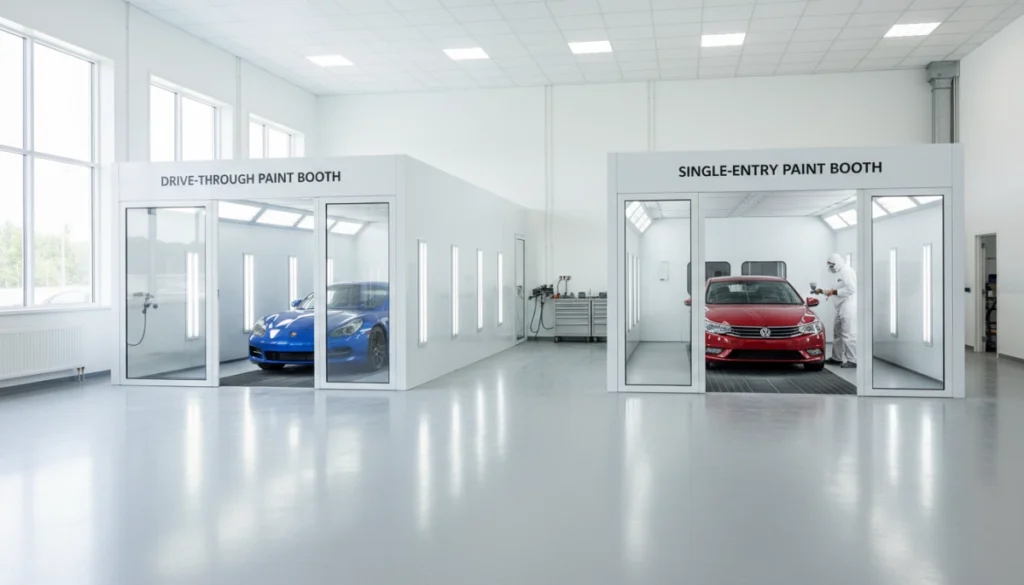
The layout of your paint booth shapes how your shop runs every single day. It determines how many vehicles move through the paint cycle, how your technicians organize their work, and whether the booth becomes a throughput engine or a bottleneck. This guide covers how both configurations work, where each one makes sense, and what to think through before you commit to a layout.
Page URL: https://sprayboothmanufacturer.com/product/
The Core Difference
A single-entry paint booth — sometimes called a drive-in, back-out booth — has one set of doors used for both entry and exit. The vehicle drives in, gets sprayed and baked, and then backs out when the cycle is complete. Straightforward, space-efficient, and the most common configuration in local collision centers across the country.
A drive-through paint booth has doors at both ends. Vehicles enter through the front, move through the spray and bake cycle, and exit through the rear into a cooling or reassembly area. The workflow moves in one continuous forward direction, which is what makes it the standard choice for high-production operations.
Both configurations produce professional-quality finishes. The difference is in how efficiently they handle volume and how they fit into the physical reality of your shop floor.
Single-Entry: Making the Most of Limited Space
Why It Works for Most Shops
The biggest practical advantage of a single-entry booth is that it fits where other layouts can’t. Because vehicles enter and exit through the same set of doors, you can install the booth against a back wall, in a corner, or in any dead-end bay where a rear exit isn’t possible. You don’t need a clear driving lane on both ends — just enough clearance for the doors to swing open and a vehicle to pull in.
That physical flexibility translates directly to cost. A single-entry booth requires fewer doors, simpler airflow engineering, and less construction than a drive-through equivalent. For shops watching their initial capital outlay, that difference is meaningful.
For custom painters, mid-sized repair shops, and any operation doing one to three paint cycles per day, a single-entry booth is usually the right answer. It delivers professional results without requiring a facility redesign or a significantly larger footprint.
The Trade-offs
The operational limitation of a single-entry layout is that every finished vehicle has to back out before the next one can come in. That creates a stop-and-go rhythm that adds time to every cycle. When the booth is busy, there’s no way to stage the next vehicle at the door — you have to wait for the space to clear completely before the queue moves.
Reversing a freshly painted vehicle out of a tight space also carries risk. It requires caution, slows down the turnaround, and creates the possibility of shop dust settling on a finish that hasn’t fully hardened. None of these are dealbreakers, but they are real factors that add up across a busy production week.
Drive-Through: Built for Volume
The Linear Workflow Advantage
In a drive-through setup, the vehicle enters the front doors and exits the rear doors. There’s no reversing, no waiting for the booth to clear before the next car can approach, and no interruption to the forward flow of work. As one vehicle exits the back into the cooling or reassembly area, the next prepped car is already moving in from the front.
That continuous one-direction movement is what gives drive-through booths their throughput advantage. The workflow runs like a production line rather than a series of individual stops, which compounds across a full shift into a meaningful difference in daily car count.
Forward-only movement also reduces the risk of damage. Reversing freshly painted vehicles in a busy shop is one of the more common sources of avoidable accidents and touch-up work. Eliminating that step entirely keeps the work moving and reduces the chance of an expensive mistake.
For collision centers handling five or more paint cycles per day, high-volume insurance work, or any operation where the booth is the pacing constraint on daily output, the drive-through configuration is the right investment.
The Space and Cost Reality
A drive-through booth needs a runway on both ends. You need straight-line approach clearance at the front to align vehicles coming in, and exit clearance at the rear to pull them out without hitting other equipment. As a rough guide, plan for 15 to 25 feet of clear space on each side of the booth, beyond the booth dimensions themselves.
That footprint requirement rules out drive-through setups in a lot of facilities. If your building is narrow, doesn’t have a secondary exit path, or has equipment or walls that prevent a straight-line lane through the shop, the drive-through configuration isn’t a viable option regardless of budget.
The additional set of doors and the more complex airflow engineering also add to the upfront cost. For shops doing the right volume to justify it, that investment pays back quickly. For shops that don’t need the throughput, it’s cost that doesn’t return value.
Side-by-Side Comparison
| Feature | Single-Entry | Drive-Through |
|---|---|---|
| Space Requirement | Minimal — fits corners and dead ends | High — needs clear lanes on both ends |
| Daily Throughput | Best for 1–3 cycles per day | Best for 5+ cycles per day |
| Workflow Style | Drive in, back out | Forward-only linear flow |
| Initial Investment | Lower | Higher |
| Risk of Damage | Higher — reversing required | Lower — forward movement only |
| Airflow Options | Crossdraft or semi-downdraft | Full downdraft in most high-end setups |
Airflow Configuration and Booth Type
The layout choice also connects to airflow configuration. Single-entry booths are commonly set up with crossdraft or semi-downdraft systems, which are cost-effective and work well for the production levels these booths typically handle. Crossdraft pulls air horizontally front to back; semi-downdraft introduces air from the ceiling and exhausts through the rear wall — a cleaner result than straight horizontal flow without requiring a floor pit.
High-end drive-through booths almost always run full downdraft systems. Air enters through ceiling filters and exits through a floor pit or raised basement system. That vertical airflow is what keeps the exit end of the booth clean for the next vehicle coming in, and it’s what allows the production pace of a drive-through operation to maintain consistent finish quality across every cycle.
The choice of airflow configuration does affect installation complexity and cost, so it’s worth thinking through both decisions together rather than treating them as separate.
How to Choose: A Practical Framework
Start with your building. Measure the actual available floor space, including what’s on both sides of where the booth would sit. If you don’t have a clear driving path front to back with adequate approach and exit clearance, a drive-through isn’t physically possible. That narrows the choice before budget or production goals even enter the conversation.
Match the configuration to your actual volume. If you’re regularly painting one to three vehicles per day, a single-entry booth is the right fit and the drive-through overhead isn’t justified. If your queue is consistently backed up and the booth is the constraint on your daily output, a drive-through is worth the investment. Be honest about where you actually are, not where you hope to be in five years.
Think about total cost, not just purchase price. The drive-through costs more upfront, but if it lets your team complete one additional job per day, the math often works out in its favor within the first year for a busy shop. A single-entry booth that costs less to buy but creates constant bottlenecks has its own hidden cost in slower job completion and technician time lost to shuffling vehicles around.
Consider your vehicle types. For heavy-duty trucks and long commercial vehicles, the drive-through is a significantly better fit from a pure safety standpoint. Reversing a 30-foot vehicle in a busy shop is a high-risk operation. Forward-only movement through a drive-through eliminates that risk entirely and speeds up the process considerably on larger vehicles.
Long-Term ROI
The throughput difference between the two configurations compounds over time. A drive-through setup that allows one additional complete paint cycle per day doesn’t just improve that day’s revenue — it improves every subsequent day the shop operates. Over a year, that accumulates into a meaningful revenue difference that offsets the higher initial investment.
That said, the ROI calculation only holds if the volume is there to justify it. A drive-through booth in a shop doing two cycles a day is an expensive asset that’s operating well below its capability. The higher initial cost pays back through volume — if the volume isn’t there, the payback timeline extends significantly.
For shops somewhere in between — currently doing three to four cycles a day but expecting growth — this is where the decision gets harder. One practical approach is to plan the facility layout to accommodate a drive-through in the future even if you start with a single-entry booth now. Positioning the initial booth to allow for a rear door addition later costs relatively little at the planning stage and avoids a complete facility reconfiguration down the road.
Common Questions
Can a single-entry booth be converted to a drive-through later? It’s possible but rarely straightforward. Converting requires cutting a second opening in the booth structure for the rear doors, which often means relocating the exhaust system, fans, or the plenum depending on the original configuration. The structural modifications and door hardware costs can run close to the cost of a new unit. If there’s a real chance you’ll need a drive-through eventually, it’s more cost-effective to start there.
Which layout is better for large trucks? Drive-through, consistently. Maneuvering a long vehicle in reverse is risky in a busy shop environment. Forward-only movement eliminates that risk, speeds up the loading and unloading process, and makes it much easier to maintain the airflow alignment around a large vehicle throughout the spray cycle.
How much extra floor space does a drive-through actually require? The booth structure itself isn’t dramatically larger, but the clearance requirements on both ends add significantly to the total space claimed. Plan for at least 15 to 25 feet of clear approach space at the front and the same at the rear, in addition to the booth footprint. A single-entry booth can sit against a back wall and use that same rear space for other purposes.
By how much does a drive-through actually improve throughput? In practice, shops that switch from single-entry to drive-through typically see a 20 to 30% improvement in vehicle throughput rate. The biggest gains come from eliminating the wait time between cycles and removing the need to reverse vehicles out — both of which create dead time in a single-entry workflow that adds up significantly across a full production day.
Tell Us What You’re Working With
Share your facility dimensions, daily vehicle count, vehicle types, and any layout constraints you’re working around. We’ll spec out the right paint booth configuration for your operation and send a detailed quote with layout drawings — usually within 48 hours.
Related Pages
- Bus Spray Booth Design Guide → https://sprayboothmanufacturer.com/transit-coach-spray-booth-requirements/
- Truck Paint Booth Guide → https://sprayboothmanufacturer.com/truck-paint-booth-semi-truck-spray-booth-specifications-buying-guide/
- Other related products → https://www.autokemanufacture.com/product
- Contact our sales Team → https://sprayboothmanufacturer.com/contact-us/
✅ CE Certified | ✅ ISO 9001:2015 | ✅ Factory Direct | ✅ Ships to 60+ Countries | ✅ 1-Year Warranty | 🔒 HTTPS Secured