
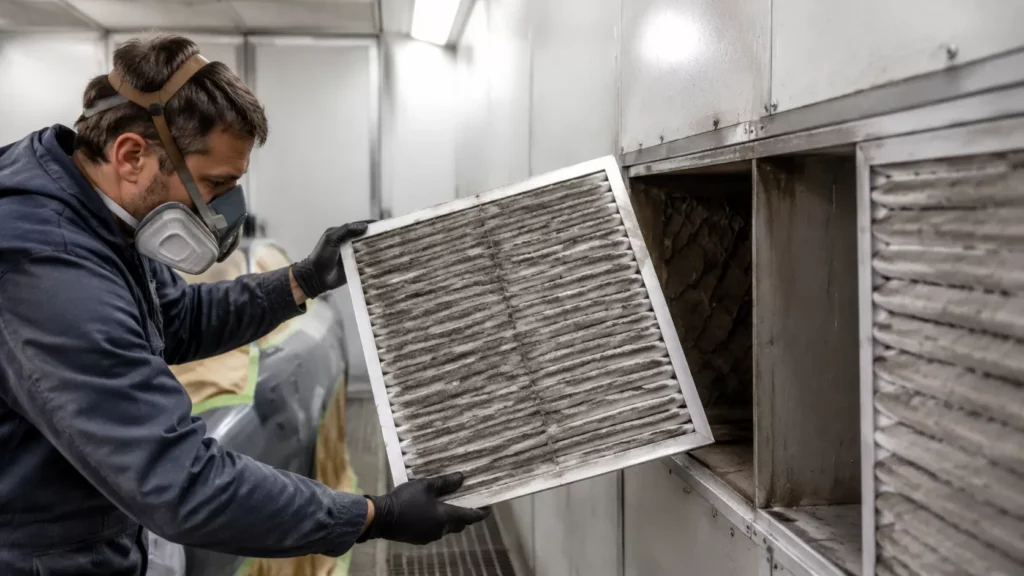
Most filter problems don’t announce themselves all at once. They show up gradually — a few dust nibs in the clear coat, air that feels a little thick, cycle times creeping up for no obvious reason. By the time the issue is obvious, there’s already a ruined job or a strained motor behind it. Knowing what to look for before it gets to that point is what separates a shop that runs smoothly from one that’s constantly playing catch-up. Here are the five signs that tell you a filter change can’t wait, plus what ignoring them actually costs you.
Page URL: https://sprayboothmanufacturer.com/product/
Five Signs a Filter Change Can’t Wait
1. The Manometer Reading Is Outside Normal Range
Your differential pressure gauge is the most reliable indicator of filter condition in the booth. It measures the pressure drop across the filter media, and when that number climbs above the manufacturer’s recommended limit — typically around 0.5 inches of water column — the exhaust filter is loaded and airflow is being choked.
A reading that suddenly drops to zero is a different problem but equally urgent. It usually means a filter has collapsed or pulled away from its frame, allowing unfiltered air to bypass the media entirely. Either extreme tells you the filter needs attention immediately, not at the next scheduled service.
2. Finish Defects Showing Up in Fresh Paint
When intake filters reach the end of their useful life, they stop trapping fine particles — and those particles end up on your wet surface instead. Dirt nibs, dust specs in the clear coat, and fish eyes that weren’t there before are all direct symptoms of filtration that’s no longer doing its job. If your painters are spending extra time color sanding and buffing out contamination that shouldn’t be there, the filter is the first place to look.
3. Overspray That Doesn’t Clear Quickly
A functioning downdraft system clears overspray out of the cabin within seconds of the trigger being released. If a mist cloud hangs in the air around the vehicle, the system’s air velocity has dropped. Clogged filters restrict CFM, and instead of being pulled down into the exhaust pits, overspray drifts and settles back onto the paint surface as dry spray. This one is easy to spot — just watch what the air does after a pass.
4. Visible Face-Loading on the Filter Surface
A quick look at the filter face tells you a lot. When the surface looks like a solid layer of dried paint rather than a filter, air can’t pass through it efficiently. Intake filters that have gone from white to dark gray or brown are fully loaded with dust and should have been changed already. Heavy face-loading doesn’t mean the filter is almost done — it means it’s been done for a while.
5. Stronger Chemical Smells in the Cabin
Some solvent odor is normal in a paint shop. A sudden spike in chemical smell during or after spraying is not. When exhaust filters are saturated, the system can’t evacuate fumes at the rate they’re being produced. Solvent vapors build up inside the cabin instead of clearing through the exhaust path — which is both an OSHA air quality issue and an uncomfortable, potentially unsafe environment for whoever is holding the gun.
What Delayed Filter Changes Actually Cost You
Rework and Wasted Material
Overloaded filters let overspray drift back onto fresh surfaces. Every job that comes out of the booth with contamination in the clear coat means additional buffing time, additional material, and a cycle that took twice as long as it should have. That’s not recoverable time — it’s gone.
Motor and Fan Strain
Exhaust fans are designed to pull against a specific static pressure range. When filters are clogged, the motor has to work harder to maintain airflow — drawing more amps, generating more heat, and wearing out faster than it should. A burned-out exhaust fan motor is an expensive replacement and a multi-day shutdown. The filter that caused it costs a fraction of that.
Compliance and Safety Risk
Overloaded filters don’t just affect finish quality — they create real hazards. Restricted airflow means overspray isn’t being cleared from the painter’s breathing zone at the rate OSHA requires. Dry chemical residue building up in the airflow path is a fire risk under NFPA standards. And when the booth is running out of balance, particulate emissions from the exhaust stack may exceed what EPA permits allow.
How Long Filters Actually Last
Filter lifespan depends on production volume and coating type, not just time on the calendar. A busy shop spraying high-solid coatings will load exhaust filters significantly faster than a lighter operation. The table below gives general guidance, but your manometer reading is a more accurate indicator than any fixed schedule.
| Filter Type | Standard Volume | High Volume | Role in the Booth |
|---|---|---|---|
| Intake Filters | 2–3 months | 4–6 weeks | Traps incoming dust and airborne particles |
| Ceiling Diffusion Mats | 6–12 months | 4–6 months | Distributes airflow evenly across the ceiling plenum |
| Fiberglass Exhaust Media | 50–60 baking hours | 2–3 weeks | Captures paint overspray before it reaches the fan |
| HEPA / Carbon Stage | 6–12 months | 3–4 months | VOC control and OSHA air quality compliance |
Booth configuration also affects how quickly filters load. Downdraft setups pull overspray directly into the floor exhaust filters, which means those filters take the heaviest load and need the most frequent attention. Crossdraft and semi-downdraft systems distribute loading more unevenly, so it’s worth checking multiple points across the exhaust face rather than assuming uniform wear.
Waterborne coatings are worth calling out specifically. The overspray stays sticky longer than solvent-based paint, which means it face-loads intake and exhaust filters faster. If you’ve recently switched coating systems and your filters seem to be dying faster than before, that’s likely why.
Better Habits for Managing Filter Life
Monitor the Gauge, Not the Calendar
Replacing filters on a fixed two-week schedule sounds organized, but it doesn’t match how booths actually work. A heavy production week loads filters faster than a quiet one. Checking the manometer when the booth is running empty gives you a true baseline reading, and watching how that number changes over time tells you exactly when the filter is nearing the end — before it starts affecting your work.
Keep a Simple Log
A logbook next to the control panel doesn’t have to be complicated. Record the pressure reading after each fresh filter install, note the date and type of media, and log any finish problems that occur. Over time, this makes it easy to predict filter life based on your actual production pattern and spot when something is wearing faster than expected.
Install Filters Correctly Every Time
Even a good filter performs poorly if it’s not seated properly. Gaps around the edges of ceiling diffusion mats or exhaust pockets allow air — and overspray — to bypass the media. Make sure filters sit flush in their holding frames with no sagging, gaps, or loose edges. Check the gaskets and locking tracks at every changeout. A filter that’s installed incorrectly gives you the cost of a fresh filter with the performance of a clogged one.
FAQ
How do I know if my filters are causing finish defects? If dust nibs and contamination appear in your clear coat without an obvious source in the cabin, check your intake filters first. Overloaded ceiling diffusion mats release trapped particles back into the airflow as pressure builds — those particles land directly on wet paint. Replace the intake filters, run a clean bake cycle, and see if the defects disappear.
Can clogged exhaust filters damage the fan motor? Yes. When exhaust filters restrict airflow, the fan motor draws more current to compensate, which causes it to run hotter than it was designed to. Over time this shortens the motor’s service life significantly and can lead to premature burnout. The cost of a burned motor and the associated downtime is many times higher than keeping up with filter changes.
Do waterborne coatings require more frequent filter changes? Generally yes. Waterborne overspray stays wet longer than solvent-based material and tends to face-load filters faster. Shops that have moved to waterborne systems often find their previous filter schedule isn’t adequate anymore. Use the manometer reading to establish a new baseline after switching coating types.
What does it mean if my manometer reads zero? A sudden drop to zero usually means a filter has failed structurally — collapsed, pulled away from the frame, or developed a large bypass gap. The system will appear to be running normally because airflow is no longer being restricted, but unfiltered air is going straight through. Inspect the filter frame and media immediately and replace any filter that has lost contact with its sealing surface.
Tell Us What You’re Working With
Share your booth configuration, coating types, and current filter schedule. We’ll help identify the right filter spec for your setup and send a detailed quote — usually within 48 hours.
Related Pages
- Bus Spray Booth Design Guide → https://sprayboothmanufacturer.com/transit-coach-spray-booth-requirements/
- Truck Paint Booth Guide → https://sprayboothmanufacturer.com/truck-paint-booth-semi-truck-spray-booth-specifications-buying-guide/
- Other related products → https://www.autokemanufacture.com/product
- Contact our sales Team → https://sprayboothmanufacturer.com/contact-us/
✅ CE Certified | ✅ ISO 9001:2015 | ✅ Factory Direct | ✅ Ships to 60+ Countries | ✅ 1-Year Warranty | 🔒 HTTPS Secured