
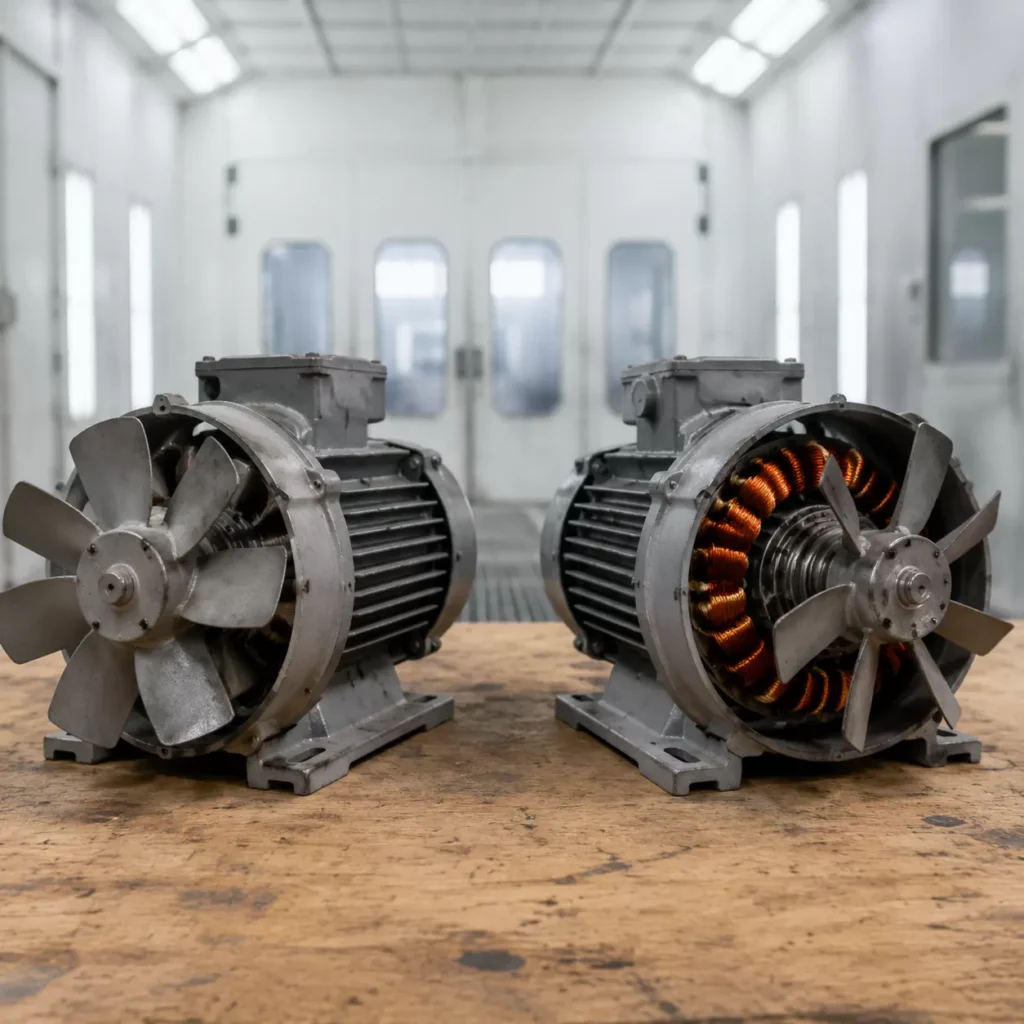
When your exhaust fan motor starts showing signs of failure, the decision feels straightforward — replace it with whatever is cheapest and available. But in a professional spray booth environment, that choice has consequences that show up in your energy bills, your maintenance schedule, and at the worst possible moment, in the middle of a job. This guide breaks down the technical differences between standard and copper core motors, what those differences mean for daily production, and how to figure out which option actually makes sense for your operation.
Page URL: https://sprayboothmanufacturer.com/product/
Why the Fan Motor Is More Critical Than It Looks
The exhaust fan is what makes a paint booth function as a controlled environment. It’s what maintains the airflow velocity that keeps VOCs and overspray moving away from the painter and the wet paint surface. When it fails or underperforms, the entire system fails with it — fumes build up, airflow drops below the minimum required by OSHA and NFPA 33, and the booth can no longer produce a clean finish.
The environment these motors operate in is genuinely brutal. Heavy overspray and particulates constantly load the ventilation path. Long bake cycles push ambient temperatures well above what most standard industrial motors are designed for. And in a production shop, these motors run continuously for eight to twelve hours a day, day after day, without recovery time.
Motor failures don’t just mean a replacement cost. They mean a job that was mid-spray has to stop. It implies lingering vapors failing to vent properly. It means refinishing flawed paintwork that cannot be repaired. In a high-volume collision center, an unplanned fan failure in the middle of a shift costs far more in lost production and ruined material than the price difference between a standard motor and a premium one.
What a Standard Paint Booth Motor Actually Is
Standard motors in most entry-level and budget booth setups use aluminum windings or mixed-alloy conductors rather than pure copper. The appeal is obvious — lower upfront cost and fast availability. If you need to get a booth back online quickly without a large budget, standard motors are easy to source.
The limitation becomes apparent under sustained production load. Aluminum has higher electrical resistance than copper, which means the motor has to work harder to push the same volume of air. More resistance means more heat generated internally. More heat means faster degradation of the winding insulation. In a light-use environment — a hobbyist booth, a weekend project setup, or a shop that sprays infrequently — this thermal limitation rarely becomes a problem. In a production environment running continuous shifts, it’s a predictable failure pattern rather than a surprise.
The true cost of a standard motor isn’t the purchase price — it’s the combination of higher energy consumption, shorter service life, and the production disruption that comes with an unplanned replacement in the middle of a busy week.
What a Copper Core Motor Delivers
Copper core motors use 100% pure copper windings throughout the stator assembly. The performance difference comes directly from copper’s physical properties.
Lower electrical resistance means less power is wasted generating heat within the windings themselves. More of the electrical energy drawn from the circuit goes into producing airflow, which makes a copper core motor meaningfully more energy-efficient than an equivalent aluminum-wound unit. The difference in monthly electricity consumption on a production booth running daily adds up to a number worth paying attention to.
Better heat dissipation is the more operationally critical advantage. Copper conducts heat away from the windings more effectively than aluminum does, which means the motor runs at a lower operating temperature under the same load. A motor that runs cooler lasts longer — the insulation on the windings degrades more slowly, bearings wear more predictably, and the failure modes that cause mid-shift breakdowns simply occur less often.
Structural integrity under continuous load is the third advantage. Copper handles the sustained high RPMs and mechanical vibration of a production spray booth environment better than aluminum. The windings maintain their dimensional stability rather than expanding and shifting under thermal stress, which preserves the electrical performance over years of use rather than months.
| Feature | Standard Motor | Copper Core Motor |
|---|---|---|
| Winding Material | Aluminum or mixed alloy | 100% pure copper |
| Electrical Resistance | Higher — wastes more power | Lower — more efficient |
| Heat Management | Runs hotter under load | Runs cooler throughout |
| Airflow Consistency | Can drop as motor heats up | Maintains CFM under continuous load |
| Expected Lifespan | Shorter in production environments | Significantly longer |
| Upfront Cost | Lower | Higher initial investment |
| Long-Term ROI | Lower — more frequent replacement | Higher — lower total cost over time |
How They Compare in Daily Operation
Airflow Consistency
A copper core motor maintains its torque output more consistently as operating temperature rises. In a standard motor, airflow can drop off as the motor heats up over a long shift — the increased resistance from a hot aluminum winding reduces electrical efficiency and therefore mechanical output. In practical terms, the booth that passed its airflow calibration at the start of the day may be running below the required CFM by hour six of a continuous shift. A copper core motor holds its output more reliably through the full duration.
Energy Consumption
Because copper conducts electricity with less resistance, the motor draws less power to produce the same airflow. For a production booth running forty or more hours per week, this efficiency difference shows up on the monthly utility bill. It’s not dramatic on any single day, but over the course of a year it’s a real number — and it runs in your favor every single day the booth operates.
Maintenance and Downtime
Standard motors under continuous production load wear out faster and fail more unpredictably. Copper core motors have longer service intervals and fail more predictably, which means you’re more likely to catch a developing problem through routine inspection rather than through a mid-job shutdown. Over a multi-year horizon, the reduced maintenance frequency and lower replacement rate offset the higher purchase price — typically before the first standard motor has needed its first replacement.
Is the Upgrade Worth It?
For production environments — professional collision centers, industrial coating facilities, high-volume auto body shops — the answer is clearly yes. When the booth is running back-to-back cycles all day, the copper core’s thermal stability and consistency directly support the production schedule. A motor that fails mid-bake cycle costs more in that single incident than the premium between a standard motor and a copper core unit.
For light-use applications — weekend hobbyists, occasional touch-up work, temporary setups — the standard motor is a practical choice. If the booth runs a few hours a week and sits idle most of the time, the thermal limitations of an aluminum-wound motor rarely become a problem in practice.
The calculation for most professional shops is straightforward: the upfront cost difference pays back quickly when measured against avoided downtime, reduced energy consumption, and fewer replacement cycles over the equipment’s service life.
What to Check Before Upgrading
Choosing copper core over standard doesn’t complete the upgrade decision. A few technical verifications matter before ordering.
CFM and static pressure matching. The replacement motor needs to deliver the correct airflow volume for your booth’s dimensions while overcoming the resistance created by your filters, ductwork, and any bends or dampers in the exhaust path. A motor that’s oversized or undersized for your system’s static pressure won’t perform correctly regardless of winding material. Confirm these specs against your booth’s original design before purchasing.
Explosion-proof rating. This is non-negotiable for any spray booth application. The interior of a paint booth is classified as a Class I, Division 1 hazardous location — airborne solvent vapors and paint fumes can ignite if a motor produces a spark. Any replacement motor must carry the correct hazardous location rating to meet OSHA and NFPA 33 requirements. Standard industrial motors without this rating are not acceptable in the spray zone regardless of their other specifications.
Physical compatibility. Frame size, shaft diameter, and mounting bracket configuration all need to match the existing fan housing. A motor with better electrical characteristics that doesn’t fit your housing without significant ductwork modification creates a different kind of problem. Verify these dimensions against the existing installation before the replacement is ordered.
Common Questions
How do I know if my current motor is failing? The most common early indicators are reduced airflow — the booth feels sluggier, the manometer reads lower than baseline — along with unusual vibration or noise from the fan assembly, and the motor housing running noticeably hotter than it used to. Any of these warrant inspection before the motor fails completely during a job.
Will a copper core motor work in my existing fan housing? In most cases yes, because the upgrade is to the motor’s internal winding material rather than the motor’s external form factor. However, always verify the frame size and mounting specifications against your existing installation before ordering. Don’t assume compatibility without checking.
How much difference does the copper core actually make in energy consumption? The exact number depends on the motor’s horsepower rating, how many hours per week the booth runs, and your local electricity rate. For a production booth running full days, the annual savings are typically meaningful enough that the energy difference alone contributes noticeably to the payback calculation — separate from the value of reduced maintenance and extended service life.
Can I just repair my current motor instead of replacing it? Sometimes, but it depends on what failed and how far the damage has progressed. Burned windings typically aren’t worth rewinding in a small motor — the labor cost approaches or exceeds a new unit. Bearing failure is often repairable if caught early. If the motor is already running hot and performance has degraded, repairing it returns you to a condition that’s already failing rather than resolving the underlying limitation.
Tell Us What You’re Working With
Share your booth model, current motor specs, operating hours per week, and any performance issues you’re seeing. We’ll help identify the right copper core motor upgrade for your specific setup and send a detailed quote — usually within 48 hours.
Related Pages
- Bus Spray Booth Design Guide → https://sprayboothmanufacturer.com/transit-coach-spray-booth-requirements/
- Truck Paint Booth Guide → https://sprayboothmanufacturer.com/truck-paint-booth-semi-truck-spray-booth-specifications-buying-guide/
- Other related products → https://www.autokemanufacture.com/product
- Contact our sales Team → https://sprayboothmanufacturer.com/contact-us/
✅ CE Certified | ✅ ISO 9001:2015 | ✅ Factory Direct | ✅ Ships to 60+ Countries | ✅ 1-Year Warranty | 🔒 HTTPS Secured