
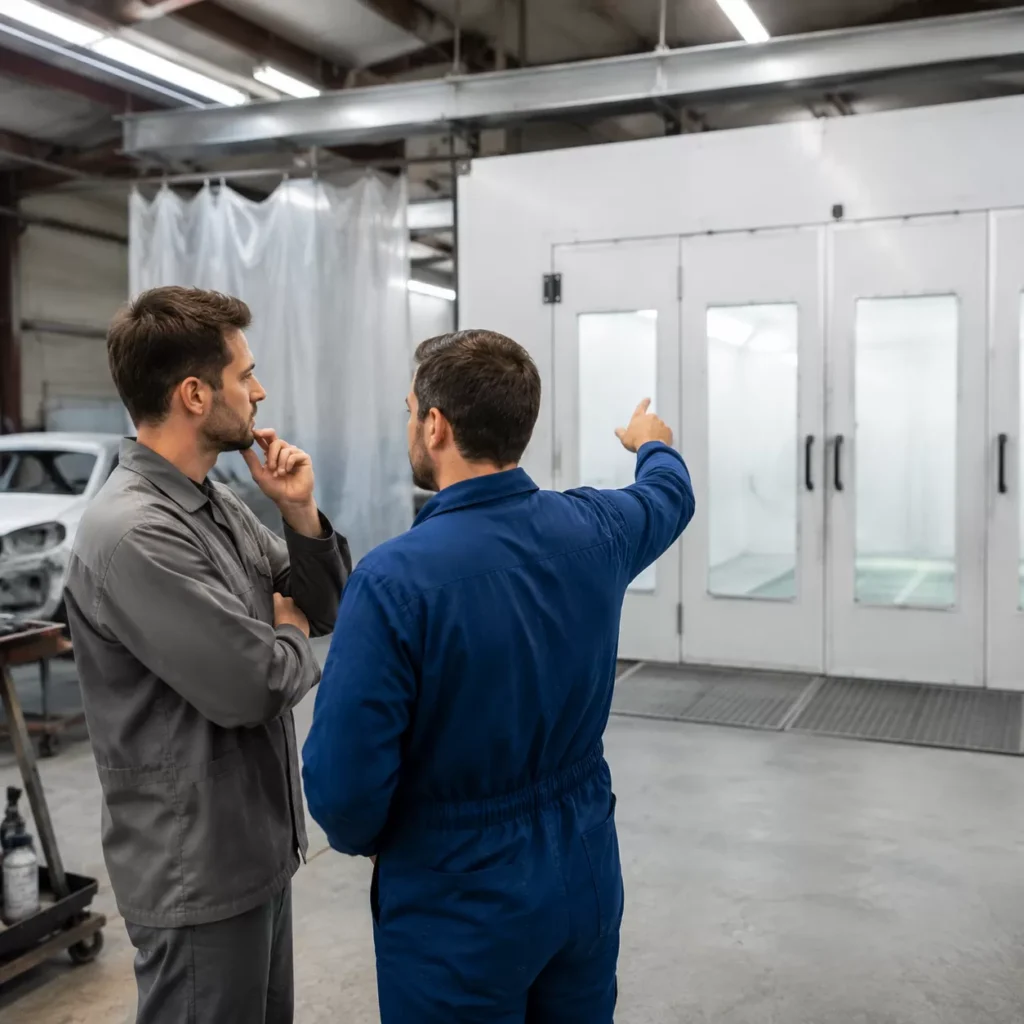
Shopping for a spray booth is one of the bigger decisions a shop owner makes, and there’s a lot of room to get it wrong. The mistakes aren’t always obvious up front — some only show up after installation, some show up at inspection, and some show up slowly on your utility bills over years of operation. This guide covers seven of the most common ones, why they happen, and what to check before you commit.
Page URL: https://sprayboothmanufacturer.com/product/
Mistake 1: Choosing Based on Upfront Price Alone
The cheapest booth on the market rarely stays cheap. Budget-grade units typically use thin-gauge steel that warps under pressure, low-quality motors that burn out under continuous load, and poor insulation that drives up your heating costs from day one. None of that shows up in the sticker price, but all of it shows up within the first year.
The right way to evaluate a booth is total cost of ownership over five or more years — not the purchase price in isolation. A booth that costs $5,000 more upfront but lasts twice as long with lower energy consumption and fewer repairs is the better investment by a wide margin.
| Cost Factor | Budget Online Booth | Quality Build |
|---|---|---|
| Initial Price | Low | Moderate to High |
| Lifespan | 2–5 years | 10+ years |
| Energy Usage | High — inefficient design | Low — proper insulation and motors |
| Downtime Risk | High — frequent component failure | Low — industrial-grade parts |
If a deal looks too good to be true at face value, look harder at what’s been cut to get to that price.
Mistake 2: Ignoring Local Codes Before You Buy
This one can shut your shop down before a single car gets painted. Local fire marshals have the authority to padlock your operation if the booth doesn’t meet code, and they will use it. It doesn’t matter how much you paid or how quickly you need it running.
The three bodies you need to satisfy are NFPA 33 (construction and ventilation standards for spray booths using flammable materials), OSHA (air velocity and worker safety requirements), and the EPA (VOC emissions limits for exhaust). All three apply regardless of booth size or operation type.
Electrical certification is where a lot of imported booths fail at inspection. Inspectors look for UL or ETL listed components on control panels, motors, and lighting. A booth without those certifications on paper is a problem that’s difficult and expensive to fix after installation.
| Certification | What It Covers |
|---|---|
| ETL Listed | Full assembly independently tested to US safety standards |
| UL Certified | Electrical components safe for vapor-rich environments |
| NFPA 33 Compliant | Construction, ventilation, and operational safety |
Talk to your local fire marshal before you purchase, not after. A ten-minute conversation can save you from a very expensive mistake.
Mistake 3: Picking the Wrong Airflow Design
The airflow configuration determines how clean your finishes come out. Getting it wrong means fighting contamination and overspray on every job, and no amount of technique makes up for a poorly designed system.
Crossdraft is the most affordable option. Air enters at the front and moves horizontally to the back exhaust wall. The problem is that overspray travels across the entire length of the vehicle as the air moves, which increases contamination risk on rear panels. For shops doing light or utility work, it’s workable. For high-end refinishing, it creates more buffing time than it’s worth.
Semi-downdraft and side-downdraft designs are practical middle options. Air comes from the ceiling and exhausts through the lower side walls, pulling overspray downward and away from the vehicle without requiring a concrete pit. These are a reasonable choice for shops that want cleaner results without the construction cost of a full downdraft.
Full downdraft is the cleanest setup available. Air enters through a filtered ceiling plenum and exhausts through floor pits beneath the vehicle. Gravity aids the working process. Overspray flows straight down away from painted surfaces, keeping the painter’s breathing area clean during the whole operation. For high-volume collision centers or shops doing premium work, it’s the right choice if the floor construction is feasible.
Mistake 4: Miscalculating the Space You Actually Need
A booth that fits the car doesn’t necessarily fit the workflow. Many shop owners only match booth size to vehicle dimensions while ignoring other factors, resulting in overly cramped working space inside the cabin.
Painters need at least three feet of clear space around all sides of the vehicle to move freely and maintain the right gun distance. You also need floor space inside the cabin for bumper stands and trim pieces being painted at the same time. Door clearances — both the vehicle entry doors and personnel access doors — need to open fully without hitting anything.
Outside the booth, NFPA 33 requires a minimum of three feet of clear space between the booth walls and any combustible structure or building wall. Fire officials enforce this mandatory rule for approval, which directly limits the actual placement position of the booth in your workshop.
A simple way to calculate what you need:
| Dimension | Formula |
|---|---|
| Internal Width | Max vehicle width + 6 feet |
| Internal Length | Max vehicle length + 6 feet |
| Internal Height | Max vehicle height + 2 feet |
| External Footprint | Internal dimensions + wall thickness + 6 feet NFPA setback |
Run these numbers before you finalize the booth size or sign off on a floor plan.
Mistake 5: Skipping the Air Makeup Unit
A booth without a heated Air Makeup Unit is limited by whatever the weather is doing outside. In cold or humid climates, that means extended flash times between coats, increased risk of dust settling in wet paint, and cure problems that show up as dulling, die-back, or solvent trap. In the middle of January in the Midwest, an unheated booth can essentially stop production.
Modern waterborne and low-VOC coatings require consistent temperature management to cure properly. The AMU is what delivers that — replacing exhausted booth air with fresh, tempered air at the right temperature to keep cure cycles on schedule regardless of conditions outside.
| Feature | Standard Heated Booth | Direct-Fired Gas AMU |
|---|---|---|
| Bake Cycle Speed | Slow — relies on gradual air temperature rise | Fast — hits target temperature quickly |
| Energy Efficiency | Low — runs longer to compensate | High — direct combustion, less waste |
| Daily Output | 2–3 cycles | 5–8+ cycles |
For shops trying to turn volume, the AMU is what makes the difference between three cars a day and eight.
Mistake 6: Forgetting Installation and Utility Costs
The spray booth purchase cost does not cover all expenses for full operation. Many shop owners overlook this point, and unplanned extra costs can greatly exceed the preset budget.
Electrical is usually the biggest surprise. Commercial spray booths with heavy exhaust fans and heated AMUs require serious amperage — often 3-phase power. Shops using regular single-phase power need to upgrade electrical panels first, which adds extra costs before the spray booth goes into use.
Gas lines for direct-fired burners need to be dedicated high-pressure runs to the unit. Existing shop gas lines usually aren’t sufficient.
Exhaust ducting needs to vent above the roofline, which means roof penetrations, flashing, and sealing — professional work that adds to the installation budget.
Fire marshals require fire suppression systems before all spraying work begins. These systems are seldom part of standard booth pricing, and certified contractors must complete their installation.
| Expense Category | What’s Involved |
|---|---|
| Electrical | 3-phase upgrade, dedicated panel, high-amperage lines |
| Gas | High-pressure line run to the heating unit |
| Structural | Roof penetrations, exhaust stack, concrete trenching if needed |
| Safety | Certified fire suppression system, permits, inspection |
Budget for all of these before the booth arrives, not after.
Mistake 7: Buying a Used Booth to Save Money
A used booth looks like a shortcut. It rarely works out that way. Problems arise right from relocation. Galvanized panels deform and lose sealing performance during disassembly and transit, while fittings are easily lost. After reassembly in a new site, the airflow status alters noticeably and is difficult to troubleshoot.
The bigger problem is compliance. Authorities have greatly tightened NFPA 33 rules over the years, and old spray booths often fail to meet current standards for official approval. If the unit doesn’t have a valid certification plate, getting local fire marshal approval is very difficult — sometimes impossible. A booth you can’t permit isn’t a bargain; it’s an expensive obstacle taking up floor space.
Used booths also come with worn motors, aging filters, and exhausted fans that will likely need replacement regardless — which means you end up spending close to new-booth money on a booth with no warranty and no parts availability guarantee.
| Feature | New Booth | Used Booth |
|---|---|---|
| Warranty | Full factory coverage | None — as-is |
| Parts | Guaranteed availability | Often discontinued |
| Compliance | Pre-certified | High risk of failure |
| Structural Integrity | Complete seal | Air leaks likely |
For most shops, the math on used equipment doesn’t hold up once you account for compliance risk, installation costs, and likely component replacement within the first year.
Tell Us What You’re Working With
Share your shop dimensions, vehicle types, and production volume. We’ll help you identify the right configuration and send a detailed quote — usually within 48 hours.
Related Pages
- Bus Spray Booth Design Guide → https://sprayboothmanufacturer.com/transit-coach-spray-booth-requirements/
- Truck Paint Booth Guide → https://sprayboothmanufacturer.com/truck-paint-booth-semi-truck-spray-booth-specifications-buying-guide/
- Other related products → https://www.autokemanufacture.com/product
- Contact our sales Team → https://sprayboothmanufacturer.com/contact-us/
✅ CE Certified | ✅ ISO 9001:2015 | ✅ Factory Direct | ✅ Ships to 60+ Countries | ✅ 1-Year Warranty | 🔒 HTTPS Secured