
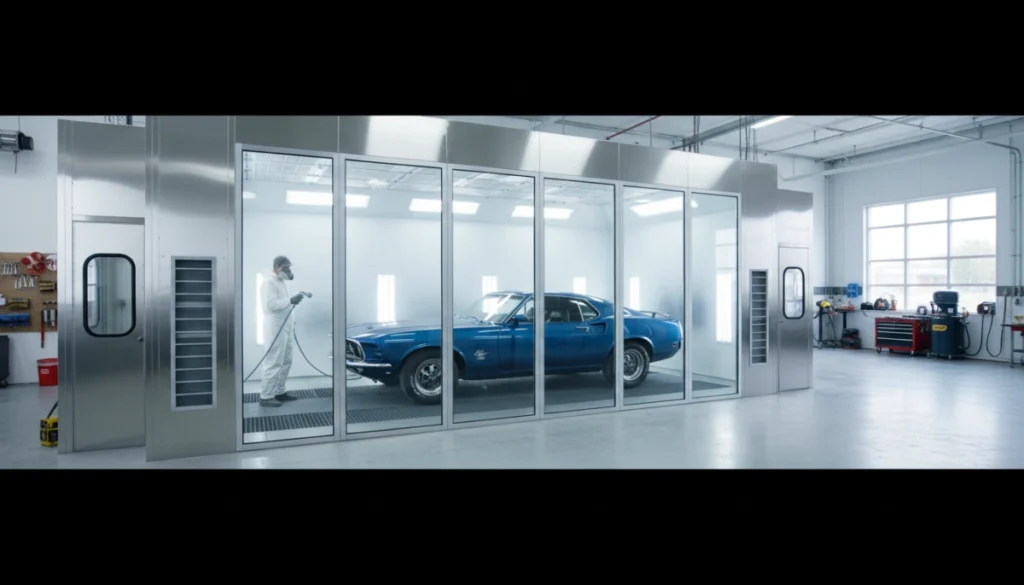
If you want better finish quality than a cross draft provides but can’t commit to the concrete pit that a full downdraft requires, the side draft paint booth sits in exactly the right place. It delivers ceiling-sourced filtered air and genuine overspray containment without any floor excavation. This guide covers how the airflow works, how it compares to other configurations, what installation involves, and what to stay on top of to keep it running well.
How a Side Draft Paint Booth Works
The Airflow Path
Clean air enters through filtered media in the ceiling plenum, creating downward pressure across the full width of the cabin. From there, instead of continuing to the floor like a true downdraft or moving horizontally to the back wall like a crossdraft, the air flows down over the vehicle and out through exhaust plenums built into the lower sections of the side walls.
This path creates what’s sometimes called a wrap-around effect. As the air moves from the ceiling toward the side walls, it envelopes the vehicle from above and pulls outward simultaneously — carrying overspray and paint mist away from the surface before it has a chance to settle back onto the wet finish. It’s a meaningfully different result from horizontal airflow, where contamination can travel across the entire vehicle before reaching the exhaust.
Key Components
The ceiling intake uses high-tack filter media designed to capture fine dust particles before they enter the cabin. The side exhaust plenums house the exhaust filtration media and are positioned to pull air over the shortest possible path from the vehicle surface to the filter. Industrial-grade fans — typically centrifugal or tube-axial — move enough air volume to maintain consistent cabin pressure throughout the spray and cure cycle. A manometer pressure gauge monitors filter loading and confirms the system is operating within balance.
Side Draft vs. Other Configurations
Side Draft vs. Cross Draft
A cross draft system moves air horizontally from the front of the booth to the rear exhaust wall. It works, but the path air takes over a vehicle means any dust picked up at the front of the booth travels across the entire job before exiting. In a side draft system, air enters from above and exhausts through the sides — the path is shorter and the contamination exposure is lower. The wrap-around effect also means the airflow is actively moving away from the vehicle surface rather than across it.
Side Draft vs. Full Downdraft
A true downdraft pulls air straight from the ceiling to a floor pit, which gives it the cleanest possible airflow pattern and the lowest contamination risk of any configuration. It’s also the most expensive to install because it requires either concrete pit excavation or a raised steel basement platform. For shops that can’t or don’t want to break the floor — leased spaces, high water tables, facilities with post-tension slabs — a side draft booth is the closest you can get to downdraft performance without touching the floor. You lose some of the directional purity of pure vertical airflow, but you gain a significantly cleaner environment than any horizontal configuration provides.
Side Draft vs. Semi-Downdraft
A semi-downdraft brings air in through the ceiling but exhausts it through the rear wall, which means the air follows a diagonal path across and toward the back. That diagonal movement can cause overspray to drift horizontally over the vehicle surface before reaching the exhaust. In a side draft setup, air splits outward toward both side walls simultaneously, which shortens the travel distance and keeps the pressure more evenly balanced across the full width of the cabin.
| Airflow Type | Pit Required | Finish Quality | Best For |
|---|---|---|---|
| Side Draft | No | High | Automotive refinishing, industrial coating |
| Cross Draft | No | Basic | Budget shops, wood finishing, small parts |
| Semi-Downdraft | No | Moderate | General purpose, leased spaces |
| Full Downdraft | Yes | Superior | High-volume premium collision centers |
Why Shops Choose Side Draft
Finish Quality Without the Construction Cost
The most common reason shops choose a side draft setup is that it delivers a meaningfully cleaner finishing environment than a crossdraft without the cost and permanence of pit excavation. Overspray is pulled away from the vehicle surface quickly, which reduces the contamination that ends up in the clear coat. Less contamination means less time wet sanding and buffing after every job — and for a shop doing volume, that labor difference adds up fast.
No Floor Excavation Required
A side draft booth mounts directly on a flat concrete slab. There’s no digging, no concrete work, and no permanent modification to the facility. For shops in leased spaces, this is a significant practical advantage — you can install a professional finishing environment without losing your security deposit or violating your lease agreement. If you move locations, the booth can move with you.
Painter Safety and VOC Control
Because air enters from above and moves down and outward, fumes and paint particles are actively drawn away from the painter’s breathing zone rather than through it. This is a better safety profile than a cross draft system, where air passes across the painter’s working area, and it keeps VOC concentrations at the work position lower throughout the spray cycle.
Space Flexibility
Side draft booths don’t require the overhead clearance of a full ceiling intake plenum system or the floor depth of a pit. For shops with low ceiling heights or limited vertical clearance, this makes the side draft configuration viable where other options aren’t. It’s the configuration that tends to fit best in older buildings and commercial spaces not originally designed for paint finishing.
Equipment Features Worth Understanding
LED lighting designed for color accuracy and shadow-free coverage matters for paint matching. A lighting system that creates shadows or shifts colors makes accurate spraying difficult and increases the chance of uneven coverage that only becomes obvious outside the booth.
Filtration quality directly controls what reaches the vehicle surface. Premium intake filters paired with properly rated exhaust media are what produce consistent results. Cutting corners on filter media is the fastest way to end up with contamination problems that take far longer to fix than they would have cost to prevent.
Heavy-gauge galvanized steel construction handles the daily exposure to solvents, waterborne paints, and humidity without corroding or degrading the structural integrity of the panels. Tight panel connections also keep the pressure balance stable — gaps in the structure are gaps in contamination control.
Variable Frequency Drives (VFDs) on the fan motors allow airflow to be adjusted to actual demand rather than running at a fixed speed throughout the cycle. This helps maintain consistent cabin pressure during different stages of the job and reduces energy consumption compared to fixed-speed systems.
Installation and Compliance
NFPA 33 and OSHA Requirements
A side draft booth operating in a professional spray finishing environment needs to meet NFPA 33, which governs spray applications using flammable or combustible materials, and OSHA regulations for worker protection and VOC exposure limits. Both are mandatory, not optional. Local fire marshals and building inspection departments may also have additional requirements that vary by city or county — verify these before installation begins, not after.
Fire Suppression
A certified fire suppression system is required for any commercial spray operation. Modern side draft booths are designed to accept dry chemical or clean agent systems, and the suppression system needs to be wired directly to the booth’s control panel so that a fire detection event immediately shuts down the exhaust fans and cuts power to spray equipment. This interlock isn’t a feature — it’s a code requirement.
Ductwork
The exhaust path from the side plenums to the exterior needs to be as direct as possible. Every bend in the ductwork creates resistance that reduces airflow velocity and degrades exhaust efficiency. Seal all duct connections with code-approved sealant to prevent fumes from leaking back into the shop. The exhaust stack needs to terminate at the correct height above the roofline with a proper weather canopy to keep rain and debris out of the system.
Maintenance: What Keeps Performance Consistent
Filter Replacement
Ceiling intake filters should be inspected weekly. In a high-volume shop, replacement every two to four months keeps the incoming air clean and prevents the fan system from working harder than it needs to. Exhaust filters load much faster because they’re capturing wet overspray — plan on replacing these every 50 to 100 hours of spray time, and check them more frequently during heavy production periods.
Exhaust Plenum Cleaning
Over time, paint solids can bypass the filter media and accumulate inside the plenum walls. Heavy buildup disrupts the wrap-around airflow pattern, creates stagnant zones inside the cabin, and is a fire hazard. Clean and vacuum the exhaust plenums at least annually — more often in high-volume operations.
Manometer Monitoring
The manometer is the most useful tool for knowing when filters need attention. Record the pressure readings when filters are brand new to establish a clean baseline. When pressure climbs past the manufacturer’s recommended limit — typically around 0.5 inches of water column — the filters are loaded and need to be swapped. Don’t wait for visible contamination in the finish to act on what the gauge is already telling you.
| Component | Action | Frequency |
|---|---|---|
| Intake Filters | Inspect for loading and gaps | Weekly |
| Exhaust Filters | Check for heavy loading | Daily during production |
| Exhaust Plenum | Deep clean paint buildup | Annually |
| Manometer | Check pressure readings | Every spray session |
| Fan Belts | Inspect tension and wear | Quarterly |
Common Questions
Is a side draft booth better than a cross draft for professional work? For most automotive refinishing and industrial coating applications, yes. The ceiling intake and side exhaust path produces a wrap-around airflow that controls overspray significantly better than horizontal airflow does. You avoid the dead zones that cross draft systems can develop, and the finish requires less post-paint correction work.
How much extra space does the side plenum add? Leave at least 3 feet of clearance around the exterior of the booth for the side exhaust plenums. That space is also what gives you comfortable access for filter changes and regular maintenance without squeezing into tight corners. The overall footprint increase over a cross draft booth of the same interior dimensions is modest.
Can I add heating later? Yes. An Air Makeup Unit can be added after installation without major modifications to the booth structure. A heated AMU gives you controlled curing temperature, accelerated bake cycles, and consistent cabin conditions year-round — all of which improve throughput and finish quality once you’re ready for that investment.
Does a side draft booth require any floor work? No — and that’s the point. The exhaust exits through the side walls, not the floor, so there’s nothing to excavate. The booth installs directly on an existing flat slab. If your situation ever changes and you need to relocate, the booth moves without leaving anything behind in the floor.
Tell Us What You’re Working With
Share your facility dimensions, ceiling height, vehicle types, and weekly production volume. We’ll spec out the right side draft paint booth setup for your operation and send a detailed quote with layout drawings — usually within 48 hours.
Related Pages
- Bus Spray Booth Design Guide → https://sprayboothmanufacturer.com/transit-coach-spray-booth-requirements/
- Truck Paint Booth Guide → https://sprayboothmanufacturer.com/truck-paint-booth-semi-truck-spray-booth-specifications-buying-guide/
- Other related products → https://www.autokemanufacture.com/product
- Contact our sales Team → https://sprayboothmanufacturer.com/contact-us/
✅ CE Certified | ✅ ISO 9001:2015 | ✅ Factory Direct | ✅ Ships to 60+ Countries | ✅ 1-Year Warranty | 🔒 HTTPS Secured