
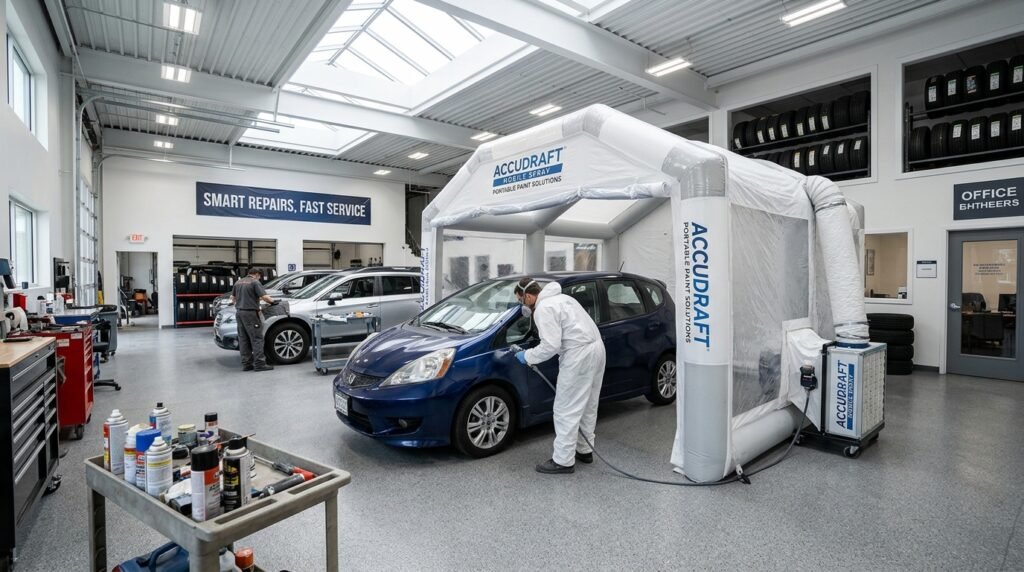
Looking for a portable spray booth for a small auto repair shop? This guide covers compact booth options, what specs actually matter, and how to pick the right setup for your space and budget.
Page URL: https://www.autokemanufacture.com/
Portable Spray Booth for Small Auto Repair Shops: Compact Car Spray Booth Options & Buying Tips
If you’re running a small auto repair shop and trying to figure out your spray booth situation, you’ve probably already looked at portable and inflatable options. They seem like the obvious answer when space is tight and the budget isn’t unlimited.
But there’s a gap between what looks like the right solution and what actually works day to day in a busy shop.
This page is honest about that gap. We’ll cover what portable and inflatable booths can and can’t do, what a compact stationary booth actually costs and delivers, and what to look for before you spend money on either.
Portable and Inflatable Booths: What You Should Know Before Buying
The appeal is obvious. They’re cheap, they ship fast, and you can set them up without any construction. For a shop that only occasionally needs a booth, or for someone just getting started, that can make sense.
But for a shop using a booth regularly, the problems show up quickly:
They don’t hold up. Inflatable tents and soft-wall enclosures aren’t built for daily use. Punctures, tears, and worn seams are common within the first year. Replacing them regularly adds up faster than most people expect.
The airflow isn’t there. A clean finish depends on consistent, controlled airflow pulling overspray away from the surface. Most portable setups can’t maintain this reliably. You end up with contamination in the finish that takes time to fix.
They can’t handle real heating systems. If you want to run proper bake cycles to cure paint properly, you need a booth that can safely contain the heat. Inflatable and soft-wall enclosures aren’t built for that. This limits your finish quality and slows down your cycle time.
If you’re doing occasional touch-up work, a portable setup might be fine. If you’re doing full paint jobs regularly, it’s going to hold you back.
Compact Stationary Booths: The Practical Alternative
A compact stationary booth — 6 meters or 7 meters — gives you the same core performance as a full-sized industrial booth, scaled down to fit a smaller footprint.
For most small shops, this is the better investment. Here’s why:
It does the job properly. Rigid walls, a real ventilation system, and integrated heating mean you can paint to a professional standard every time. You’re not working around the limitations of a temporary setup.
It’s built to last. Heavy-duty wall panels, copper-core motors, and proper floor grating are standard on a well-made compact booth. These don’t need replacing every year.
It keeps you compliant. A proper stationary booth with multi-stage filtration and documented specs is what local fire codes and EPA standards are looking for. A portable tent usually isn’t.
It adds value to your business. A permanent installation signals a professional operation to customers and makes your shop easier to sell if you ever decide to move on.
6-Meter vs 7-Meter: Which Size Do You Need?
For most small shops, the choice comes down to these two sizes.
6-meter booth — fits compact cars, sedans, and smaller SUVs comfortably. Good for shops where most work is on smaller passenger vehicles. It saves floor space without giving up much in terms of what you can paint.
7-meter booth — gives you extra clearance for full-sized sedans, modern SUVs, and light trucks. If you’re doing bigger vehicles regularly, the extra meter makes a real difference in how comfortably your painters can move around the vehicle.
| 6-Meter Model | 7-Meter Model | |
|---|---|---|
| Best for | Compacts, sedans, small parts | SUVs, full-sized sedans, light trucks |
| Airflow capacity | 25,000 m³/h | 30,000 m³/h |
| Heating options | 30KW electric / Diesel G10 | 38KW electric / Diesel G20 |
| Ventilation setup | 2 × 3KW intake fans | 2 × 4KW intake fans |
| Floor | Non-slip full grille | Non-slip full grille |
If you’re working on longer wheelbase trucks or extended vans regularly, consider stepping up to an 8-meter model. The 6 and 7 meter options are the right fit for standard passenger vehicles.
Alloy Wheel and Small Parts Booths
If a big part of your work is rim restoration or small component painting, a full car booth isn’t always the right tool.
Smaller dedicated booths for wheels and parts let you paint and bake in a separate space, which keeps your main booth free for larger jobs. This is one of the most effective ways to increase daily output without adding a second full booth.
These units are compact, purpose-built, and often include an integrated curing oven. If wheel work is a significant part of your revenue, it’s worth looking at seriously.
What to Check Before You Buy
Space and Clearances
Before you order anything, measure your bay properly. You need the booth’s footprint plus space for door swing, ventilation ducting, and a safe perimeter around the booth as required by local fire codes.
Inside the booth, painters need room to move comfortably around the vehicle with a spray gun without getting close to wet panels. A booth that fits the car but not the painter creates problems.
Ventilation
For a small shop booth, the industry benchmark is 25,000 to 30,000 m³/h of airflow capacity. This is what you need to keep the cabin clear of overspray and give your painters a safe, clean environment.
Check the fan motor specs — 7KW intake fans with a 2×3KW exhaust setup is a solid baseline for a 6-meter booth. If the numbers are significantly lower, the booth will struggle to maintain proper airflow under real working conditions.
Heating
Your heating choice depends mainly on what your shop already has available.
Electric heating (30–38KW) — the right choice if you don’t have a gas line. Halogen systems with Quantum Emitter technology heat quickly, run cleanly, and don’t require fuel storage. Straightforward to install.
Diesel or gas burners — if you have gas available or prefer a fuel-based system, Italian-made Riello burners (G10 for 6m, G20 for 7m) are the industry standard. They heat up fast and are very reliable over the long term. Diesel versions need only a small fuel tank, which makes them practical for shops without gas lines too.
Both options can get you to proper bake temperatures. The choice is mostly about what your shop setup supports.
Filtration
A properly filtrated booth keeps your finishes clean and keeps you compliant. What you need:
- Intake filters — keeps dust from entering the booth
- Ceiling filters — for a dust-free downward airflow onto the vehicle
- Floor/exhaust filters — traps overspray before it exits, protects the fan motors
Multi-stage filtration is standard on any booth that meets EPA requirements. If a booth you’re looking at doesn’t specify this clearly, ask.
Build Quality
Two things to insist on regardless of price point:
Copper-core motors — they run cooler, handle sustained use better, and last significantly longer than aluminum-core alternatives. A shop running its booth every day will notice the difference within a year or two.
Non-slip grille flooring — supports the vehicle’s weight, allows proper downdraft airflow through the floor, and is safe for painters moving around in a confined space.
Lighting
Inside a compact booth, lighting placement matters more than in a large space because shadows are harder to avoid. Look for high-CRI LED lighting positioned both at the ceiling and at the sides. You need bright, even light to spot imperfections and match colors accurately before the vehicle leaves the booth.
Filter Maintenance: What to Expect
For a compact booth running regularly, here’s a reasonable maintenance schedule:
- Pre-filters — every 2–3 months, or roughly every 100–150 spray hours
- Ceiling filters — every 6–12 months
- Floor/exhaust filters — every 2–4 weeks depending on your paint volume
The floor and exhaust filters need the most frequent attention because they’re catching the bulk of the overspray. Letting them go too long causes airflow to drop, which affects both your finish quality and your compliance.
Customization for Tight Spaces
Not every small shop has a standard rectangular bay with a convenient place to run ducting. If your space has low ceilings, an unusual shape, or access constraints, it’s worth talking to the manufacturer about options before you buy.
Things that can usually be adjusted:
- Motor placement — intake and exhaust fans can often be side-mounted or rear-mounted instead of top-mounted to deal with ceiling height limitations
- Door configuration — entry door size and swing direction can be adjusted to fit your vehicle workflow
- Heating system — swapping between electric and fuel-based heating based on your utility situation
Common Questions
Can a standard car fit in a 6-meter booth? Yes — a 6-meter booth is well-suited for most sedans, coupes, and compact SUVs. It gets tight with long-wheelbase pickups or extended vans. For those, the 7-meter or 8-meter model is a better fit.
Do I need permits for a stationary booth? Almost certainly yes. A permanent stationary booth is subject to local fire codes and EPA regulations around ventilation, filtration, and installation. A booth with proper certifications and documented specs makes this process much easier. Check with your local fire marshal about ducting and installation requirements before you commit to a location.
What if my shop doesn’t have a gas line? Electric halogen heating is a solid option that doesn’t require any fuel infrastructure — just the right electrical capacity. Diesel Riello burners are another option that only needs a small fuel tank on-site. Either works well; the choice depends on what’s more practical for your setup.
Why not just use an inflatable booth? For occasional light work, an inflatable booth can be fine. For regular professional painting, the airflow is inconsistent, it can’t safely support a real heating system, and it wears out fast. A compact rigid booth costs more upfront but delivers proper results and doesn’t need replacing every year or two.
Not Sure Which Size Fits Your Shop?
Tell us your bay dimensions, the vehicles you typically work on, and your heating setup. We’ll tell you which booth makes sense and send a quote with a layout drawing — no pressure, just a straight answer.
[Get a Free Quote] [Download Spec Sheet] [Chat With an Engineer]
Related Pages
- Automotive Paint Booth for Sale →https://www.autokemanufacture.com/Autoke-car-spray-booth
- Downdraft vs Crossdraft Spray Booth →https://sprayboothmanufacturer.com/which-one-should-you-choose/
- Contact Our Sales Team →https://www.autokemanufacture.com/contact-us.html
✅ CE Certified | ✅ ISO 9001:2015 | ✅ Factory Direct | ✅ Ships to 60+ Countries | ✅ 1-Year Warranty | 🔒 HTTPS Secured