
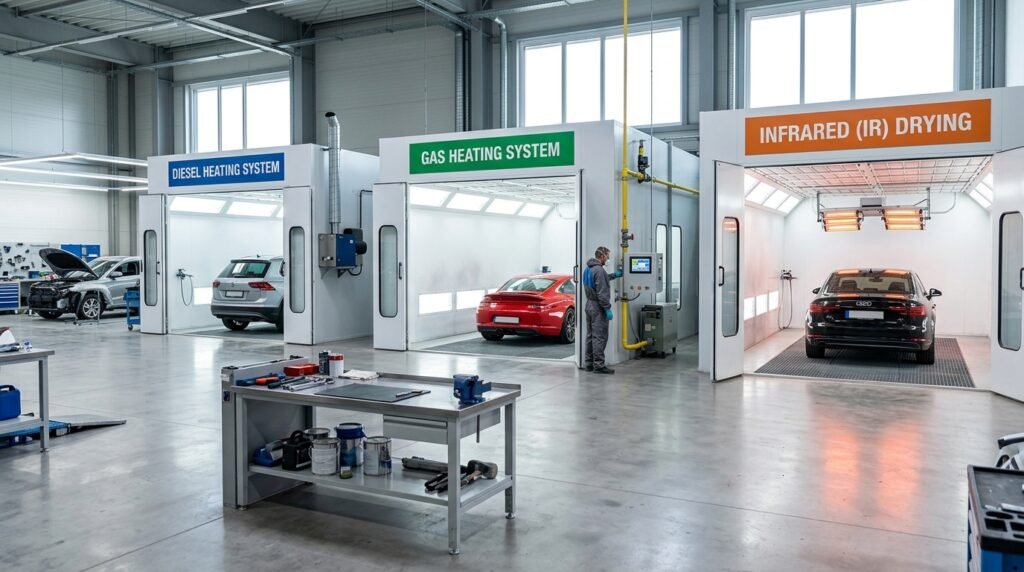
Diesel Heating Systems: The Rugged Traditionalist
If your shop is off the beaten path or located in an industrial park without a dedicated gas line, diesel heating systems are your reliable workhorse. I’ve seen these units perform consistently in the harshest winter conditions where other systems might struggle to keep up with the cold intake air.
How it Works: Diesel Burners and Heat Exchangers
The mechanics are straightforward but effective. A diesel burner atomizes fuel under high pressure, igniting it within a combustion chamber. This heat is then transferred to the booth’s airflow via a stainless steel heat exchanger. The design ensures that the combustion exhaust is vented outside, while only clean, heated air enters the cabin to maintain a pristine finish.
The Pro-and-Con Breakdown
When evaluating a diesel setup for your curing cycle efficiency, consider these trade-offs:
- The Pros:
- Energy Independence: No need for expensive municipal gas infrastructure or high-voltage electrical upgrades.
- High BTU Output: Diesel provides an incredible punch of heat, allowing for rapid temperature climbs even in poorly insulated buildings.
- Portability: These systems are easier to relocate or install in temporary shop setups.
- The Cons:
- Routine Maintenance: You’ll need to stay on top of fuel filters and nozzle cleaning to prevent soot buildup.
- Fuel Price Volatility: Your operational cost per car is tied directly to the fluctuating price of diesel or heating oil.
- Storage Requirements: You must manage an on-site fuel tank and monitor levels to avoid downtime mid-spray.
Best For: Rural Shops and Infrastructure Gaps
We recommend a diesel-heated booth primarily for rural shops or locations where the cost of running a new gas line is prohibitive. If you need a “set it and forget it” heat source that can overpower a freezing January morning, this rugged technology remains a staple in the industry for a reason. Often, the initial investment is lower than high-end gas or electric systems, making it a viable entry point for growing businesses.
Gas Heating Systems: The Efficiency King
When weighing a Paint Booth with Diesel, Gas or Infrared Heating System: Which Is Best for Your Shop?, gas is consistently the top choice for American shops focused on high-volume production. It is the gold standard for reliability and provides the most stable thermal efficiency for a busy floor.
Direct-Fired vs. Indirect-Fired Systems
Choosing the right gas setup changes your operational cost per car and your air quality:
- Direct-Fired: This is the most popular choice for modern shops. The burner fires directly into the airstream, achieving nearly 100% efficiency. It offers the fastest curing cycle efficiency and rapid temperature rises.
- Indirect-Fired: These units use a heat exchanger to keep combustion byproducts separate from the booth air. While it’s slightly less efficient, it’s a solid choice for specialty finishes where air purity is the absolute priority.
The Pros: Why We Back Gas
- Minimal Maintenance: Unlike diesel, you don’t deal with soot buildup or clogged fuel filters.
- Precision Control: Gas allows for consistent temperature regulation, which is critical for meeting the tech specs of modern low-VOC paint curing.
- Clean Energy: It burns much cleaner than oil, extending the life of your ceiling filters and internal components.
The Cons: The Initial Hurdle
- Installation Costs: You’ll face a higher upfront investment for gas line plumbing and professional permits.
- Utility Dependence: Your shop must be located in an area with reliable Natural gas vs. Propane infrastructure.
Best For: High-Volume Collision Centers
If your goal is to maximize spray booth throughput and minimize the cost of every bake cycle, gas is your best bet. It’s designed for shops running multiple cycles a day that need a dependable, “set it and forget it” heating solution. Regardless of the outside temperature, a gas system keeps your production line moving without the headache of constant fuel deliveries.
Infrared (IR) Heating Systems: The Precision Specialist
When you’re comparing a paint booth with diesel, gas or infrared heating system, infrared is the surgical tool of the group. I’ve seen this tech completely change the workflow for shops that prioritize speed on a per-panel basis. It doesn’t waste energy warming up all the air in the booth; instead, it uses radiant heat technology to send energy directly into the panel.
The Science of Radiant Heat
In our experience, the biggest advantage here is how it cures. IR waves pass through the paint film and heat the substrate (the metal or plastic) directly. This means the paint cures from the “bottom up,” which practically eliminates solvent trap issues and leads to a massive flash-off time reduction. You aren’t waiting for the air to circulate; you’re getting heat exactly where it’s needed.
Pros of Electric Infrared (IR) Curing
- Lightning-Fast Cycles: We’re talking about curing parts in a fraction of the time required by convection.
- Targeted Heating: Perfect for spot repairs or single-panel jobs without firing up the main burner.
- Clean Energy: No combustion means zero risk of soot or fumes affecting the finish.
The Cons to Consider
- Line-of-Sight Limitations: If the lamp can’t “see” the surface—like deep recessed areas or complex bumper curves—it won’t heat it effectively.
- Electrical Load: These systems require a heavy-duty electrical setup. You need to make sure your shop’s panel can handle the high electrical demand.
Best For: High-Speed Precision
We usually recommend IR systems for custom shops, rapid-repair centers, and high-end detailing pros. If your business model relies on getting small-to-medium repairs out the door every hour, the precision of an IR system is hard to beat. It’s the ultimate setup for maximizing spray booth throughput on high-margin, quick-turnaround work.
Paint Booth with Diesel, Gas or Infrared Heating System: Side-by-Side Breakdown
Choosing the right setup means looking at the hard numbers. I’ve broken down how these systems stack up in a real-world shop environment so you can see which one protects your bottom line.
Heating System Cost and Performance Comparison
| Feature | Diesel Heating | Gas (Natural/Propane) | Infrared (IR) |
|---|---|---|---|
| Initial Investment | Moderate | High (Plumbing required) | Moderate to High |
| Operational Cost per Car | High (Fluctuating) | Lowest | Moderate (Electric rates vary) |
| Curing Cycle Efficiency | Good | Excellent | Fastest (Targeted) |
| Maintenance Needs | High (Filters/Soot) | Low | Minimal |
| Best Paint Match | Solvent-based | All types | Low-VOC & Waterborne |
Analyzing the Operational Cost per Car
When I look at long-term profitability, fuel consumption rates are the biggest factor.
- Gas systems win on daily overhead. While the plumbing costs more upfront, the cost per BTU is usually the lowest in most US states.
- Diesel offers independence but leaves you at the mercy of the pump.
- Infrared seems expensive on paper, but because it doesn’t waste energy heating the air, the thermal efficiency for spot repairs is unbeatable.
Curing Cycle Efficiency for Low-VOC Paints
Modern low-VOC paint curing requires precise temperature control to avoid solvent trap or die-back.
- Convection systems (Gas/Diesel) rely on high air turnover rates to pull moisture and solvents off the panel.
- Infrared technology cuts flash-off time reduction significantly by heating the coating from the inside out. This makes IR a game-changer for high-volume shops looking to increase spray booth throughput.
Environmental Impact and Emissions
Every shop in 2026 has to consider their carbon footprint.
- Gas burners are the cleanest combustion option, producing minimal soot and lower CO2 than diesel.
- Electric Infrared is the “greenest” at the point of use, especially if your local grid utilizes renewables.
- Diesel remains the toughest to manage regarding local air quality regulations due to particulate emissions.
- [Calculate your shop’s ROI](gemini://submit_prompt?text=Create+a+spreadsheet+template+to+calculate+painthttp://googleusercontent.com/interactive_content_block/0
- [Compare gas burner efficiency](gemini://submit_prompt?text=List
Choosing Your Paint Booth with Diesel, Gas or Infrared Heating System
Deciding which setup is right for your shop comes down to your local reality. You can’t just pick based on what the guy down the street uses. You have to look at your specific environment, your utility bills, and your bottom line.
Geographic Climate and BTU Requirements
Your location dictates your thermal efficiency needs. If you’re dealing with harsh northern winters, a system with a high BTU output is non-negotiable to maintain a steady bake.
- Cold Climates: Require massive heat raises to reach curing temperatures quickly without straining the burner.
- High Humidity: Affects flash-off time reduction, often requiring specialized airflow or IR assistance to move moisture out of the booth.
Shop Volume and Throughput
We measure success by your spray booth throughput. How many cycles are you running a day?
- High Volume (5+ cycles): You need a system with the highest curing cycle efficiency to keep the booth clear and the painters moving.
- Low Volume/Custom: You can afford to prioritize precision or lower initial equipment costs over raw speed.
2026 Local Utility Rates
The operational cost per car is heavily influenced by your local utility grid. In 2026, we see a wide gap in energy pricing depending on your state.
| Utility Type | 2026 Market Outlook | Best Match |
|---|---|---|
| Natural Gas | Most cost-effective for high-volume shops. | High-production urban centers. |
| Electricity | Powers Electric Infrared (IR) curing; check peak demand rates. | Custom shops and spot repairs. |
| Diesel/Propane | Best for independence from the grid; prices fluctuate. | Rural shops or areas without gas lines. |
Paint Specifications and Tech Sheets
Always match your heating system to your paint brand’s tech sheet. Modern low-VOC paint curing has very specific temperature windows that must be hit to ensure a durable finish.
- Waterborne Paints: These require consistent heat and high air turnover to evaporate water carriers effectively.
- Solvent-Based Paints: While more forgiving, they still require uniform temperatures to prevent solvent trap and die-back.
The Autoke Advantage: Engineering the Future of Curing
At Autoke, we don’t just sell equipment; we provide long-term solutions for your shop’s productivity. We know that choosing a Paint Booth with Diesel, Gas or Infrared Heating System is a big investment, which is why our engineering focuses on flexibility and “future-proofing” your workspace.
Hybrid-Ready Designs and Easy Retrofitting
The industry is moving fast, and your shop needs to keep up. We specialize in retrofitting heating systems and building hybrid-ready designs.
- Adaptability: If you start with diesel today but want to switch to gas or add infrared later, our booths are built to handle the transition.
- Cost-Effective Upgrades: You don’t need to replace your entire booth to get better tech. Our systems integrate into your existing setup to improve spray booth throughput immediately.
Heat Exchanger Durability and Component Strength
A heating system is only as good as its weakest part. We focus on heavy-duty construction to ensure your booth stays running during your busiest seasons.
- High-Grade Stainless Steel: Our heat exchanger durability is industry-leading, resisting the cracks and corrosion common in cheaper units.
- Precision Burners: Whether you use gas or diesel, our burner components are engineered for consistent ignition and thermal efficiency.
Case Study: Cutting Cycle Times for a Local Shop
We recently worked with a high-volume collision center in the Midwest that was struggling with slow bake times and rising fuel costs. By upgrading them to an Autoke high-efficiency system, the results were clear:
| Performance Metric | Before Autoke | After Autoke Upgrade |
|---|---|---|
| Bake Cycle Time | 45 Minutes | 28 Minutes |
| Fuel Consumption | High | 20% Reduction |
| Daily Vehicle Count | 6 Cars | 9 Cars |
By focusing on curing cycle efficiency, this shop was able to increase its daily output without adding a second booth, proving that the right heating tech is the ultimate force multiplier for your bottom line.
Common Questions: Choosing a Paint Booth with Diesel, Gas or Infrared Heating System
We get a lot of questions from shop owners trying to decide which setup will actually move more cars through the door. Here are the straight answers on the Paint Booth with Diesel, Gas or Infrared Heating System options we offer.
Which heating system has the lowest daily operating cost?
In the United States, natural gas is almost always the winner for high-volume shops. It offers the lowest operational cost per car because utility rates are generally more stable than diesel prices. While a diesel heating system is great for rural areas without gas lines, the fuel and maintenance costs add up. For small spot jobs, Electric Infrared (IR) curing is actually the cheapest because you only heat the panel, not the entire booth.
Can I switch from diesel to gas heating in my existing booth?
Yes, retrofitting heating systems is a service we handle frequently. Most rugged booth frames can accommodate a burner swap. It typically requires:
- Installing a new gas-fired burner unit.
- Running a municipal gas or propane line to the booth.
- Updating the control panel to manage gas safety valves.
This switch significantly improves thermal efficiency and cuts down on messy fuel deliveries.
Does infrared heating work effectively with waterborne paints?
It works exceptionally well. Because radiant heat technology penetrates the paint layer to heat the substrate, it forces moisture out from the bottom up. This leads to a massive flash-off time reduction for waterborne coatings, which can otherwise be sluggish in humid climates. It’s one of the best ways to increase your spray booth throughput for modern, eco-friendly paints.
How often do I need to maintain a gas burner vs. a diesel burner?
Maintenance needs vary wildly between these two:
- Diesel Burners: Require frequent attention. You’ll need to change fuel filters, clean nozzles, and check the heat exchanger for soot buildup every few months to maintain curing cycle efficiency.
- Gas Burners: These are “set it and forget it” for the most part. A professional tuning once a year is usually all it takes to keep your paint booth maintenance costs low and your temperatures consistent.
Quick Comparison: Maintenance and Cost
| System Type | Maintenance Level | Best Use Case |
|---|---|---|
| Diesel | High | Rural/Off-grid shops |
| Gas | Low | High-production collision centers |
| Infrared | Minimal | Custom work and rapid spot repairs |