
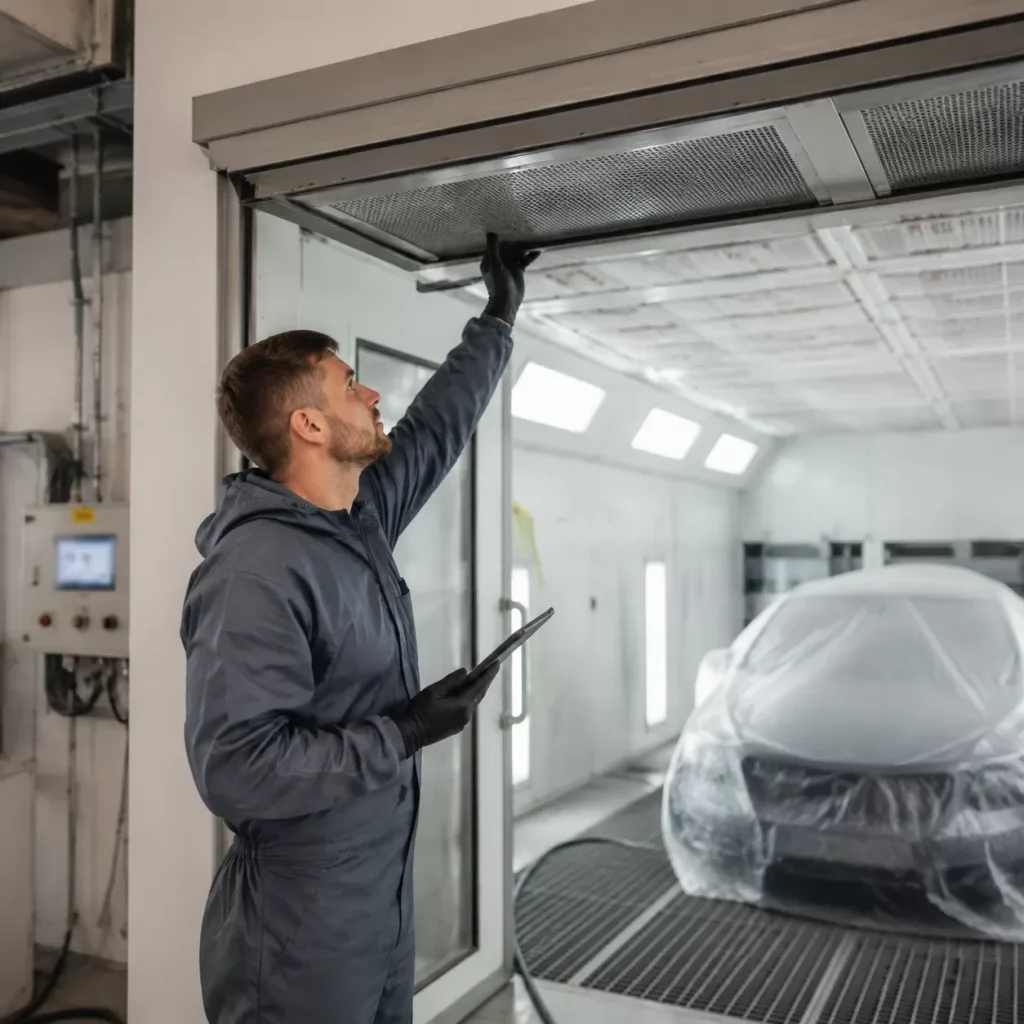
When a paint booth won’t hit its baking temperature, everything behind it in the queue stops moving. Soft clear coats, extended cycle times, and the risk of solvent pop or under-curing add up fast — and the longer the booth runs below target, the more money walks out the door. The good news is that most heating failures trace back to one of three areas: airflow, combustion, or heat containment. This guide walks through the common causes, how to diagnose them in order, and what to do when environmental conditions are working against you.
Page URL: https://sprayboothmanufacturer.com/product/
The Five Most Common Reasons a Booth Won’t Heat Up
1. Clogged Intake or Exhaust Filters
This is the first thing to check because it’s the most common cause and the easiest to confirm. A direct-fired gas burner needs a specific volume of air moving through the system to transfer heat into the cabin. When intake or exhaust filters are loaded with overspray, air velocity drops — and the heat simply can’t circulate the way it needs to.
The indicator is a manometer reading higher than normal static pressure. If airflow inside the cabin feels sluggish or the booth is taking significantly longer than usual to warm up, check both the ceiling intake filters and the floor exhaust filters before anything else. Replace them if there’s visible loading and recheck the pressure reading.
2. Burner and Fuel Issues
If airflow is fine but the temperature still isn’t climbing, the problem is likely in the combustion system. Three things commonly go wrong here:
Low gas manifold pressure prevents the burner from reaching its full output. If the gas pressure at the unit drops below the manufacturer’s spec, the flame will be too weak to bring the cabin up to bake temperature regardless of how long it runs.
Soot and overspray buildup on the burner profile plates disrupts the flame pattern and reduces combustion efficiency. A burner that looks dirty almost certainly isn’t performing at full capacity.
A faulty igniter or failing flame sensor causes short-cycling — the burner fires, shuts off before the cabin heats up, fires again, and never builds sustained heat. This one usually needs component replacement rather than cleaning.
3. Temperature Sensors Out of Calibration
Sometimes the booth is actually generating heat, but the control system doesn’t know it — or is reading it incorrectly. A PID controller that’s out of calibration may under-fire the burner based on a bad signal. A damaged or corroded thermocouple may shut the burner down early because it’s reading the cabin as hotter than it actually is.
| Component | Failure Mode | Effect on Bake Cycle |
|---|---|---|
| PID Controller | Out of calibration | Burner under-fires or won’t reach full output |
| Thermocouple | Corrosion or physical damage | Misreads cabin temp, causes early shutdown |
If your panel shows the target temperature but the actual cabin feels cool, thermocouple calibration is where to start.
4. Exhaust Damper Problems and Air Balance
The switch from spray mode to bake mode depends on dampers working correctly. When the exhaust damper stays wide open during a bake cycle, the booth is continuously dumping heated air out the stack — essentially trying to bake an open oven.
A mismatched air balance creates a different problem. If the exhaust fan is pulling more CFM than the supply fan is pushing, the booth runs at negative pressure and draws in cold shop air through any gap it can find. Both issues result in the same symptom: the burner runs, the booth never gets hot enough, and fuel gets wasted throughout.
5. Door Seals and Panel Gaps
A well-tuned burner won’t overcome significant thermal leaks in the booth envelope. Worn or cracked door seals around vehicle entry doors and man doors allow heated air to bleed out continuously — not dramatically, but enough to prevent the booth from building and holding temperature. Loose wall panels with unsealed gaps do the same thing.
Run your hand along door seals while the booth is at operating temperature. Any noticeable airflow coming through means heat is leaving the same way.
Step-by-Step Diagnostic Routine
Work through these in order. Most heating failures are resolved before Phase 3.
Phase 1: Basic Checks First
Before touching any components, confirm the simple things. Check door seals for obvious gaps or hardened rubber. Make sure the controller is actually set to bake mode and not a high-temperature spray setting. Clear anything inside the cabin that might be blocking heat vents.
Phase 2: Airflow Verification
| Checkpoint | What to Look For | Action |
|---|---|---|
| Intake Filters | Heavy overspray buildup, gray or brown fiber mats | Replace immediately |
| Static Pressure Manometer | Reading outside normal operating range | Adjust exhaust damper to restore balance |
| Drive Belts | Loose or slipping pulleys on intake or exhaust fans | Tighten or replace worn belts |
Phase 3: Burner and Thermal Core
If airflow checks out and the cabin is still not heating, look at the combustion system directly.
Watch the flame through the sight glass. A clean, steady blue flame means the burner is firing correctly. A lazy yellow or orange flame points to incorrect gas pressure or a bad air-to-fuel ratio. Check gas manifold pressure against the manufacturer’s spec — if it’s low, that’s your answer. If pressure is fine, run a thermocouple calibration to confirm the sensor is reading accurately.
How Environmental Conditions Make Things Worse
Cold Weather
Winter is hard on bake cycles for straightforward reasons. The AMU draws in outside air, and heating 30°F ambient air up to a 140°F bake temperature requires significantly more BTUs than the same job in summer. If the burner isn’t calibrated for seasonal temperature swings, it may technically be running at full capacity while still falling short of the target.
Cold weather also causes gas supply pressure to fluctuate, which can starve the burner at the worst moments. Uninsulated exhaust ductwork running through a cold shop or venting outside radiates heat away before it ever reaches the cabin — a significant but easy-to-miss efficiency drain.
Heavy Steel as a Heat Sink
The vehicle inside the booth affects heating performance more than most people account for. Large metal structures absorb thermal energy from the air around them — the booth air may reach target temperature while the actual metal surface stays cold for much longer.
| Payload Type | Thermal Behavior | Effect on Bake Cycle |
|---|---|---|
| Aluminum or plastic panels | Heats quickly | Normal cycle times |
| Standard passenger vehicles | Moderate heat absorption | Standard warm-up phase needed |
| Heavy steel frames | Pulls heat out of the air | Extended cycle time, PID lag |
If your PID is reading air temperature rather than panel temperature, the coating may appear to have cured while the substrate is still cold underneath. For heavy commercial vehicles or structural steel work, plan for extended bake times and account for the metal mass in your cycle programming.
Preventing Heating Failures: Maintenance Schedule
Most bake cycle failures are predictable and avoidable. A consistent maintenance routine catches the problems — filter loading, seal degradation, sensor drift — before they become mid-shift breakdowns.
| Frequency | Area | Action |
|---|---|---|
| Daily | Filters and pressure | Check manometer readings, inspect intake filters for overspray buildup |
| Weekly | Seals and exhaust | Check door seals for drafts, verify exhaust fan output, clear debris from dampers |
| Monthly | Burner and controls | Check gas manifold pressure, inspect burner flame, run thermocouple calibration |
If your shop regularly works with heavy payloads or operates in cold climates, upgrading to a higher-capacity AMU is worth evaluating. Modern units regulate airflow balance automatically, deliver heat more directly into the cabin, and ramp up to bake temperature faster — which shortens cycle times and reduces fuel consumption per job.
FAQ
Why is my booth taking so long to heat up? The most common cause is restricted airflow from loaded intake or exhaust filters. When filters are clogged, the AMU can’t circulate enough air across the burner to build cabin temperature efficiently. Other frequent causes include a slipping fan belt, a misadjusted damper stuck partially open, or uninsulated ductwork losing heat before it reaches the cabin. Start with the filters and manometer reading before anything else.
How do I know if my burner is failing? Watch the flame quality. A healthy burner produces a steady blue flame. Yellow or orange flames indicate incorrect gas pressure or a bad air-to-fuel mix. If the burner is short-cycling — firing and shutting off repeatedly without building temperature — the thermocouple or PID controller is the likely cause and needs calibration or replacement.
What temperature should a paint booth reach for baking? For standard automotive refinishing, target metal temperature — not air temperature — should be between 140°F and 160°F (60°C to 71°C).
| Coating Type | Target Temp | Typical Cycle Time |
|---|---|---|
| Standard clearcoats and primers | 140°F–145°F | 30–45 minutes |
| High-solids production clears | 150°F–160°F | 20–30 minutes |
Always calibrate your readings against the actual panel surface temperature, not just the air inside the cabin.
Can clogged filters actually cause the booth to fail to heat? Yes. When filters restrict airflow enough to spike static pressure beyond the AMU’s safety threshold, the high-limit switch shuts the burner down entirely as a safety measure. The booth runs, the burner stops, the cabin never heats — and the job is left uncured. It’s one of the more frustrating failure modes because the system appears to be operating normally right up until it doesn’t.
Tell Us What You’re Working With
Share your booth model, heating system specs, and the symptoms you’re seeing. We’ll help diagnose the issue and identify the right parts or configuration adjustment — usually within 48 hours.
Related Pages
- Bus Spray Booth Design Guide → https://sprayboothmanufacturer.com/transit-coach-spray-booth-requirements/
- Truck Paint Booth Guide → https://sprayboothmanufacturer.com/truck-paint-booth-semi-truck-spray-booth-specifications-buying-guide/
- Other related products → https://www.autokemanufacture.com/product
- Contact our sales Team → https://sprayboothmanufacturer.com/contact-us/
✅ CE Certified | ✅ ISO 9001:2015 | ✅ Factory Direct | ✅ Ships to 60+ Countries | ✅ 1-Year Warranty | 🔒 HTTPS Secured