
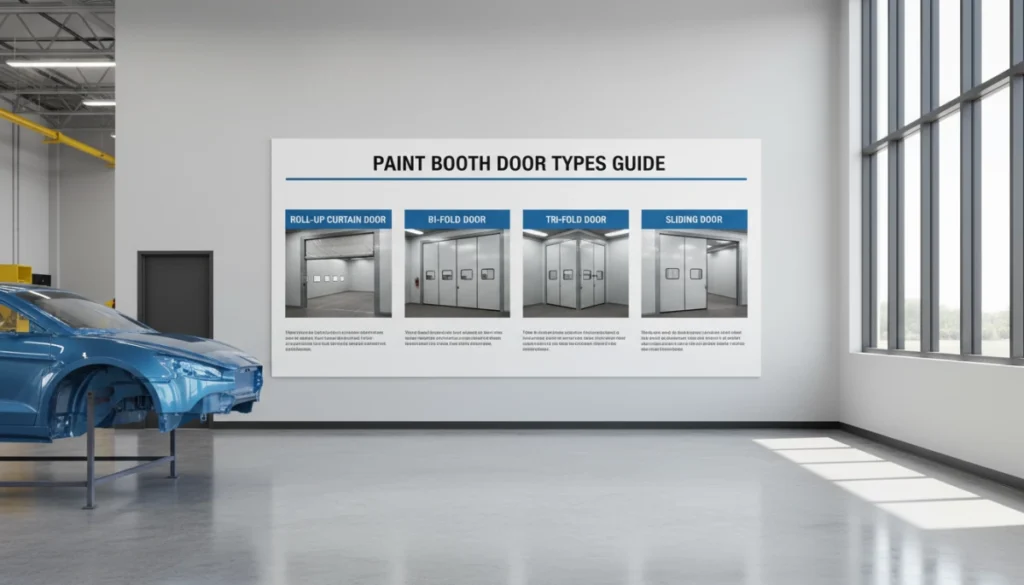
The door system is one of the most overlooked parts of a paint booth purchase, but it has a direct effect on finish quality, airflow performance, and daily workflow. A door that doesn’t seal properly doesn’t just let in dust — it disrupts the static pressure balance the entire booth depends on, pulling unfiltered shop air directly into the spray zone. This guide covers the main door configurations, what the personnel door requirement is about, what the technical specs actually mean, and how to keep the system performing over time.
Page URL: https://sprayboothmanufacturer.com/product/
Why the Door System Matters More Than Most People Realize
The booth door is the primary barrier between your controlled finishing environment and the shop floor. When it fails to seat properly, the vacuum created by the exhaust system pulls unfiltered air in through the gap — carrying dust and debris directly onto wet paint. Even a small leak changes the pressure balance inside the cabin, creating airflow irregularities that affect spray pattern consistency and allow overspray to settle in areas it shouldn’t.
Beyond finish quality, door design has compliance implications. NFPA 33 requires that booth doors be built from non-combustible materials, equipped with explosion relief hardware, and designed to provide an unobstructed egress path in an emergency. These aren’t optional features — they’re what local fire marshals look for during inspection.
A well-designed door also protects the rest of the facility. Keeping overspray contained inside the booth rather than drifting into adjacent work areas is part of what makes a finishing operation safe and code-compliant.
The Four Main Door Configurations
Swing Doors (Wing Doors)
The traditional choice for most automotive refinishing shops. Swing doors come in two-leaf or three-leaf setups, open outward from the center, and provide a robust, reliable seal when properly maintained. They’re cost-effective, straightforward to service, and produce a tight fit that supports good static pressure control.
The limitation is space. A standard swing door needs a clear “swing zone” in front of the booth equal to roughly the full width of the door. If your shop layout places equipment or workstations close to the booth entry, that clearance requirement can become a real constraint.
Best for: Standard collision and refinishing shops with adequate floor space in front of the booth.
Bi-Fold Doors
Bi-fold doors fold in the middle as they open, cutting the required swing zone roughly in half compared to a standard swing door. They provide the same wide clear-span opening but work in tighter spaces where full outward swing isn’t possible.
When closed, a properly built bi-fold door maintains a clean interior profile that supports laminar airflow without creating gaps or irregular pressure points. For shops where the booth sits close to other workstations or walls, bi-fold is usually the right call.
Best for: Shops where floor space is limited and full swing clearance isn’t available.
Roll-Up and High-Speed Doors
Roll-up doors retract vertically into a coil above the opening, leaving zero footprint on the shop floor. In high-production industrial environments, this delivers a major advantage. Vehicles and large parts move in and out unobstructed, and vertical door movement eliminates the need for any extra side clearance space.
High-speed roll-up doors open and close rapidly, cutting down the time the booth interior stays exposed to the shop during loading and unloading. This is critical for dust control: every extra second the booth remains open allows airborne contaminants to get inside. High-speed door panels usually contain insulating material, which easily meets the heat requirements of paint baking cycles.
Best for: High-production automotive and industrial facilities, spray lines with frequent cycling, shops with large parts that need maximum opening width.
Sliding Doors
Sliding doors travel horizontally on a track rather than swinging or rolling up. They’re the right choice for aerospace, rail, or heavy equipment applications where the opening span is too large for any swinging door to handle structurally, and where vertical clearance for a roll-up isn’t available.
The trade-off is that the door needs clear wall space adjacent to the opening to slide into. If the booth sits against a wall or near other equipment on both sides, sliding doors may not work. But for wide openings on large industrial booths, they offer the most stable and reliable movement for heavy-duty use.
Best for: Aerospace, rail, large equipment, and powder coating operations with very wide openings.
The Personnel Door: The Most Overlooked Safety Requirement
Every paint booth needs a dedicated personnel door separate from the main equipment doors. This is a compliance requirement, not a convenience feature, and it’s the element most frequently missing in inadequate installations.
Why It’s Non-Negotiable
Emergency egress is the primary reason. In a fire or chemical incident, technicians need a fast, outward-swinging exit that doesn’t require navigating past a vehicle or waiting for a large door to open. The main equipment doors are designed for moving vehicles, not for emergency exit.
Pressure control is the operational reason. Every time the main door opens, it disrupts the cabin pressure balance and the airflow pattern inside the booth. Painters need to enter and exit the space regularly during a job — using a smaller personnel door for those movements preserves the static pressure that the finishing environment depends on.
Seal longevity is the maintenance reason. The heavy gasket seals on main equipment doors are designed for vehicle entry, not frequent foot traffic. Using those doors constantly accelerates seal wear. A dedicated personnel door protects the main seals by keeping that wear off them entirely.
Integrated vs. Standalone
Integrated personnel doors are built into one of the main swing or bi-fold doors — a smaller inset door within the larger door frame. They save wall space and work well in smaller automotive shops where every square foot matters.
Standalone personnel doors are installed in the side or rear wall of the booth, completely separate from the main entry. This is the preferred approach for high-volume industrial operations because it routes foot traffic away from the main intake area, keeping the airflow pattern cleaner and the main door seals in better condition.
Both designs mandate outward-swinging doors, non-combustible construction materials, and a clear, unblocked emergency exit passage.
Technical Specifications That Actually Matter
Gasket Seals
The quality of the gasket seal determines whether the door actually performs its contamination control function. Heavy-duty EPDM or silicone gaskets maintain their flexibility across the temperature range the booth operates through — including high-heat bake cycles where cheaper rubber compounds harden and crack. A door with a compromised gasket is a door with an air leak, which shows up in the paint as contamination and in the pressure gauge as inconsistent static pressure.
Explosion Relief Latches
These devices comply with NFPA 33 standards and are mandatory rather than optional. Explosion relief latches automatically open when internal pressure exceeds safe thresholds. They protect the booth structure and on-site personnel during pressure surges. You must test these latches regularly to ensure proper operation and prevent overspray buildup from accidentally sealing them shut.
Insulation and Heat Retention
For shops running bake cycles, the insulating value of the door panels matters as much as the insulating value of the booth walls. Doors with low R-values allow heat to escape during curing, which forces the burner to work harder and longer to maintain target temperature — adding cost to every bake cycle. High-quality door panel insulation is a direct energy efficiency factor.
Observation Windows
Tempered safety glass windows allow supervisors to monitor technicians and check finish progress from outside the booth without opening the door. Ordinary glass cannot withstand thermal cycling in a baking booth, so use tempered glass for heat resistance and safe breakage if failure occurs. Reinforce door frames to preserve structural rigidity and avoid creating weak spots in the panel.
Choosing the Right Configuration for Your Shop
Match the Door to Your Floor Plan
Before selecting a door type, measure what’s actually available in front of the booth. With 10 feet or more of clear space in front of the entry, swing doors work fine. For tighter layouts with nearby equipment, bi-fold doors cut down the required clearance significantly. In truly limited floor-space conditions, roll-up doors eliminate the clearance issue entirely. Don’t buy a swing door and then figure out it can’t open fully — measure first.
Match the Door to Your Production Volume
A shop doing two or three paint jobs a day has very different requirements from one running six or more cycles. Low-to-medium volume operations are well served by manual swing or bi-fold doors that stay closed for long periods. High-production industrial environments benefit from automated high-speed roll-up doors that cycle quickly, minimize booth exposure during loading, and can handle thousands of open/close cycles without wearing out the seal hardware.
Factor in Total Cost, Not Just Purchase Price
Cheaper door hardware — thinner seals, lower-quality latches, minimal insulation — costs more over time through higher energy bills, more frequent seal replacement, and eventual alignment problems as the frame and hinges wear. Furthermore, a door that doesn’t seal perfectly makes the fans work harder, shortens filter life, and introduces contamination that requires rework. Consequently, the ROI on quality door construction is consistent across every bake cycle the booth runs.
Maintenance: What Keeps the Door System Working
Gasket Inspection and Cleaning
Gaskets are the most maintenance-sensitive component of the door system. Dry overspray accumulates on the seal surface over time, making the rubber less flexible and reducing the contact quality when the door closes. Weekly cleaning of the seal edges removes that buildup before it hardens. Monthly inspection for cracks, flat spots, or areas where the gasket has lost its compression tells you when replacement is coming before it starts showing up in the paint. In a busy shop, annual replacement is a reasonable planning assumption.
Hardware Lubrication
Hinges on swing and bi-fold doors need periodic lubrication to prevent binding and sagging. Silicone-based lubricants work well since they do not attract dust unlike oil-based products. Sliding door tracks need to stay clean of grit and overspray debris because such particles can cause the door to bind or run unevenly. A door that does not move smoothly gets forced, thereby accelerating hardware wear.
Explosion Relief Latch Testing
You must test these latches regularly, usually every month, to ensure they release properly under pressure and that overspray does not accidentally seal them closed. A stuck or paint-sealed latch offers no protection during a pressure emergency. This is a safety check, not a maintenance convenience.
Alignment Checks
Booth doors get bumped and jostled in a working shop environment. Even minor misalignment creates a gap that disrupts pressure balance and introduces contamination. If you hear a whistling sound when the booth is running, the door isn’t seating correctly. Regularly inspect swing doors to ensure they hang plumb, confirm bi-fold panels align perfectly when closed, and check for no visible perimeter gaps once the doors latch.
| Maintenance Task | Frequency | Why It Matters |
|---|---|---|
| Seal cleaning | Weekly | Prevents air leaks and dust ingress |
| Hinge lubrication | Quarterly | Prevents sag and alignment drift |
| Pressure verification | Daily | Confirms the booth is balanced |
| Explosion relief latch test | Monthly | Required for OSHA and fire safety |
Common Questions
What’s the best door type for a small shop? Bi-fold is usually the right answer for space-constrained shops — it provides a full-width clear opening without the swing zone that standard wing doors require. If space is extremely limited, roll-up eliminates the floor clearance requirement entirely.
How often do door seals need replacing? Inspect them thoroughly every six months. In a busy production environment, plan to replace them annually. If you start seeing dust contamination in the clear coat or notice static pressure dropping, check the seals before looking elsewhere — a leaking seal is the most common cause of both problems.
Are fire-rated doors required? Yes. NFPA 33 requires non-combustible construction and explosion relief latches on booth doors. The latches aren’t a design option — they’re what prevents structural failure if internal pressure spikes during a combustion event. Local fire marshals check for them specifically during inspection.
Can swing doors be automated? Technically this is possible, yet it seldom serves as the most efficient route for high-volume production operations. If your workflow needs automatic door cycling, choose high-speed roll-up doors tailored for this scenario. They withstand thousands of opening and closing cycles, and integrate with the booth control system to stabilize airflow during workpiece loading.
What should I look for in the observation window? Bake operations require tempered safety glass. It withstands repeated thermal cycles without cracking and breaks into safe fragments if damaged. The frame around the window needs to maintain the door’s structural rigidity without creating a weak point in the panel. Size it large enough for clear visibility of the working area, but not so large that it compromises the door’s insulating value.
Tell Us What You’re Working With
Share your shop floor dimensions, production volume, booth type, and any space constraints around the entry area. We’ll spec out the right door configuration for your operation and send a detailed quote with layout drawings — usually within 48 hours.
Related Pages
- Bus Spray Booth Design Guide → https://sprayboothmanufacturer.com/transit-coach-spray-booth-requirements/
- Truck Paint Booth Guide → https://sprayboothmanufacturer.com/truck-paint-booth-semi-truck-spray-booth-specifications-buying-guide/
- Other related products → https://www.autokemanufacture.com/product
- Contact our sales Team → https://sprayboothmanufacturer.com/contact-us/
✅ CE Certified | ✅ ISO 9001:2015 | ✅ Factory Direct | ✅ Ships to 60+ Countries | ✅ 1-Year Warranty | 🔒 HTTPS Secured