
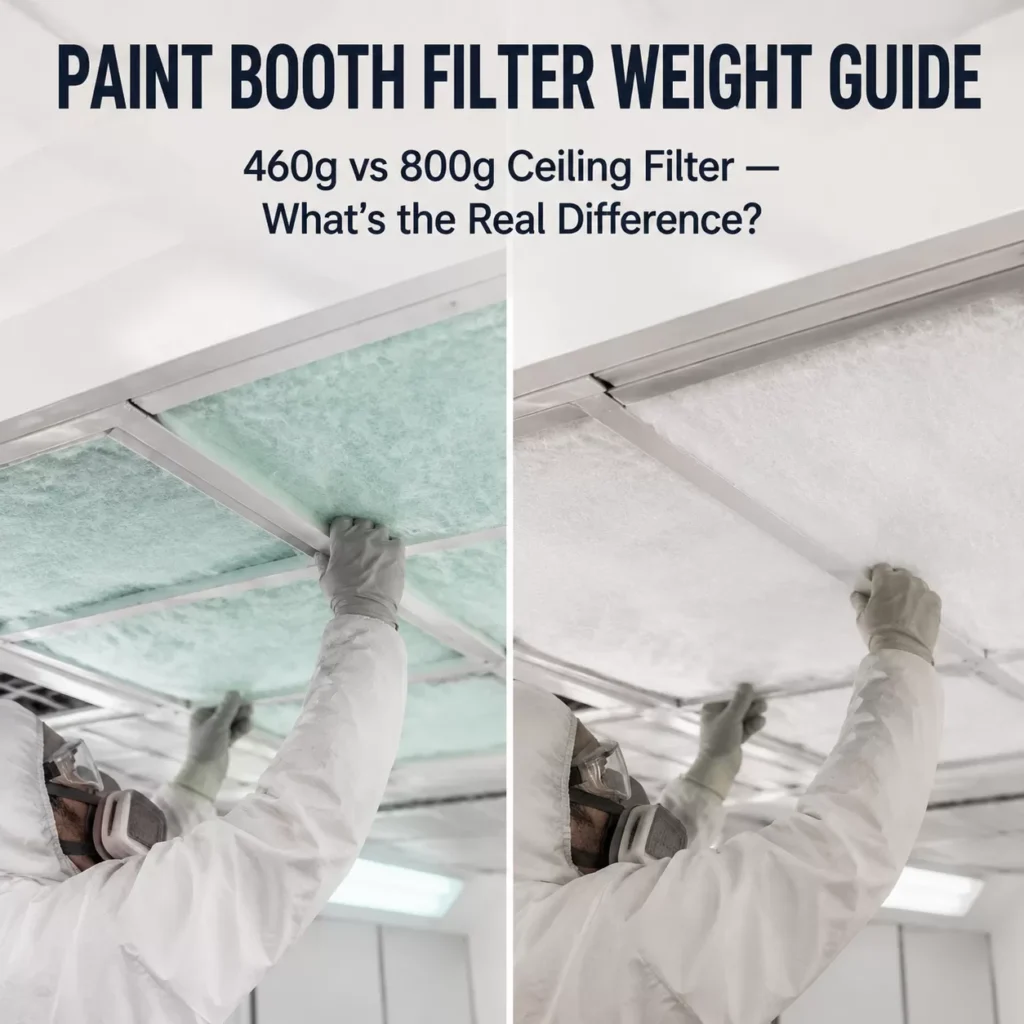
Choosing the wrong ceiling filter weight is one of the more subtle ways a booth underperforms without anyone being sure why. Too light and fine dust slips through into the finish. Too heavy and the exhaust fans can’t move enough air, throwing off cabin pressure and airflow velocity. This guide covers what GSM actually means for filter performance, how the 460g and 800g options differ in practice, and how to match the right weight to your specific setup.
Page URL: https://sprayboothmanufacturer.com/product/
What GSM Means and Why It Matters
GSM stands for Grams per Square Meter — the measurement of a filter’s weight and density per unit area. In the context of paint booth ceiling filters, this number tells you how much synthetic fiber material is packed into the media, which directly determines two things: how fine a particle the filter captures, and how much resistance it adds to the airflow path.
Higher GSM means more fibers, a tighter matrix, and greater particle-holding capacity before the filter reaches saturation. It also means higher initial airflow resistance — the fans have to push harder to move air through denser media. That trade-off is the core of the 460g vs 800g decision.
Spray booth operators cannot overlook the inherent relationship between filter weight, static pressure and booth hardware performance. Fitting an 800g filter to booth motors not engineered for such resistance will curb airflow beneath the minimum required velocity. This disrupts cabin pressure balance, lowers downdraft speed, and eventually forms airflow dead zones that make overspray settle back onto fresh wet paint.
Getting the filter weight right means matching the media’s density to your exhaust fan capacity, not just picking the heaviest option available.
460g Ceiling Filters: The Standard Choice
The 460g filter is the most widely used ceiling filter specification across standard auto body and industrial spray booth installations. It captures particulates down to 10 microns and carries an EU5/M5 classification — solid performance for everyday collision repair and general refinishing work.
The key advantage of the 460g weight is airflow compatibility. Lighter media creates lower initial resistance, which means standard exhaust fans and motors can maintain the correct downdraft velocity without being pushed into high static pressure conditions. Cabin pressure balancing is more straightforward, and the system operates closer to its designed performance envelope.
Where 460g works well: Medium-volume shops running steady daily production, solvent-based paint applications, and booths with standard blower configurations where denser media would risk restricting airflow. If your booth doesn’t have a Variable Frequency Drive on the fan motors to compensate for increased resistance, the 460g is the safer specification.
The trade-off: Because the media is less dense, it reaches saturation faster under heavy production conditions. Replacement frequency is higher than an 800g filter running the same volume of work — which adds up in consumable cost and maintenance time over a busy production schedule.
800g Ceiling Filters: The Heavy-Duty Option
The 800g filter is built for applications where contamination control requirements are at the highest level. A significantly denser fiber structure combined with heavier tackifier saturation gives it substantially greater particle-holding capacity than the 460g — it traps finer particulates, holds more total contamination before saturating, and lasts longer between changeouts in high-production environments.
For waterborne coatings, aerospace finishing, and high-end custom work where even microscopic dust inclusions in the clear coat are unacceptable, the 800g media provides a meaningfully cleaner booth environment. The denser filter matrix stops particles that would pass through lighter media, and the extended saturation point means the filter maintains peak performance longer into its service life.
Where 800g makes sense: High-volume production facilities running back-to-back jobs, aerospace and specialty coating applications, waterborne paint systems that are particularly sensitive to dust, and booths equipped with high-capacity blower systems and VFD motor control.
The constraint: The 800g filter creates noticeably higher initial airflow resistance. Running this media in a booth without sufficient fan capacity or VFD adjustment will starve the cabin of air. This isn’t a small margin issue — an underpowered system running 800g media will fail to maintain the minimum airflow velocity required for both compliance and finish quality. The fan system has to be able to handle the load before this filter weight makes sense.
Head-to-Head: How They Actually Compare
| Feature | 460g Ceiling Filter | 800g Ceiling Filter |
|---|---|---|
| Particle Retention | Moderate — captures to 10 microns | Maximum — captures finer particulates |
| Filter Lifespan | Standard — more frequent changes | Extended — fewer changeouts |
| Airflow Resistance | Lower — gentler on motors | Higher — requires capable blower system |
| Energy Consumption | Lower | Higher, offset by fewer replacements |
| Finish Quality | Excellent for standard work | Flawless — zero-dust environment |
| Best Application | Medium-volume, solvent-based | High-volume, waterborne, aerospace |
Lifespan and total cost: The 800g filter costs more upfront but lasts longer. In a high-production environment where the 460g would need frequent replacement, the 800g’s extended saturation point means fewer changeouts over the same production period. Whether the total cost of ownership favors one or the other depends on your actual spray volume and production schedule.
Energy consumption: Denser filters make fans work harder, which adds to electricity draw. In most cases this is partially or fully offset by buying fewer replacement filters and spending less labor on maintenance intervals.
Finish quality: For standard collision repair and solvent-based applications, the 460g produces consistently clean results. For waterborne coatings — which flash more slowly and remain wet and vulnerable to contamination longer — or for high-end clear coat work where any dust inclusion means rework, the 800g’s tighter filtration provides the additional protection that’s worth the higher resistance.
How to Choose the Right Weight for Your Shop
Check Your Blower Capacity First
This is the starting point. If exhaust fans lack a high static pressure rating or the spray booth lacks VFD motor control, the 800g filter will restrict airflow below the booth’s normal operating requirement. In this case, choose the 460g filter. It is not an inferior option; it simply matches the actual capacity of your existing system. Running a denser filter than the motor capacity allows doesn’t produce a cleaner finish; it produces lower airflow, poorer overspray capture, and potential compliance issues.
Match the Filter to Your Paint Chemistry
Waterborne coatings are more sensitive to dust contamination than solvent-based systems, and they take longer to flash off — meaning the paint surface is vulnerable to contamination for a longer window during each job. If waterborne is your primary coating, the extra filtration margin of the 800g is genuinely useful. For shops predominantly running solvent-based materials, the 460g handles the job without the added complexity.
Think About Total Cost, Not Just Purchase Price
The right comparison between the two weights isn’t the per-filter price — it’s the total cost of filters plus labor plus downtime for changeouts over a six-month or annual production period. High-volume shops typically find the 800g more economical on a total cost basis despite the higher unit cost, because the fewer replacement intervals more than offset the price premium. Lower-volume shops usually find the opposite — the 460g keeps costs predictable without leaving holding capacity on the table.
| Operation Factor | Choose 460g | Choose 800g |
|---|---|---|
| Blower System | Standard motors, fixed speed | High-capacity blowers with VFD |
| Production Volume | Low to medium | High-volume, continuous production |
| Paint Type | Standard solvent-based | Waterborne, aerospace, high-end custom |
| Budget Approach | Lower upfront, standard lifecycle | Higher initial cost, extended lifespan |
Getting the Most From Either Weight
Install It Correctly
The tacky side of the filter faces down toward the booth cabin — this is the surface that captures fine particulates before they reach the freshly sprayed panels. Installers must seat and fasten the filter firmly within the ceiling grid, leaving no loose edges or gaps. Perimeter bypass gaps around an improperly fitted filter negate the value of high-quality filter media. Unfiltered air still flows into the cabin through those openings, no matter how well the filter performs on its own.
Protect the Ceiling Filters With Pre-Filters
Pre-filters at the air intake are the first line of defense against heavy dust and debris. Keeping these changed regularly means larger particles get caught before they reach the ceiling filter. This is the single most effective way to extend the service life of your ceiling media — whether 460g or 800g — without any other changes to your maintenance routine.
Use Your Gauges, Not Your Eyes
The manometer or Magnehelic gauge is the right tool for deciding when to change filters. Visual inspection tells you the surface is dirty, but the gauge tells you when airflow restriction has reached the point where performance is actually being affected. Scheduling changes based on a fixed calendar date either replaces filters too early (wasting media that still has useful life) or too late (running degraded airflow). Track the pressure reading and change when the reading reaches the manufacturer’s threshold — this applies equally to 460g and 800g media.
Common Questions
Can I switch from 460g to 800g without changing anything else? Only if your blower system can handle the increased static pressure. If your booth has VFD motor control and high-capacity fans, the switch is usually straightforward. If not, the higher resistance will reduce airflow below the system’s designed performance levels. Check your motor specifications against the 800g filter’s pressure drop rating before making the switch.
How often should ceiling filters be replaced? There’s no universal answer because production volume, coating type, and pre-filter maintenance all affect the rate of saturation. Track the rate of change on your pressure gauge over a few filter cycles to establish a baseline for your specific operation. Use that baseline to plan replacements rather than a generic calendar interval.
Does the 800g filter actually produce a noticeably cleaner finish? For standard collision repair work with solvent-based coatings, the difference between 460g and 800g is typically small. For waterborne coatings or high-end custom clear coat work, the improvement in contamination control is meaningful enough to reduce polishing and correction time. The value of the upgrade depends on the finish quality demands of the work your shop does.
What does fiber migration mean and why does it matter? Low-quality filter media can shed loose fibers into the airstream during the bake cycle, which then land on the wet clear coat. Quality media — regardless of weight — should be manufactured with bonded fibers that don’t separate under normal operating conditions. It’s worth confirming this specification when sourcing filters, because contamination from the filter itself is a problem no amount of careful preparation can prevent.
Tell Us What You’re Working With
Share your booth configuration, blower system specs, production volume, and the coatings you’re running. We’ll help confirm the right filter weight for your specific setup and send a quote on the media you need — usually within 48 hours.
Related Pages
- Bus Spray Booth Design Guide → https://sprayboothmanufacturer.com/transit-coach-spray-booth-requirements/
- Truck Paint Booth Guide → https://sprayboothmanufacturer.com/truck-paint-booth-semi-truck-spray-booth-specifications-buying-guide/
- Other related products → https://www.autokemanufacture.com/product
- Contact our sales Team → https://sprayboothmanufacturer.com/contact-us/
✅ CE Certified | ✅ ISO 9001:2015 | ✅ Factory Direct | ✅ Ships to 60+ Countries | ✅ 1-Year Warranty | 🔒 HTTPS Secured