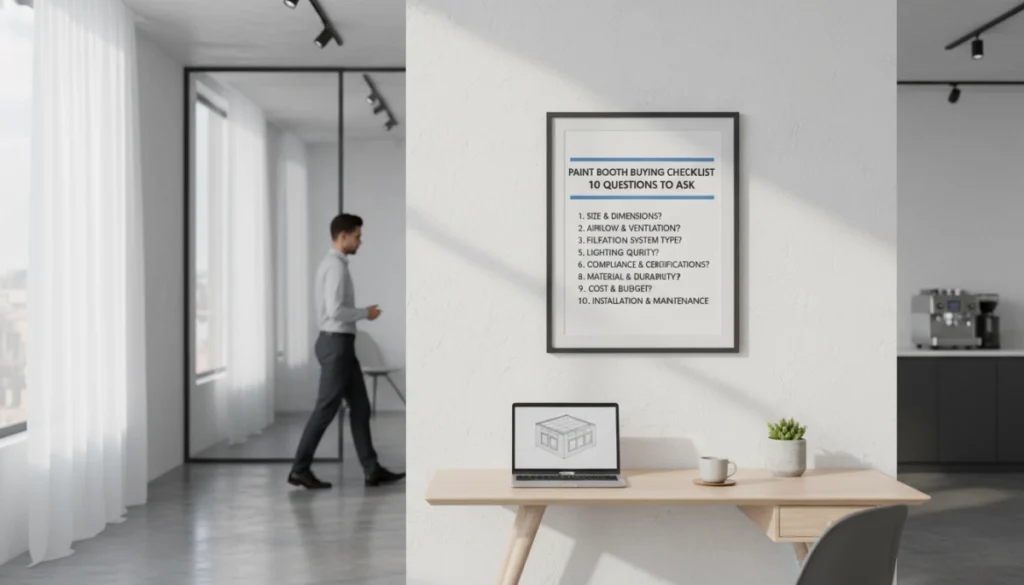
Buying a paint booth is one of the bigger capital decisions a shop makes, and the wrong choice shows up in finish quality, compliance problems, and operating costs for years after the purchase. This checklist covers the questions worth working through before you commit — from booth sizing and airflow to heating, filtration, electrical supply, and what the real total cost of ownership looks like.
Page URL: https://sprayboothmanufacturer.com/product/
1. What Size Do I Actually Need?
The most common mistake is sizing the booth around current work rather than the full range of what goes through it — including worst-case scenarios.
The 3-foot rule is the starting point for internal dimensions. You need at least three feet of clearance between the object being sprayed and the booth walls, ceiling, and filters. This isn’t a comfort preference — it’s what allows the airflow to work correctly. Insufficient clearance creates dead zones where overspray swirls and settles back onto wet paint instead of being pulled to the exhaust.
Beyond that working clearance, the distinction between internal dimensions, external dimensions, and total footprint matters for installation planning.
| Dimension Type | What It Includes | Why It Matters |
|---|---|---|
| Internal | The actual workspace inside the cabin | Determines the maximum part size you can spray |
| External | Walls, plenum, intake and exhaust fans | Determines if the unit fits under your ceiling and near other equipment |
| Total footprint | Booth plus required NFPA clearances | Required for fire marshal approval and maintenance access |
When calculating your size requirement, account for part height when loaded on carts or sawhorses — internal height is the dimension most commonly underestimated. And size for your worst-case project, not your average one. If you’re planning to take on larger vehicles or longer structural components in the next couple of years, upsizing now costs significantly less than replacing the booth later.
2. Which Airflow Pattern Fits My Work?
The airflow configuration has more impact on finish quality than almost any other decision, and it should match both the type of work you do and the facility constraints you’re working within.
Crossdraft is the most affordable option — air enters through the front and travels horizontally to a rear exhaust wall. No pit required, simple installation, and it works well for basic industrial finishing, wood coatings, and budget-conscious setups. The limitation is that air and any contamination it picks up near the front of the vehicle travels across the full length of the job before exiting.
Side downdraft is a strong middle-ground option for shops that want automotive-quality results without floor excavation. Air enters through ceiling filters and exits through filtered plenums in the lower side walls, producing a downward curtain effect that controls overspray significantly better than horizontal flow.
Full downdraft is the gold standard for automotive refinishing and high-end custom work. Air flows from ceiling to floor pit, with gravity assisting the downward movement of contamination away from every painted surface simultaneously. It requires a concrete pit or raised basement, which adds installation cost, but the finish quality and contamination control are unmatched.
If you’re spraying waterborne coatings, airflow requirements also increase regardless of booth type. Waterborne paint needs significantly more air movement to drive evaporation than solvent-based coatings do. A standard exhaust setup that handles solvent fine may produce slow flash-off times with waterborne, which stalls production. Make sure the airflow pattern and fan capacity you’re specifying are appropriate for the coating chemistry you’re actually using.
3. Does It Meet Local and National Safety Codes?
Buying a booth that doesn’t comply with applicable codes means you’ve purchased a metal box you can’t legally operate. In the United States, compliance isn’t optional — it’s the baseline.
NFPA 33 governs the fire safety requirements for spray finishing operations using flammable materials. It dictates how booths must be constructed, where they must be positioned relative to other equipment, and how ventilation systems must perform. A booth that isn’t built to NFPA 33 standards is likely uninsurable for spray finishing operations.
OSHA standards focus on the painter’s safety. The minimum airflow velocity for most manual spray operations is 100 feet per minute — enough to keep hazardous vapor concentrations below dangerous levels in the breathing zone. This isn’t a guideline; it’s an enforceable requirement.
ETL or UL certifications on the electrical components are what inspectors look for. Every motor, light fixture, and control panel inside or near the spray zone needs to be rated for hazardous locations — Class I, Division 1 or Division 2. The main control panel should carry UL 508A certification. Unlisted electrical components inside a spray booth are a compliance failure and a fire risk.
Fire suppression integration is required before most local fire marshals will sign off on a permit. Look for booths that come with pre-punched plenums and mounting points for dry chemical nozzles, and confirm that the suppression system is wired to automatically shut off the exhaust fan and compressed air to the spray gun when it activates.
| Compliance Factor | Standard | Business Impact |
|---|---|---|
| Fire safety | NFPA 33 | Required for insurance coverage |
| Air quality | OSHA | Protects workers, avoids fines |
| Electrical | UL/ETL listed | Safe for explosive environments |
| Local permits | Fire marshal approval | Required to legally operate |
4. Do I Need Heating and a Bake Cycle?
For any shop doing regular production work, this is one of the more important decisions for daily throughput.
A non-heated booth relies on ambient shop temperature to dry the finish. In a cold building in winter, that can mean eight or more hours of drying time per vehicle. For occasional hobby use that may be acceptable. For a professional shop trying to turn multiple vehicles per day, it’s a serious bottleneck.
A heated booth with an Air Makeup Unit (AMU) changes the workflow entirely. A proper bake cycle ramps the cabin to 140°F to 160°F after spraying and cures the paint through to the substrate — not just the surface. The result is a more durable finish that’s ready to handle, polish, or deliver much sooner than an air-dried alternative.
| Feature | Non-Heated Booth | Heated Bake Booth |
|---|---|---|
| Dry Time | 4–8+ hours | 30–60 minutes |
| Daily Throughput | 1–2 jobs | 5+ jobs |
| Finish Quality | Higher risk of dust settling | Controlled cure |
| Energy Source | Electricity (fans only) | Gas, propane, or electric |
Most US shops run natural gas or propane for the heat source. Both offer fast heat-up times and cost-effective operation for high-volume schedules. Electric infrared is a solid alternative for targeted curing or facilities where gas line installation is restricted or cost-prohibitive.
5. How Does the Filtration System Work?
Filtration is what keeps contaminants out of the finish and keeps the operation environmentally compliant. It deserves more scrutiny than it usually gets during the buying process.
Intake filtration is the first defense. Ceiling filters in a downdraft system should provide fine-grade laminar filtration to ensure clean air reaches the vehicle. Pre-filters at the air entry point extend the life of the more expensive internal filter media by catching larger debris early.
Exhaust filtration has to meet EPA 6H standards in the United States — the exhaust system needs to capture at least 98% of paint overspray before it exits the building. Multi-stage fiberglass or polyester filter pads are the standard approach for most professional booths.
The manometer is the operational tool that tells you when filters need changing. A booth without a draft gauge leaves you guessing based on visual inspection, which typically means filters run too long and airflow suffers before anyone notices. Any booth worth buying should include this gauge as standard.
Practically, inspect filter access in advance before you purchase a spray booth. Complicated disassembly for intake filter replacement will delay regular maintenance, which hurts paint finish quality and shortens motor service life. Tool-free access rails and swing-down filter ceilings bring great convenience and deserve priority consideration. You should also confirm the booth adopts industry-standard filter sizes. Custom proprietary sizes will force you to rely solely on a single supplier for replacement consumables.
6. Is the Lighting Good Enough for Accurate Color Matching?
Lighting is consistently underestimated in the buying process. A shop can invest in high-end spray equipment and premium coatings, then miss a color mismatch or a dry spot because the lighting doesn’t reveal what’s actually happening on the panel.
All spray zone fixtures must meet Class I, Division 2 explosion-proof ratings. This is a mandatory requirement, not an optional preference. LED fixtures have become the mainstream choice. They operate cooler than fluorescent lights—critical when placed near wet paint—with better vibration resistance against exhaust fan operation and far lower power consumption.
For color accuracy, the two specs that matter are CRI (Color Rendering Index) and color temperature. A CRI of 90 or higher ensures the light spectrum is full and balanced enough for reliable color matching. Color temperature in the 5000K to 6000K range mimics natural noon daylight — the reference condition for identifying whether a color match will hold under different lighting outside the shop.
Fixture placement matters as much as the fixtures themselves. Overhead lighting alone leaves the lower door panels and rocker panels in shadow. A combination of ceiling, hip-angle, and side-wall fixtures at waist height is what produces genuinely shadow-free coverage across the full vehicle. White powder-coated interior walls help by reflecting light into corners and lower panels rather than absorbing it.
7. What’s the Build Quality of the Enclosure?
The physical construction of the booth determines how long it holds its performance and how well it maintains the pressure balance that clean finishing depends on.
Steel gauge matters for structural integrity. 18-gauge galvanized steel is the right specification for a professional booth — heavy enough to resist vibration from exhaust fans without warping, which is what causes panel gaps and air leaks over time. G90 galvanized coating provides corrosion resistance in high-humidity environments.
Single-wall vs. dual-wall insulated panels comes down to whether you’re running a heated system. Single-wall is fine for non-heated applications. If you bake paint finishes, dual-wall insulated panels justify the extra cost. They retain heat inside the booth cabin during curing cycles instead of letting heat escape into the workshop, cutting energy consumption and shortening curing cycle times.
Door type should match your operational flow. Swing doors provide a reliable seal and are standard for most automotive applications, but require clearance in front of the booth to open fully. Roll-up doors work well for tight spaces or when you’re regularly moving large industrial parts in and out — they stay out of the way and allow faster vehicle transitions.
8. Is My Shop Electrically Ready?
Electrical preparation is one of the most common reasons paint booth installations get delayed after the equipment arrives.
Most industrial-grade booths require three-phase power for the exhaust fans and AMU to run efficiently. Single-phase power limits motor size and generally isn’t adequate for high-production operations. If your building only has single-phase service, that’s a conversation to have with an electrician before you order equipment, not after.
| Power Type | Typical Voltage | Best For |
|---|---|---|
| Single phase | 208V–230V | Small shops, hobby use |
| Three phase | 208V, 230V, or 460V | High-production industrial use |
Compressed air supply also needs to be planned. Hard-piped aluminum or copper lines to the booth prevent the rust and moisture problems that flexible hose runs introduce over time. Professional automotive finishing requires a refrigerated or desiccant air dryer. Moisture in compressed air lines directly ruins the paint finish. Install lines of at least 3/4‑inch size to prevent pressure drop when you pull the spray gun trigger, and arrange at least two air supply points inside the booth.
9. What After-Sales Support Does the Manufacturer Offer?
The purchase doesn’t end when the equipment arrives. Motors fail, filters run out during rush periods, and technical issues come up. How quickly you can get parts and support directly affects how much downtime you absorb when something goes wrong.
Before finalizing a purchase, confirm that consumables — filters, gaskets, belts — are stocked and available rather than on long lead times. Verify that replacement mechanical components like motors and exhaust fans are accessible through US distribution channels rather than requiring overseas sourcing. And confirm that technical support is reachable by phone or video during business hours, particularly for installation and startup questions.
On warranty terms, look past the headline number of years and understand what’s actually covered. Structural warranties on the cabin and panels typically run five or more years. Mechanical warranties on motors and control panels typically run one to two years. Clarify whether warranty service covers just parts or also the technician’s time.
A booth from a supplier who can’t get you a filter when you need one mid-job will cost you more in downtime than you saved on the original price.
10. What Does the Total Cost of Ownership Look Like?
The sticker price is only part of the investment. A booth that’s cheap to buy but expensive to operate or maintain will cost more over time than one that costs more upfront but runs efficiently.
Installation costs beyond the equipment price include freight and rigging, professional installation labor, permitting fees, any engineering stamps required by local authorities, and site preparation like concrete cutting or electrical upgrades. These can add significantly to the capital outlay and should be budgeted in advance.
Ongoing energy consumption is largely determined by the booth’s design. Variable Frequency Drives on fan motors reduce electricity usage by matching fan speed to actual resistance rather than running at full capacity all the time. Heat recirculation during bake cycles reuses warmed cabin air instead of continuously heating cold outside air, which cuts gas or propane consumption significantly. Dual-wall insulated panels reduce the heat loss that makes the AMU work harder than it needs to.
Maintenance costs accumulate over time through filter replacement, motor and belt service, and cleaning labor. Booths designed for easy filter access keep maintenance time — and therefore cost — down. Using standard-size filters means you can source consumables competitively rather than from a single proprietary supplier.
| Cost Factor | Low-End Booth | High-Efficiency Booth |
|---|---|---|
| Energy Usage | High — constant speed fans | Low — VFD and heat recirculation |
| Filter Life | Short — basic media | Long — high-capacity filters |
| Downtime | Frequent — cheaper parts | Rare — industrial-grade components |
| Resale Value | Minimal | Strong |
The booth that costs more to buy but runs efficiently, requires less maintenance, and holds its resale value will typically cost less over a 10-year horizon than the cheaper booth with higher operating overhead.
Common Questions
How much space do I need around the booth? NFPA 33 mandates a minimum 3-foot clear space on all sides of the spray area. This space supports maintenance and fire department access, and keeps combustible materials away from the spraying zone. Keep this area fully clear during operation; do not use it for temporary storage.
Can I convert a crossdraft booth to downdraft later? Rarely worth it. Converting airflow patterns means either excavating a concrete pit or building a raised basement, replacing the entire intake and exhaust filtration system, and making significant structural modifications to the booth panels. In most cases it’s cheaper and faster to start with the right configuration.
What’s the typical lifespan of a professional spray booth? A well-maintained galvanized steel cabin can last 20 to 25 years. Mechanical components — motors, fans, burners — typically run 10 to 15 years before needing significant overhaul. Maintenance is the biggest variable; a booth that gets proper filter changes and routine mechanical attention will outlast one that doesn’t by a significant margin.
Do I need a permit? Yes, in virtually every US jurisdiction. You’ll need building permits for the physical structure, mechanical and electrical permits for the AMU and wiring, fire marshal approval for the suppression system, and depending on your state and production volume, environmental permits for emissions tracking. Start the permitting process before the equipment arrives — approval timelines vary significantly by location.
Tell Us What You’re Working With
Share your facility dimensions, vehicle types, production volume, and coating processes. We’ll help you work through the right configuration for your operation and send a detailed quote with layout drawings — usually within 48 hours.
Related Pages
- Bus Spray Booth Design Guide → https://sprayboothmanufacturer.com/transit-coach-spray-booth-requirements/
- Truck Paint Booth Guide → https://sprayboothmanufacturer.com/truck-paint-booth-semi-truck-spray-booth-specifications-buying-guide/
- Other related products → https://www.autokemanufacture.com/product
- Contact our sales Team → https://sprayboothmanufacturer.com/contact-us/
✅ CE Certified | ✅ ISO 9001:2015 | ✅ Factory Direct | ✅ Ships to 60+ Countries | ✅ 1-Year Warranty | 🔒 HTTPS Secured