
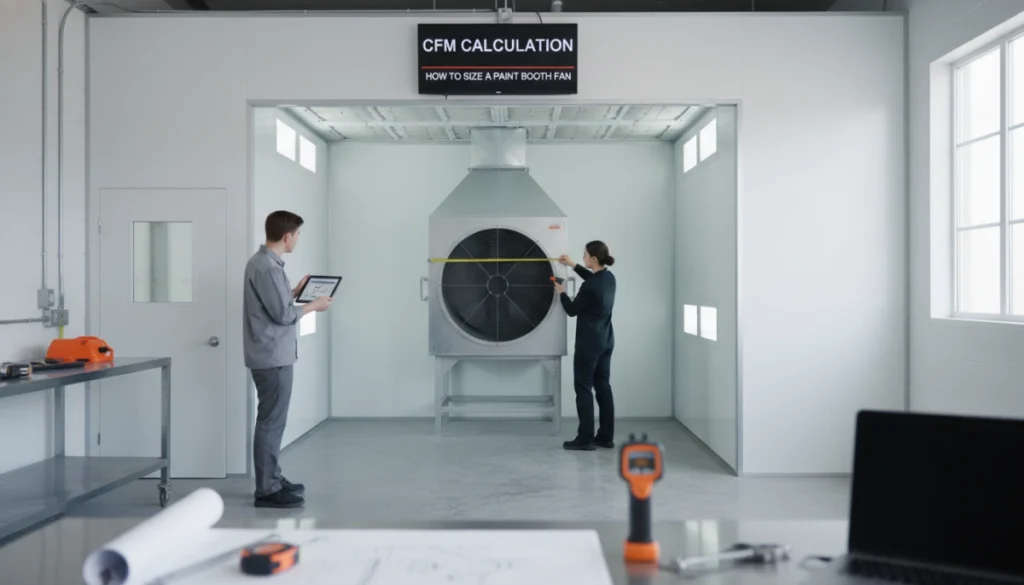
Getting the fan sizing wrong is one of the most common reasons a paint booth underperforms — and one of the easiest to avoid if you understand the math before you buy. Too little airflow and you have a compliance problem and a finish quality problem. Too much and you’re wasting energy and creating turbulence that keeps overspray in the air longer than it should be. This guide covers the core calculation, how booth type affects the approach, what static pressure does to your real-world numbers, and what fan type actually fits your setup.
Page URL: https://sprayboothmanufacturer.com/product/
CFM and FPM: The Two Numbers That Matter
These two measurements work together and you need both to size a fan correctly.
CFM — Cubic Feet per Minute is the total volume of air the fan moves every minute. It’s the overall capacity of the ventilation system. Too low and the fan doesn’t have the muscle to clear overspray out of the booth fast enough.
FPM — Feet per Minute is air velocity — how fast the air is moving as it passes through the booth. This is what actually carries paint particles and solvent vapor away from the painter and the wet surface before they settle or get inhaled.
The relationship between them is a simple formula: CFM = Area (square feet) × Velocity (FPM). The area depends on the booth type, and the velocity is set by the applicable safety standard for your spray method.
You need both numbers working correctly. A large booth paired with an undersized fan delivers enough air volume but lacks proper airflow velocity. This lets overspray drift freely instead of drawing it away cleanly. A powerful fan feeding into a restricted intake creates a vacuum effect that pulls unfiltered air in through every gap in the structure. Balance between the two is what produces a properly functioning booth.
Velocity Requirements: What OSHA and NFPA 33 Require
The minimum airflow velocity inside the spray zone is set by regulation, not preference.
| Spray Method | Required Velocity | Standard |
|---|---|---|
| Manual spraying | 100 FPM | OSHA / NFPA 33 |
| Automated spraying | 50–75 FPM | NFPA 33 |
| Electrostatic spraying | 60 FPM | NFPA 33 |
For most automotive and industrial manual spray operations in the US, 100 FPM is the benchmark to design around. Automated and electrostatic systems can run at lower velocities because they produce less overspray and are more efficient at hitting the target. If you’re running a manual operation, don’t try to save money by designing to the lower automated requirements — under-calculating here is a compliance liability and a safety risk. A slight surplus of airflow is always preferable to coming up short on the OSHA minimum.
The CFM Calculation by Booth Type
Crossflow Booths
In a crossflow setup, air moves horizontally from the front intake filters to the rear exhaust wall. The area you’re calculating is the cross-section of the booth — the face the air travels through.
Area = Booth Width × Booth Height
A booth that’s 14 feet wide and 9 feet high has a cross-sectional area of 126 square feet. At 100 FPM, the required CFM is 12,600.
Downdraft Booths
Downdraft systems pull air from ceiling filters straight down into a floor pit. The area used for the calculation is the floor area, because that’s the surface the air passes through.
Area = Booth Length × Booth Width
A 24-foot-long, 14-foot-wide booth has 336 square feet of floor area. Downdraft systems often operate effectively at 50 to 75 FPM because gravity assists the downward movement of overspray — but check your specific compliance requirements before designing below 100 FPM.
Semi-downdraft booths exhaust through a rear filter bank rather than a floor pit. Use the area of the rear exhaust filter bank for the calculation rather than the full floor area.
Open-Face Booths
These are common for wood finishing or small parts. The relevant area is the actual front opening where the painter works.
Area = Opening Width × Opening Height
Since open-face booths lack a full seal and remain exposed to the surrounding shop environment, operators must maintain a consistent 100 FPM airflow across the entire face opening to meet safety standards and regulatory compliance.
Static Pressure: The Number Most People Ignore
The CFM your fan is rated for and the CFM it actually delivers in a real installation are often very different numbers, and the gap comes from static pressure.
Static pressure is the resistance the fan has to work against to move air through the system. It’s measured in inches of water gauge (w.g.). In an open field with nothing attached, a fan delivers its rated output. Once you add filters, ductwork, elbows, and dampers, each component adds resistance and the actual delivered CFM drops.
The Biggest Variable: Filter Loading
A clean intake filter might have a resistance of 0.1 to 0.2 inches w.g. As the filter loads with overspray, that resistance can easily double or triple. The smart approach is to size the fan for loaded filter conditions, not clean ones. If the fan maintains adequate CFM with loaded filters, you stay compliant throughout the filter’s useful life rather than only when it’s fresh.
Use a manometer to monitor static pressure during operation. When the reading climbs significantly above baseline, filters are approaching saturation and need to be changed — don’t wait for visible performance problems to tell you what the gauge already knows.
Ductwork Resistance
Every component between the booth and the exhaust termination adds resistance. A single 90-degree elbow adds the equivalent resistance of 10 to 20 feet of straight pipe. Longer duct runs require more fan capacity. Narrower duct diameter increases air velocity but also increases static pressure, making the fan work harder. When routing exhaust ductwork, keep runs as straight and short as possible, and account for every bend when sizing the fan.
Why “Free Air” CFM Ratings Are Misleading
Fan specifications typically lead with the free-air CFM rating — the output with zero resistance attached. This number is useful for comparing fans to each other, but it’s not what the fan will deliver in your booth. A fan rated at 8,000 CFM in free air might deliver 5,500 CFM at 0.5 inches of static pressure. If your calculation requires 6,000 CFM, that fan fails to meet it under real conditions.
Always look at the fan’s performance curve — specifically the CFM output at the static pressure your system will actually generate. A fan that looks adequate on a spec sheet but is evaluated at zero resistance will underperform consistently in service.
Choosing the Right Fan Type
Tube Axial Fans
Tube axial fans are the standard choice for most crossflow and semi-downdraft automotive booth applications. These fans are built to move large air volumes against moderate resistance, with low installation and maintenance costs. Manufacturers mount the belt‑driven motor outside the airflow path to isolate it from flammable overspray. Tube axial fans work perfectly for most standard booth layouts with typical duct lengths.
Centrifugal Fans
When the ductwork system is complex — long runs, multiple bends, heavy filtration — a tube axial fan may stall out against the resistance before delivering the required CFM. Centrifugal fans (squirrel cage fans) are better at pushing through high static pressure situations. They cost more and take up more space, but they’re the right tool when the system demands it. If you calculate high static pressure or have complex duct routing, you should choose centrifugal fans. The extra investment ensures airflow performance matches your design calculations exactly.
Explosion-Proof Motors
This isn’t optional regardless of fan type. The interior of a spray booth and its exhaust ducting are Class I, Division 1 hazardous locations under NFPA 33 and NEC. Every fan motor inside the spray zone must be explosion-proof rated for this classification. Fan impellers should be non-ferrous — aluminum is standard — so that if a blade contacts the housing, it doesn’t generate a spark in a vapor-rich exhaust stream. Standard industrial fans are not acceptable in this environment regardless of how well they move air.
| Fan Type | Best Application | Pressure Handling |
|---|---|---|
| Tube Axial | Standard booths, moderate duct runs | Low to medium |
| Centrifugal | Long duct runs, complex layouts, heavy filtration | High |
| Explosion-Proof Motor | All paint booth fans | Required for compliance |
Common Sizing Mistakes
Over-Sizing the Fan
More airflow isn’t always better. Excessive air velocity creates turbulence inside the booth that keeps overspray suspended rather than pulling it cleanly to the exhaust. It also pulls more air through intake filters than necessary, which loads them faster and increases replacement frequency. And running an oversized fan in a heated shop means you’re continuously exhausting conditioned air and paying to replace it with outside air — the energy cost is real and ongoing.
Under-Sizing the Fan
Under-sizing is more common and more dangerous. If the fan can’t maintain the minimum required FPM, you’re in violation of OSHA and NFPA 33 standards. Flammable vapor concentrations can build toward ignitable levels. The painter is breathing contaminated air that should have been evacuated. Overspray drifts and settles on wet paint. There’s no upside to under-sizing — it costs you in safety, finish quality, and compliance simultaneously.
Ignoring Make-Up Air
This is probably the most frequent mistake. If the exhaust fan pulls 12,000 CFM out of the booth, 12,000 CFM of replacement air has to come from somewhere. You will create negative pressure inside the booth without a dedicated Make-Up Air Unit. This makes doors hard to open, draws exhaust fumes from other gas appliances back into the building, and lets unfiltered air seep in through every crack and gap in the booth structure. That un-filtered infiltration air brings dust and debris directly into the spray environment. The intake and exhaust sides of the system have to be matched. Designing one without the other is an incomplete system.
Common Questions
How often do filters need to be changed to maintain proper CFM?
Use a manometer to track pressure instead of relying on a calendar. When the pressure reading rises significantly above the baseline, the filters become clogged and start restricting airflow. For most production shops this works out to every 50 to 100 hours of spray time, but production volume and coating type both affect the actual rate. Overspray lingering in the air longer than usual is also a reliable signal that the filters are restricting flow.
Can I use a standard industrial fan in a spray booth?
Standard shop fans are neither explosion-proof nor rated for Class I, Division 1 hazardous locations. They also lack the design to sustain proper CFM airflow against static pressure from filters and ductwork. A standard fan that works well in an open environment loses most of its performance once you attach it to a real booth system — and the spark risk from non-rated motors in a flammable vapor environment is a direct safety hazard.
What’s the minimum FPM for automotive painting?
100 FPM is the standard for manual spray operations under OSHA and NFPA 33. Some downdraft configurations can operate at 50 to 75 FPM because gravity assists the downward movement of overspray, but 100 FPM is the conservative and safe target for most professional shop setups.
Why does duct length matter for fan selection?
Every foot of ductwork adds resistance the fan has to overcome, and every 90-degree elbow adds the equivalent of 10 to 15 feet of straight pipe. The longer and more complex the duct run, the higher the static pressure the fan operates against — and the more the actual delivered CFM drops from the rated number. Long or complicated duct runs often push a system from tube axial territory into centrifugal fan territory to maintain the required CFM at the elevated static pressure.
What does “Free Air” CFM actually mean?
You measure this output with no attachments and zero resistance. Once you connect the fan to a booth fitted with filters and ductwork, the airflow output drops immediately. Always evaluate fan performance at the static pressure your actual system will generate, not the free-air rating. A fan that looks adequate at free-air will underperform consistently once installed in a real booth.
Tell Us What You’re Working With
Share your booth dimensions, spray method, duct layout, and production volume. We’ll work through the CFM calculation for your specific setup and send a detailed fan sizing recommendation — usually within 48 hours.
Related Pages
- Bus Spray Booth Design Guide → https://sprayboothmanufacturer.com/transit-coach-spray-booth-requirements/
- Truck Paint Booth Guide → https://sprayboothmanufacturer.com/truck-paint-booth-semi-truck-spray-booth-specifications-buying-guide/
- Other related products → https://www.autokemanufacture.com/product
- Contact our sales Team → https://sprayboothmanufacturer.com/contact-us/
✅ CE Certified | ✅ ISO 9001:2015 | ✅ Factory Direct | ✅ Ships to 60+ Countries | ✅ 1-Year Warranty | 🔒 HTTPS Secured