
The Physics of Scale: Why Big Vehicles Break Standard Airflow Logic
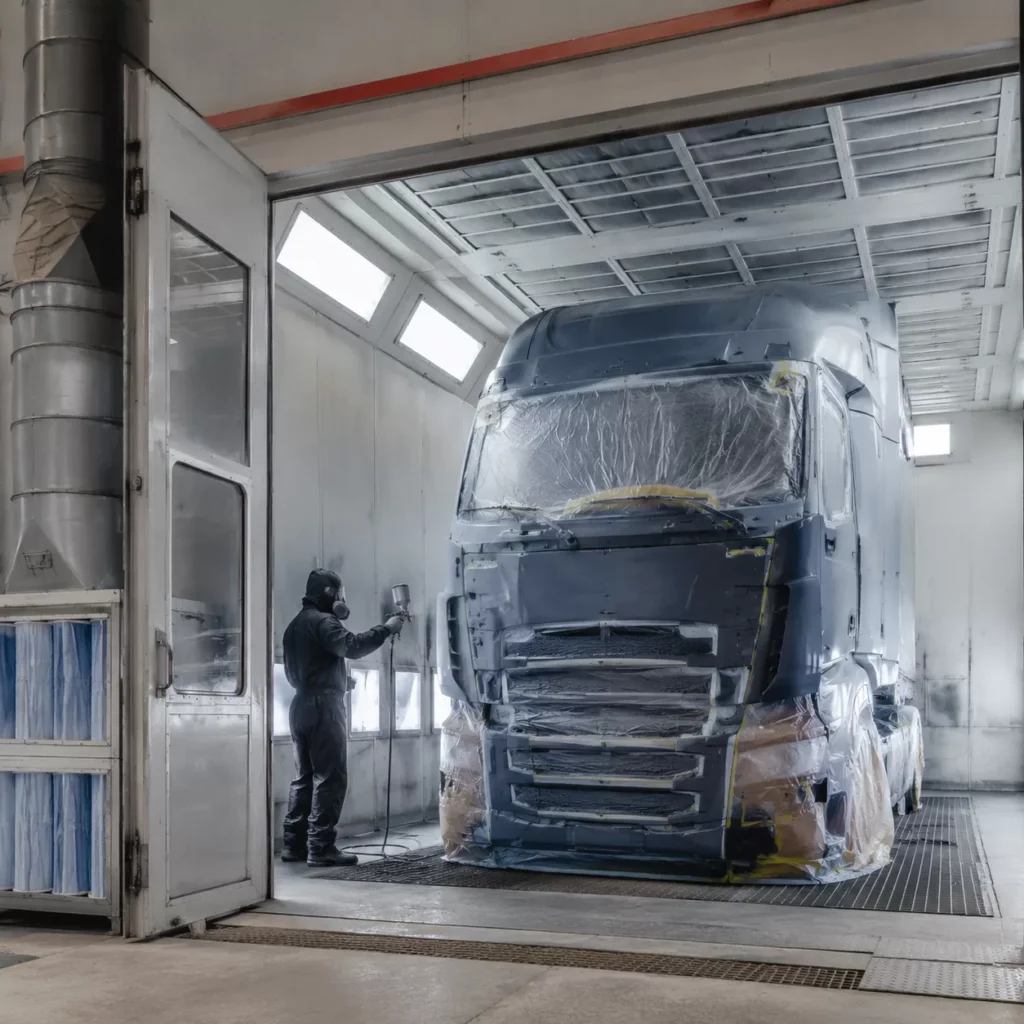
Painting a passenger car is relatively forgiving. Painting a 53-foot trailer or a class-8 semi-truck is an entirely different beast. When you pull a massive commercial vehicle into a spray booth, standard ventilation logic completely breaks down. The sheer physical mass alters how air moves, creates hidden risk zones, and demands a precise balance between air volume and speed to ensure a flawless finish.
Page URL: https://sprayboothmanufacturer.com/product/
The Obstruction Factor
A standard automotive cabin allows air to flow freely around its contours. In contrast, a large trailer acts as a massive physical block, splitting the airflow and forcing it into tight paths between the vehicle sides and the booth walls.
At AUTOKE, we engineer systems to counter this massive displacement. If your booth design fails to account for this obstruction, air velocity spikes in narrow gaps while dropping to a crawl elsewhere, trapping overspray and clouding your clear coat.
The Danger of Dead Zones
Where airflow drops, turbulence takes over. Large commercial vehicles are riddled with complex shapes—deep wheel wells, chassis rails, fenders, and undercarriages—that naturally shield against moving air. These areas form dangerous dead zones.
- Solvent Popping: When stagnant air sits over wet paint, evaporated solvents cannot escape, trapping micro-bubbles in the finish.
- Dry Spray: Airborne overspray settles back down onto drying sections instead of being swept into the exhaust filters.
- Die-Back: A loss of gloss caused by solvent vapors lingering on the coating surface during the initial flash-off.
Air Volume vs. Air Velocity
Managing heavy-duty paint booth ventilation requires balancing two distinct metrics: Cubic Feet per Minute (CFM) and Linear Feet per Minute (LFM). Moving a massive volume of air means nothing if that air moves too slowly to sweep particulate matter away.
| Metric | What It Measures | Why It Matters for Large Vehicles |
|---|---|---|
| Air Volume (CFM) | Total quantity of air moved per minute. | Must be exceptionally high to turn over the massive air volume inside a 60-foot or 80-foot booth. |
| Air Velocity (LFM) | Speed at which air travels past the vehicle. | Must maintain a steady 50–100 LFM across the vehicle profile to physically pull overspray away from the painter. |
If you rely solely on high CFM without structured ducting and proper exhaust placement, you end up with massive air movement in the open spaces but zero velocity in the critical workspace zones. We design our ventilation packages to ensure that high air volume translates directly into the targeted speed needed to maintain a clean, safe, and efficient painting environment.
Choosing the Right Truck Paint Booth Ventilation Airflow Configuration
Selecting the right airflow pattern for a heavy-duty paint booth isn’t just a technical detail—it directly impacts your shop’s daily throughput, finish quality, and operating costs. Large commercial vehicles present unique spatial challenges. Matching your booth design to your fleet dimensions and facility constraints is essential for proper commercial vehicle overspray management.
Downdraft Airflow: The Gold Standard for Premium Fleet Finishes
For high-volume shops demanding flawless results, downdraft ventilation is the top tier. This configuration introduces clean, filtered air through the ceiling plenum and pulls it straight down over the vehicle, exhausting through a dedicated concrete floor pit below.
- Gravity-Assisted Control: Air moves from top to bottom, pulling overspray and airborne particulates down into the floor filters instantly.
- Zero Overspray Wrap: Because air flows downward over the vehicle, overspray cannot settle on freshly sprayed adjacent panels.
- Pit Requirement: This design requires concrete floor excavation, making it a permanent, premium investment for long-term fleet painting contamination control.
Semi-Downdraft Airflow: The Balanced, Pitless Alternative
If concrete excavation isn’t feasible for your facility, a semi-downdraft configuration offers an effective, balanced alternative. Air enters through the front ceiling section and is pulled diagonally across the vehicle toward an exhaust plenum located at the lower rear wall.
- No Floor Excavation: Installs directly onto an existing concrete shop floor, significantly reducing upfront facility modification costs.
- Effective Clearing: Drafts air down and back, keeping the painter’s breathing zone clear of heavy concentrations of solvent vapors.
- Draft Patterns: While highly efficient, air velocity can vary slightly near the front bumper compared to the rear exhaust wall.
Side Downdraft Airflow: High Performance without the Trenching
Side downdraft configurations are highly popular in commercial spray booth airflow patterns for large fleet shops. Air enters through a full-length ceiling plenum and is pulled down and out through low exhaust plenums running along both sidewalls.
- True Downward Vector: Delivers a similar top-to-bottom airflow path as a full downdraft booth without requiring a floor pit.
- Consistent Wrapping: Excellent for handling wide utility trucks, preventing dead zones along the lower rocker panels and fenders.
- Shop Floor Friendly: Keeps the shop floor flat and unobstructed for easy vehicle staging and masking.
Crossdraft Airflow: The Risks of Front-to-Back Ventilation
In a crossdraft setup, air enters through filters in the front main doors and travels horizontally down the entire length of the trailer before exiting through the back exhaust wall. While cost-effective to install, this setup introduces serious quality risks for long vehicles.
The Chain of Contamination: As air travels down a 53-foot trailer, it picks up overspray from the front section and carries it directly over the wet paint at the back, resulting in a hazy, dry finish on rear panels.
| Airflow Configuration | Floor Excavation Required? | Best For | Overspray Risk |
|---|---|---|---|
| Full Downdraft | Yes (Floor Pit) | High-end fleet finishes, transit buses | Extremely Low |
| Semi-Downdraft | No | Retrofitted shops, mid-sized box trucks | Low to Moderate |
| Side Downdraft | No | High-volume fleet trailers, heavy equipment | Low |
| Crossdraft | No | Priming, utility tractors, short vehicles | High (on long vehicles) |
Managing Truck Paint Booth Ventilation: Pressure Control and Air Makeup Units
Keeping a heavy-duty paint booth running smoothly comes down to mastering the balance of air pressure and temperature. When painting massive rigs, managing booth air pressure and the role of Air Makeup Units (AMUs) becomes your primary defense against costly mistakes.
The Power of True Positive Pressure
Achieving true positive pressure is the secret to a flawless finish. This means our system supplies slightly more clean, filtered air into the booth than the exhaust fans pull out.
- Dust Deflector: This tiny pressure difference creates a natural barrier. When doors are opened or seals flex, air pushes out instead of sucking shop dust, dirt, and lint in.
- Contamination Control: For fleet vehicles with massive surface areas, even minor airborne dust can trigger hours of detailing and buffing. Positive pressure keeps the workspace pristine.
Why Large Booths Demand Dedicated AMUs
You cannot run a heavy-duty truck spray booth efficiently without a dedicated Air Makeup Unit (AMU). Standard building HVAC systems simply aren’t built to handle the extreme volume of air these enclosures require.
[Building HVAC] ──(Inadequate)──> [Large Truck Booth] ──> (Depressurization)
[Dedicated AMU] ──(High CFM Balance)──> [True Positive Pressure] ──> (Perfect Cure)
- Preventing Facility Depressurization: A massive truck booth pulls tens of thousands of Cubic Feet per Minute (CFM). Without a dedicated AMU to replace that air, the booth will starve, depressurizing your entire shop. This causes backdrafts in facility heaters, slams doors shut, and pulls dirty air into the paint area.
- Heating Heavy Steel Chassis: Large commercial vehicles contain tons of structural steel. When it is time to bake the coating, a high-output AMU delivers the precise BTU capacity needed to heat that massive metal mass up to curing temperature, ensuring a durable, high-gloss finish every time.
OSHA and NFPA 33 Standards for Truck Paint Booth Ventilation
Safety in heavy-duty paint booth ventilation isn’t just about a clean finish—it is about fire prevention and legal compliance. When spraying large commercial vehicles, the sheer volume of chemicals demands strict adherence to OSHA spray booth airflow regulations and NFPA 33 ventilation standards.
- The 100 LFM Rule: OSHA requires a minimum air velocity of 100 linear feet per minute (LFM) across the breathing zone of the painter. For a massive truck booth, maintaining this speed across the entire cross-section is a major engineering feat.
- Lower Flammable Limits (LFL): NFPA 33 mandates that mechanical ventilation must keep the concentration of flammable vapors below 25% of the LFL. If your airflow drops, explosive solvent vapors can pool in dead zones, creating an immediate flash-fire hazard.
- Industrial Paint Booth Duct Velocity: Exhaust ductwork must maintain a high enough velocity—typically around 1,500 to 2,000 LFM—to keep heavy particulates suspended until they hit the filtration system, preventing dangerous buildup inside the exhaust stacks.
Multi-Stage Exhaust Filtration for Fleet Facilities
Managing commercial vehicle overspray management requires a multi-stage approach. Large trucks use gallons of paint per coat, meaning standard filters will clog in days, throwing off booth balance and triggering EPA fines.
The Three-Stage Filtration Defense
| Filter Stage | Target Particulate | Purpose |
|---|---|---|
| Stage 1: Primary Arrestor | Heavy overspray & large droplets | Catches 90%+ of bulk paint solids before they hit the exhaust plenum. |
| Stage 2: Secondary Media | Fine mists & smaller particulates | Captures sub-micron particles that bypass the primary pads. |
| Stage 3: Carbon/HEPA (Optional) | VOCs & ultra-fine dust | Polishes the air before environmental discharge to meet strict local EPA limits. |
Routine paint booth exhaust filtration maintenance is non-negotiable for high-volume fleet painting. If your filters plug up, static pressure spikes, airflow plummets below OSHA minimums, and your booth will pull contaminated air right back onto your fresh clear coat.
Maximizing Efficiency with AUTOKE Engineering
When you are dealing with heavy-duty paint booth ventilation, off-the-shelf solutions simply won’t cut it. Large-scale fleet vehicles demand a precise mechanical balance that standard automotive setups can’t provide. At AUTOKE, we design and manufacture custom systems engineered specifically to solve the unique airflow challenges of painting semi-trucks, trailers, and industrial equipment.
The AUTOKE Approach: Custom Shop Layouts & Fleet Dimensions
We don’t believe in a one-size-fits-all model. Our engineering process starts with a deep dive into your specific shop floor layout, ceiling heights, and the exact dimensions of your fleet.
- Custom Volume Mapping: We calculate the exact truck spray booth CFM requirements based on your largest vehicle profile, ensuring your booth maintains ideal linear face velocity without overtaxing your utility lines.
- Contamination Strategy: By mapping out your physical floor space, we place intake and exhaust plenums precisely where they will eliminate turbulence, giving you total fleet painting contamination control.
- Seamless Integration: Whether you have structural building columns in the way or tight clearance zones, our team tailors the ductwork and booth footprint to maximize your usable workspace.
Long-Term Reliability: High-Efficiency Fans & Curing Design
Running a high-volume commercial shop means your equipment takes a beating, and energy bills can spiral out of control during extended baking cycles. AUTOKE booths are built to protect your bottom line over the long haul.
- Premium Dual-Skin Insulated Panels: Our heavy-duty construction locks in heat during the bake cycle, drastically reducing the load on your Air Makeup Unit (AMU) for truck booths.
- Low-Draw Fan Engineering: We utilize precision-balanced, high-efficiency centrifugal fans that deliver maximum static pressure while minimizing electricity consumption.
- Advanced Curing Efficiency: Massive steel chassis take a long time to heat up. Our custom-engineered airflow profiles sweep heat evenly across the entire vehicle structure, speeding up cure times and cutting down on total cycle energy draw.
With AUTOKE, you get an industrial-grade partner focused on lowering your operating costs, keeping your shop compliant, and delivering flawless finishes on every single job.
Truck Paint Booth Ventilation: FAQ
How many CFM does a standard commercial truck paint booth require compared to a car booth?
A standard automotive booth generally handles between 8,000 and 14,000 CFM (Cubic Feet per Minute). Because of the massive physical scale involved in heavy-duty spraying, a standard commercial truck paint booth requires anywhere from 30,000 to over 60,000 CFM. The exact volume depends on the overall length of the enclosure and your specific choice of commercial spray booth airflow patterns.
Can I convert a crossdraft truck booth to a semi-downdraft system?
Yes. Converting a crossdraft setup to a semi-downdraft system is a highly effective way to improve heavy-duty paint booth ventilation without excavating a concrete floor pit. The modification involves sealing the front intake doors, installing a filtered overhead plenum to introduce air from the ceiling, and redirecting the exhaust to a lower rear wall plenum.
How often should exhaust filters be replaced in a high-volume fleet painting environment?
In high-volume fleet painting environments, paint booth exhaust filtration maintenance must follow a strict schedule to prevent airflow drops and contamination control issues:
- Prefilters / Intake Filters: Every 2 to 4 weeks or after 100 operating hours.
- Exhaust Filters (Particulate Arrestors): Every 1 to 2 weeks, or sooner if the draft gauge indicates a static pressure drop.
- Secondary / Carbon Filters: Every 3 to 6 months depending on local EPA VOC compliance limits.
Why am I getting a hazy finish on the back end of long trailers?
A hazy finish on the back end of long trailers is a classic symptom of overspray settling on the curing surface. This occurs when using a crossdraft configuration over a long vehicle. The air moves horizontally from front to back, picking up paint particles along the way. By the time the air reaches the rear of the trailer, it is completely oversaturated, which drops the industrial paint booth duct velocity and creates a compounding chain of contamination that ruins the clear coat.
Related Pages
- Bus Spray Booth Design Guide → https://sprayboothmanufacturer.com/transit-coach-spray-booth-requirements/
- Truck Paint Booth Guide → https://sprayboothmanufacturer.com/truck-paint-booth-semi-truck-spray-booth-specifications-buying-guide/
- Other related products → https://www.autokemanufacture.com/product
- Contact our sales Team → https://sprayboothmanufacturer.com/contact-us/
✅ CE Certified | ✅ ISO 9001:2015 | ✅ Factory Direct | ✅ Ships to 60+ Countries | ✅ 1-Year Warranty | 🔒 HTTPS Secured