
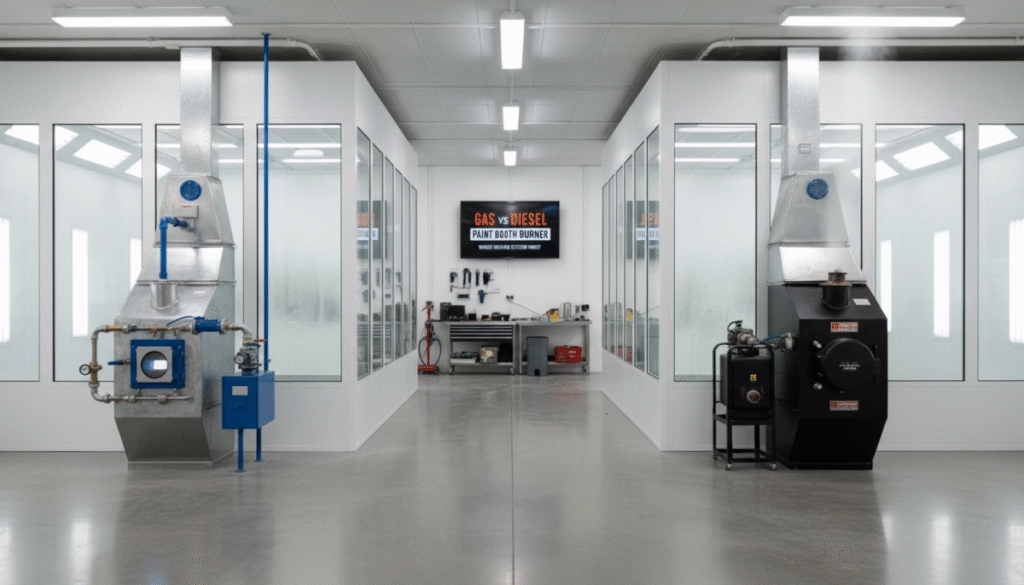
Choosing the wrong heating system for your paint booth doesn’t just affect finish quality — it affects how fast you can cure, how much you spend to run the booth every month, and how much time your team spends on maintenance. This guide breaks down how both systems work, where each one makes sense, and what the real cost comparison looks like so you can make the right call for your shop.
Page URL: https://sprayboothmanufacturer.com/product/
How Diesel Burners Work
The core of a diesel system is the combustion chamber. Fuel is pumped through a precision nozzle at high pressure, which breaks it into a fine mist — a process called fuel atomization. An ignition electrode sparks that mist, creating a controlled flame inside the heat exchanger. The booth’s fans blow air over the outside of the exchanger, heating it before it enters the cabin. The exhaust from combustion stays inside the sealed chamber and vents out separately, so combustion gases never mix with the booth air.
Where Diesel Works Well
Diesel’s biggest practical advantage is independence from utility infrastructure. If your shop is in a rural area or an industrial park where natural gas lines don’t reach, a diesel system with an on-site storage tank gives you reliable, powerful heat without any dependency on the municipal grid. The equipment cost is also generally lower upfront, and because the fuel is stored on your property, the whole setup is easier to relocate if your shop ever moves.
Diesel also delivers a high BTU output that brings a cold booth up to bake temperature quickly, which matters in climates where the booth is starting from a low baseline temperature in the morning.
Where Diesel Creates Ongoing Work
The trade-off is maintenance. A diesel system requires regular nozzle cleaning, soot removal from the heat exchanger, and consistent filter changes to keep combustion running cleanly. Skip these and you get burner misfires, reduced efficiency, and eventually the contamination risk that comes with soot buildup. If the heat exchanger develops a crack from age or neglect, combustion byproducts can enter the spray zone — the result is yellowing clear coats or microscopic soot in a fresh finish.
Fuel storage also adds regulatory overhead. Keeping diesel on-site means dealing with fire codes, double-walled tank requirements, and in some states, environmental spill permits. In urban areas, that adds complexity to your compliance picture.
| Feature | Diesel Burner |
|---|---|
| Installation | Fast — no gas line permits needed |
| Maintenance | High — monthly inspections required |
| Heat Speed | Excellent — high thermal output |
| Cleanliness | Moderate — requires strict filtration |
How Gas Burners Work
Gas systems — whether natural gas or LPG — operate through one of two configurations. Direct-fired burners put the flame directly in the airstream of the Air Makeup Unit, which means nearly 100% of the fuel energy converts to heat with minimal loss. Indirect-fired gas setups use a heat exchanger the same way diesel does, keeping combustion gases separated from the booth air.
Where Gas Stands Out
The cleanliness advantage is real. Gas burns without the soot and oily residue that diesel systems produce, which means less contamination risk reaching the paint surface and far less time spent on maintenance. There are no fuel filters to swap out frequently and no nozzles to clean on a regular schedule. Day-to-day, a gas system asks much less of you.
On operating costs, natural gas is typically cheaper per BTU than diesel in most parts of the United States, and the price is more stable. For a shop running multiple bake cycles daily, that difference adds up significantly over the course of a year. Gas valves also allow precise temperature modulation — you can hit and hold an exact temperature, which is particularly important when working with modern waterborne paints that require specific curing conditions.
The Infrastructure Barrier
The biggest hurdle with gas is upfront. If your shop doesn’t already have a high-pressure gas line, the cost of plumbing and utility hookup can be substantial. And once you’re on the gas grid, you’re dependent on it — if supply pressure drops or the line goes down, the booth stops running. LPG tanks on-site solve the infrastructure problem but add some of the storage logistics that diesel already requires.
| Feature | Gas Burner |
|---|---|
| Thermal Efficiency | Up to 100% (direct-fired) |
| Fuel Type | Natural gas or LPG |
| Maintenance Level | Low |
| Temperature Control | High precision |
Head-to-Head: The Metrics That Matter
Curing Speed
Direct-fired gas systems are the fastest option. With the flame in the airstream, there’s essentially no heat loss in the transfer — all of it goes directly into the booth. Diesel’s indirect-fired method through a heat exchanger is still fast and delivers plenty of BTU output, but a portion of heat escapes through the exhaust stack. The practical difference is usually a few extra minutes to reach peak bake temperature, which matters on a high-volume schedule where those minutes add up across the day.
Operating Costs
| Metric | Diesel Burner | Gas Burner |
|---|---|---|
| Fuel Cost | Fluctuates with oil market; generally higher | Usually lower and more stable |
| Energy Loss | 15–20% through heat exchanger | Near 0% (direct-fired) |
| Maintenance Cost | High — filters, nozzles, soot removal | Low — mainly sensor and solenoid checks |
| Infrastructure | On-site storage tanks and pumps | Utility line or LPG tank |
Longevity and Reliability
Diesel burners can last a long time, but they require consistent attention. Nozzle wear, soot accumulation in the combustion chamber, and filter clogging are ongoing realities that have to be managed proactively. Let maintenance slip and performance degrades quickly.
Gas systems have fewer moving parts and no liquid fuel to gum up the system. Maintenance largely comes down to periodic solenoid and igniter checks. Over time, the lower operational overhead and fewer emergency breakdowns give gas a reliability edge in high-production environments.
Environmental Compliance
Gas burns significantly cleaner than diesel, with lower carbon emissions and fewer particulates. For shops in states with strict EPA requirements or local air quality regulations, gas is the more straightforward compliance path. Diesel systems, while safe for paint quality when properly maintained, produce more exhaust particulates and may require additional permitting in urban areas.
Location Matters More Than Most People Realize
Your zip code is a major factor in this decision — sometimes more than the specs of the heating system itself.
City shops typically have municipal gas lines running to the street already. Tapping into that supply for a direct-fired gas burner is usually the most cost-effective and practical path. The infrastructure is there; you’re paying to connect to it, not build it from scratch.
Rural shops often don’t have that option. Running a commercial gas line out to an industrial property or rural location can cost more than the booth itself, if it’s possible at all. In those situations, diesel with an on-site tank or LPG delivery is the practical answer — not a compromise, just the reality of the location.
Cold climate considerations add another layer. In the Midwest and Northeast, extreme winter temperatures cause diesel fuel to gel and thicken, which disrupts atomization and drops thermal efficiency. Managing this requires fuel additives or heated storage, which adds cost and complexity. Natural gas and LPG flow reliably regardless of how cold it gets outside.
Fuel storage regulations are worth factoring in too. Keeping diesel on-site comes with fire code requirements, containment regulations, and in some states, environmental permits. Running a gas line eliminates all of that storage overhead and makes ongoing compliance much simpler to manage.
Which One Is Right for Your Shop
Choose diesel if:
Your shop is in a rural or remote area where natural gas isn’t accessible. Diesel with an on-site tank gives you reliable, high-output heat without any dependency on utility infrastructure. It’s also a practical fit if your initial equipment budget is tighter or if you already manage fuel storage for other machinery on the property.
Choose gas if:
You’re running a high-volume shop and want the lowest per-cycle operating cost and minimal maintenance burden. Gas is also the better choice if you’re in a state with strict emissions compliance requirements, or if you’re working heavily with waterborne paints that benefit from precise temperature control. If the gas line infrastructure is already in place, the long-term economics are hard to argue with.
The dual-fuel option:
For shop owners who want maximum flexibility, dual-fuel burner systems are becoming more common at the high end of the market. These allow you to switch between gas and diesel depending on current fuel prices or supply availability. The initial setup is more complex and the cost is higher, but it removes the risk of being locked into one fuel source when conditions change.
Quick Comparison Summary
| Feature | Diesel Burner | Gas Burner |
|---|---|---|
| Initial Investment | Lower upfront cost | Higher installation cost |
| Maintenance Needs | High — filters, nozzles, soot | Low — mostly sensor checks |
| Fuel Source | On-site storage tank | Municipal line or LPG tank |
| Curing Consistency | Good, needs monitoring | Excellent, high precision |
| Best For | Remote or rural shops | High-volume urban shops |
Both systems can run a productive, compliant paint booth. The question is which one fits your location, your production volume, and your operational priorities — not which one wins in the abstract.
Common Questions
Is diesel heating safe for paint quality? Yes, when properly maintained. Modern indirect-fired diesel systems keep combustion gases completely separated from booth air. The contamination risk comes from neglected maintenance — cracked heat exchangers or soot buildup that hasn’t been cleared. A well-maintained diesel system produces clean air inside the booth.
How much does the operating cost difference actually add up to? It depends on your local fuel prices and how many bake cycles you run per day. For a shop running five or more vehicles daily, the difference in fuel cost between diesel and natural gas can represent a meaningful sum over a year. For a lower-volume shop, the gap narrows considerably.
Can I switch from diesel to gas later if I want to? In most cases yes, but it’s not a minor swap. The burner and AMU configuration change, and if you don’t have existing gas infrastructure, that’s a significant addition. It’s worth getting the decision right upfront rather than planning to convert later.
What about LPG as a middle ground? LPG is a solid option for shops that want gas’s clean burning and precision without access to a natural gas line. The main consideration is on-site tank storage, which has its own regulations, though typically less complex than diesel’s requirements.
Tell Us What You’re Working With
Share your shop location, booth dimensions, current heating setup, and weekly production volume. We’ll help you determine whether gas or diesel is the right fit for your operation and send a detailed quote with system recommendations — usually within 48 hours.
Related Pages
- Bus Spray Booth Design Guide → https://sprayboothmanufacturer.com/transit-coach-spray-booth-requirements/
- Truck Paint Booth Guide → https://sprayboothmanufacturer.com/truck-paint-booth-semi-truck-spray-booth-specifications-buying-guide/
- Other related products → https://www.autokemanufacture.com/product
- Contact our sales Team → https://sprayboothmanufacturer.com/contact-us/
✅ CE Certified | ✅ ISO 9001:2015 | ✅ Factory Direct | ✅ Ships to 60+ Countries | ✅ 1-Year Warranty | 🔒 HTTPS Secured