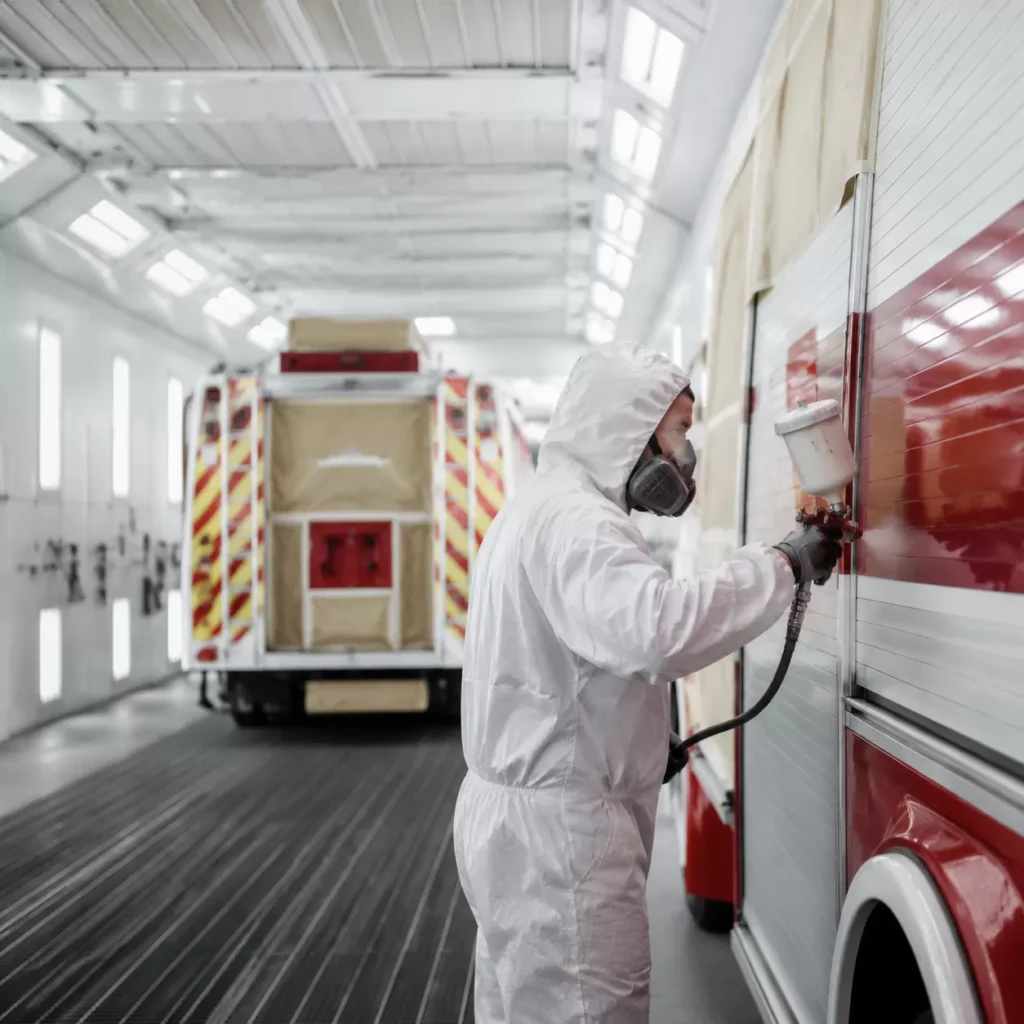
When a fire truck or ambulance rolls into your shop, the job is nothing like refinishing a pickup or a sedan. These rigs are bigger, heavier, and held to a much higher standard — because the finish on a first responder vehicle isn’t just about looks. It’s about visibility, corrosion resistance, and keeping a million-dollar piece of equipment in service as long as possible. This guide covers what makes an emergency vehicle paint booth different, what to look for when choosing one, and how to get a finish that actually holds up in the field.
Page URL: https://sprayboothmanufacturer.com/product/
Why Standard Auto Booths Don’t Work Here
Most standard spray booths are built around passenger vehicles. A modern fire engine or Type I ambulance is a completely different animal — longer, taller, and far heavier than anything a conventional booth was designed to handle.
The clearance problem alone rules out most standard setups. Light bars, ladder mounts, and aerial equipment on a pumper truck can push overall height well past what a typical 10-foot booth can manage. Our emergency vehicle booths are built to handle rigs from 10 to 15 meters in length, with ceiling clearance starting at 14 feet and going higher depending on the configuration.
Beyond size, there’s an airflow problem. A large vehicle body creates dead zones — areas where air stalls and overspray settles instead of being carried out. In a booth built for compact vehicles, those dead zones are a constant issue. A booth designed for heavy apparatus solves this at the structural level, not through workarounds.
| Feature | Standard Auto Booth | Emergency Apparatus Booth |
|---|---|---|
| Airflow Volume | Low to Moderate | High-CFM Laminar Flow |
| Filtration | Single Stage | Multi-Stage Heavy Duty |
| Height Clearance | 8–10 ft | 14–16+ ft |
| Vehicle Length | Up to ~6 m | 10–15 m |
| Construction | Lighter Gauge Steel | 18-Gauge Non-Combustible Steel |
Safety and Compliance Requirements
NFPA 33 and OSHA Standards
Spray booths used for emergency vehicle refinishing have to meet strict requirements — NFPA 33 compliance, proper ventilation rates, and explosion-proof electrical components throughout. These aren’t optional. The interior of an operating booth is classified as a Class I, Division 1 hazardous location, and any shortcuts in the electrical or mechanical design put your shop at serious risk.
Our booths are built with 18-gauge non-combustible steel panels, tongue-and-groove sealed joints, and explosion-proof lighting and motors as standard. The goal is a booth that doesn’t require add-ons or modifications to pass inspection — it passes as built.
Gaseous Fire Suppression
Because you’re painting the vehicles that respond to fires, the booth itself needs a serious suppression plan. Water-based sprinkler systems are a problem here — a water discharge inside a booth can destroy a fresh paint job and cause electrical damage to a rig worth over a million dollars.
Gaseous suppression systems handle this differently. They work by displacing oxygen or interrupting the combustion reaction directly, leaving no residue behind. They also trigger automatic shutdowns of fans and burners, which limits smoke and heat spread. For emergency vehicle shops, this is the right choice.
Airflow: Why It Matters More Than You Think
Downdraft Systems for Large Vertical Surfaces
A downdraft system pulls air from the ceiling straight down through floor-level exhaust pits. For a vehicle the size of a fire engine, this is the most effective setup available. Overspray is pulled away from the surface immediately instead of drifting across the vehicle. Fumes move down and away from the painter. And across those large, flat vertical panels, the coverage stays even from top to bottom.
Laminar airflow — smooth, single-direction movement at a consistent speed — is what makes this work in practice. Turbulent air kicks up dust and creates inconsistent drying. Laminar flow keeps contamination out and keeps the finish clean.
Multi-Stage Filtration
Keeping a large booth clean requires more than a basic filter pad. We use a three-stage filtration approach: intake filters to block incoming dust and pollen, ceiling diffusers to balance air pressure across the full ceiling area, and heavy exhaust filters to capture paint solids before they reach the fan. Each stage does a specific job, and skipping any of them shows up in the finished product.
The Refinishing Process
Refinishing a fire truck or ambulance follows a different sequence than standard auto body work. The metals involved — aluminum and galvanized steel — are used specifically because they’re light and rust-resistant, but they’re also harder for paint to bond to.
Surface prep starts with mechanical scuffing to give the paint something to grip, followed by chemical pre-treatment with an etching primer. Every panel gets wiped down to remove oils and silicone before anything else goes on — skipping this step is how fish-eye defects happen.
The primer coat is a high-build, corrosion-resistant formula that seals the metal and fills minor surface imperfections. This is what determines how the finish holds up three, five, and ten years into the vehicle’s service life.
The topcoat — whether it’s fire engine red, lime yellow, or white — goes on in overlapping passes to avoid striping across large panels. We use high-solid polyurethane paint for the UV resistance and chemical toughness it provides. A thick clearcoat goes on last to protect the pigment from hydraulic fluids, road salts, and harsh cleaning detergents.
The bake cycle is the final step. The booth heats the finish to between 140°F and 160°F, which causes the paint to cross-link and harden properly. An air-dried finish on a vehicle that operates in extreme conditions isn’t durable enough. Baking it is what makes it field-ready.
| Process Stage | Primary Goal | Key Factor |
|---|---|---|
| Pre-Treatment | Grip and Adhesion | Aluminum Etching |
| Priming | Corrosion Blocking | High-Build Solids |
| Topcoat | Color and Visibility | Polyurethane Gloss |
| Baking | Hardness and Durability | Heated Plenum Cure |
Smart Features Worth Having
Precision Lighting
Matching fire engine red across multiple panels under bad lighting is how color inconsistencies happen. Shadow-free LED lighting positioned specifically for tall, vertical surfaces makes a real difference — painters can spot runs, dry spots, and coverage gaps before the rig goes into the bake cycle rather than after.
VFD Motor Controls
Variable Frequency Drives adjust fan speed based on actual system pressure rather than running the motors at full capacity all day. During prep and flash-off stages, this can cut electricity consumption significantly. During the bake cycle, recirculation mode reuses heated air rather than constantly pulling in fresh cold air — which makes a real difference on a booth heating a 12-meter vehicle.
| Feature | Operational Benefit |
|---|---|
| VFD System | Reduces electricity costs during prep and flash cycles |
| Recirculation Mode | Cuts gas consumption during heated bake cycles |
| Smart Controls | Programs flash-off times, bake stages, and safety interlocks |
FAQ
What size booth do I need for a long-wheelbase fire engine? For most modern heavy apparatus, you need a booth that’s at least 45 to 50 feet long, 16 to 18 feet wide, and 16 feet tall. Our standard emergency vehicle configurations cover vehicles from 10 to 15 meters in length. Always measure with compartment doors open if you plan to do interior work inside the booth.
Why does temperature control matter so much for large rigs? Large metal vehicles act as heat sinks. If the substrate is too cold when you apply paint, the coating won’t flow or bond correctly — you get orange peel texture or, worse, delamination down the road. The heated intake plenum keeps the vehicle surface at a stable working temperature throughout the job. Consistent heat during the bake cycle is what delivers the chemical resistance these vehicles require in the field.
Do I need a separate mixing room? Yes. NFPA 33 and OSHA both require that mixing of flammable coatings happen in a dedicated, fire-rated space away from the main shop floor. A proper paint mix room keeps vapors contained, gives technicians a clean environment to work in, and keeps open containers of paint away from shop contamination.
Can a standard motor handle continuous operation in this environment? Not reliably. The extended bake cycles and continuous runtime in a heavy apparatus shop push standard motors past their design limits. An explosion-proof motor with appropriate specs for your booth’s CFM and static pressure requirements is mandatory — both for safety compliance and for avoiding mid-job failures.
Tell Us What You’re Working With
Share your current booth dimensions, the types of apparatus you’re refinishing, and how many cycles per week you’re running. We’ll put together a recommendation and a detailed quote — usually within 48 hours.
Related Pages
- Bus Spray Booth Design Guide → https://sprayboothmanufacturer.com/transit-coach-spray-booth-requirements/
- Truck Paint Booth Guide → https://sprayboothmanufacturer.com/truck-paint-booth-semi-truck-spray-booth-specifications-buying-guide/
- Other related products → https://www.autokemanufacture.com/product
- Contact our sales Team → https://sprayboothmanufacturer.com/contact-us/
✅ CE Certified | ✅ ISO 9001:2015 | ✅ Factory Direct | ✅ Ships to 60+ Countries | ✅ 1-Year Warranty | 🔒 HTTPS Secured