
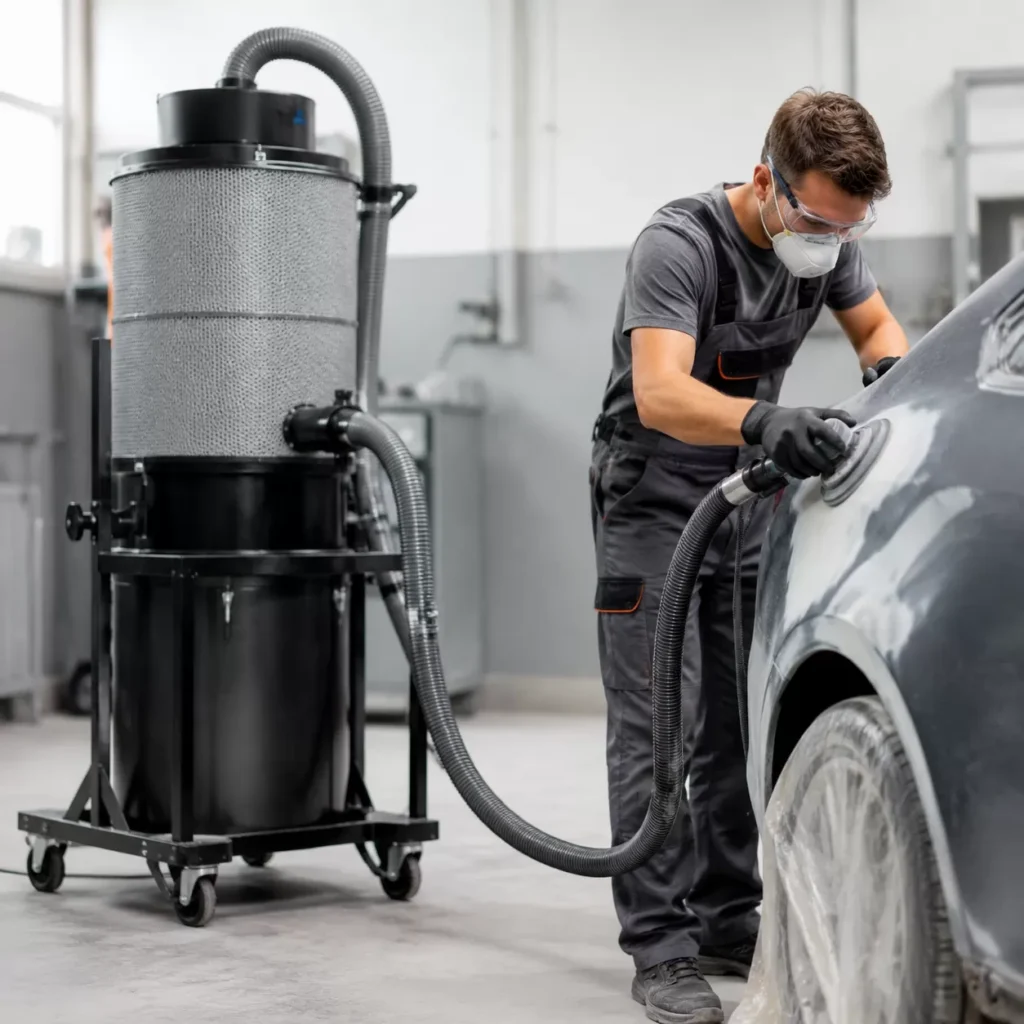
A regular shop vac can keep a floor tidy, but it’s not built for what happens during automotive surface prep. The dust from sanding body filler and primer is fine enough to stay airborne for hours, and a standard vacuum doesn’t capture it — it just pushes it around. For any collision shop doing serious work, a proper dry sanding dust collector is a fundamental part of the setup. This guide covers how these systems work, what to look for, and why the difference between at-source extraction and ambient filtration matters more than most shops realize.
Page URL: https://sprayboothmanufacturer.com/product/
What a Dry Sanding Dust Collector Actually Does
Auto body dust extraction systems follow one core principle: trap dust right at its source before it spreads. This is different from shop fans or ceiling filtration units, which try to clean the air after dust is already floating around. By the time ambient filtration gets to work, particles have already settled on panels, entered the painter’s breathing zone, and contaminated surfaces that are ready for the next coat.
On-site extraction draws in dust right at the sanding pad as it forms. It keeps work surfaces tidy, maintains fresh breathable air, and eliminates intermediate booth cleaning between working steps.
| Feature | Ambient Filtration | At-Source Extraction |
|---|---|---|
| Capture Method | Cleans air in the room | Pulls dust directly from the tool |
| Surface Impact | Dust can settle on panels | Keeps the work surface clean |
| Health Benefit | Technician still breathes dust | Dust doesn’t reach the breathing zone |
| Efficiency | High energy, slow results | Low energy, high-velocity capture |
The core components that make this work are an industrial-grade turbine for consistent suction, HEPA-rated filtration to catch particles down to 0.3 microns, and tool-integrated hoses that connect directly to the sander and sync suction with the trigger.
Why It Matters for Day-to-Day Shop Operations
Finish Quality
Dust is one of the most common causes of paint defects. Loose body filler particles land on newly prepared panels and cause nibs and fish eyes in clear coats. Workers then spend extra hours sanding and polishing to repair these defects long after finishing regular painting work. Pulling that dust away before it becomes airborne is the simplest way to reduce re-dos that come from contamination rather than application error.
Technician Health and OSHA Compliance
Sanding old paint and body filler releases hazardous particles, including silica dust, lead compounds, and chromium depending on the vehicle’s age and history. OSHA sets Permissible Exposure Limits for these materials, and a high-quality extraction system is one of the most direct ways to stay within those limits. A clean working environment also reduces the reliance on heavy respirators during light sanding tasks, which matters over the course of an eight-hour shift.
Shop Productivity
Without dedicated extraction, technicians spend a significant portion of their day cleaning up between stages — blowing off panels, sweeping bays, wiping down surfaces. An integrated dust collection setup cuts that cleanup time down and allows a more direct flow from sanding to masking to paint. The time saved across a week of production adds up quickly.
Abrasive and Equipment Life
Dust that doesn’t get extracted ends up loading the sandpaper — clogging the grit until the disc stops cutting and needs to be replaced. Consistent suction keeps the abrasive surface clear, which extends disc life noticeably. It also pulls heat away from the sander’s pad during heavy work, which reduces wear on the tool itself over time.
The Dry Sanding Cabinet: 3000 × 1000 × 2000mm
Our dry sanding cabinet is built specifically for the surface prep stage in auto body and collision repair shops. At 3000 × 1000 × 2000mm, it provides a dedicated enclosed workspace for dry sanding tasks — keeping dust contained within the cabinet rather than letting it travel through the shop.
The cabinet format works differently from a portable extractor. You place workpieces inside the enclosed built-in extraction space instead of linking the device to handheld tools. This is particularly useful for panel prep, bumper work, and component sanding where a controlled environment around the part gives better results than open-bay sanding.
Key advantages of the cabinet format:
The enclosed structure prevents sanding dust from reaching the rest of the shop floor entirely. Filtration happens within the unit, so the exhaust air is already clean before it returns to the workspace. The cabinet features a fixed size, so you can place it neatly in workshop layouts. It never occupies irregular extra floor space like mobile equipment.
System Options: Portable vs. Centralized
Portable Extractors
Portable units are the practical choice for smaller shops or operations where technicians move between bays. They link straight to orbital sanders with standard vacuum fittings, need no permanent installation, and allow flexible repositioning anytime. For shops with one or two bays doing moderate daily volume, a portable setup is often the right starting point.
Centralized Systems
High-volume collision centers benefit from a centralized extraction host installed in a fixed utility location and piped to multiple work stations. Technicians plug into wall drops in each bay rather than managing individual units, and the main turbine runs from a location that keeps noise out of the work area. These systems support anywhere from two to ten or more simultaneous users without a drop in suction at any station.
| Feature | Portable Units | Centralized Systems |
|---|---|---|
| Best For | Small shops, spot repairs | High-volume collision centers |
| Bay Capacity | 1–2 bays | 4–10+ bays |
| Installation | None — roll and go | Professional piping required |
| Noise | In the bay | Isolated to utility room |
| Maintenance | Per-unit filter checks | Centralized waste collection |
Filtration and Self-Cleaning
Body filler dust loads standard filters fast. Multi-stage filtration addresses this by separating larger particles before they reach the primary filter, which keeps airflow consistent throughout the shift rather than dropping off as the filter fills.
Reverse-flow pulse cleaning is the feature that makes a real difference in production environments. Instead of manually removing and cleaning the filter — which means stopping work — the system uses timed air pulses to knock accumulated dust off the filter surface and into the collection bin automatically. The filter stays clear, suction stays consistent, and technicians don’t need to stop to deal with it.
HEPA-rated final filters capture particles down to 0.3 microns at 99.97% efficiency, which covers the silica dust fraction that poses the most significant health risk. These filters last 12 to 18 months under normal production load if primary filtration is maintained properly.
Maintenance Schedule
An extraction system that isn’t maintained stops performing like one. Suction loss almost always traces back to a clogged filter, a full collection bag, or a loose hose connection — all of which are simple to prevent with a basic routine.
| Task | Frequency | Why It Matters |
|---|---|---|
| Filter Pressure Check | Daily | Catches loading before it affects suction |
| Dust Bin or Bag | Weekly | Prevents backpressure on the motor |
| Hose and Seal Inspection | Monthly | Eliminates suction loss at connection points |
| HEPA Filter Replacement | Every 12–18 months | Maintains OSHA compliance and capture efficiency |
One practical point worth emphasizing: the most common source of suction loss at the tool is a loose hose coupling. Training technicians to check the connection at the sander before starting each job eliminates a lot of the “the vacuum isn’t working” complaints that are actually just a fitting that didn’t seat properly.
FAQ
Can a regular shop vacuum handle auto body sanding dust? Not reliably. Standard shop vacs aren’t built for the fine particle sizes generated during body filler and primer sanding. They typically lack the filtration to capture these particles and often exhaust them back into the air through the motor housing. For a professional environment with OSHA requirements, a proper extraction system with HEPA filtration is the right tool.
Does the system work with both pneumatic and electric sanders? Yes. Most professional extraction systems are designed to connect to both types. Pneumatic connections integrate with the air line and trigger automatically when the tool runs. Electric orbital sanders use standard vacuum attachment hoses. The auto-start function on most units means the suction kicks in the moment the trigger is pulled on either type.
How often do filters actually need to be replaced? Pre-filters should be checked weekly and replaced every three to six months depending on production volume. HEPA filters in a well-maintained system typically last 12 to 18 months. Systems with automatic reverse-flow cleaning extend these intervals by keeping the primary filter clear throughout the shift rather than letting it cake between manual cleanings.
Is the dry sanding cabinet suitable for bumper and panel work? Yes. The 3000 × 1000 × 2000mm format accommodates full bumper covers and large body panels, making it a practical option for shops that want to keep sanding work contained in a dedicated area rather than generating dust throughout the prep bay.
Tell Us What You’re Working With
Share your shop size, daily sanding volume, and whether you’re looking at a portable setup, centralized system, or the dry sanding cabinet. We’ll put together a recommendation and a detailed quote — usually within 48 hours.
Related Pages
- Bus Spray Booth Design Guide → https://sprayboothmanufacturer.com/transit-coach-spray-booth-requirements/
- Truck Paint Booth Guide → https://sprayboothmanufacturer.com/truck-paint-booth-semi-truck-spray-booth-specifications-buying-guide/
- Other related products → https://www.autokemanufacture.com/product
- Contact our sales Team → https://sprayboothmanufacturer.com/contact-us/
✅ CE Certified | ✅ ISO 9001:2015 | ✅ Factory Direct | ✅ Ships to 60+ Countries | ✅ 1-Year Warranty | 🔒 HTTPS Secured