
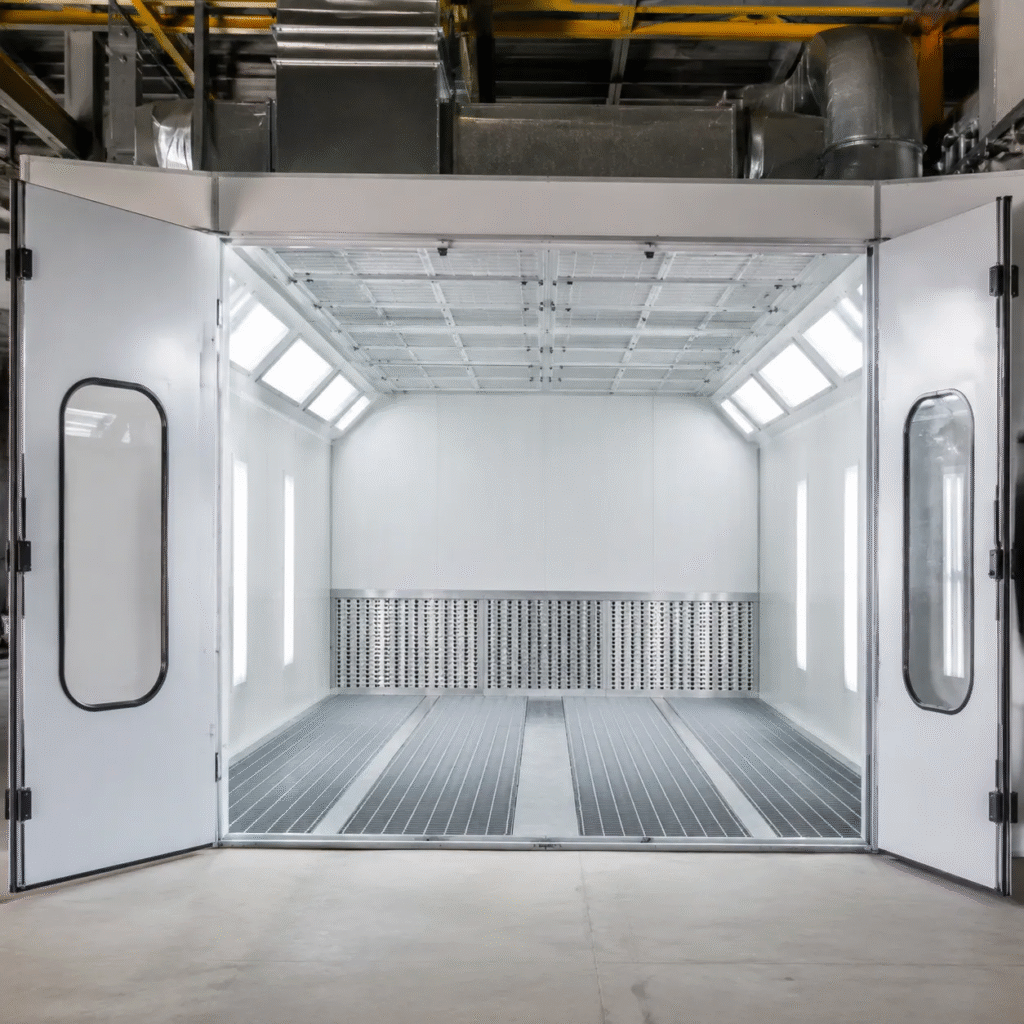
Down Draft Paint Booth Specifications: What the Numbers Actually Mean
Understanding Down Draft Paint Booth Specifications
Buying a spray booth without understanding the spec sheet is a fast track to poor finish quality, lingering overspray, and code compliance failures. When we look at a booth’s technical data, we are looking at the direct blueprint of how air moves through the cabin. A true downdraft airflow system pulls air from the ceiling down to the floor pit, enveloping the vehicle or part to pull contaminants away instantly. Misinterpreting these numbers leads to dead air pockets, dry spray, and costly rework.
Page URL: https://sprayboothmanufacturer.com/product/
What CFM, SP, and FPM Actually Mean
To evaluate a booth properly, we must master the core metrics of airflow dynamics. These three specifications dictate how clean your shop stays and how fast your painters can work.
- CFM (Cubic Feet per Minute): This measures the total volume of air the exhaust fan motor moves through the cabin every sixty seconds.
- FPM (Feet per Minute): This measures velocity profile—the actual speed at which that air travels past the painter and the object being coated.
- SP (Static Pressure): Measured in inches of water gauge, this represents the resistance the air faces as it pushes through intake filtration media and exhaust filters.
| Metric | Short Definition | Why It Matters for Your Shop |
|---|---|---|
| CFM | Air Volume | Determines the sizing of your air makeup unit and total air turnover. |
| FPM | Air Velocity | Controls overspray settlement and keeps contaminants out of the wet paint. |
| SP | Air Resistance | Indicates when filters are loaded and how hard the fan motor has to work. |
Why Reading the Spec Sheet Prevents Overspray Issues
Overspray collection efficiency depends entirely on balanced pressure. If the booth specifications show an underpowered fan or incorrect duct sizing, overspray will cloud the cabin instead of hitting the exhaust filters. We analyze the spec sheet to ensure the intake and exhaust systems match perfectly. When the volume of air entering equals the volume being pulled out, the booth maintains a slight negative or controlled positive pressure. This balance ensures absolute overspray control, keeping your shop clean and satisfying NFPA 33 compliance.
How Air Velocity Impacts Your Finish Quality
Air velocity is the secret to a flawless clear coat. If your velocity profile drops below the industry baseline, overspray hangs in suspension, drifting back down onto your wet finish as dry spray. Conversely, if the velocity is too high, it creates turbulence, lifting dust from the floor and whipping it across your fresh paint.
Achieving the correct FPM ensures that airborne contaminants are pulled straight down into the floor filters in a smooth, laminar flow. This direct movement cuts down on your buffing time and guarantees a pristine, factory-level finish on every job.
Airflow Volume and Velocity Requirements
Getting the numbers right on your downdraft airflow prevents wet edges from blowing around and keeps overspray off your fresh paint. We look at two main metrics to ensure your cabin clears out fumes instantly: Cubic Feet per Minute (CFM) and Feet per Minute (FPM).
The 100 FPM Standard Explained
The industry standard for a proper downdraft paint booth is a velocity profile of 100 FPM. This means the air moves downward past the vehicle at a steady rate of 100 feet every minute. If your velocity drops below this mark, overspray hangs in the air, settles back onto your clear coat, and ruins the finish quality.
Calculating Ideal CFM for Your Shop
To calculate the total volume of air your exhaust fan motor needs to move, we look at the footprint of your booth floor. The calculation is straightforward: multiply the width of the booth by its length to get the square footage, then multiply that by the 100 FPM speed standard.
| Booth Size (Width x Length) | Floor Area (Sq. Ft.) | Required Airflow Volume (CFM) |
|---|---|---|
| 14′ x 24′ (Standard Car) | 336 sq. ft. | 33,600 CFM |
| 16′ x 30′ (Large SUV / Van) | 480 sq. ft. | 48,000 CFM |
| 16′ x 40′ (Truck / Commercial) | 640 sq. ft. | 64,000 CFM |
How Booth Dimensions Alter Your Airflow Calculation
Larger cabins demand significantly higher cubic feet per minute to maintain the same draft speed. If you increase the length or width of your booth to accommodate bigger global transport vehicles, your air makeup unit and exhaust system must scale up proportionally. Adding height does not change the floor footprint calculation for a true downdraft, but extra length and width will immediately alter your equipment requirements to avoid dead zones.
Static Pressure and Exhaust Fan Performance
If your exhaust fan can’t fight the resistance inside the cabin, you get overspray settling right back onto your fresh clear coat. That resistance is what we call static pressure, and getting this number right makes or breaks your velocity profile.
Decoding TESP (Total External Static Pressure)
Total External Static Pressure (TESP) is the total resistance your exhaust fan motor has to push and pull against to keep air moving. It is measured in inches of static pressure water gauge (w.g.).
- Low TESP: The fan cannot overcome the resistance of the ductwork and filters, leading to sluggish downdraft airflow.
- High TESP: The fan moves air efficiently through the entire system, pulling overspray straight down into the pits.
Why Static Pressure Rises with Dirty Filters
As your intake filtration media and exhaust pockets load up with overspray, the gaps for air to pass through shrink. This restriction forces the static pressure water gauge reading to climb.
| Filter Condition | Impact on Static Pressure | Impact on Airflow |
|---|---|---|
| Brand New Filters | Low resistance (baseline w.g.) | Peak CFM and optimal draft |
| Loaded/Dirty Filters | High resistance (climbing w.g.) | Dropping FPM and hazy cabin air |
When resistance gets too high, your exhaust fan stalls out, cutting down your air changes and ruining your overspray collection efficiency.
Choosing Fan Horsepower and Blade Type
We build our booths with heavy-duty axial limit-load fans or radial-blade centrifugal fans to handle these pressure shifts without dropping performance.
- Axial Fans: Great for high-volume downdraft airflow at lower static pressures; highly cost-effective.
- Centrifugal Fans: Best for complex duct runs because they maintain strong static pressure even as filters clog.
- Motor Horsepower (HP): Never undersize here. A higher HP exhaust fan motor ensures the booth maintains its target FPM from the first spray job to the last one before a filter change.
Down Draft Paint Booth Specifications: Cabin Dimensions and Material Specs
When you are reviewing down draft paint booth specifications, the cabin build and physical footprint are just as critical as the airflow. If you get these numbers wrong, your largest vehicles won’t fit, or worse, the structure will buckle under heavy static pressure.
Working Dimensions vs. External Footprint
We always look at two distinct sets of measurements on a spec sheet: Clear Working Dimensions: The actual usable space inside the cabin. Your largest project must have at least 2 to 3 feet of clearance on all sides to allow for proper downdraft airflow and painter movement. External Booth Footprint: The total space the booth occupies in your shop. This includes the width of the plenum, exhaust ducts, and the air makeup unit.
Sheet Metal Gauge: 18-Gauge vs. 20-Gauge Steel
The thickness of the booth walls dictates its lifespan and structural integrity.
| Steel Gauge | Thickness | Performance Impact |
|---|---|---|
| 18-Gauge Steel | Thicker (~0.048″) | Our recommendation. Stronger structural integrity, resists oil-canning (popping noises), and withstands high static pressure from powerful exhaust fan motors. |
| 20-Gauge Steel | Thinner (~0.036″) | Budget-friendly but prone to flexing, vibration, and faster wear under heavy commercial use. |
Pre-Coated vs. Galvanized Steel Durability
The finish of your cabin panels affects both shop lighting and rust resistance. Galvanized Steel: Provides excellent corrosion protection, but the raw dull gray finish absorbs light, requiring higher spray booth lighting intensity to see your velocity profile clearly. Pre-Coated (White Powder-Coated): This is our standard for premium builds. The reflective white surface maximizes your lux levels, improves visibility during precision painting, and adds an extra layer of chemical and overspray resistance.
Spray Booth Lighting and Lux Levels for Precision Painting
If you cannot see the paint color accurately, you cannot spray it right. When evaluating down draft paint booth specifications, lighting configuration is just as critical as airflow. We design our booths to eliminate shadows and color distortion so your team gets a flawless finish on every job.
LED vs. T8 Fluorescent Booth Fixtures
We use high-efficiency LED fixtures over traditional T8 fluorescent tubes. LEDs provide brighter, more consistent light while consuming a fraction of the energy. They also generate less heat, which helps maintain stable booth temperatures during the spraying phase.
| Feature | LED Fixtures | T8 Fluorescent |
|---|---|---|
| Energy Efficiency | High (Up to 60% savings) | Moderate |
| Lifespan | 50,000+ hours | 10,000 to 15,000 hours |
| Light Degradation | Minimal over time | Dims noticeably with age |
| Heat Output | Very low | Low to moderate |
Class I Division 2 (C1D2) Explosion-Proof Ratings
Safety is non-negotiable in an environment filled with atomized flammable solvents. Our spray booth lighting systems carry a strict Class I Division 2 (C1D2) hazardous location rating.
- Explosion-Proof Seals: Fixtures are completely sealed to prevent volatile vapors from contacting electrical sparks.
- Tempered Glass: Outer lenses utilize impact-resistant tempered glass that withstands shop impacts and heavy cleaning.
- NFPA 33 Compliance: Meeting C1D2 standards ensures your shop aligns with local code requirements and fire safety regulations.
Achieving Proper Lumens and Color Rendering Index (CRI)
To spot runs, sags, or coverage issues before the bake cycle, you need clear visibility and color accuracy.
- Target Lux Levels: We target a minimum of 1,000 to 1,500 lux (approx. 100–150 foot-candles) at the working height to eliminate shadows.
- Color Rendering Index (CRI): Our booths utilize lamps with a CRI rating of 90 or higher. A high CRI ensures that the color you see inside the booth matches exactly how it looks in natural daylight.
- Color Temperature: We spec our lights at 5000K (daylight spectrum) to provide a neutral white light balance, preventing the yellow distortion common in cheaper light setups.
Down Draft Paint Booth Specifications: Heating and Burner Systems
Getting the right heating system determines how fast your shop can turn vehicles around. If your burner specs aren’t up to par, your baking cycle temperature will drag, stalling your production line.
Direct-Fired vs. Indirect-Fired Gas Burners
We build our downdraft airflow booths with two primary heating configurations. Choosing between them impacts your energy bills and air quality.
- Direct-Fired Burners: 100% thermal efficiency. The fuel burns directly in the airstream, offering the fastest heat-up times and lowest operating costs.
- Indirect-Fired Burners: The flame stays inside a heat exchanger. It keeps combustion byproducts out of the cabin, making it ideal for specialty coatings, though it uses more fuel.
| Feature | Direct-Fired System | Indirect-Fired System |
|---|---|---|
| Thermal Efficiency | 100% | 75% – 80% |
| Warm-Up Speed | Ultra-Fast | Moderate |
| Fuel Source | Natural Gas / Propane | Natural Gas / Propane / Oil |
| Best For | High-volume collision shops | Custom shops & specialty finishes |
BTU Ratings and Cure Cycles
Your burner’s BTU capacity dictates how quickly the booth reaches its target baking cycle temperature. For a standard automotive down draft paint booth, look for a system delivering between 1.0 million to 1.5 million BTUs.
- Flash-off phase: Safely drives off solvents at lower temperatures before the bake begins.
- Cure phase: Sustains steady metal temperatures (typically 140°F to 160°F / 60°C to 71°C) to bake the clear coat completely.
Recirculation Percentages During the Bake Phase
Running a heated air makeup unit on 100% fresh air during a bake cycle destroys your utility budget. To save fuel, our systems switch to a heavy recirculation mode during the curing process.
- Bake Mode Recirculation: The system recirculates 80% to 90% of the heated air, passing it through the intake filtration media again.
- Fresh Air Exhaust: The remaining 10% to 20% is exhausted to safely vent evaporated solvents and maintain static pressure balance.
Down Draft Paint Booth Specifications: Filtration and Compliance
We know the anxiety of facing an EPA inspection or dealing with a ruined paint job because a rogue dust particle landed right in the clear coat. When evaluating down draft paint booth specifications, filtration efficiency isn’t just a compliance checkbox—it’s what stands between a flawless finish and hours of rework.
Intake Filtration Media and Diffusion Ceilings
Our down draft system relies on a full-length diffusion ceiling to ensure a perfectly uniform velocity profile. The intake filtration media must capture microscopic airborne particles before they ever reach the vehicle cabin.
- Micron Rating: We utilize high-efficiency ceiling filters rated to capture 99% of particles down to 10 microns (and over 50% of particles down to 2.5 microns).
- Diffusion Material: Premium tacky media prevents fiber migration, ensuring that the downdraft airflow remains completely laminar and free of turbulence.
Exhaust Filtration Stages for EPA 6H Compliance
Meeting NESHAP EPA 6H compliance means your exhaust system must achieve at least a 98% overspray collection efficiency. We use a multi-stage exhaust filtration setup to protect both the outdoor environment and your exhaust fan motor from paint buildup.
| Filtration Stage | Filter Type | Primary Function | Target Efficiency |
|---|---|---|---|
| Stage 1 (Primary) | Fiberglass or Expanded Paper pad | Captures large overspray droplets right under the grates | ~90-95% particulate capture |
| Stage 2 (Secondary) | High-density polyester pocket filter | Traps fine paint particulates and mist | Exceeds 98% EPA 6H standard |
Magnehelic Pressure Gauge Specs for Filter Monitoring
You cannot manage what you do not measure. We equip our booths with a standard magnehelic pressure gauge to track the static pressure water gauge readings across the filter banks in real time.
- Baseline (Clean Filters): Typically operates around 0.2 to 0.3 inches of water gauge (w.g.).
- Replacement Threshold: When the differential pressure rises by 0.2 to 0.25 inches w.g. above the clean baseline, it is time to change the media.
- The Risk: Neglecting these readings restricts airflow, throws off your cabin pressure, and forces overspray back onto your fresh paint.
FAQs About Down Draft Paint Booth Specs
What happens if my booth’s CFM is too low?
When your downdraft airflow drops below the recommended cubic feet per minute (CFM), overspray hangs in the air instead of clearing out. This directly ruins your finish quality by letting dust and paint mist settle back onto the wet clear coat. It also creates a hazy environment that violates safety codes and puts your painters at risk.
Can I run a down draft booth without a heated air makeup unit?
You can, but we do not recommend it for commercial operations. A down draft paint booth moves a massive volume of air. Without an air makeup unit to heat the incoming air, your booth temperature will match the outdoor weather. In winter, this prevents paint from flowing correctly and stretches your baking cycle temperature timelines out indefinitely.
How often do I change filters based on the static pressure reading?
You should track your magnehelic pressure gauge daily. Every manufacturer lists a baseline static pressure water gauge reading for clean filters.
- Green Zone: Baseline up to $+0.2$ inches of water column (WC)—filters are clean.
- Yellow Zone: $+0.2$ to $+0.5$ inches of WC—intake filtration media is loading up.
- Red Zone: Hits $+0.5$ inches of WC or higher—change the filters immediately to protect your exhaust fan motor and maintain your velocity profile.
What electrical phase and voltage do standard commercial booths require?
| Component | Standard Voltage | Phase Requirements |
|---|---|---|
| Exhaust Fan Motor | 208V / 230V / 460V | 3-Phase (Recommended for industrial durability) |
| Spray Booth Lighting | 120V / 277V | Single-Phase |
| Control Panel & Interlocks | 120V | Single-Phase |
Most standard commercial shops require a 3-phase power supply to run the heavy-duty motors efficiently and maintain strict NFPA 33 compliance.
Related Sources
- https://www.spraysystems.com/crossdraft-vs-downdraft-paint-booths-which-airflow-design-is-right-for-you/
- https://wesellfans.com/ventilation-resource/paint-booth-cfm-calculator-air-flow-design-measurement/
- https://commercialledlights.com/applications/hazardous-location/paint-booth-lighting/
- https://www.aafintl.com/us/products/hvac-equipment/magnehelic-gauges
- Bus Spray Booth Design Guide → https://sprayboothmanufacturer.com/transit-coach-spray-booth-requirements/
- Truck Paint Booth Guide → https://sprayboothmanufacturer.com/truck-paint-booth-semi-truck-spray-booth-specifications-buying-guide/
- Other related products → https://www.autokemanufacture.com/product
- Contact our sales Team → https://sprayboothmanufacturer.com/contact-us/
✅ CE Certified | ✅ ISO 9001:2015 | ✅ Factory Direct | ✅ Ships to 60+ Countries | ✅ 1-Year Warranty | 🔒 HTTPS Secured