
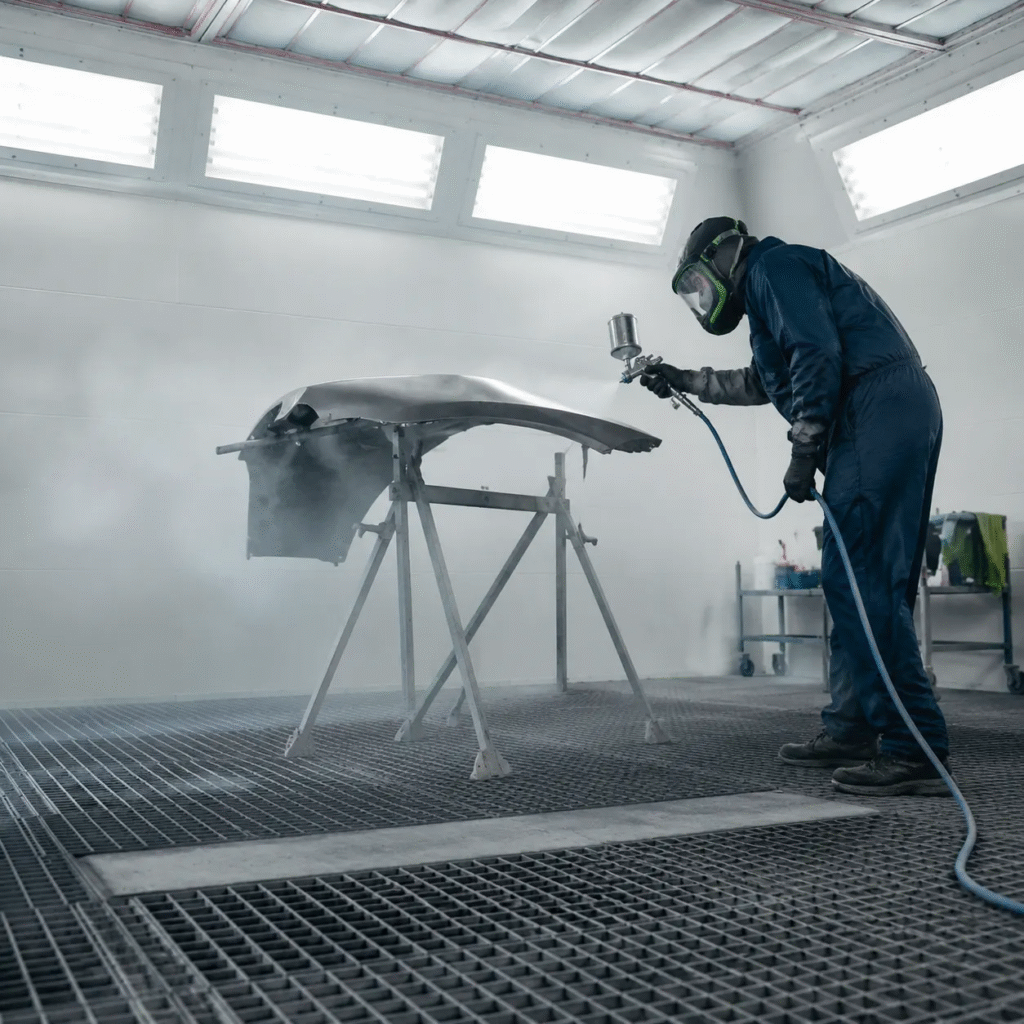
Every shop owner knows the frustration of a ruined paint job. You spend hours prepping a vehicle, only for a stray piece of dust or horizontal overspray to trash your clear coat.
You probably already know that a downdraft paint booth is considered the gold standard. But does it actually deliver the flawless, high-gloss results to justify the higher price tag?
In this quick guide, you are going to learn exactly how a downdraft paint booth improves finish quality compared to crossdraft and semi-downdraft airflow types. We will break down the real physics of laminar airflow, look at how it eliminates dry spray defects, and find out if it can truly slash your post-paint buffing time.
Let’s get right into it.
Page URL: https://sprayboothmanufacturer.com/product/
The Physics of Clean Air: Understanding Paint Booth Airflow Patterns
Achieving a flawless, high-gloss automotive finish isn’t just about the painter’s skill or the quality of the gun. It comes down to physics. When you spray, you create a cloud of finely atomized paint particles. If your booth’s airflow patterns aren’t perfectly controlled, those particles turn into overspray contamination control nightmares, drifting back onto your fresh wet coat.
To deliver a pristine surface, we design our systems to manage air velocity, pressure, and direction with absolute precision. How a downdraft paint booth improves finish quality vs other airflow types starts with mastering these invisible currents.
What is Laminar Airflow?
In an enclosed spray booth, we want laminar airflow physics at work. Laminar flow means the air moves in smooth, parallel lines at a constant velocity, without any chaotic swirling or turbulence.
- The Problem with Turbulence: Eddies and pockets of trapped air keep overspray suspended right next to your paint job.
- The Laminar Solution: It acts like an invisible curtain, wrapping around the vehicle and pushing airborne contaminants immediately away from the wet panels.
The Role of Gravity
Airflow designs that fight gravity are inherently inefficient. Traditional crossdraft setups pull air horizontally across the vehicle, meaning overspray from the front can travel over the entire length of the car before exiting.
A downdraft configuration works with gravity. By introducing clean air from the ceiling intake filtration system and pulling it straight down toward the floor, gravity helps drag heavy overspray and dust particles directly into the exhaust pits. Contaminants travel the shortest possible distance before being trapped, drastically reducing dry spray defects.
The AUTOKE Engineering Principle
At AUTOKE, we engineer our industrial finishing equipment around this exact harmony of laminar flow and gravity. We maximize paint transfer efficiency by balancing the booth’s interior pressure.
Our advanced ceiling plenums ensure that air enters evenly across the entire roof surface, eliminating dead zones. By precisely calibrating the air make-up unit (AMU), our systems create a steady, downward draft that guarantees a cleaner environment, better visibility for the technician, and a significant reduction in post-paint buffing and compounding time.
The Anatomy of Airflow: Downdraft vs. Alternative Configurations
When we design high-gloss automotive finish environments, the choice of equipment layout dictates the final product quality. Let’s look at how a downdraft paint booth improves finish quality vs other airflow types by breaking down the four primary configurations used in the industry today.
1. Full Downdraft Paint Booths (The Premium Benchmark)
In our full downdraft setups, air enters through a ceiling intake filtration system and flows straight down over the vehicle or part. The air is then pulled through a paint booth floor pit located directly beneath the workspace.
- Airflow Direction: Top to bottom.
- Overspray Contamination Control: Excellent. Gravity and mechanical suction work together to drag overspray away instantly.
- Finish Quality: Maximizes paint transfer efficiency and eliminates dirt inclusions.
2. Crossdraft Paint Booths (The Economy Option)
A crossdraft system is the most basic industrial finishing equipment layout. Air enters through the front main doors and travels horizontally across the entire length of the vehicle before exiting through exhaust filters at the back of the shop.
- Airflow Direction: Front to back.
- The Flaw: Overspray from the front of the vehicle travels past the middle and rear sections, significantly increasing the risk of dry spray defects and dust landing on wet clear coats.
- Post-Paint Impact: Leads to excessive post-paint buffing and compounding time.
3. Semi-Downdraft Paint Booths (The Compromise Setup)
The semi-downdraft configuration introduces air through the first section of the ceiling and pulls it diagonally down and out through the rear exhaust wall.
- Airflow Direction: Diagonal front-top to back-bottom.
- The Reality: While it offers better overspray contamination control than a basic crossdraft layout, a dead zone of low-velocity air often forms at the front bumper area, which can cause finish inconsistencies.
4. Side Downdraft Paint Booths (The Pitless Alternative)
For shops that cannot excavate a concrete pit, the side downdraft configuration is a highly effective alternative. Air comes in through a full-length ceiling plenum and is drawn down toward the floor, but it exits through exhaust ducts built into the lower side walls.
- Airflow Direction: Top to lower sides.
- Performance: It delivers nearly identical laminar airflow physics to a full downdraft system, keeping the critical top surfaces of the vehicle perfectly clean without requiring expensive concrete work.
How a Downdraft Paint Booth Improves Finish Quality vs Other Airflow Types
Achieving a flawless, high-gloss automotive finish requires total control over your environment. We designed our system to leverage gravity, pulling air from the ceiling down to the floor. This specific direction changes everything for the final paint grade.
Elimination of Airborne Contaminants
Dust and lint are the ultimate enemies of a clean paint job. In a standard setup, air moves horizontally, dragging particles across the wet panels. Our downdraft configuration pulls contaminants straight down and away from the vehicle surface instantly. Prevents airborne dust from landing on wet clear coat Drastically reduces post-paint buffing and compounding time Keeps the spraying zone isolated from ambient shop dirt
Prevention of Over-Spray Redeposit
When you spray, fine paint mist hangs in the air. If the airflow carries this mist across a freshly painted panel, it creates dry spray defects. Enforces a top-to-bottom laminar airflow path Envelops the vehicle in a clean envelope of air Maximizes paint transfer efficiency by removing mist before it settles
Uniform Flash Times and Drying
Inconsistent airflow leads to uneven solvent evaporation. If one side of a car dries faster than the other, you risk mapping, die-back, or loss of gloss. Delivers equal air velocity across all vehicle surfaces Ensures predictable flash times for base coats and clear coats Works perfectly alongside an air make-up unit (AMU) for balanced baking cycles
Enhanced Visibility for the Technician
A painter cannot hit perfection if they are standing in a cloud of overspray. Poor visibility leads to heavy spots, runs, and missed coverage. Clears the tech’s line of sight within seconds of pulling the trigger Pulls hazardous fumes away from the painter’s breathing zone immediately Creates a bright, clear workspace for precise color matching and metallic layout
Operational Comparison Matrix
Choosing the right spray booth airflow patterns comes down to balancing your budget with your finish quality goals. To help you see exactly how a downdraft paint booth improves finish quality vs other airflow types, we have broken down the core operational differences.
| Airflow Configuration | Defect Risk (Dust/Overspray) | Post-Paint Labor Required | Upfront Installation Cost | Ideal Application |
|---|---|---|---|---|
| Full Downdraft | Very Low (Excellent overspray contamination control) | Minimal (Drastically cuts post-paint buffing and compounding) | High (Requires a paint booth floor pit or raised basement) | High-volume collision centers aiming for a flawless high-gloss automotive finish. |
| Side Downdraft | Low (Maintains a clean, downward air envelope) | Low to Moderate (Slightly more detailing required) | Medium to High (No pit needed, uses side exhaust plenums) | Premium shops looking to avoid major concrete excavation. |
| Semi-Downdraft | Moderate (Diagonal airflow can create minor draft dead zones) | Moderate (Requires routine correction to clear dry spray defects) | Medium | Custom shops and mid-tier commercial operations. |
| Crossdraft | High (Overspray travels horizontally across the entire vehicle) | High (Heavy buffing needed to fix trapped dust nibs) | Low | Budget-conscious start-ups or industrial finishing equipment for large machinery. |
Key Takeaways from Our Performance Data
- Overspray Contamination Control: In a head-to-head evaluation of crossdraft vs downdraft paint booth setups, gravity works directly with the full downdraft system to pull airborne contaminants straight down into the filters.
- The Bottom Line on Labor: While a semi-downdraft spray booth or side downdraft configuration offers a solid middle ground, nothing eliminates post-paint labor quite like a full downdraft. Your technicians spend their time spraying next-level finishes rather than correcting mistakes.
Cost vs. Value: Justifying the Downdraft Investment for Your Shop
We know that a full downdraft setup requires a larger upfront investment than a standard crossdraft cabin. However, looking at this strictly as an equipment expense misses the bigger picture. When you evaluate how a downdraft paint booth improves finish quality vs other airflow types, the upfront price tags melt away against the massive daily labor savings and flawless paint transfer efficiency. For high-volume shops, this system is an asset that pays for itself by eliminating recleans and heavy compounding.
The Reality of Concrete Work
The biggest hurdle for most shop owners is the pit excavation. A true downdraft booth pulls air downward through a filtered floor pit, which requires concrete cutting and trenching.
- The Pit Factor: Excavation adds to your initial installation timeline and cost.
- The Basement Option: If digging into your floor isn’t possible due to post-tension slabs or budget limits, raised steel floors with ramps offer the exact same laminar airflow physics without touching the concrete.
Energy and CFM Demands
Moving air straight down against natural resistance requires serious power. Downdraft systems run higher CFM ventilation requirements to maintain the optimal downward draft.
- Air Make-Up Units (AMU): Because these systems move a massive volume of air, an AMU is highly recommended to heat incoming air and maintain balanced cabin pressure.
- Efficiency Savings: Modern premium booths use variable frequency drives (VFDs) and smart baking cycles to lower energy use, ensuring your utility bills don’t swallow your profits.
Calculating the ROI
The return on investment comes down to one metric: post-paint buffing and compounding time.
| Expense Category | Crossdraft Booth | Downdraft Booth |
|---|---|---|
| Average Buffing Time Per Vehicle | 2–3 hours (fighting dust nibs) | 15–30 minutes (clean finish) |
| Redo / Bake Cycle Risk | Moderate to High | Extremely Low |
| Daily Vehicle Throughput | Lower due to clean-up delays | Maximized cycle times |
By keeping overspray contamination control at an absolute maximum, our technicians spend their time painting instead of color-sanding and polishing out dry spray defects. If you save two hours of labor per vehicle on a volume of 20 cars a week, the system completely pays for itself within the first year of operation.
FAQs: Demystifying Spray Booth Airflow Patterns
Why is a downdraft booth better than a crossdraft layout?
A full downdraft paint booth uses gravity to its advantage. Air enters through ceiling intake filtration and moves straight down to the floor. This draft pulls overspray and airborne contaminants directly away from your high-gloss automotive finish.
In contrast, a crossdraft layout pulls air horizontally across the vehicle. This carries overspray from the front of the car over the back panels, drastically increasing the risk of dry spray defects and contamination.
Does a downdraft paint booth always require a concrete floor pit?
No. While a concrete floor pit is the premium benchmark for industrial finishing equipment, you can opt for a side downdraft configuration or a raised basement setup.
- Pitless Downdraft: The booth sits on an elevated metal basement with ramps, exhausting air through the floor grids into side ducts.
- Side Downdraft: Air comes from the ceiling and gets pulled down, but exits through exhausts located at the bottom of the side walls.
How does airflow type impact my post-paint buffing and compounding time?
Your choice of airflow pattern directly dictates your post-paint labor. Because laminar airflow physics in a downdraft system envelope the vehicle and instantly remove dirt, paint transfer efficiency drops defects to near zero.
| Airflow Configuration | Contamination Risk | Post-Paint Buffing & Compounding |
|---|---|---|
| Full Downdraft | Extremely Low | Minimal (Light nibbing only) |
| Side Downdraft | Low | Low to Moderate |
| Semi-Downdraft | Moderate | Moderate (Requires extra blocking) |
| Crossdraft | High | Heavy (Significant color sanding needed) |
What ventilation and CFM requirements are needed for an efficient downdraft system?
An efficient system requires a balanced air make-up unit (AMU) to maintain proper cabin pressure. For standard automotive spraying, you need a minimum velocity of 100 feet per minute (FPM).
To achieve this in a standard automotive cabin, your CFM ventilation requirements generally range between 10,000 to 14,000 CFM. This rapid air exchange ensures overspray contamination control and guarantees uniform flash times and drying across all panels.
Related Sources
- https://wesellfans.com/ventilation-resource/paint-booth-cfm-calculator-air-flow-design-measurement/
- https://www.spraysystems.com/how-does-airflow-in-a-spray-booth-work/
- https://sprayboothmanufacturer.com/downdraft-paint-booth-airflow-balance/
- Bus Spray Booth Design Guide → https://sprayboothmanufacturer.com/transit-coach-spray-booth-requirements/
- Truck Paint Booth Guide → https://sprayboothmanufacturer.com/truck-paint-booth-semi-truck-spray-booth-specifications-buying-guide/
- Other related products → https://www.autokemanufacture.com/product
- Contact our sales Team → https://sprayboothmanufacturer.com/contact-us/
✅ CE Certified | ✅ ISO 9001:2015 | ✅ Factory Direct | ✅ Ships to 60+ Countries | ✅ 1-Year Warranty | 🔒 HTTPS Secured