Sending cars to an outside shop for paint work is one of those costs that feels unavoidable — until you do the math. Every unit that leaves your lot for a third-party shop adds days to your reconditioning cycle, takes a cut of your labor margin, and puts finish quality in someone else’s hands. More dealerships are pulling that work in-house, and the reason is straightforward: when you control the booth, you control the profit. This guide covers why the shift makes sense, what to look for in a setup, and how to run it without it becoming a headache.
Page URL: https://sprayboothmanufacturer.com/product/
Why Dealers Are Bringing Refinishing In-House
The Real Cost of Subletting Paint Work
Outsourcing adds three to seven days to your reconditioning cycle — and those days cost money. Floorplan interest accumulates on every car sitting off-site. Transport fees add up. And you’re paying an outside shop’s markup on labor and materials every time, typically 25 to 40 percent over what it would cost you to do it yourself.
Bringing that work in-house eliminates the markup, cuts turnaround to one to three days, and keeps your cars at the front of the line because there is no line. Your reconditioning schedule runs on your timeline, not a vendor’s.
| Cost Factor | Outsourced | In-House |
|---|---|---|
| Vendor Markup | 25–40% | None |
| Average Turnaround | 5–10 Days | 1–3 Days |
| Transport Cost | High | Zero |
| Quality Control | Limited | Full |
Keeping Revenue in Fixed Ops
Every bumper blend and scratch repair you send out the door is labor revenue leaving your service department. At $125 or more per hour, those jobs add up fast. An in-house booth lets you capture that labor rate internally — and still charge the used car department a rate that beats what an outside shop would charge. It’s a straightforward way to turn a cost center into something that contributes to gross profit.
Finish Consistency for CPO Inventory
Certified Pre-Owned vehicles have real aesthetic standards, and color matching through a rotating cast of outside shops is a gamble. When the finish isn’t right, it either goes back to the vendor for a week or it goes to the customer as-is. Neither is a good outcome. With an in-house setup, a correction that isn’t right gets fixed the same day — not the following week.
Choosing the Right Booth Configuration
Full Downdraft for High-Volume Stores
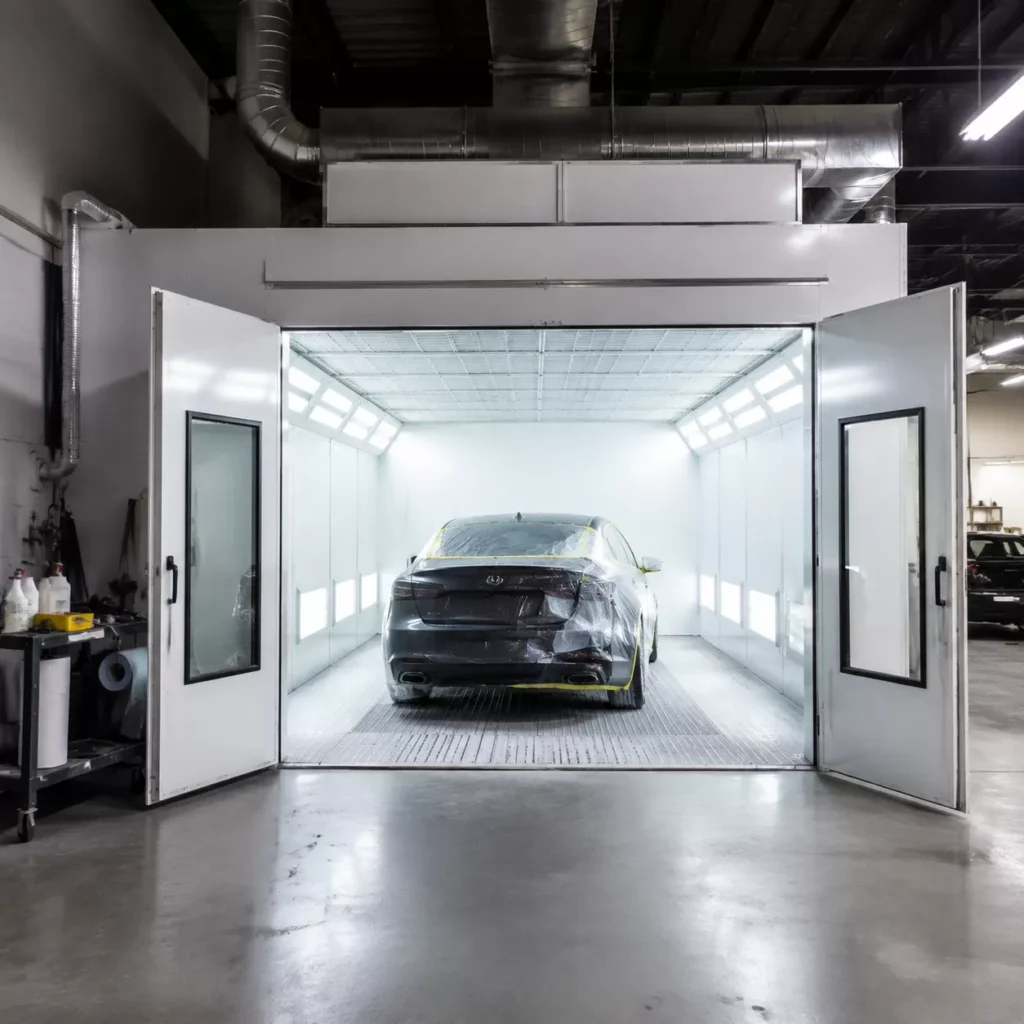
A full downdraft booth pulls air in through the ceiling and exhausts it through floor-level pits, which draws overspray away from the vehicle immediately. The result is a cleaner finish with less buffing time and fewer re-dos. Our passenger car configurations cover vehicles from 7 to 9 meters, which handles sedans, SUVs, and most light commercial vehicles without modification.
The trade-off is installation cost — a pit requires concrete work, and a ramp setup adds footprint. For high-volume stores running fifteen or more cars per week, the output quality justifies the investment.
Side-Downdraft and Crossflow for Tighter Spaces
If the shop floor doesn’t allow for pit excavation, there are practical alternatives.
A side-downdraft booth brings air in through the ceiling and exhausts it through the lower side walls. You get most of the finish quality benefits of a full downdraft without cutting into the slab — a good middle ground for medium-volume stores that want cleaner output without major construction.
Crossflow booths move air horizontally from the front doors to the rear exhaust wall. They’re the most affordable option, fit into standard bays, and work well for lighter reconditioning volumes where speed matters more than a showroom-perfect finish.
| Booth Type | Civil Work | Best Fit |
|---|---|---|
| Full Downdraft | Pit or ramp required | High volume, CPO quality standard |
| Side-Downdraft | None | Medium volume, clean finish |
| Crossflow | None | Light recon, fast turnaround |
Smart Repair Stations for Minor Work
Not every car coming through reconditioning needs a full spray job. Most used inventory just needs a bumper blend, a scratch repair, or a small panel touch-up. A dedicated smart repair station handles those jobs without tying up the main booth — which keeps the main booth available for the heavier work that actually needs the controlled environment. It’s a simple way to increase throughput without adding a second full booth.
Technical Requirements to Get Right
Airflow and Air Quality
The standard for a safe, clean environment is 100 feet per minute of airflow across the work area. Below that, overspray doesn’t clear properly and painters are working in poor air quality. The air makeup unit (AMU) is what makes this work consistently — it replaces exhausted air with fresh, tempered air so the booth stays pressurized, the temperature stays stable, and outside dust doesn’t get pulled in through gaps.
For compressed air, a desiccant dryer is worth the investment for paint work specifically. Refrigerated dryers handle general shop air fine, but moisture in the lines during spraying causes fish-eye defects that require a complete re-do. A desiccant system removes that risk.
Lighting
5000K LED lighting is the standard for color matching because it closely mimics natural daylight. Under cooler or warmer shop lighting, a color match that looks right in the booth can look wrong on the lot — this is a well-known phenomenon called metamerism, and the fix is consistent daylight-spectrum lighting throughout the booth. LEDs also have no warm-up time and run significantly cheaper than fluorescent alternatives.
Compliance and Permits
What You Need Before You Start
An in-house paint booth is a miniature industrial setup inside a retail building, and it comes with real regulatory requirements. Before installation, the key requirements to confirm are:
- NFPA 33 covers how the booth is built, ventilated, and separated from the rest of the service bay
- OSHA requires specific PPE and respiratory protection programs for anyone working with refinishing materials
- EPA 6H NESHAP sets limits on hazardous air pollutants and VOC emissions
The most important step before any concrete work or panel installation is talking to your city planning department. Not every commercial zone permits automotive refinishing, and finding out after installation is an expensive problem.
| Compliance Area | Requirement | What It Covers |
|---|---|---|
| Fire Safety | NFPA 33 | Construction, ventilation, electrical |
| Worker Safety | OSHA | PPE, air quality, respiratory programs |
| Emissions | EPA 6H NESHAP | VOC and particulate limits |
Fire Suppression
Any booth spraying flammable materials needs an integrated fire suppression system — this is non-negotiable under NFPA 33. Most installations use a dry chemical system that automatically cuts power to fans and heat sources when it triggers. Your local fire marshal will also likely require the booth’s system to tie into the building’s main alarm.
Running the Booth Efficiently
Shop Layout and Workflow
The booth works best when it sits physically between the prep area and the detailing department. Cars move in one direction — through mechanical inspection, into prep and paint, then straight to detail and photos. Every time a vehicle has to backtrack or wait in a staging area, it adds time to the reconditioning cycle. The layout should make the logical path the easy path.
Maintenance Schedule
A booth that isn’t maintained stops performing like one. Clogged exhaust filters cause pressure problems that pull overspray back onto fresh paint. Dirty intake filters let dust into the cabin. Neither problem shows up until it’s already ruined a job.
| Task | Frequency | Why It Matters |
|---|---|---|
| Intake Filters | Every 100–150 baking hours | Keeps incoming air clean |
| Exhaust Filters | Every 50–60 operating hours | Maintains cabin pressure and VOC compliance |
| Burner and AMU Inspection | Annually | Keeps cure times consistent and fuel costs down |
| Floor Cleaning | Daily | Prevents dust from migrating into the booth |
Tracking Costs Through Your DMS
The only way to know if the in-house booth is actually profitable is to track every job properly. Flag labor hours for prep and paint separately. Connect your paint mixing room inventory to the DMS so material costs are billed automatically. Run the total refinishing cost into the vehicle’s internal repair order so the used car department has an accurate net profit figure for every unit.
FAQ
How much space does a dealership paint booth require? The booth cabin for a passenger car setup typically runs around 15 by 27 feet, but you need more than that. Plan for at least 20 by 35 feet of clear floor space to account for the AMU, ductwork, and mixing room. Ceiling clearance should be 14 to 16 feet minimum. Our 7 to 9 meter car booth configurations fit most standard dealership service bays without major structural changes.
Do I need permits before installing? Yes. You’ll need mechanical and electrical permits for high-voltage wiring and ventilation, fire marshal approval for the suppression system, and potentially an environmental air permit depending on your state. Talk to your city planning department before anything else — zoning approval is the first step, not an afterthought.
Can I convert an existing bay into a paint booth? It’s possible in many cases. The floor needs to be level and capable of handling the booth weight. Intake and exhaust ducting needs to route through the roof or side wall. If you want a full downdraft setup, you’ll need to either excavate a pit or build a ramp system. Crossflow and side-downdraft setups are easier to retrofit into existing bays because they don’t require floor work.
What’s a realistic payback period? Most dealerships reach break-even within 12 to 24 months. The math is straightforward — eliminate the sublet markup, reduce days-to-market, and retain the labor revenue that was previously leaving the building. At around 15 units per month, the savings on sublet costs alone cover most booth investments within that window.
Tell Us What You’re Working With
Share your current reconditioning volume, the types of vehicles you’re handling, and your available floor space. We’ll put together a booth recommendation and a detailed quote for your specific setup — usually within 48 hours.
Related Pages
- Bus Spray Booth Design Guide → https://sprayboothmanufacturer.com/transit-coach-spray-booth-requirements/
- Truck Paint Booth Guide → https://sprayboothmanufacturer.com/truck-paint-booth-semi-truck-spray-booth-specifications-buying-guide/
- Other related products → https://www.autokemanufacture.com/product
- Contact our sales Team → https://sprayboothmanufacturer.com/contact-us/
✅ CE Certified | ✅ ISO 9001:2015 | ✅ Factory Direct | ✅ Ships to 60+ Countries | ✅ 1-Year Warranty | 🔒 HTTPS Secured