
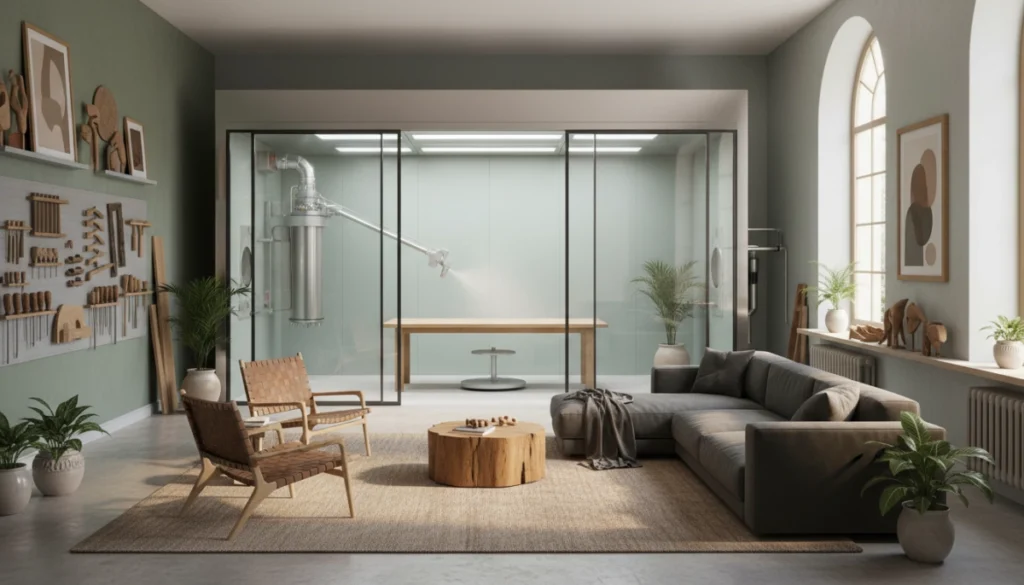
Looking for a furniture spray booth or cabinet spray booth for woodworking? This guide covers booth types, key components, airflow requirements, and what to look for before you buy.
Page URL: https://sprayboothmanufacturer.com/product/
Furniture Spray Booth: Cabinet Spray Booth Guide for Woodworking & Cabinetry Shops
If you’ve ever spent time sanding back a fresh coat because dust settled into the wet lacquer, you already know why a dedicated furniture spray booth matters.
Open-shop spraying doesn’t work at a professional level. Airborne sawdust is everywhere in an active woodshop, and it doesn’t stop moving just because you’re spraying. A dedicated booth gives you a controlled space where the air coming in is filtered, overspray is pulled away from your work, and fumes are managed before they build up to dangerous levels.
This guide covers the main booth types for woodworking and cabinetry, the components that actually make the difference, what compliance requires, and what to think about before you set one up.
Why a Dedicated Booth Makes a Difference
Finish quality. Dust nibs and surface contamination are almost impossible to avoid completely when spraying in an open environment. A booth with proper filtration and controlled airflow keeps the work area clean while you’re spraying, which means fewer defects and less rework on high-gloss topcoats and lacquer finishing.
Health and safety. Spraying solvents, stains, and clear coats releases vapors that are harmful to breathe over time. A booth with proper ventilation pulls these continuously away from the painter and out through filtration, rather than letting them accumulate in the shop air.
Compliance. Any professional woodworking operation spraying flammable finishes needs to meet NFPA 33 requirements. That means explosion-proof lighting and electrical components, fire suppression systems, and ventilation rates that keep vapor concentrations below dangerous levels. A properly built booth handles these by design.
Productivity. Controlled airflow accelerates flash-off between coats and reduces the time spent waiting for dust to settle before you can spray again. Less rework and faster cycle times directly affect how many pieces move through the shop each week.
Booth Types: Which One Fits Your Work
Open-Face Booth
The most common setup for woodworking shops. An open-face booth has no front enclosure — you work directly in front of it, and a powerful exhaust fan draws air through the open face, pulling overspray and fumes away from the painter and into the filters behind.
These work well for large furniture pieces — dining tables, wardrobes, long runs of trim — where you need to move freely around the work without being constrained by walls. They’re straightforward to install and use, and the open access makes loading and positioning large pieces much easier.
Enclosed Crossflow Booth
Air enters through intake filters at one end and exhausts at the other, creating a pressurized, dust-free environment inside the booth. For high-end cabinetry work — kitchen doors, painted furniture, lacquered panels — where a single speck of dust can ruin a finished surface, an enclosed booth gives you significantly better contamination control than an open-face setup.
The tradeoff is that you’re working inside the booth, which limits how you can position yourself around larger pieces. For most cabinet spray booth work on individual components like doors and drawer fronts, this isn’t a problem.
Bench-Top Booth
For small parts, hardware, sample doors, or trim pieces, a full walk-in booth is often more than you need. A bench-top booth sits on your workbench, uses smaller filters, draws less power, and keeps fine overspray from drifting into the rest of the shop. A practical and cost-effective solution for lower-volume finishing work on smaller items.
Custom Modular Setup
Every woodshop has a different floor plan. If a standard booth configuration doesn’t fit your space — low ceilings, narrow bays, an integrated conveyor system, or an unusual layout — a modular custom solution can be built around your actual footprint. This is also worth considering if your production volume is likely to grow, since modular designs can be extended without replacing the whole system.
| Booth Type | Best For | Key Advantage |
|---|---|---|
| Open-face | Large furniture, general production | Easy access and movement |
| Enclosed crossflow | High-end cabinetry, lacquered panels | Superior dust control |
| Bench-top | Small parts, hardware, samples | Compact and cost-effective |
| Custom modular | Unique shop layouts | Scalable, fits your floor plan |
Key Components: What Actually Matters
Filtration
Paint arrestor filters — designed specifically to catch heavy lacquer and stain particles — are the core of overspray management. A multi-stage setup captures heavy particles early in the system before they can reach the fan blades or the exhaust stack, which keeps the equipment clean and the air leaving the building within legal limits.
A manometer (pressure gauge) fitted to the system shows you in real time when filters are loading up and restricting airflow. This is more reliable than any fixed schedule because actual filter loading depends on what you’re spraying and how much — a day of spraying high-solids lacquer loads filters much faster than a day of thin stains.
Ventilation and Airflow
The standard airflow target for a furniture spray booth is at least 100 feet per minute (FPM) across the face of the booth. That’s fast enough to pull overspray and vapors away from the painter effectively, but not so fast that it causes turbulence or drags the wet finish off the surface.
Getting this right is a calculation based on the booth’s cross-sectional area — width times height. If the fan isn’t sized correctly for the booth dimensions, you either get insufficient airflow or too much turbulence, and both affect the finish.
Lighting
Color accuracy and defect detection both depend on good lighting. A thin spot in a topcoat or a run in the lacquer that’s invisible under poor lighting becomes obvious once the piece is in daylight. Explosion-proof LED fixtures rated for Class I Division 2 hazardous locations are the standard for spray environments — they provide bright, daylight-corrected illumination safely around flammable solvent vapors.
Air Makeup Unit (AMU)
In many US climates, pulling raw outside air directly into the spray area causes problems — cold air thickens lacquers and affects how they flow and level, and fluctuating humidity causes issues with waterborne finishes. An AMU heats and conditions the incoming air to maintain a stable temperature inside the booth regardless of the weather outside. It also creates slight positive pressure, which prevents dust from being pulled in through gaps around doors and floor seals.
Layout and Workflow Considerations
Where you place the booth in your shop matters as much as which booth you choose. Ideally, the booth sits between your final sanding station and a dedicated flash-off or drying area. This keeps the distance wet pieces travel as short as possible, which reduces the time they’re exposed to airborne sawdust.
For shops doing volume work on cabinet components, a few additions make a real difference in daily throughput:
Turntables allow 360-degree access to a piece without physically moving around it, which is especially useful for spraying all four sides of a cabinet door to consistent film thickness without putting it down and picking it up repeatedly.
Drying racks near the exhaust area let finished pieces flash off vertically, which makes better use of floor space in smaller shops and reduces the chance of pieces being disturbed while still wet.
Fire suppression is non-negotiable when spraying solvent-based lacquers and stains. Depending on your local codes and insurance requirements, this may mean automatic sprinklers or a dry chemical system. Dry chemical is often preferred in woodworking shops where water damage to finished or semi-finished products is a concern. Check with your local fire marshal about what’s required in your jurisdiction.
Maintenance: What to Stay On Top Of
Filters — check the manometer daily. If pressure is rising toward the limit, change the filters rather than waiting for the reading to go into the red. For a shop spraying high-solids lacquers all day, this might mean changing paint arrestor filters weekly or even more frequently. Don’t guess — the gauge tells you.
Fan blades — overspray builds up on fan blades over time. Even a thin layer of dried finish throws them out of balance, which creates vibration, accelerates bearing wear, and reduces airflow. Check monthly and clean as needed.
Interior walls — peelable booth coating or booth film applied to the interior walls is the most practical solution for managing wall buildup. When overspray accumulates, peel and reapply rather than scraping. It keeps the booth bright, which helps with visibility and color accuracy, and avoids the risk of scraping creating sparks near flammable residue.
Air makeup unit — check intake filters monthly. A clogged MAU intake restricts the conditioning system and affects temperature stability inside the booth.
Common Questions
What airflow speed do I need for a woodworking booth? At least 100 feet per minute (FPM) across the face of the booth is the industry standard. Below this, overspray and vapors don’t clear fast enough. Above roughly 150 FPM for most lacquer work, you risk turbulence that disturbs the wet finish surface.
Do I need an enclosed booth for cabinet doors? If you prioritize finish quality — especially for high-gloss painted or lacquered doors — you can control dust far better with an enclosed booth than with an open-face setup. For general production where a very high-gloss finish isn’t the goal, an open-face booth is usually sufficient.
Are LED lights safe for solvent-based finishing? Yes, you can use them if manufacturers specifically rate them for hazardous locations—require Class I Division 2 ratings at minimum. Standard LED shop lights cannot keep you safe in a spray environment. Explosion-proof fixtures block sparks from reaching flammable vapors with tight seals, and they outperform older alternatives in brightness and energy efficiency.
How often should exhaust filters be changed? Use the manometer, not a fixed schedule. When the pressure reading indicates restricted airflow, change the filters. For most busy woodworking shops, this works out to every 2–4 weeks for paint arrestor filters, but it varies significantly with what you’re spraying and how much.
Do I need an AMU for lacquer finishing? If your shop is in a climate with cold winters or significant humidity swings, yes. Uncontrolled incoming air temperature affects lacquer flow and curing, and humidity causes issues with waterborne products. An AMU gives you stable, consistent conditions inside the booth year-round.
Tell Us About Your Shop
Share your shop size, what you’re finishing, and your production volume. We’ll tell you which booth type fits and send a quote with a layout drawing — no pressure, just a straight answer.
Related Pages
- Bus Spray Booth Design Guide →https://sprayboothmanufacturer.com/transit-coach-spray-booth-requirements/
- Truck Paint Booth Guide →https://sprayboothmanufacturer.com/truck-paint-booth-semi-truck-spray-booth-specifications-buying-guide/
- Other related products→https://www.autokemanufacture.com/product
- Contact our sale Team →https://sprayboothmanufacturer.com/contact-us/
✅ CE Certified | ✅ ISO 9001:2015 | ✅ Factory Direct | ✅ Ships to 60+ Countries | ✅ 1-Year Warranty | 🔒 HTTPS Secured