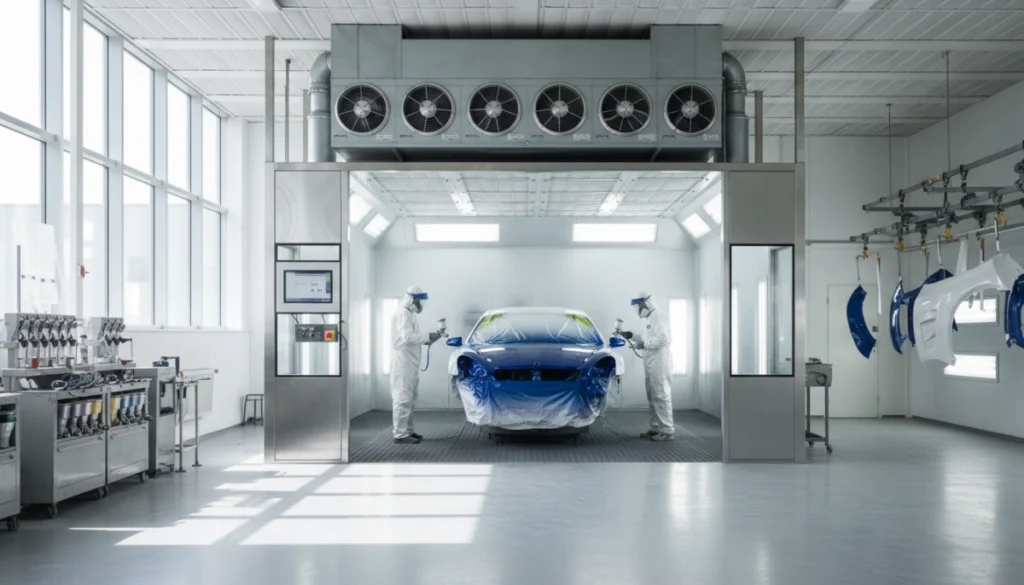
Planning an oversized bus paint booth for your fleet? This guide covers dimensions, airflow, heating, filtration, and what to look for to keep your operation running efficiently.
Page URL: https://sprayboothmanufacturer.com/product/
Bus Spray Booth: Oversized Bus Paint Booth Dimensions & Fleet Finishing Guide
One of the most common problems fleet managers run into when planning a bus spray booth is getting the size wrong.
Too small and you’re restricting airflow, limiting how painters can move around the vehicle, and compromising the finish. Too large and you’re spending more than necessary heating a space that doesn’t need to be that big. Either way, the wrong booth size costs you money.
This guide covers how to size a bus spray booth correctly, how airflow works at this scale, what the heating and filtration requirements look like, and what questions to ask before you commit to a configuration.
Standard vs. Oversized Bus Paint Booth Dimensions
The right dimensions depend on what’s actually in your fleet — not on a generic standard. Here’s how the main vehicle types break down:
| Vehicle Type | Average Length | Average Width | Minimum Booth Height |
|---|---|---|---|
| Transit bus | 10.5m – 12m (35–40ft) | 2.6m (8.5ft) | 4.3m – 4.9m (14–16ft) |
| Motorcoach | 13.7m (45ft) | 2.6m (8.5ft) | 4.9m – 5.5m (16–18ft) |
| Articulated bus | 18m+ (60ft+) | 2.6m (8.5ft) | 4.9m (16ft) |
| School bus | 7.6m – 13.7m (25–45ft) | 2.4m (8ft) | 3.7m – 4.3m (12–14ft) |
These are vehicle measurements — not booth measurements. The booth itself needs to be larger to give painters room to work and for airflow to function properly.
Working Clearances: How Much Extra Space Do You Actually Need?
This is where a lot of facilities get caught out. The booth dimensions on paper look fine, but once the vehicle is inside, there’s not enough room to work properly.
Here’s what to build in:
Side clearance — at least 1.5 meters on each side of the vehicle. This is enough for painters to operate spray equipment at the right distance and for man-lifts or telescopic platforms to move along the vehicle without obstruction.
End clearance — a minimum of 2.5 to 3 meters of extra length beyond the vehicle at each end. This accommodates the exhaust plenum, allows doors to close fully, and keeps airflow from being disrupted near the front and rear of the bus.
Vertical clearance — at least 1 meter above the highest point of the vehicle. This is necessary for proper downdraft air distribution and for lighting fixtures to cover the full roof surface without creating dark spots.
So for a standard 12-meter transit bus, the booth interior should be at least 15–16 meters long, 5.5–6 meters wide, and 5.5 meters tall. For an 18-meter articulated bus, those numbers go up accordingly.
Why Modular Construction Makes Sense for Fleet Facilities
Fleet requirements change. The vehicles you’re painting today may not be the same ones you’re painting in three years, and a booth that fits your current fleet might not fit the next contract.
Modular booth construction addresses this by using pre-fabricated panel sections that can be extended or reconfigured as needed. If you move to longer articulated vehicles, adding wall and ceiling sections is far less disruptive and expensive than replacing the whole booth.
Modular panels also seal more reliably than site-built alternatives, which matters for maintaining the pressurized environment that keeps VOCs contained and filtration systems working as intended.
Airflow in an Oversized Bus Paint Booth
Moving enough air through a 15-meter booth to maintain a clean, safe environment is a serious engineering job. The two main configurations are downdraft and crossdraft, and the choice affects both finish quality and installation cost.
Downdraft is the better option for bus painting. Air flows from the ceiling plenum straight down and out through the floor, pulling overspray away from the vehicle at every point along its length. On a large, flat-sided vehicle like a transit bus or motorcoach, this matters — overspray that drifts sideways before exiting can settle on sections that were just painted. Downdraft eliminates that problem. It requires a floor pit, which adds to installation cost, but for high-volume fleet operations where finish quality is important, it’s worth it.
Crossdraft moves air horizontally from the front doors to a rear exhaust bank. It costs less to install and doesn’t require concrete excavation, which makes it appealing for facilities that can’t do major construction. The tradeoff is that air carries overspray across the full length of the vehicle before exiting, which increases contamination risk on longer vehicles. It works for utility painting where the finish standard is lower, but for professional fleet refinishing, the limitations show up in the work.
Air Volume Requirements
The volume of air a booth needs to move is directly tied to its size:
| Booth Size | Airflow Required | Purpose |
|---|---|---|
| Standard 12m transit bus booth | 20,000 – 30,000 m³/h | Consistent overspray removal |
| Articulated 18m bus booth | 40,000+ m³/h | End-to-end airflow coverage |
If the fans are undersized for the booth volume, airflow drops off toward the middle and rear of the booth — and that shows in the finish.
Floor Grating for Heavy Vehicles
For downdraft booths, the floor grating needs to handle the weight of a fully loaded commercial bus. Standard grating won’t do it. The pit design and grating should be specified for 30,000+ pound axle loads to ensure structural integrity doesn’t become a maintenance issue down the road.
Heating and Curing: What Changes at Bus Scale
A 12-meter transit bus is a large mass of metal and composite materials. Getting the surface temperature up to the level needed for proper paint curing takes more energy and more time than heating the same area on a passenger car — and the heating has to be even across the full length of the vehicle, not just in one zone.
Direct-fired gas burners integrated into the air makeup unit (AMU) are the standard approach for bus paint booths. They produce the heat output needed to bring a large-volume cabin up to baking temperature quickly, which is important for throughput. A system that takes too long to heat up creates a bottleneck when you’re moving multiple vehicles through each day.
Recirculation mode is worth paying attention to at this scale. During the bake cycle, rather than exhausting all the heated air and replacing it with fresh cold air, a recirculation system retains and reuses most of the already-heated air. This can reduce gas consumption by up to 80% during baking. On a system processing large vehicles multiple times a day, that’s a significant operating cost difference over the course of a year.
For the bake cycle itself, a full-sized motorcoach typically needs 40–60 minutes at 60–70°C once the booth reaches temperature. Getting the booth to temperature in the first place takes longer than with a car booth because of the thermal mass involved — factor this into your cycle time planning.
Filtration and Compliance
Multi-stage filtration is required for both finish quality and regulatory compliance. The standard setup:
- Intake filters — clean incoming air before it enters the cabin, keeping dust and debris off wet paint
- Exhaust filters — capture paint solids before air exits the building, protecting the fans and meeting EPA 6H discharge requirements
Exhaust filtration needs to capture at least 98% of paint solids to meet federal standards. A pressure gauge (manometer) fitted to the system tells you when filters are restricting airflow — use this rather than guessing based on time, since actual filter loading depends on how much spraying is happening, not how many days have passed.
Fire suppression is mandatory for commercial bus spray booths. Large volumes of atomized paint create real fire risk, and the suppression system needs to provide coverage throughout the full cabin and exhaust plenum — not just in one area.
All electrical components inside the spray zone must be explosion-proof, including lights, fan motors, and control switches, rated for Class I Division 1 or 2 hazardous locations.
Equipment That Makes a Real Difference
Man-lifts and access platforms — painting the upper sides and roof of a transit bus with ladders is slow and creates unnecessary fall risk. Pneumatic telescopic lifts integrated into the booth walls let painters move smoothly along the upper panels without stopping to reposition equipment. The speed improvement over ladder-based work is significant when you’re painting multiple buses per week.
Lighting placement — a bus has large, flat vertical surfaces that naturally create shadows if lighting is only at the ceiling. Proper coverage means fixtures at the ceiling, upper side walls, and lower side walls, using high-CRI LEDs that replicate natural daylight. This is what allows painters to catch inconsistencies in the wet coat and match colors accurately before the vehicle leaves the booth.
Smart controls — a touchscreen control panel that manages booth pressure, temperature, humidity, and cycle transitions from one interface reduces the chance of operator error and makes the shift from spray mode to bake mode automatic rather than manual. Variable frequency drives on the fan motors allow airflow to be adjusted to actual demand rather than running at full power throughout every stage.
Common Questions
How big does a booth need to be for a standard transit bus? For a 12-meter transit bus, plan for an interior length of at least 15–16 meters, width of 5.5–6 meters, and height of 5–5.5 meters. Add 1 meter of clearance above the highest point of the vehicle and at least 1.5 meters on each side.
Can a truck paint booth be used for buses? Technically yes, but it’s rarely the right tool. A bus has large flat vertical surfaces and an expansive roof that require specific lighting placement and airflow design to avoid shadows and dry spray. A dedicated bus spray booth is engineered for that profile. A truck booth built for a tractor-trailer often gets the length right but falls short on height, lighting, and airflow distribution for a coach’s boxy shape.
How long does a full-sized motorcoach take to cure? With a properly sized heating system, the bake cycle itself typically runs 40–60 minutes at 60–70°C. The time to bring the booth and vehicle up to that temperature adds to the total cycle time — a large bus has significant thermal mass and takes longer to heat up than a passenger car. Factor this into your production schedule rather than planning around the bake cycle time alone.
Is modular construction worth it? For most fleet facilities, yes. It gives you the option to extend the booth if your fleet changes, and pre-fabricated panels seal more reliably than site-built alternatives, which matters for maintaining booth pressure and VOC containment.
Tell Us About Your Fleet
Share your vehicle types, fleet size, facility dimensions, and weekly production volume. We’ll design the right booth configuration and provide a detailed proposal with layout drawings — usually within 48 hours.
Related Pages
- Bus Spray Booth Design Guide →https://sprayboothmanufacturer.com/transit-coach-spray-booth-requirements/
- Truck Paint Booth Guide →https://sprayboothmanufacturer.com/truck-paint-booth-semi-truck-spray-booth-specifications-buying-guide/
- Other related products→https://www.autokemanufacture.com/product
- Contact our sale Team →https://sprayboothmanufacturer.com/contact-us/
✅ CE Certified | ✅ ISO 9001:2015 | ✅ ATEX Available | ✅ Factory Direct | ✅ Ships to 60+ Countries | ✅ 1-Year Warranty | 🔒 HTTPS Secured