
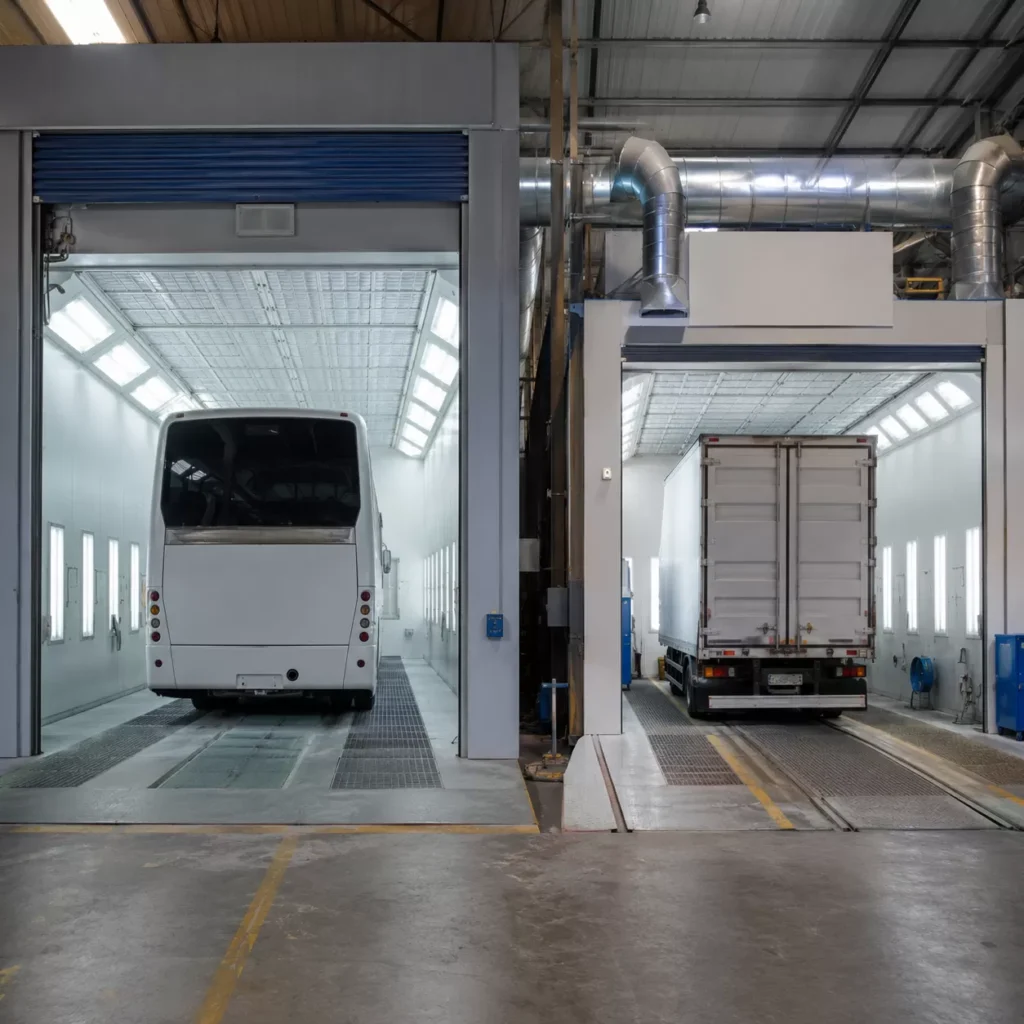
Bus Paint Booth vs Truck Paint Booth: Key Differences in Size
When upgrading your fleet maintenance facilities, a standard bay won’t cut it. Choosing between a bus paint booth vs truck paint booth comes down to understanding the distinct physical footprints of these massive vehicles. While both fall under the heavy-duty paint booth category, their design envelopes require different engineering to ensure proper vehicle envelope clearance and flawless finishes.
The Bus Envelope (Transit, Motorcoach, School Buses)
Buses are long, tall, monolithic boxes. Whether you are spraying a city transit bus, a luxury motorcoach, or a standard school bus, you are dealing with a continuous, unbroken surface area.
- Height Requirements: Modern transit buses with roof-mounted HVAC units or CNG tanks require extreme vertical clearance.
- Length Dynamics: Articulated buses require specialized booths that can extend up to 60 feet or more.
- Clearance Needs: You need consistent walk-room along the entire length of the vehicle so technicians can maintain an optimal spray gun distance.
The Commercial Truck Envelope (Box Trucks, Semi-Tractors, Heavy Haulers)
Commercial trucks present a completely different geometric challenge. Unlike the uniform shape of a bus, a semi-tractor or a heavy hauler features irregular shapes, exposed chassis components, and varying cab configurations.
- Modular Lengths: A booth designed only for semi-tractors can be significantly shorter than a bus booth. However, if you are painting full box trucks or tractor-trailer combinations, the length requirement skyrockets.
- Width Variances: Widened side mirrors, extended exhaust stacks, and dual-rear-wheel axles demand extra width clearance at specific points rather than a uniform wide tunnel.
Internal Booth Dimensions Compared
To help you visualize the physical footprint needed in your shop, we have broken down the standard internal booth dimensions for both vehicle classes:
| Vehicle Class | Standard Length | Standard Width | Standard Height | Key Spatial Consideration |
|---|---|---|---|---|
| Transit & School Buses | 40′ – 60′ | 16′ – 18′ | 16′ – 18′ | Must clear roof-mounted HVAC and CNG fuel cells. |
| Semi-Tractors & Box Trucks | 30′ – 50′ | 14′ – 16′ | 14′ – 16′ | Must accommodate exhaust stacks and wide mirrors. |
AUTOKE Industry Insight
In our years of engineering commercial vehicle refinishing solutions for the US market, we have seen too many shop owners buy a booth based on the vehicle’s bumper-to-bumper measurements alone. This is a critical mistake.
For efficient operations, you must factor in a minimum 3-foot clearance buffer on all sides of the vehicle. This extra space ensures your technicians can safely maneuver with their equipment, guarantees proper overspray containment, and allows the airflow system to pull contaminants away from the fresh paint film effectively. Buying for your maximum vehicle envelope ensures you never face costly rework.
Airflow Configurations in a Bus Paint Booth vs Truck Paint Booth
Managing overspray and maintaining pristine finishes requires a deep understanding of how air moves through a heavy-duty paint booth. Because buses and commercial trucks have drastically different shapes and panel configurations, choosing the right airflow layout directly impacts your cycle times, safety compliance, and finish quality.
The Fluid Dynamics of Overspray
When spraying massive surface areas, overspray containment becomes a major battle. Large commercial vehicles create massive air displacement inside the cabin. If your airflow configuration isn’t perfectly matched to the vehicle envelope clearance, released paint particles will eddy, swirl, and settle right back onto your wet clear coat or create a hazardous cloud for the technician. Efficient fluid dynamics rely on pulling air predictably past the vehicle profile to prevent these turbulent air pockets.
Downdraft Airflow Systems: The Gold Standard for Buses
For transit, motorcoach, and school buses, a downdraft airflow configuration is the absolute best setup for commercial vehicle refinishing.
- How it works: Clean, filtered air enters through the ceiling plenum and travels straight down over the roof and sides of the bus, exhausting through a filtered concrete pit in the floor.
- Why it suits buses: Buses are essentially large, continuous aerodynamic boxes with massive flat roofs and sides. A downdraft system ensures that overspray from the roof doesn’t drape down over the side panels, pulling contaminants away from the painter instantly.
Semi-Downdraft & Side-Downdraft Systems: Optimized for Trucks
A side-downdraft system or a semi-downdraft booth is often the ideal choice for fleet maintenance facilities handling box trucks, semi-tractors, and heavy haulers.
- Semi-Downdraft: Air comes in through the first third of the ceiling and gets pulled horizontally to the back wall exhaust. It offers great airflow around truck cabs without the high cost of a concrete pit.
- Side-Downdraft: Air enters through a full-length ceiling plenum and exhausts through the lower side walls.
- The Truck Advantage: Semi-tractors have highly irregular shapes, gaps between the cab and chassis, and exposed mechanical parts. Side-downdraft and semi-downdraft systems pull air down and outward, which keeps overspray from getting trapped in the complex geometries of a truck chassis.
Crossdraft Systems
A crossdraft booth is the most straightforward, budget-friendly airflow setup on the market, but it comes with limitations for large vehicles.
- Mechanics: Industrial exhaust fans at the back of the booth pull air horizontally from the front main doors across the entire length of the vehicle.
- The Catch: While it works fine for smaller box trucks or component painting, using a crossdraft setup for a full-length transit bus means the air traveling past the back of the vehicle is already heavily contaminated with overspray from the front. This dramatically increases your sanding and buffing prep time.
Technical Metrics for Bus Paint Booth vs Truck Paint Booth: CFM, Velocity, and Air Makeup
When engineering a heavy-duty paint booth, guesswork isn’t an option. Commercial vehicle refinishing requires precise control over air movement to ensure a flawless finish and a safe shop environment.
CFM (Cubic Feet per Minute) Requirements
The sheer size of a vehicle envelope dictates your airflow needs. Because a transit bus has a much larger cross-sectional area than a semi-tractor, it requires significantly higher CFM (Cubic Feet per Minute) to move air effectively.
To maintain the standard required air velocity of 100 feet per minute (FPM), we use the following target metrics based on internal booth dimensions:
| Vehicle Class | Typical Booth Dimensions (LxWxH) | Required Airflow Range (CFM) | Exhaust Fan Setup |
|---|---|---|---|
| Commercial Truck / Semi-Tractor | 30′ x 16′ x 16′ | 15,000 – 20,000 CFM | Dual industrial exhaust fans |
| Transit / School Bus / Motorcoach | 50′ x 18′ x 16′ | 25,000 – 35,000+ CFM | High-capacity multi-fan systems |
Maintaining Positive Pressure & Avoiding Static Resistance
Achieving the perfect balance in a heavy-duty paint booth means managing positive pressure ventilation. We engineer our systems to introduce slightly more clean air than the exhaust fans pull out. This prevents shop dust from sucking into the cabin when doors open.
- Static Pressure Resistance: As intake and exhaust filters load up with overspray, static pressure increases.
- Velocity Maintenance: If your fans can’t handle this resistance, air velocity drops, creating a hazy booth.
- The Fix: We utilize variable frequency drives (VFDs) on our fans to automatically adjust speeds, keeping pressure balanced as filters age.
The Necessity of Heated Air Makeup Units (AMUs)
You cannot pull 30,000 CFM of air from a local fleet maintenance facility without replacing it. A dedicated Air Makeup Unit (AMU) is mandatory for both bus and truck configurations.
- Temperature Control: An AMU draws raw outdoor air, heats it to the optimal spraying temperature (usually 70°F to 75°F), and delivers it to the booth.
- Flash and Bake Cycles: For high-solids commercial coatings, the AMU accelerates the spray-to-cure cycle by shifting into a high-heat bake mode (up to 160°F), rapidly curing the finish and maximizing shop throughput.
Operational & Prep Considerations: Bus Paint Booth vs Truck Paint Booth
Prepping a transit bus versus a semi-truck involves completely different physical challenges. The vehicle envelope clearance dictates how your crew moves, masks, and sprays, making prep work the most labor-intensive part of commercial vehicle refinishing.
Masking and Surface Preparation Dynamics
Buses and trucks require distinct prep strategies before they ever hit the heavy-duty paint booth.
- Buses (Transit, School, Motorcoach): These are massive, continuous flat surfaces. Masking off large window arrays, rubber seals, and expansive body panels requires miles of masking tape and paper. Because you are dealing with seamless sides, maintaining a wet edge during the spray cycle is critical to avoid visible lap marks.
- Commercial Trucks (Box Trucks, Semi-Tractors): Trucks are highly complex shapes with exposed fuel tanks, chrome stacks, complex grilles, and trailing chassis components. Prep crews spend less time on windows and more time wrapping intricate mechanical parts to prevent overspray containment failures on expensive chrome and aluminum finishes.
Lighting Arrays and Technician Visibility
You cannot spray what you cannot see. Shadows are the enemy of a flawless finish, especially when managing fleet maintenance facilities that demand fast turnaround times.
| Vehicle Type | Primary Lighting Challenge | Optimal Shadow Elimination Strategy |
|---|---|---|
| Buses | Long, unbroken vertical panels and roof radii. | Continuous horizontal LED sidewall lights combined with high-angle ceiling fixtures to illuminate the upper radius. |
| Commercial Trucks | Deep shadows under hoods, around fenders, and behind the cab. | Lower vertical light tracking and adjustable corner lights to penetrate the recessed areas of a semi-tractor chassis. |
In our operations, we integrate premium, color-correcting LED arrays placed strategically along the lower, mid, and upper booth walls. This specific configuration ensures that whether a tech is spraying the lower skirt of a transit bus or underneath the air fairing of a heavy hauler, the lux levels remain uniform, eliminating the risk of thin spots or runs.
Compliance, Permitting, and Facility Engineering for a Bus Paint Booth vs Truck Paint Booth
Operating a heavy-duty paint booth requires navigating strict US safety regulations and facility demands. Because of the sheer size of a bus paint booth vs truck paint booth, compliance and engineering logistics differ significantly between these two vehicle classes.
NFPA 33 and OSHA Regulations for Large Spaces
Meeting commercial vehicle refinishing codes is a non-negotiable step for fleet maintenance facilities. Both options must comply with OSHA regulations and NFPA 33 (Standard for Spray Application Using Flammable or Combustible Materials). However, the specific booth volume changes the enforcement dynamics:
- Airflow and Ventilation Requirements: OSHA mandates specific positive pressure ventilation and minimum continuous airflow to prevent hazardous chemical buildup.
- Overspray Containment: NFPA 33 dictates strict clearance distances from combustible materials, automated fire suppression placement, and electrical classification areas based on the vehicle envelope clearance.
- Class I, Division 1 Classification: Because a bus paint booth handles a larger continuous volume of vaporized paint than a standard truck paint booth, the hazardous zone extends further, demanding larger explosion-proof industrial exhaust fans and specialized lighting arrays.
Foundation and Infrastructure Demands
The structural requirements of your shop floor will shift depending on whether you install a downdraft airflow configuration or a side-downdraft system.
| Infrastructure Component | Bus Paint Booth Requirements | Truck Paint Booth Requirements |
|---|---|---|
| Concrete Pit Depth | Requires deep, engineered concrete pits for full under-floor exhaust systems to handle high CFM (Cubic Feet per Minute). | Can often utilize shallow pits, a raised ramp, or a semi-downdraft booth setup without major excavation. |
| Floor Load Capacity | Must support ultra-heavy, concentrated wheel loads from transit and school buses. | Scaled for semi-tractors, box trucks, or heavy-duty haulers. |
| Utility Supply Loads | Demands high-capacity gas and electrical lines to power massive Air Makeup Units (AMUs) to fight static pressure resistance. | Standard industrial utility feeds generally suffice for typical spray-to-cure cycles. |
Choosing between a bus paint booth vs truck paint booth means evaluating your facility’s physical foundation. A full downdraft bus system requires extensive excavation and structural engineering, while many truck configurations can integrate into existing slabs with fewer facility modifications.
FAQs: Bus Paint Booth vs Truck Paint Booth
Can you spray a transit bus in a truck paint booth?
Generally, no. A standard truck paint booth lacks the required vehicle envelope clearance for a transit bus. Transit buses are much taller and wider than semi-tractors or box trucks. Forcing a bus into a smaller booth compromises overspray containment, ruins the finish, and creates a major safety hazard by blocking necessary airflow.
How do you calculate the correct CFM for a heavy-duty paint booth?
Calculating CFM (Cubic Feet per Minute) requires multiplying the cross-sectional area of the booth by the target airspeed (usually 100 feet per minute for OSHA compliance).
$$text{CFM} = text{Booth Width} times text{Booth Height} times text{Target Airspeed (100 FPM)}$$
For a heavy-duty paint booth, you must also account for static pressure resistance from the filters to ensure the industrial exhaust fans maintain proper positive pressure ventilation.
Is a concrete pit always necessary for a full downdraft system?
No, a concrete pit is not mandatory, but it is the cleanest option. If you want a downdraft airflow configuration without tearing up your shop floor, you can install a raised-floor booth with ramps. However, for heavy fleet maintenance facilities, a concrete pit is usually preferred to allow vehicles to drive in at ground level.
What is the average spray-to-cure cycle time for commercial fleets?
| Phase | Average Time | Temperature |
|---|---|---|
| Prep & Spray | 1 to 2 hours | 70°F (21°C) |
| Flash-Off | 10 to 15 minutes | Ambient |
| Bake Cycle | 30 to 45 minutes | 140°F – 160°F (60°C – 71°C) |
| Cool Down | 10 to 15 minutes | Ambient |
A complete spray-to-cure cycle typically runs between 1.5 to 3 hours per vehicle. This timeline relies heavily on a high-performance Air Makeup Unit (AMU) to rapidly bake and cure the commercial vehicle refinishing coatings.
Related Pages
- Bus Spray Booth Design Guide → https://sprayboothmanufacturer.com/transit-coach-spray-booth-requirements/
- Truck Paint Booth Guide → https://sprayboothmanufacturer.com/truck-paint-booth-semi-truck-spray-booth-specifications-buying-guide/
- Other related products → https://www.autokemanufacture.com/product
- Contact our sales Team → https://sprayboothmanufacturer.com/contact-us/
✅ CE Certified | ✅ ISO 9001:2015 | ✅ Factory Direct | ✅ Ships to 60+ Countries | ✅ 1-Year Warranty | 🔒 HTTPS Secured