When you’re opening a new shop on a tight budget, it’s tempting to spend as little as possible on the booth and put the rest toward tools, marketing, or working capital. That’s a reasonable instinct — but the booth isn’t the place to cut corners, because the legal minimums aren’t optional. Getting this wrong can shut down a business before it ever gets going. This guide covers what you actually need to stay legal and operational from day one, without spending more than necessary.
Page URL: https://sprayboothmanufacturer.com/product/
The Non-Negotiable Legal Minimums
EPA NESHAP 6H Compliance
If you’re spraying target hazardous air pollutants — and automotive refinishing work involves them — the EPA requires a fully enclosed spray environment. That means four solid walls and a complete roof, not an open bay or a curtained-off corner of the shop. Your exhaust system must use certified 98% particulate filters to capture overspray before it exits the building. You’re also required to use HVLP spray guns or equivalent technology to minimize waste and maximize transfer efficiency.
NFPA 33 Fire Safety Requirements
This is where local inspectors focus most of their attention. NFPA 33 sets the construction and operational standards for spray booths handling flammable materials, and OSHA enforces the same rules for worker safety. The three things that come up at every inspection are: an approved automatic fire suppression system inside the booth, explosion-proof fixtures for all lights and motors inside or near the booth, and a minimum three feet of clear space between the booth walls and any combustible structure or material.
Local Zoning and Air Quality Permits
This is step zero — before you buy any equipment. EPA approval of the equipment doesn’t mean your municipality allows automotive refinishing at your specific address. Every city has its own rules about commercial land use, air quality permits, and waste disposal. Check with your local building department and air quality board before committing to a location or placing an order.
What Size Booth Do You Actually Need?
Minimum Dimensions for Passenger Vehicles
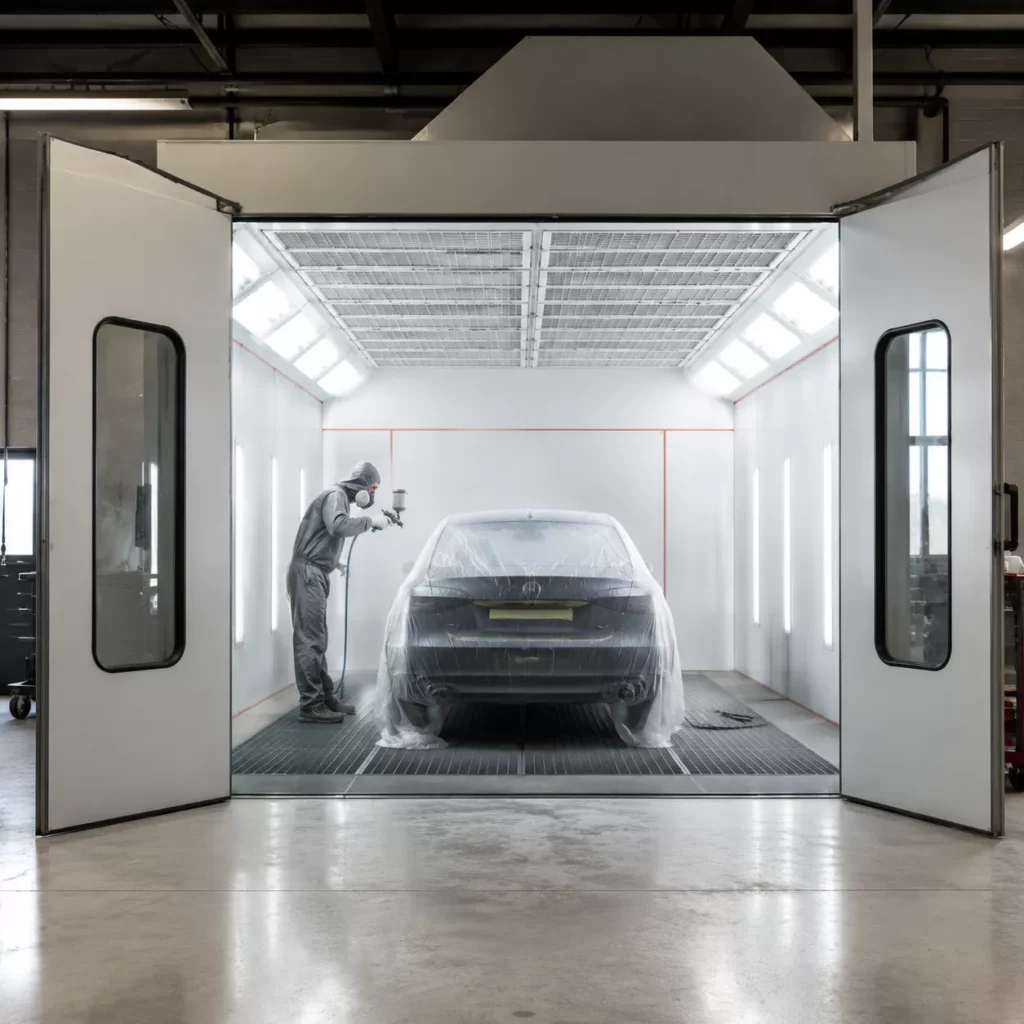
For a standard passenger car, crossover, or small truck, the practical minimum is 14 feet wide by 24 feet long by 10 feet tall. This gives you enough room to work around the vehicle without bumping fresh paint and keeps airflow able to move around the car properly.
The three-foot clearance rule applies inside the booth too — not just around the exterior. You need at least three feet between the vehicle and the booth walls on all sides. This isn’t just a code requirement; it’s what gives painters room to move, maintain proper gun distance, and allows air to sweep around all the panels and carry overspray away.
Smaller Options for Parts and Spot Work
If you’re starting with panel repairs, bumper work, or component painting rather than full resprays, you can scale down significantly and save on floor space.
| Booth Type | Typical Dimensions | Best Used For |
|---|---|---|
| Open-face parts booth | 10′ W x 8′ L x 8′ H | Bumpers, wheels, individual panels |
| Mobile prep station | Enclosed or curtained | Small blend jobs, scratch repairs |
| Standard passenger booth | 14′ W x 24′ L x 10′ H | Full resprays and larger vehicles |
Airflow Options: What a Startup Can Realistically Use
Crossdraft — The Budget-Friendly Starting Point
For most new shops watching startup costs, a crossdraft booth is the practical choice. Air enters through the front doors and travels horizontally across the vehicle to an exhaust filter bank at the back wall. The major advantage for a startup is that it requires zero concrete work — the booth bolts to your existing floor. No pit excavation, no raised basement, no civil engineering. That makes it the lowest-cost entry point that still meets code.
The trade-off is that overspray travels across the full length of the vehicle before it exits, which can increase contamination risk on rear panels if spraying sequence isn’t managed carefully.
Downdraft — The Premium Option With Hidden Costs
Downdraft is the cleanest airflow design available. Air enters through a filtered ceiling plenum and is pulled straight down over the vehicle into floor pits. The finish quality is consistently better than crossdraft, but the installation cost is significantly higher. A concrete pit requires engineering, excavation, new reinforced concrete pour, and proper grating — easily $10,000 to $20,000 in civil work before the booth itself is even counted. For most startups, this cost is prohibitive on day one.
Semi-Downdraft — The Middle Ground Worth Considering
A semi-downdraft or side-downdraft setup splits the difference. Air introduces through a ceiling plenum and exhausts through the lower back or side walls. You get the benefit of downward airflow carrying overspray away from the painter without cutting into your floor. For a new shop that wants better finish quality than crossdraft without the construction cost of a true downdraft, this is often the right choice.
Hidden Infrastructure Costs You Need to Budget For
The booth equipment is only part of the total investment. These items catch a lot of first-time buyers off guard.
Air Makeup Unit (AMU)
When the booth exhausts air out of the building, it has to be replaced. Without a dedicated intake system, the booth runs at negative pressure and pulls in cold, dusty, unfiltered shop air through every gap it can find — which ruins finishes and makes consistent curing impossible in cold weather.
Whether you need a heated AMU on day one depends on your local climate. In northern states with cold winters, a heated AMU is effectively mandatory — spraying cold air onto a vehicle destroys paint atomization and makes curing unreliable. In warmer climates, a non-heated fresh air intake system may be workable initially, provided local code allows it. The trade-off is slower cycle times since you can’t run a proper bake cycle without heat. AMU pricing typically runs $10,000 to $25,000, so plan for it even if you don’t install it immediately.
Electrical Service
Most commercial spray booths run on three-phase power. If your building only has single-phase service, you’re looking at a significant electrical upgrade — either bringing three-phase service to the building through your utility provider or installing rotary phase converters or VFDs to run the booth motors on single-phase power. Either way, factor this into your startup budget before the booth arrives. Always hire a licensed electrician with experience in NFPA 33 requirements to handle the hookup.
Compressed Air Quality
Your finish is only as clean as the air delivering the paint. A dedicated multi-stage filtration loop between the compressor and your spray gun is necessary — a refrigerated air dryer to remove moisture, followed by oil-coalescing filters. Use aluminum or copper piping for your air lines, not PVC, which creates static that attracts dust and is a fire risk around solvents.
What Does a Legal, Functional Setup Actually Cost?
This is where expectations need to be realistic. A homemade structure or a cheap canopy won’t pass inspection, won’t qualify for commercial insurance coverage, and puts the business at serious risk.
| Setup Type | Equipment Cost | Compliance | Key Risk |
|---|---|---|---|
| DIY or non-compliant | $2,000–$5,000 | Fails NFPA 33 and EPA 6H | Insurance denial, fines, fire hazard |
| Entry-level compliant booth | $7,000–$14,000 | Fully compliant | Standard operating costs only |
| Premium industrial setup | $40,000–$80,000+ | Fully compliant | High civil and utility costs |
A realistic all-in budget for a startup that wants to open legally and operate without fear of a code enforcement shutdown is $15,000 to $30,000. The booth itself might run $8,000 to $12,000. The remainder covers fire suppression installation, electrical work, mechanical permits, and any ductwork or intake system required. Cutting below this typically results in a denied insurance claim or a forced retrofit — both of which cost more than doing it right the first time.
FAQ
Can I get commercial insurance with an uncertified booth? No. Insurance providers require proof of compliance with fire codes and national safety standards before covering a spray booth operation. An uncertified DIY setup puts your entire business at financial risk if a fire or chemical accident occurs — the claim will be denied and the policy may be cancelled entirely.
What CFM does a standard crossdraft booth require? For a 14-foot wide by 24-foot long by 10-foot tall crossdraft booth, the target is between 9,000 and 12,000 CFM to maintain the minimum 100 linear feet per minute of air velocity across the painter’s work area. The exact number depends on your booth’s specific cross-section and your local code requirements.
Is a heated AMU required from day one? Not always at the federal level, but practically speaking it depends on your climate and local building code. If your booth exhausts 10,000 CFM, that air has to be replaced. Without a dedicated intake, you pull negative pressure on the building and draw in whatever air is available — cold, dusty, unfiltered. In any climate with cold winters, a heated AMU is effectively required to maintain spray and cure temperatures. In warmer regions, a non-heated intake may get you started, though it limits your ability to run a proper bake cycle.
What’s the minimum booth size for a full vehicle respray? 14 feet wide by 24 feet long by 10 feet tall is the practical minimum for a standard passenger vehicle, accounting for the three feet of clearance required around the vehicle on all sides. Going smaller creates airflow problems and makes it difficult to maintain proper gun distance on larger panels.
Tell Us What You’re Working With
Share your location, available floor space, the type of work you’re planning to do, and your startup budget. We’ll help identify the right entry-level configuration for your situation and send a detailed quote — usually within 48 hours.
Related Pages
- Bus Spray Booth Design Guide → https://sprayboothmanufacturer.com/transit-coach-spray-booth-requirements/
- Truck Paint Booth Guide → https://sprayboothmanufacturer.com/truck-paint-booth-semi-truck-spray-booth-specifications-buying-guide/
- Other related products → https://www.autokemanufacture.com/product
- Contact our sales Team → https://sprayboothmanufacturer.com/contact-us/
✅ CE Certified | ✅ ISO 9001:2015 | ✅ Factory Direct | ✅ Ships to 60+ Countries | ✅ 1-Year Warranty | 🔒 HTTPS Secured