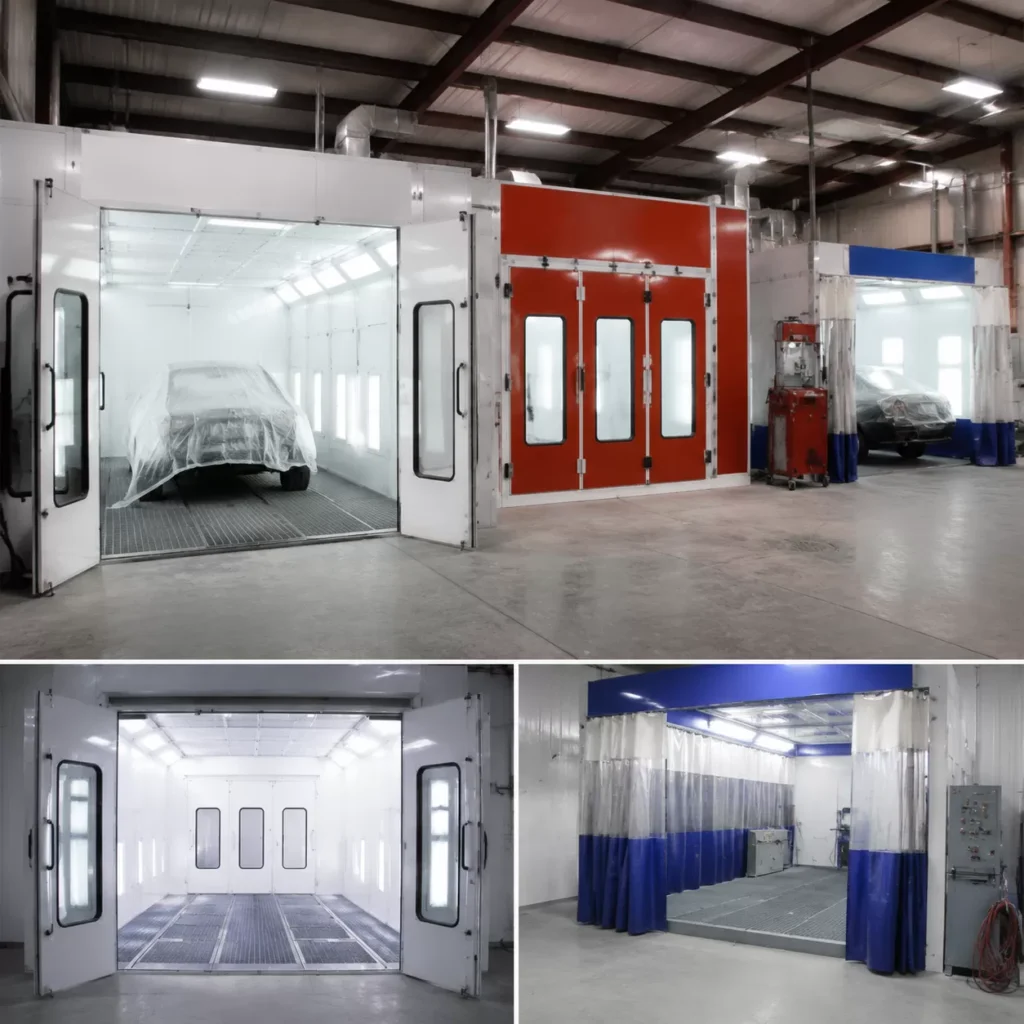
Choosing the wrong spray booth is one of the more expensive mistakes a shop can make. The airflow configuration affects finish quality on every single job that goes through it, and the wrong setup for your production volume and facility creates problems that can’t be solved by better spray technique. This guide covers the main types of car spray booths and their features, what the essential components are, how to size the booth for your operation, and what compliance requires.
Page URL: https://sprayboothmanufacturer.com/product/
The Main Booth Configurations and How They Work
Downdraft
Air enters through ceiling filters and travels straight down, exiting through exhaust grates in the floor. Gravity assists the downward movement of overspray and contamination, pulling both away from every surface of the vehicle simultaneously rather than carrying them across it.
This is the cleanest configuration available and the standard for high-volume collision centers where finish quality is non-negotiable. It requires either a concrete exhaust pit or a raised steel basement platform — which adds to the installation cost — but for shops doing premium refinishing work, the reduction in contamination and rework justifies the investment.
Crossdraft
Air moves horizontally from intake filters at the front of the booth to an exhaust plenum at the rear wall. No pit is required, which makes installation straightforward and keeps the upfront cost lower than any other configuration.
The trade-off is that any contamination picked up at the front of the vehicle travels across the full length of the job before reaching the exhaust. For basic industrial finishing, cabinet and wood coatings, or entry-level automotive work where absolute finish perfection isn’t the primary requirement, crossdraft is a practical and cost-effective choice.
Semi-Downdraft
Air enters through ceiling filters at the front of the booth and travels diagonally toward exhaust filters at the lower rear wall. It combines the cleaner ceiling-sourced intake of a downdraft system with a rear exhaust arrangement that doesn’t require floor excavation.
The result is better contamination control than a standard crossdraft without the pit requirement. For mid-size shops looking for improved finish quality over what a crossdraft provides without committing to the full installation cost of a downdraft, semi-downdraft is a reasonable middle ground.
Side Downdraft
Air enters through ceiling filters and exits through exhaust plenums built into the lower sections of the side walls. The downward movement from the ceiling creates a curtain effect that carries overspray away from the vehicle surface and toward the sides rather than across it.
This configuration delivers performance closer to a full downdraft than either crossdraft or semi-downdraft, and it does so without requiring floor excavation. For facilities where the foundation can’t be cut — leased spaces, high water tables, or structurally constrained buildings — side downdraft is typically the best available option.
Mobile and Inflatable Booths
Portable enclosures that set up quickly and use directional fans with replaceable filter panels. The airflow is a simplified crossdraft arrangement. These aren’t designed for full vehicle refinishing — they’re for mobile technicians, SMART repairs (Small to Medium Area Repair Technology), and temporary overflow capacity when a fixed booth isn’t available.
| Booth Type | Airflow Direction | Pit Required | Finish Quality | Best Use Case |
|---|---|---|---|---|
| Downdraft | Ceiling to floor | Yes — or raised platform | Exceptional | High-volume premium refinishing |
| Crossdraft | Front to back | No | Good | Budget-friendly, industrial, entry-level |
| Semi-Downdraft | Diagonal — top to rear | No | Very good | Mid-tier shops wanting quality and value |
| Side Downdraft | Ceiling to lower sides | No | Excellent | Shops unable to excavate |
| Mobile | Horizontal, variable | No | Acceptable | Temporary use, SMART repairs |
Essential Features to Evaluate
Filtration System
Air quality is what separates a booth that produces clean results from one that requires significant buffing and correction after every job. A multi-stage filtration setup handles this at both ends — intake filters catch particulates before they enter the cabin, and exhaust filters capture overspray before the air exits the building.
HEPA-rated filters are worth specifying for automotive refinishing work. They keep the spray environment clean enough to meaningfully reduce the time spent on post-paint correction, which adds up across every job the booth processes.
LED Lighting
Lighting affects finish quality in a direct and measurable way. If a painter can’t see a dry spot, a run, or uneven coverage while the paint is wet, the problem goes into the bake cycle rather than getting corrected. Shadow-free fixture placement with color-correct LEDs in the 5000K to 6000K daylight range lets painters see the true color and texture of the surface throughout the application.
Color-correct lighting is also what makes accurate paint matching possible. Metallic and pearl finishes in particular show their true character under daylight-equivalent lighting — under color-shifted lighting, a match that looks right in the booth won’t match under daylight outside.
Heating System and AMU
A heated booth with an Air Makeup Unit changes the production capacity of an operation. The AMU replaces exhausted air with fresh, heated air — maintaining the right cabin temperature for proper paint application and flash-off during the spray phase, then ramping to a bake cycle temperature that cures the finish through to the substrate rather than just drying the surface.
For shops doing waterborne coatings, the AMU also drives the air movement that removes moisture during flash-off. Waterborne paint doesn’t dry the same way solvent-based coatings do — it needs active airflow to break the saturated boundary layer on the panel surface. A properly sized AMU handles both heating and drying requirements for whichever coating system you’re running.
Control Panel and VFDs
Modern booth controls should do more than just turn the system on and off. Variable Frequency Drives on the fan motors allow airflow to adjust to actual demand — running at high speed during spray and bake phases and stepping down during flash-off when full airflow isn’t needed. This reduces electricity consumption meaningfully across a high-production operation.
Automated pressure control takes the guesswork out of maintaining the cabin’s pressure balance. Rather than relying on manual adjustment, the system holds the right conditions consistently throughout the job regardless of filter loading or external air pressure changes.
Booth Construction
The structural materials determine how long the booth holds its performance. Heavy-gauge galvanized steel — typically 18-gauge minimum — resists the daily impacts and chemical exposure of a working shop without warping or corroding. Insulated dual-wall panels are worth specifying for heated booths because they retain heat during bake cycles rather than bleeding it into the surrounding shop, which reduces burner run time and energy cost per cycle.
| Feature | What to Look For | Why It Matters |
|---|---|---|
| Filtration | Multi-stage, HEPA-rated | Eliminates dust for a clean clear coat |
| Lighting | Color-correct LEDs, 5000K+ | Prevents color mismatches and missed defects |
| Heating | AMU with bake cycle capability | Speeds drying, boosts daily throughput |
| Controls | VFDs and automated pressure | Lowers utility bills, simplifies operation |
| Build | Heavy-gauge galvanized steel | Structural longevity under heavy daily use |
Sizing and Shop Layout
Standard Dimensions
For standard passenger vehicles, sedans, SUVs, and standard pickups, a booth running 24 to 28 feet long by 14 feet wide and 9 feet high is the typical specification. This provides enough internal clearance for the vehicle plus working room for the painter on all sides.
For commercial vehicles — fleet trucks, delivery vans, or heavy-duty pickups — dimensions need to step up accordingly. These applications typically need 30 feet or more in length, taller door openings, and wider interior dimensions to give painters adequate access around large vehicle bodies.
Always apply the 3-foot clearance rule to internal dimensions as well. Three feet of space between the vehicle and the booth walls, ceiling, and filters is what allows airflow to work correctly around the full surface of the vehicle rather than creating dead zones where overspray can swirl and settle.
Clearances and Layout
The booth can’t sit directly against shop walls. Safety codes typically require a minimum 3 feet of clear space around the booth exterior — this serves three purposes: maintenance access for filters and motors, fire department access around the perimeter, and a fire break that prevents an internal incident from spreading to the rest of the facility.
Door clearance also needs to be planned before installation. Standard swing doors need clear space equal to the full door width in front of the booth to open properly. If your layout doesn’t accommodate that, bi-fold or roll-up doors need to be specified instead.
Exhaust ducting needs the most direct path possible from the exhaust fan to the exterior. Every bend adds resistance that reduces airflow performance. Plan the ductwork route before committing to the booth location.
Planning for Growth
Position the booth where it won’t prevent future expansion. A booth installed against the back wall or in a corner preserves the rest of the floor plan for prep stations, mixing rooms, or additional equipment that may be added later. Relocating a fully installed booth is a major undertaking — getting the position right the first time is substantially cheaper than moving it.
Safety and Compliance
OSHA and EPA
OSHA requires adequate airflow velocity to protect painters from hazardous vapor concentrations in the breathing zone — the minimum for most manual spray operations is 100 linear feet per minute. Falling below that threshold is both a compliance failure and a genuine safety hazard.
EPA requirements govern what exits the building. Exhaust filtration systems need to capture paint solids before they reach the exhaust stack, and high-volume facilities may face additional VOC emission requirements depending on state and local regulations. Meeting EPA standards isn’t just about compliance — it’s what keeps the operation insurable and legally operating.
NFPA 33
This standard governs fire safety in spray finishing operations. Requirements include maintaining safe clearance zones around the booth, installing explosion-proof electrical components inside the spray zone, and running an effective exhaust system that keeps combustible overspray from accumulating in the ductwork or the exhaust path. All electrical equipment inside the spray zone must be rated Class I, Division 1 or Division 2 — standard industrial components aren’t acceptable in a flammable vapor environment.
Local Permits
Federal and national standards are the baseline. Local fire marshals and building departments often have additional requirements specific to the municipality or county. Pulling local permits before installation starts is the right sequence — discovering a zoning or permitting issue during or after installation is far more expensive than confirming requirements beforehand.
Common Questions
How long does a professional spray booth typically last?
A well-built booth with proper maintenance typically runs 15 to 25 years. The structural enclosure generally outlasts the mechanical components, which may need significant attention or replacement at the 10 to 15-year mark. Staying on top of filter changes, keeping the cabin clean, and addressing mechanical wear before it causes failures is what extends the service life toward the upper end of that range.
How often do filters need replacing?
The schedule depends on production volume and coating type, but a workable baseline for active production shops: exhaust filters every 50 to 100 operating hours (roughly every two to four weeks in a busy shop), intake filters every 400 to 600 operating hours (roughly every three to six months), and ceiling diffusion filters annually. Monitor exhaust filter replacement using the manometer reading instead of following a fixed schedule. When static pressure rises significantly, the filters become clogged no matter how long they have been in use.
Do I need a concrete pit for a downdraft booth?
No. A raised steel basement is a legitimate alternative. The booth sits on a steel platform with drive-up entry ramps, and the exhaust system pulls air downward through the platform rather than through a pit in the floor. The airflow performance is identical. The trade-off is that the booth sits above the floor level and requires ramps for vehicle entry, which adds to the total booth footprint and requires slightly more ceiling clearance. For facilities where floor excavation isn’t possible, this is the right path to downdraft performance.
Can I use a mobile booth for regular automotive finishing?
Mobile and inflatable spray booths work well for SMART repairs and on-site jobs, yet they cannot handle high-volume full vehicle refinishing. They feature simplified filtration, limited pressure control, and a structure not built to withstand daily commercial shop operation demands. For any operation doing regular refinishing work, a fixed booth is the right investment.
Tell Us What You’re Working With
Share your facility dimensions, production volume, vehicle types, and any layout constraints. We’ll spec out the right booth configuration for your operation and send a detailed quote with layout drawings — usually within 48 hours.
Related Pages
- Bus Spray Booth Design Guide → https://sprayboothmanufacturer.com/transit-coach-spray-booth-requirements/
- Truck Paint Booth Guide → https://sprayboothmanufacturer.com/truck-paint-booth-semi-truck-spray-booth-specifications-buying-guide/
- Other related products → https://www.autokemanufacture.com/product
- Contact our sales Team → https://sprayboothmanufacturer.com/contact-us/
✅ CE Certified | ✅ ISO 9001:2015 | ✅ Factory Direct | ✅ Ships to 60+ Countries | ✅ 1-Year Warranty | 🔒 HTTPS Secured