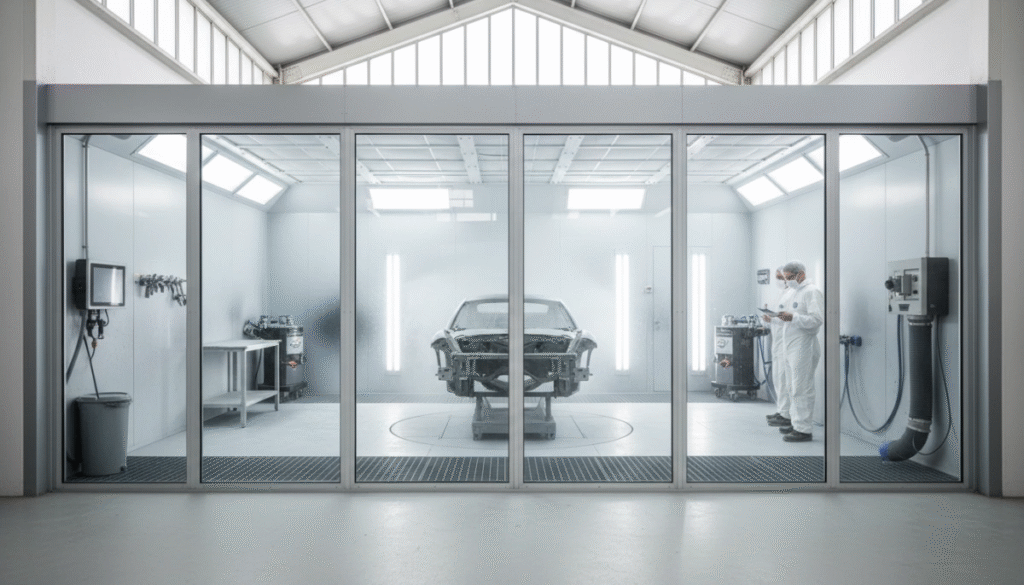
Not every shop floor looks the same — and not every finishing operation fits into an off-the-shelf booth. This guide covers when a custom paint booth makes business sense, how the engineering works, what compliance requires, and what the return on investment actually looks like.
Why Standard Booths Fall Short
A standard booth is built around an average use case. The moment your operation steps outside that average, you start running into problems that no amount of process adjustment will fix.
The most common issues are dimensional. If you’re coating oversized equipment, long structural steel, or unusually shaped parts, a standard enclosure simply doesn’t give painters the clearance they need to reach every angle — and the airflow pattern wasn’t designed for that geometry either. Overspray ends up in the wrong places, and finish quality suffers as a result.
Facility layout is the other common constraint. Most shop floors have support columns, low ceilings, or footprints that don’t line up neatly with standard booth sizes. Forcing a standard product into an awkward space means compromising either the booth performance or your workflow around it — sometimes both.
When your daily operation involves unique part dimensions, a tight facility layout, or strict coating specs, a custom paint booth stops being a preference and becomes a practical necessity.
What a Custom Paint Booth Actually Solves
Oversized and Non-Standard Parts
When you’re finishing heavy equipment, long structural components, or irregular shapes, the enclosure has to be built around the product — not the other way around. A special size industrial spray booth scales the interior dimensions to match your largest workpieces, giving painters proper clearance and keeping airflow consistent across the full surface of the part.
Difficult Facility Layouts
Awkward column placement, low ceilings, and irregular floor plans don’t have to mean poor performance. A custom booth is engineered to work within your existing footprint, routing ventilation and exhaust in ways that maximize airflow without requiring major structural changes to the building.
Production Line Integration
If your finishing operation is part of a larger production line, the booth needs to work with your material handling equipment, not around it. That means designing entry systems, door configurations, and internal clearances around how parts actually move through your facility — whether that’s via conveyor, overhead crane, or forklift.
Pass-through designs handle continuous high-volume lines. Crane-accessible roof openings let overhead bridge cranes drop heavy machinery directly into the spray zone. Reinforced structural supports accommodate robotic painting arms. The booth gets built for how you actually work.
Cleanroom and Climate-Controlled Applications
Aerospace and medical-grade coatings operate within tight atmospheric tolerances that a standard booth can’t maintain. Precise humidity and temperature control during the spray and cure cycle is what separates an acceptable finish from a compliant one in these industries. A custom enclosure integrates the environmental controls needed to hit those tolerances consistently.
Core Engineering Components
Airflow Design
Airflow is the foundation of any finishing system, and getting it right depends on what you’re coating and how. A custom paint booth matches the ventilation pattern to the part geometry rather than applying a generic solution.
Crossflow works well for standard industrial parts with straightforward geometry. Side-downdraft delivers premium airflow quality for shops that can’t excavate a concrete pit. Pit-style downdraft pulls air straight down through a floor grate system, which gives the cleanest possible result on complex shapes and detailed surfaces.
The goal in every case is the same: airflow velocity that pulls overspray away from both the painter and the part at every point in the spray zone.
Material Construction
Heavy-duty galvanized steel is the standard for industrial finishing systems — rigid, durable, and built to handle daily production volume. For processes that require sustained high temperatures during curing, insulated panels hold heat more efficiently, which cuts energy costs and speeds up cycle times.
Filtration
Different coatings require different capture strategies. A custom multi-stage filtration setup is designed around what you spray — whether that’s heavy high-solids coatings, waterborne systems, or specialty industrial finishes. The right filtration keeps the air in the booth clean, the finish free of contamination, and the exhaust compliant with environmental regulations.
Entry and Loading Systems
Loading and unloading heavy or oddly shaped parts is one of the most common throughput bottlenecks in a finishing operation. Bi-fold and roll-up doors save floor space while handling heavy-duty use. Crane-accessible openings engineered into the roof let you move large workpieces in and out without the doors becoming a limiting factor.
Compliance and Safety
There’s a common assumption that custom booths are harder to certify than standard ones. In practice, a custom design makes it easier to build compliance in from the start rather than retrofitting it afterward.
NFPA 33 and OSHA Requirements
Every custom paint booth needs to meet NFPA 33 and OSHA 1910.107. These standards cover the required clearances between the booth and other equipment, the airflow volume needed to keep vapor concentrations below dangerous levels, and the electrical specifications for components operating in a flammable environment. Designing around your actual footprint makes it straightforward to hit these requirements without compromising your floor plan.
Hazardous Location Components
The interior of any spray booth handling flammable finishes is classified as a hazardous environment. Explosion-proof lighting, Class I Division 1 rated fan motors, and spark-resistant exhaust fans are standard in any properly built custom enclosure. These aren’t optional — they’re what keeps the booth insurable and certifiable.
ETL and UL Listed Controls
The electrical control panel is what ties the whole system together. ETL and UL listings confirm that the panel has been independently tested to North American safety standards. Having those certifications on your equipment is what makes the permit process straightforward and gives your fire marshal the confidence to sign off without delays.
Built-In Safety Features
Automatic interlocks shut down spray equipment if exhaust fans fail or if doors open during a cycle. Fire suppression ports are built into the structure for easy integration of dry chemical or sprinkler systems. Pressure gauges on the system let your team monitor filter loading and verify that airflow velocity stays within safe and compliant ranges.
The Design and Build Process
Site Audit
Before any engineering work begins, a full site audit maps out your floor space, utility access points, and the most efficient routing for ventilation and exhaust. The dimensions and constraints of your actual facility drive every decision from this point forward.
3D Modeling and CAD
You see the exact layout before manufacturing starts. 3D modeling and CAD drawings show how the booth fits into your facility, where every component goes, and how material handling integrates with the structure. Problems get caught at this stage, not during installation.
Heating and Cure Engineering
Cure times directly control how many jobs move through your booth each day. The Air Makeup Unit (AMU) gets sized to your specific coating requirements — not to a generic standard. A properly sized AMU means faster cure cycles, consistent heat retention, and lower energy costs per job.
Installation and Testing
Turnkey installation covers the full build and commissioning process. Once the structure is up, the system gets tested and calibrated — airflow velocity measured, controls verified, and performance confirmed against the design specs before the booth goes into production.
Cost vs. Return on Investment
A custom paint booth costs more upfront than a standard model. The question is whether the return justifies the difference — and for most operations that actually need a custom solution, it does.
The clearest return comes from material savings. When airflow is optimized for your specific part geometry, more coating lands on the product and less gets pulled into the exhaust. That directly reduces your monthly consumable costs.
Labor savings come from a better-designed environment. Painters work faster when they have proper clearance, good lighting, and a loading system that doesn’t create bottlenecks. Fewer reworks mean less time wet sanding and buffing out contamination issues. For a high-volume shop, those hours add up quickly across a production week.
The longer-term return is flexibility. A custom enclosure is built to handle your current volume and scale with your growth. When you take on larger contracts or expand production, the booth doesn’t become the limiting factor — it adapts.
Real-World Applications
Industrial — Special Size Industrial Spray Booth for Heavy Machinery
Excavators, structural steel, agricultural equipment — these jobs need a booth built for their weight and dimensions. Reinforced flooring handles the axle loads. Crane access slots let overhead equipment move parts in and out without doors or structure becoming an obstacle. Zoned airflow activates ventilation only where spraying is happening, which cuts energy costs on large enclosures.
Automotive — High-Volume Collision and Refinishing Centers
High-volume shops need workflow, not just spray space. Side-loading systems move vehicles laterally through prep, spray, and cure stages without backtracking. Integrated mixing rooms keep technicians close to the work. Advanced AMU setups handle the faster flash-off requirements of waterborne paint systems.
Aerospace — Cleanroom-Grade Finishing Environments
Aerospace coatings require precision that a standard booth can’t provide. Multi-stage HEPA filtration removes particles at a level that matters for flight-critical components. Strict climate control maintains the humidity and temperature tolerances the coatings require. Vertical downdraft airflow pulls overspray away from sensitive surfaces the moment it leaves the gun.
Common Questions
Can a custom booth still meet NFPA 33 and OSHA standards? Yes. Every custom paint booth is engineered to meet or exceed the same standards as off-the-shelf models. Compliance is built into the design from the start, not addressed after the fact.
How long does it take from design to installation? For most projects, 8 to 12 weeks covers the full process — from initial CAD drawings and engineering approvals through manufacturing and turnkey installation. More complex builds may run longer depending on the scope of customization.
How do I know if I need a custom airflow design instead of a standard downdraft? If your parts have unusual geometry, if you’re handling heavy machinery that needs reinforced flooring or crane access, or if your production targets require VOC abatement and throughput built around existing conveyor lines, a custom airflow design is the more efficient path. Standard models are built around average use cases — if your operation doesn’t fit that, they’ll hold you back.
What’s the difference between a special size industrial spray booth and a standard industrial booth? Primarily dimensions and structural engineering. A special size booth is built around your largest workpiece rather than a standard footprint, with reinforced flooring, custom door systems, and an airflow design matched to the part geometry. Everything is scaled to the actual job rather than to an off-the-shelf spec.
Tell Us What You’re Working With
Share your part types, facility dimensions, production volume, and any workflow constraints you’re working around. We’ll design the right custom paint booth for your operation and send a detailed quote with layout drawings — usually within 48 hours.
Related Pages
- Bus Spray Booth Design Guide → https://sprayboothmanufacturer.com/transit-coach-spray-booth-requirements/
- Truck Paint Booth Guide → https://sprayboothmanufacturer.com/truck-paint-booth-semi-truck-spray-booth-specifications-buying-guide/
- Other related products → https://www.autokemanufacture.com/product
- Contact our sales Team → https://sprayboothmanufacturer.com/contact-us/
✅ CE Certified | ✅ ISO 9001:2015 | ✅ Factory Direct | ✅ Ships to 60+ Countries | ✅ 1-Year Warranty | 🔒 HTTPS Secured