Looking to upgrade your auto body refinishing setup? This guide covers how a downdraft paint booth works, how it compares to other configurations, what installation involves, and what to think through before you buy.
A Standard Booth Setup Has Real Limits
Not every paint booth is built the same way, and the difference shows up directly in your finished work.
In a basic cross-draft or side-draft setup, air moves horizontally across the vehicle. That means overspray generated at one end of the car has to travel the full length of the job before it exits the booth. On the way, some of it settles back onto panels you already sprayed. The result is dirt nibs, contamination in the clear coat, and hours of wet sanding and buffing that eat into your margins on every job.
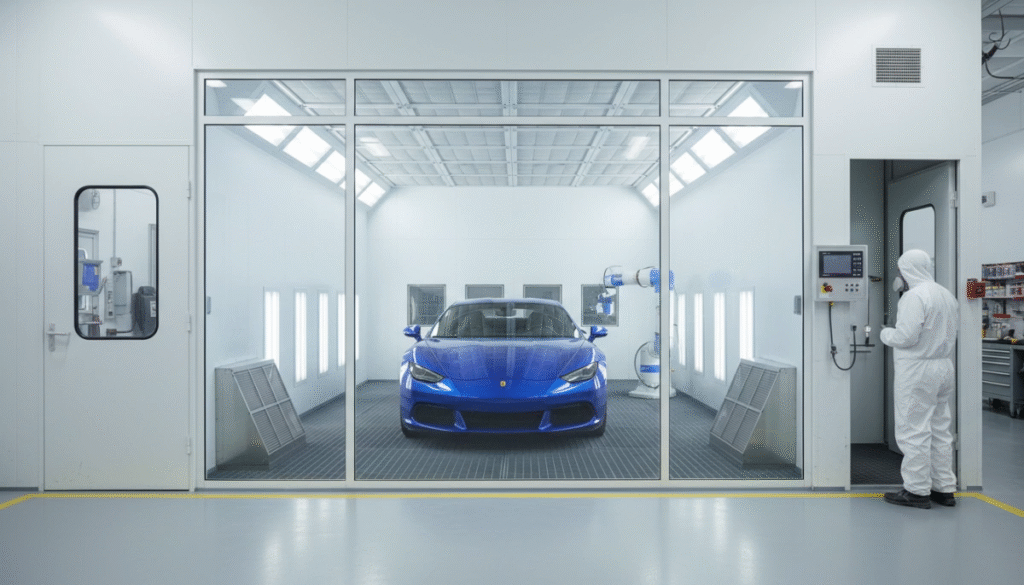
A downdraft paint booth for auto body work solves this at the source. Instead of moving air across the vehicle, it moves air straight down — from ceiling to floor — so overspray is pulled away from every panel immediately, not after it’s had a chance to drift and land somewhere it shouldn’t.
How a Downdraft Paint Booth Actually Works
The Downward Airflow System
Clean air enters through a filtered ceiling plenum that spans the full length of the booth. From there, it flows downward in a controlled curtain over the vehicle. Dust, atomized paint, and solvent fumes are pushed straight toward the floor rather than drifting sideways across the workspace.
This vertical movement is the core of the system. It means nothing lingers in the air near freshly painted surfaces, and painters aren’t working through a cloud of overspray and fumes. The air moves away from them, not across them.
The Floor Exhaust Pit
At the bottom, a grated exhaust pit collects everything the airflow brings down. Overspray and fumes are extracted immediately — no lateral movement, no opportunity for particles to settle on adjacent panels. The system maintains consistent CFM (cubic feet per minute) throughout the booth, which is what keeps the environment safe and keeps you compliant with ventilation requirements.
The Three Filtration Stages
A properly built downdraft paint booth for auto body work runs air through three filtration stages:
| Filtration Stage | Location | Function |
|---|---|---|
| Stage 1: Pre-Filters | Air Intake | Catches large dust and debris before air enters the plenum |
| Stage 2: Ceiling Filters | Ceiling Plenum | Diffuses air evenly and removes fine particulates |
| Stage 3: Exhaust Filters | Floor Pit | Traps overspray before air exits the building |
Each stage does a specific job. Skip one and the quality of what reaches the car — or what exits your facility — suffers. Running all three is what gets you a finish that comes out of the booth ready to deliver, not ready for another hour of correction work.
Downdraft vs. Other Booth Configurations
There are three other configurations you’ll come across when shopping for a paint booth. Each has real trade-offs worth understanding before you commit.
Downdraft vs. Cross-Draft
Cross-draft booths are the entry-level option because they don’t require a floor pit. Air comes in through intake filters at one end and exits through an exhaust bank at the other. The problem is that any overspray near the front of the vehicle has to travel across the entire job before it leaves the booth. On a standard sedan, that’s already a long path for airborne paint particles. In a busy shop, that contamination risk adds up quickly across the day.
Downdraft vs. Semi-Downdraft
Semi-downdraft systems are a step up — air comes in through the ceiling, which is the right direction, but it exhausts through the rear wall instead of the floor. This creates a diagonal airflow pattern that works better than horizontal movement, but it leaves dead zones near the front of the booth where air goes stagnant. Those pockets of still air lead to uneven drying and overspray settling where it shouldn’t.
Downdraft vs. Side-Draft
Side-draft booths pull air from the ceiling and push it out through filters on the side walls. They avoid the need for a floor pit, which makes them a practical choice when facility construction isn’t an option. But without the floor exhaust, you lose the directional pull that makes downdraft so clean and consistent. You also use up interior wall space for filtration panels, which can tighten up the working area.
| Feature | Downdraft | Semi-Downdraft | Cross-Draft |
|---|---|---|---|
| Airflow Direction | Top to Bottom | Top to Back | Front to Back |
| Contamination Risk | Lowest | Moderate | Highest |
| Painter Safety | Excellent | Good | Fair |
| Installation Cost | Higher | Moderate | Lower |
| Finish Quality | Showroom Grade | Professional | Utility/Industrial |
The downdraft configuration wins on finish quality because it uses gravity. Every airborne particle is pulled straight down and out before it has a chance to land on a surface you’ve already coated. No other setup does that as reliably across the full length of the vehicle.
Installation: Pit vs. Raised Basement
The biggest installation decision with a downdraft booth is how to handle the floor exhaust.
Concrete exhaust pit. The floor is excavated to create a recessed grate system. Your shop floor stays flush, vehicles roll straight in without any incline, and the system performs exactly as designed. This is the standard approach for new construction or shops with flexible facility setups.
Raised steel basement. If breaking concrete isn’t an option — because of lease restrictions, an existing foundation, or budget — the booth can be mounted on a raised steel platform with drive-up ramps. It requires extra ceiling clearance but delivers identical airflow performance without touching the floor.
Sizing Your Booth
Don’t just measure the car. A booth needs to fit the vehicle plus give painters room to work. You need adequate clearance on both sides and above the vehicle — tight quarters mean inconsistent airflow and painters spending more time maneuvering than spraying. If your shop regularly sees full-size pickups or lifted trucks, build that into the dimensions from the start. A booth that barely fits your largest current vehicle becomes a bottleneck the moment you take on something bigger.
Heating, Curing, and Throughput
One of the practical advantages of a downdraft system is how cleanly it integrates with a heated curing setup. An Air Makeup Unit (AMU) supplies heated, conditioned air during bake cycles, and the vertical airflow distributes that heat evenly across the entire vehicle — roof, rocker panels, and everything in between. There are no hot spots at the top and no cool zones near the floor where the clear coat might stay soft.
Even heat distribution means faster and more consistent cure times. Faster cures mean more vehicles through the booth each shift. For a high-volume shop, that efficiency compounds quickly across the week.
Energy-efficient motor systems and heat recycling reduce monthly utility costs compared to older or less optimized setups, which matters once you’re running the booth hard every day.
Compliance: What the Regulations Require
Installing auto body refinishing equipment comes with compliance requirements that need to be addressed before the booth goes in, not after.
OSHA focuses on worker protection. The requirement is maintaining airflow velocity high enough to keep VOC concentrations below safe levels in the painter’s breathing zone at all times. A downdraft system addresses this directly — fumes move away from painters immediately rather than passing through their working area.
NFPA 33 covers fire safety in spray finishing operations. Every electrical component inside the spray zone must be rated for the hazardous environment classification. Fire suppression systems are mandatory. Proper clearance zones around the booth exterior are required.
EPA regulations govern what exits the building. High-efficiency exhaust filtration is required to capture paint solids before they reach the exhaust stack. High-volume facilities may face additional VOC abatement requirements depending on state and local rules.
Before installation, plan for building permits, electrical permits, and fire marshal approval. Start this process early — permit timelines vary significantly by location, and delays here push back everything else.
Common Questions
What’s the difference between a pit and a raised basement booth? Performance is identical — the airflow works exactly the same way. The difference is construction. A pit keeps your floor flush. A raised basement avoids concrete work but requires ramps and more ceiling height.
Can I use a downdraft booth for larger vehicles? Yes, but sizing matters. A booth built for standard sedans won’t have the airflow capacity or the physical dimensions to handle full-size crew cabs or commercial vans properly. If your shop takes in larger vehicles, size the booth for those, not just for your average job.
How often do filters need to be replaced? That depends on your volume and the coatings you’re using. Pre-filters typically need attention most frequently. Ceiling and exhaust filters last longer but need regular inspection. Letting filters load up too far drops your CFM and affects both finish quality and compliance.
What booth size do I need for standard collision repair? A standard footprint handles most everyday collision repair work. If you regularly see extended-cab pickups, work vans, or larger vehicles, add length and factor in extra width for parts racks.
Tell Us What You’re Working With
Share your vehicle types, booth dimensions you have in mind, facility details, and how many cars you’re pushing through per week. We’ll spec out the right downdraft paint booth for your auto body operation and send a detailed quote with layout drawings — usually within 48 hours.
Related Pages
- Bus Spray Booth Design Guide → https://sprayboothmanufacturer.com/transit-coach-spray-booth-requirements/
- Truck Paint Booth Guide → https://sprayboothmanufacturer.com/truck-paint-booth-semi-truck-spray-booth-specifications-buying-guide/
- Other related products → https://www.autokemanufacture.com/product
- Contact our sales Team → https://sprayboothmanufacturer.com/contact-us/
✅ CE Certified | ✅ ISO 9001:2015 | ✅ Factory Direct | ✅ Ships to 60+ Countries | ✅ 1-Year Warranty | 🔒 HTTPS Secured