
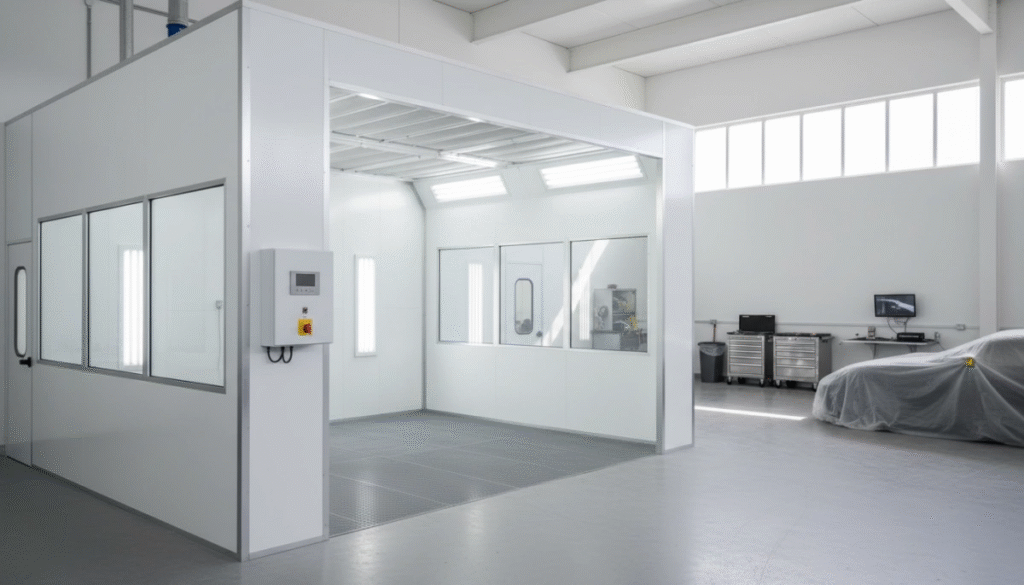
Looking for a semi-downdraft spray booth? This guide covers how diagonal airflow works, how it compares to crossdraft and full downdraft, pitless installation, and what to check before you buy.
Page URL: https://sprayboothmanufacturer.com/product/
Semi-Downdraft Spray Booth: How It Works, Who It’s For & Buying Guide
For a lot of shops, a semi-downdraft spray booth is the most practical choice — not because it’s a compromise, but because it solves the real problem most shop owners face: getting professional finish quality without the cost and disruption of digging a concrete pit.
This guide covers how the airflow actually works, how semi-downdraft compares to crossdraft and full downdraft, what the pitless installation advantage means in practice, and what specs to check before you buy.
How a Semi-Downdraft Spray Booth Works
The design combines elements from crossdraft and full downdraft systems into a single configuration that doesn’t require floor excavation.
Fresh, filtered air enters through an intake plenum in the front section of the ceiling. Instead of moving straight down like a full downdraft, or straight across like a crossdraft, the air travels diagonally — downward and toward the rear of the booth — and exits through exhaust filters mounted at floor level on the back wall.
This diagonal movement is what makes the system work. Overspray and fumes are pulled downward and away from the painter rather than drifting horizontally across the vehicle. The front ceiling intake creates slight positive pressure inside the cabin, which prevents unfiltered shop air from being drawn in through door gaps and wall seams.
The exhaust filters at the lower rear wall capture paint solids before the air is vented outside. This is what keeps the system compliant with environmental regulations and protects the exhaust fans from overspray buildup.
Semi-Downdraft vs Crossdraft vs Full Downdraft
Understanding where semi-downdraft sits relative to the other configurations helps explain why it’s the most popular choice for professional body shops and finishing facilities working within a realistic budget.
Crossdraft
Crossdraft moves air horizontally from one end of the booth to the other. The most affordable option and the simplest to install. The problem on any vehicle of meaningful length is that the air carries overspray generated at the front across every section of the vehicle before it exits at the rear. For premium finish work, this creates contamination risk that shows up in the cured coat.
Semi-downdraft
Semi-downdraft addresses this by introducing air from the ceiling rather than the front wall. The diagonal airflow pattern means overspray is being pulled downward and away from the surface rather than dragged across it. You still don’t get the perfectly vertical drop of a full downdraft, but the contamination risk is significantly lower than crossdraft and most finishing work comes out cleanly.
Full downdraft
Full downdraft delivers the cleanest environment because air moves straight down at every point — overspray falls away from the vehicle immediately at the point it’s generated, with no horizontal travel. The tradeoff is the concrete pit or raised floor system required for floor-level exhaust. For many facilities, the cost and construction disruption of pit installation is the deciding factor against full downdraft.
| Crossdraft | Semi-Downdraft | Full Downdraft | |
|---|---|---|---|
| Airflow direction | Horizontal | Diagonal | Vertical |
| Finish quality | Good | Very good | Best |
| Contamination risk | Higher | Low to moderate | Minimal |
| Pit required | No | No | Usually yes |
| Installation cost | Lowest | Moderate | Highest |
For most professional shops, semi-downdraft delivers around 90% of the finish quality of full downdraft at a fraction of the installation cost and complexity. That’s why it’s become the default choice for high-volume collision repair, automotive restoration, and industrial coating operations that can’t justify pit construction.
The Pitless Advantage: What It Means in Practice
This is the practical reason most shops end up with semi-downdraft rather than full downdraft.
A concrete pit requires excavating your shop floor, which involves permits, heavy construction, significant downtime, and a cost that can easily add tens of thousands of dollars to the project. For shops in leased buildings, cutting into the concrete often isn’t permitted at all. For facilities with post-tension slabs or high water tables, it may not even be feasible.
A semi-downdraft booth sits directly on your existing flat concrete floor. No excavation, no permits for structural work, no downtime for curing concrete. The rear wall exhaust system handles floor-level air exit without requiring anything below ground.
This also means the booth can be relocated if your business moves or your shop layout changes. A pit-based system stays where it is — the semi-downdraft goes with you.
Who Uses Semi-Downdraft Booths and Why
Auto body and collision repair — the most common application. Semi-downdraft provides a meaningfully cleaner environment than crossdraft for modern basecoat/clearcoat systems, handles daily insurance work at volume, and doesn’t create the operational disruption of pit installation. For shops doing custom work or restoration, the diagonal airflow prevents the metallic mottling and overspray drift that causes rework on high-end finishes.
Industrial manufacturing and heavy machinery — for coating large parts, structural steel, or heavy equipment where full downdraft pit construction isn’t practical, semi-downdraft gives good airflow performance on a flat floor. The system scales well for wide booths handling tractors, trailers, and large components.
Woodworking and cabinetry — in a wood shop, airborne sawdust is the enemy of a fresh lacquer coat. Semi-downdraft pulls the air diagonally across the work surface and toward the rear exhaust, keeping contaminants away from tacky surfaces. The ceiling-to-rear airflow pattern is particularly effective for horizontal surfaces like cabinet doors and panels.
Heated vs Non-Heated: Which Do You Need
A semi-downdraft booth can be set up as an ambient air system or with a heated Air Makeup Unit (AMU).
Ambient (non-heated) draws in existing shop air. Lower upfront cost, works fine in warm climates and lower-volume operations. You still get the full benefit of the diagonal airflow and overspray containment. For custom restoration shops, lower-volume industrial finishing, or operations that don’t run bake cycles, this is a practical starting point.
Heated with AMU is the right choice for any shop running multiple jobs per day or working with waterborne paints. The AMU supplies temperature-controlled, filtered air for bake cycles, which cuts cure times significantly and keeps the booth at consistent temperature and pressure regardless of outdoor conditions. Waterborne basecoats need substantial air movement and controlled temperature to flash off properly — an AMU handles both.
The advantage of semi-downdraft here is that adding an AMU doesn’t require rebuilding the booth. It’s a bolt-on upgrade that can be added when the production volume justifies it.
Specs to Check Before You Buy
Filtration — exhaust filters should be rated for at least 98% capture efficiency to meet EPA 6H NESHAP standards. The system needs a manometer (pressure gauge) fitted as standard. This is how you know when filters need changing — when pressure rises above the clean baseline — which is more reliable than any fixed schedule.
Airflow velocity — confirm that the fan and motor combination can maintain the required linear feet per minute (LFPM) across the full working area of the booth. The number should match the cross-sectional area of your specific booth size, not just be a headline CFM figure.
Lighting — color-corrected LEDs with a CRI of 90 or higher, positioned at both ceiling and side-wall locations to eliminate shadows on lower panels. All fixtures must be rated for Class I Division 2 hazardous locations.
Panel construction — 18 or 20-gauge galvanized steel is the standard. Pre-punched and flanged panels with nut-and-bolt assembly seal better than lighter designs and hold up to the vibration of high-powered fans over time. Thinner panels flex and eventually leak air around the seams.
Safety compliance — the booth should come with documentation for NFPA 33 compliance and meet OSHA ventilation requirements for hazardous finishing environments. Ask for this before you buy, not after installation.
Maintenance: What to Stay On Top Of
Exhaust filters — high-volume shops typically change these every 2–3 weeks; lower-volume operations every 1–2 months. Use the manometer rather than guessing — when pressure drops below the operational range, change the filters regardless of the schedule.
Intake and ceiling filters — these last longer, typically several months, but should be checked monthly for loading or any visible breakthrough.
Exhaust fan blades — overspray accumulates on fan blades over time, causing vibration and reducing airflow. Check quarterly and clean as needed. Unusual noise or vibration is an early warning sign worth addressing before it becomes a fan motor failure.
Door seals — check monthly for cracks or gaps. A leaking seal disrupts the positive pressure the system maintains and allows unfiltered air to enter the spray zone.
Interior walls — peelable booth coating applied to interior walls makes cleanup straightforward. Peel and reapply when overspray builds up rather than scraping, which avoids the risk of generating sparks near flammable residue.
Common Questions
Do I need a pit for a semi-downdraft booth?
No. This is one of the main practical advantages. Air enters through the front ceiling intake and exits through rear wall exhaust at floor level. No floor excavation required. The booth bolts directly to your existing concrete floor.
Can I spray waterborne paint in a semi-downdraft booth?
Yes, but waterborne paint needs significant air movement to flash off the water efficiently. If you’re spraying waterborne basecoats, pair the booth with an AMU or corner blowers to accelerate drying and keep cycle times manageable.
How often do exhaust filters need changing?
Use the manometer as your guide. For a busy shop, every 2–3 weeks is typical. Lower volume operations can often go 1–2 months. A pressure drop below the operational range means filters need changing regardless of when they were last replaced.
Is a semi-downdraft booth OSHA compliant?
Yes, when properly installed and maintained. The booth must maintain required airflow speeds, use approved filtration, and be connected to an appropriate fire suppression system. Check with your local fire marshal for any jurisdiction-specific requirements before installation.
What’s the real difference between semi-downdraft and full downdraft?
Full downdraft moves air perfectly vertically — overspray falls directly downward at the point it’s generated. Semi-downdraft moves air diagonally, so overspray still has a short horizontal travel before exiting. For most professional finishing work the difference in outcome is small. For the highest-end work where any contamination is unacceptable, full downdraft remains the better technical choice.
Tell Us What You Need
Share your booth size, what you’re painting, and whether you need a heated setup. We’ll recommend the right configuration and send a detailed quote with layout drawings — usually within 48 hours.
Related Pages
- Bus Spray Booth Design Guide →https://sprayboothmanufacturer.com/transit-coach-spray-booth-requirements/
- Truck Paint Booth Guide →https://sprayboothmanufacturer.com/truck-paint-booth-semi-truck-spray-booth-specifications-buying-guide/
- Other related products→https://www.autokemanufacture.com/product
- Contact our sale Team →https://sprayboothmanufacturer.com/contact-us/
✅ CE Certified | ✅ ISO 9001:2015 | ✅ Factory Direct | ✅ Ships to 60+ Countries | ✅ 1-Year Warranty | 🔒 HTTPS Secured