
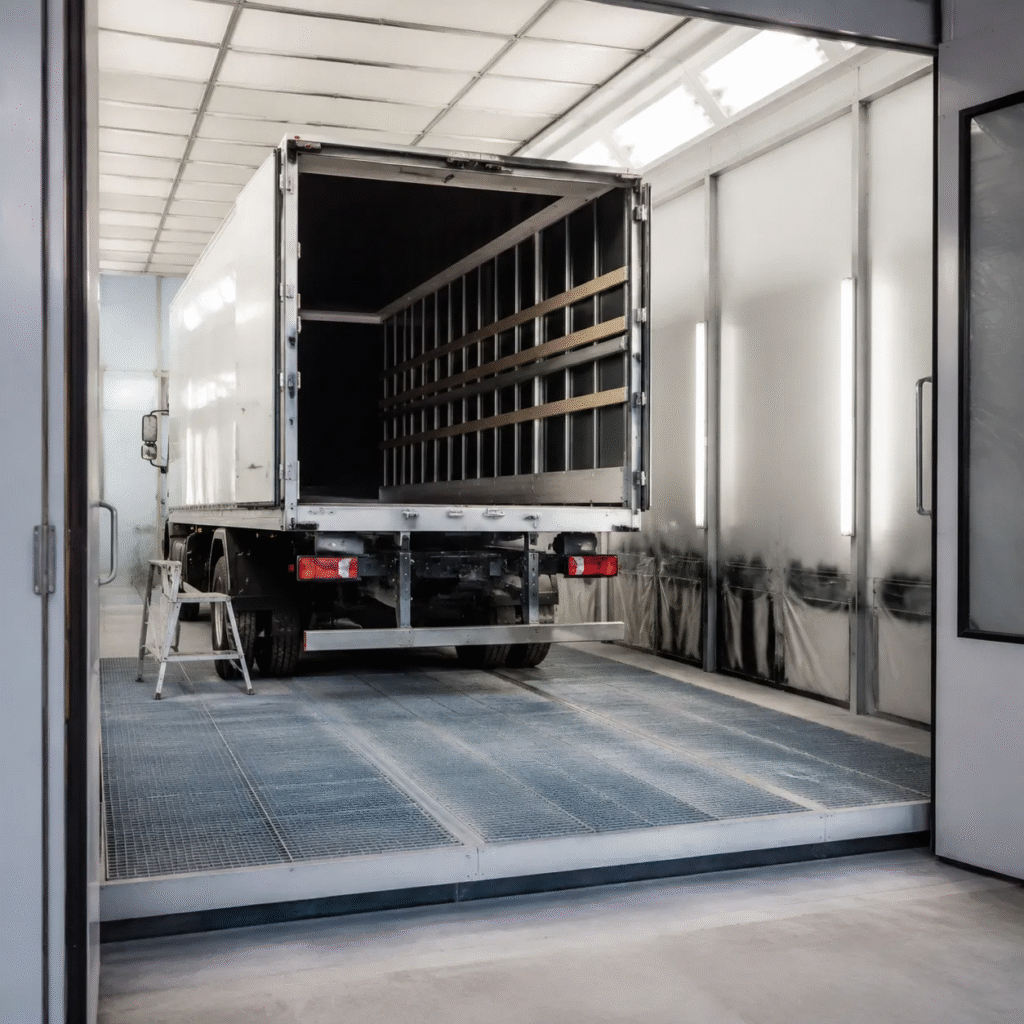
Downdraft Paint Booth for Trucks: Why Large Vehicles Need More Airflow
When you paint a standard passenger car, air flows relatively easily around the vehicle’s contours. But when you pull a massive commercial semi-truck, bus, or heavy-duty trailer into a shop, the entire dynamic changes. The physics of finishing a vehicle of this scale requires a completely different approach to ventilation.
Page URL: https://sprayboothmanufacturer.com/product/
Turbulent Air Zones in Large Booths
The sheer physical mass of a commercial truck acts as a giant roadblock to natural air paths. When high-volume air hits these massive, flat vertical panels and boxy geometries, it loses its smooth momentum. This obstruction creates turbulent air zones in large booths and dangerous paint booth dead spots management challenges.
- Air Pockets: Eddies and swirling currents form along the sides and rear of the vehicle.
- Dead Spots: Areas with zero air movement trap overspray right next to the fresh coating.
- Contamination Loops: Instead of being evacuated, airborne paint mist circulates continuously around the vehicle body.
The Cost of Airborne Paint Particles
When overspray hangs in the air due to poor ventilation, it creates a massive quality control issue. The risk of airborne paint particles settling back onto large, freshly sprayed panels is incredibly high. This creates costly finish defects that destroy your cycle times:
| Consequence | Impact on Finish | Business Cost |
|---|---|---|
| Dry Spray | Overspray dries mid-air and lands on wet paint, creating a rough, sand-like texture. | Hours of color sanding and buffing. |
| Uneven Finishes | Metallic and pearl pigments settle incorrectly in dead air zones. | Costly panel total re-sprays and wasted material. |
| Blemishes | Dust and airborne contaminants get trapped on top of the clear coat. | Rejection from fleet clients who demand factory-grade finishes. |
Why Vertical Downdraft Wins
To solve these aerodynamic hurdles, pulling air from the ceiling straight down to the floor is the only highly efficient method. A vertical downdraft configuration uses gravity to its advantage, creating a reliable envelope of protection.
- Envelopes the Vehicle: Clean air blankets the entire top of the truck cab and trailer simultaneously.
- Isolates Contaminants: It immediately pulls high-volume low-pressure (HVLP) overspray and hazardous fumes downward, away from the painter’s breathing zone.
- Prevents Redeposit: Because the air moves perpendicular to the floor, overspray has zero chance to drift sideways and settle on finished panels.
For heavy-duty equipment refinishing, managing the environment requires controlling the direction of gravity itself. A proper downdraft setup ensures that every square inch of a massive commercial vehicle receives the exact same pristine airflow.
Crossdraft vs. Vertical Downdraft for Trucks
When we look at the physics of coating a semi-truck or heavy equipment, standard airflow setups just don’t cut it. Many shops try to get by with crossdraft or semi-downdraft systems, but large commercial vehicles present unique spatial challenges that these configurations cannot handle.
The Problem with Crossdraft Systems
In a crossdraft setup, air moves horizontally from one end of the booth to the other. For a standard passenger car, this works. For a massive commercial trailer, it’s a recipe for a ruined finish.
- Overspray Drag: As horizontal air moves front to back, it carries high-volume low-pressure (HVLP) overspray across the entire length of the vehicle.
- Contamination Accumulation: Paint particles sprayed at the front of the truck travel past the middle and rear sections, settling onto wet paint and creating severe dry spray.
The Semi-Downdraft Compromise
Semi-downdraft booths pull air from the ceiling and exhaust it through the lower side walls. While this feels like an upgrade, it introduces severe turbulent air zones in large booths.
- The Bounce Effect: Air hitting the massive, flat panels of a box truck or trailer has nowhere to go. It creates high-velocity currents that bounce off the truck body.
- Paint Booth Dead Spots: This bouncing air creates eddies and pockets of stagnant air, making large vehicle overspray control nearly impossible.
Downdraft vs. Semi-Downdraft Airflow: The True Winner
To get a flawless finish on heavy-duty equipment, you need a downdraft paint booth for trucks because large vehicles need more airflow moving in the right direction.
| Airflow Type | Movement Pattern | Impact on Large Trucks |
|---|---|---|
| Crossdraft | Horizontal (Front to Back) | Drags overspray across panels; causes dry spray. |
| Semi-Downdraft | Diagonal (Ceiling to Side Walls) | Creates high-velocity currents and turbulent air pockets. |
| Full Downdraft | Vertical (Ceiling to Floor) | Pulls overspray straight down; zero cross-contamination. |
A full downdraft system creates a continuous, unbroken curtain of clean air that moves straight downward at a uniform velocity. It immediately envelops the vehicle, pulls overspray into the exhaust filtration floor grates, and clears the cabin before contaminants can settle back onto the fresh coat.
Technical Specs: Downdraft Paint Booth for Trucks: Why Large Vehicles Need More Airflow
When we engineer heavy-duty setups, the math has to be spot on. You cannot treat a commercial semi-truck like a standard passenger car. Because a massive vehicle acts like a giant wall inside the cabin, it blocks natural air paths. That’s why truck spray booth CFM requirements are typically 20% to 40% higher than smaller booths just to overcome that physical obstacle mass.
Crucial Airflow Metrics & Compliance Standards
To keep your shop safe and compliant with OSHA paint booth airflow standards and NFPA guidelines, we design our systems around strict linear airflow velocity targets. This ensures hazardous vapor build-up never happens around the vehicle body.
| Metric | Target Standard | Purpose |
|---|---|---|
| Airflow Volume (CFM) | 20% to 40% Higher Volumetric Flow | Overcomes massive vehicle obstacle mass |
| Linear Air Velocity | 100 Feet Per Minute (FPM) | Meets OSHA & NFPA safety guidelines |
| Pressure Balance | Slightly Positive (+0.02 to +0.05 i.w.g.) | Keeps shop dust out of the cabin |
Managing Booth Pressure Balance
Maintaining the perfect booth pressure balance (positive vs. negative) is a continuous balancing act. Too Negative: The booth sucks in dirty shop dust through every door seal, ruining your wet paint. Too Positive: Overspray and fumes get forced out into your main shop floor.
We solve this by using automated manometers and variable speed drives (VFDs). These systems automatically track cabin pressure and adjust the intake and exhaust fans in real-time, keeping the airflow perfectly stable.
Essential Infrastructure for a Downdraft Paint Booth for Trucks
When we design a heavy-duty spray booth, we cannot rely on standard garage ventilation. Setting up a proper downdraft paint booth for trucks requires a serious commitment to heavy-duty infrastructure. If the backbone of the system cannot handle the sheer scale of commercial vehicles, the finish will suffer.
High-Capacity Air Makeup Units (AMUs)
Moving massive volumes of air introduces a major challenge: temperature control. A high-capacity Air Makeup Unit (AMU) is absolutely non-negotiable for large vehicle overspray control.
- Massive Air Volume: Truck booths move thousands of cubic feet of air per minute. Without a dedicated AMU, the booth will quickly pull conditioned air right out of the building, freezing the shop in winter and roasting it in summer.
- Direct-Fired Heating Systems: We integrate direct-fired burners into our AMUs to heat incoming outdoor air instantly. This ensures a steady, reliable temperature during the application phase.
- Consistent Paint Curing Cycles: Large commercial vehicles act like massive heat sinks. A powerful AMU maintains the exact temperature needed to achieve uniform commercial vehicle paint curing cycles, preventing wet spots and weak bonds on heavy metal frames.
Pit Excavation vs. Pitless Raised Floors
The foundation of any vertical downdraft system comes down to how the air exits the cabin. For heavy-duty equipment refinishing, we look at two distinct structural setups:
| Infrastructure Type | Structural Reality | Best Used For |
|---|---|---|
| Concrete Pit Excavation | Requires digging a trench into the shop floor. Heavy-duty exhaust filtration floor grates sit flush with the ground to support massive axle weights. | Dedicated fleet facilities, semi-trucks, and heavy industrial machinery. |
| Pitless Downdraft Paint Booth | Avoids concrete cutting by using a raised floor or a side-downdraft configuration where air is pulled to the bottom sides of the walls. | Leased shop spaces, locations with high water tables, or shops where floor excavation is impossible. |
Choosing between a concrete pit and a pitless downdraft paint booth fundamentally shapes the shop workflow. While a concrete pit offers the purest, uninterrupted downward airflow path, a pitless side-downdraft configuration provides a flexible, high-performance alternative without the high cost of facility excavation.
Downdraft Paint Booth for Trucks: Why Large Vehicles Need More Airflow for Curing
Painting a massive commercial vehicle is only half the battle; baking it evenly is where the real challenge begins. Heavy trucks carry immense thermal mass. The heavy steel frames and thick body panels take a long time to absorb heat and cool back down, which can easily disrupt your commercial vehicle paint curing cycles.
Without targeted, high-volume airflow, you run into serious temperature imbalances inside the cabin.
Overcoming Thermal Mass and Uneven Curing
- The Thermal Mass Obstacle: Thick chassis steel absorbs heat slowly, while thin cab roof panels heat up almost instantly.
- The Risk of Uneven Curing: If your airflow isn’t perfectly calibrated, the truck cab roof might over-bake while the lower frame remains under-cured.
- The Downdraft Solution: A proper downdraft paint booth for trucks ensures that a massive volume of heated air moves uniformly from top to bottom, enveloping the entire vehicle mass simultaneously.
| Curing Challenge | Downdraft Booth Solution | Efficiency Impact |
|---|---|---|
| High Thermal Mass | High-volume, direct-fired heating | Faster heat-up and cool-down times |
| Temperature Stratification | Calibrated top-to-bottom airflow | Uniform cure from roof to frame |
| Extended Cycle Times | Automated variable speed velocity control | Drastically shorter overall bake cycles |
We design our ventilation systems to distribute heat evenly across every square inch of the vehicle body. By precision-routing the air, we eliminate turbulent air zones and temperature stratification, shrinking your cycle times and keeping your shop moving at peak efficiency.
Frequently Asked Questions (FAQs)
How much CFM does a standard commercial truck paint booth require?
A standard truck spray booth CFM requirements generally range from 20,000 to 50,000+ CFM depending on the booth size. Large vehicles need more airflow because their massive body mass disrupts the air path. We calculate the required volume by multiplying the cross-sectional area of the booth by the target linear velocity, then adding a 20% to 40% air volume buffer to overcome the vehicle’s physical obstruction.
Can I convert an existing crossdraft truck booth into a full downdraft system?
Yes, but it requires a major structural overhaul. Converting from crossdraft vs. vertical downdraft means moving your exhaust filtration floor grates to the bottom. You will either need to excavate a concrete pit beneath the booth or build a raised floor system, along with upgrading your Air Makeup Unit (AMU) to handle the increased airflow demands.
What is the difference between a concrete pit downdraft and a pitless side-downdraft booth for large vehicles?
The main differences lie in civil engineering, airflow uniformity, and cost:
| Feature | Concrete Pit Downdraft | Pitless Side-Downdraft Paint Booth |
|---|---|---|
| Airflow Direction | Straight down, ceiling to floor | Downward, then pulls out through lower side walls |
| Civil Work | High (Requires floor excavation) | Low (Sits on a flat concrete shop floor) |
| Overspray Control | Absolute best; zero turbulent air zones | Great; minor turbulence near lower side walls |
| Vehicle Clearance | Maximized ceiling height | Can reduce vertical clearance if a ramp is used |
How often do floor grate filters need to be replaced in high-volume heavy equipment booths?
For high-volume heavy-duty equipment refinishing, we recommend replacing the exhaust filtration floor grates every 40 to 60 spraying hours. If you notice the booth pressure balance shifting or see visible paint buildup on the grates, change them immediately to prevent paint booth dead spots management issues and poor overspray extraction.
What are the specific OSHA airflow velocity requirements for large vehicle refinishing?
According to OSHA paint booth airflow standards (Standard 1910.107), maintaining a minimum linear airflow velocity of 100 feet per minute (FPM) across the open face or cross-section of the spraying area is mandatory. This ensures proper industrial spray booth ventilation, keeping flammable vapors and hazardous high-volume low-pressure (HVLP) overspray below dangerous thresholds.
Related Sources
- https://www.accudraftpaintbooths.com/blog/crossdraft-vs-downdraft-paint-booths-find-the-right-fit/
- https://rttsolutions.com/blog/calculating-air-flow-in-your-spray-booth/
- https://www.spraysystems.com/crossdraft-vs-downdraft-paint-booths-which-airflow-design-is-right-for-you/
- Bus Spray Booth Design Guide → https://sprayboothmanufacturer.com/transit-coach-spray-booth-requirements/
- Truck Paint Booth Guide → https://sprayboothmanufacturer.com/truck-paint-booth-semi-truck-spray-booth-specifications-buying-guide/
- Other related products → https://www.autokemanufacture.com/product
- Contact our sales Team → https://sprayboothmanufacturer.com/contact-us/
✅ CE Certified | ✅ ISO 9001:2015 | ✅ Factory Direct | ✅ Ships to 60+ Countries | ✅ 1-Year Warranty | 🔒 HTTPS Secured