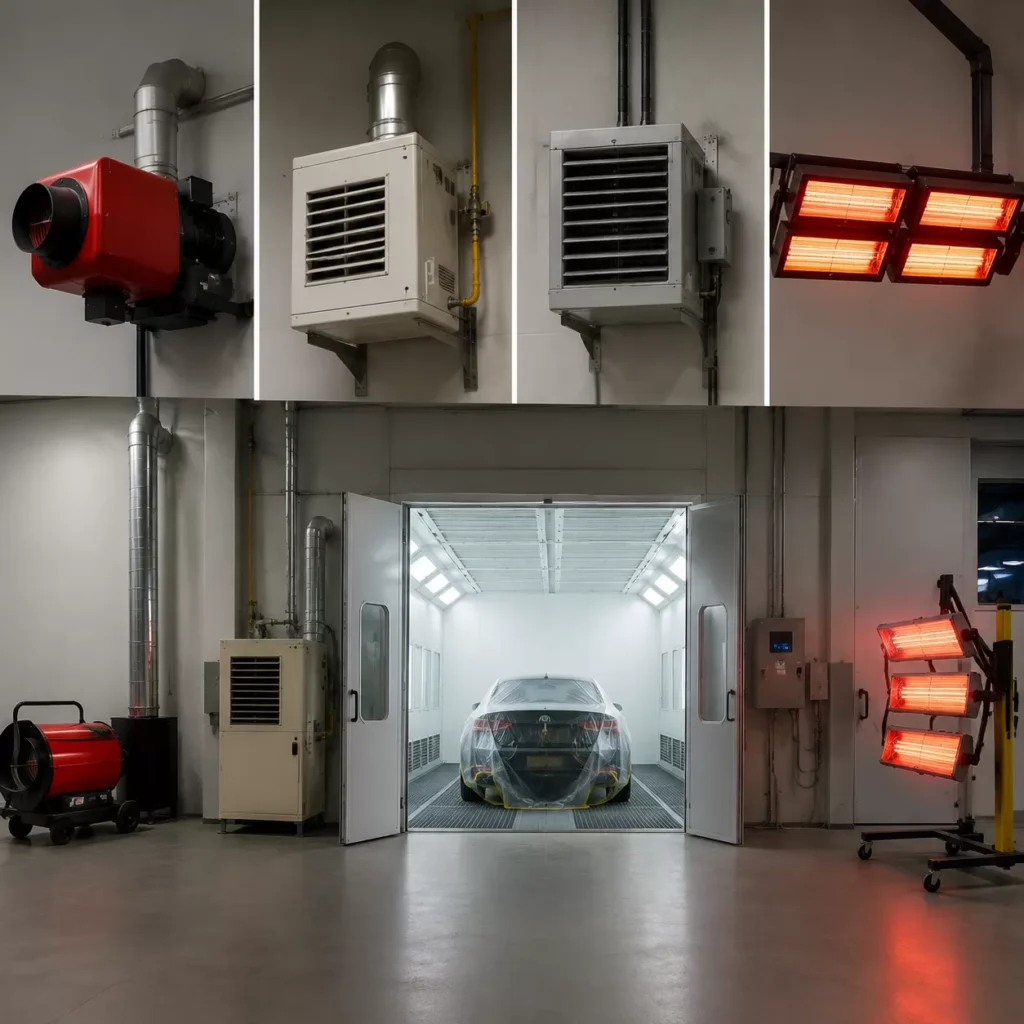
Choosing the wrong industrial paint booth heater can quietly drain your shop’s monthly profits and stall your entire production line. Your heating system isn’t just about keeping the booth warm—it dictates your bake cycle efficiency, controls waterborne paint curing times, and represents your biggest chunk of spray booth operational costs.
Whether you are battling slow solvent flash-off times, facing strict environmental EPA compliance audits, or trying to calculate the exact BTU heat output needed for a freezing winter, the choice between thermal systems isn’t always clear-cut.
At AUTOKE, we’ve engineered finishing solutions for every type of shop floor footprint imaginable. To help you make the right capital investment, we have broken down the raw data, fuel consumption rates, and real-world performance of the four dominant technologies: diesel, gas, electric convection, and infrared.
Let’s dive right in.
Page URL: https://sprayboothmanufacturer.com/product/
Paint Booth Heating System Comparison: Diesel, Gas, Electric and Infrared
Choosing the right heating system for your spray booth isn’t just about hitting a specific temperature. It dictates your daily operational costs, cycle times, and the ultimate quality of your finish. If you are struggling with slow bake cycles, skyrocketing utility bills, or uneven curing, the root cause is usually an unoptimized heat source. We break down exactly how the four primary heating technologies operate so you can select the best fit for your shop’s production demands.
Diesel Heating Systems: The Rugged Traditionalist
Diesel-fired systems are the historical workhorses of the automotive refinish industry. They rely on a heavy-duty oil burner to heat an internal heat exchanger, warming the air forced into the booth.
- How it works: Fuel is pumped from a storage tank, atomized, and ignited inside a combustion chamber. An indirect-fired heat exchanger keeps combustion byproducts completely isolated from the cabin air.
- Best for: Shops in rural areas without access to natural gas lines or locations with unstable electrical grids.
- Key Advantage: Incredible reliability and massive BTU heat output in extreme cold weather.
Gas-Fired Systems: Direct-Fired vs. Indirect-Fired High-Volume Powerhouses
Gas is the industry standard for high-volume collision centers across the United States. When evaluating gas options, you must choose between two distinct delivery methods.
- Direct-Fired Gas Burner: The gas flame fires directly into the incoming airstream of the air make-up unit (AMU). It offers 100% thermal efficiency because all the heat goes straight into the booth.
- Indirect-Fired Heat Exchanger: The flame stays sealed inside a heat exchanger, venting exhaust gases outside. While it eliminates any risk of fuel contamination, it loses roughly 20% of its efficiency through the exhaust stack.
Production Note: Direct-fired systems deliver a faster bake cycle efficiency and rapid temperature rises, making them the preferred choice for busy commercial shops.
Electric Convection Heating: The Clean Minimalist
Electric convection heating uses high-output resistive heating elements to warm the incoming air. It is the cleanest method available since it requires no fuel storage, venting, or open flames.
- The Workflow: Air passes over electrified coils, heating the booth evenly via traditional airflow currents.
- The Catch: While it lowers your shop’s carbon footprint and simplifies environmental EPA compliance, the electrical draw is massive.
- Ideal Setup: Small to mid-sized shops with low-to-moderate throughput, or regions where electricity rates are highly competitive against fossil fuels.
Infrared Curing Technology: The Surgical Instrument
Unlike convection systems that heat the air, infrared curing lamps transfer radiant energy directly to the vehicle panels.
- Bottom-Up Curing: IR waves penetrate the paint film to heat the metal substrate underneath. This triggers a bottom-up curing process, forcing solvents outward and drastically reducing solvent flash-off time.
- Efficiency Boost: Excellent for rapid spot repairs and waterborne paint curing. You only heat the specific panels you are working on, rather than wasting energy warming the entire cabin volume.
Head-to-Head Paint Booth Heating System Comparison
Evaluating a paint booth heating system comparison: diesel, gas, electric and infrared requires looking closely at daily shop realities. Choosing the wrong heat source directly damages your bottom line through high utility bills or slow cycle times. Below is the direct breakdown of how these technologies match up in American shops.
Operational Cost & Fuel Consumption Rates
Daily utility expenses dictate your long-term profitability. Fuel prices vary by region, but the fuel consumption rate and overall efficiency patterns remain consistent across the board.
- Gas-Fired Systems: These offer the lowest spray booth operational costs in most US states. A direct-fired gas burner operates at nearly 100% thermal efficiency because the flame heats the incoming air stream directly, keeping utility bills predictable even during heavy use.
- Diesel Units: These systems burn fuel rapidly and tie your wallet directly to volatile oil markets. They get expensive quickly if you run multiple bake cycles a day.
- Electric Convection Heating: Electric setups face high demand charges from power companies. Heating large volumes of moving air with raw electricity results in a massive utility draw.
- Infrared Curing Lamps: Highly efficient because they heat the panel, not the air. They consume significant power while running but slash total run time, keeping overall consumption low.
| Heating Type | Average Operational Cost | Efficiency Rating |
|---|---|---|
| Direct-Fired Gas | Low | ~100% |
| Indirect-Fired Gas | Medium | 80% – 85% |
| Diesel | High | 80% – 85% |
| Electric Convection | Very High | 95%+ (But high utility rates) |
| Infrared (IR) | Medium-Low | High (Targeted energy transfer) |
Heat-Up Speed & Production Throughput
Throughput is everything when vehicles are stacking up outside your shop. Your bake cycle efficiency depends on how fast the booth reaches target temperature and cures the coating.
- Infrared Curing Technology: The undisputed speed champion. IR waves trigger bottom-up curing, heating the metal substrate first. This slashes solvent flash-off time and cures body panels in 10 to 15 minutes instead of an hour.
- Direct-Fired Gas: The fastest option for whole-booth air heating. An air make-up unit (AMU) delivers a massive BTU heat output instantly, bringing the entire cabin up to temperature in minutes to maintain high volume.
- Indirect-Fired Gas & Diesel: These require a warm-up period because the flame must heat an indirect-fired heat exchanger before the air gets warm.
- Electric Convection: The slowest to respond. It takes considerable time to get coils hot enough to warm high-volume air streams, creating a bottleneck in high-throughput shops.
Maintenance Overhead & Component Reliability
Down time destroys production schedules. Every heating type comes with its own mechanical weak points that require regular technician attention.
- Electric & Infrared Systems: These boast the lowest maintenance needs. Electric elements and infrared curing lamps have no moving parts, no heat exchangers to crack, and no burners to clean. You simply swap out bulbs or elements after thousands of hours of use.
- Direct-Fired Gas: Requires moderate maintenance. You must regularly check the burner profile, verify gas pressure, and ensure clean airflow to keep the flame stable and safe.
- Indirect-Fired Gas & Diesel: These demand the highest maintenance overhead. Diesel systems suffer from clogged fuel nozzles, carbon buildup, and fuel pump wear. Both diesel and indirect gas systems rely on a heavy metal heat exchanger; if this component cracks, it can leak deadly carbon monoxide into the cabin, requiring an immediate and expensive replacement.
Engineering for Your Environment: Climate & Compliance Factors
Choosing the right paint booth heating system comparison—whether you are looking at diesel, gas, electric, or infrared—depends heavily on your local weather and local laws. Where you build your shop dictates how your equipment must perform.
Cold Climates vs. High Humidity Regions
Your local weather directly impacts your spray booth operational costs and bake cycle efficiency.
- Cold Climates (Northeast, Midwest, Rockies): If you operate in freezing temperatures, you need a massive BTU heat output to warm up incoming sub-zero air. A gas-fired air make-up unit (AMU) is the standard here. It pulls in freezing outside air, heats it instantly, and maintains stable cabin temperatures without draining your budget. Electric and infrared systems struggle as primary heat sources in extreme cold because they do not heat high-volume incoming air efficiently.
- High Humidity Regions (Gulf Coast, Southeast): In humid areas, the challenge is moisture control and managing solvent flash-off time. If you use waterborne paint curing, high humidity slows down dry times significantly. Here, a system that combines high airflow CFM configuration with targeted infrared curing lamps works best. The infrared waves penetrate the paint layer for bottom-up curing, forcing moisture out without trapping it under the surface.
Zoning, Permitting, and EPA Regulations
Running a shop in the United States means balancing production with environmental EPA compliance and local building codes.
- Emissions and Permitting: Direct-fired gas burners are highly efficient but face strict permitting in states with tight emissions caps, like California (SCAQMD rules) or New York. In contrast, electric convection heating and infrared systems produce zero shop-floor emissions, making them the easiest to approve through local zoning boards.
- NFPA 33 Compliance: The National Fire Protection Association (NFPA) sets strict safety distances for heating elements near spraying areas. Infrared lamps must be interlocked with your exhaust fans so they cannot turn on unless air is moving.
- Diesel Challenges: While diesel is a rugged traditional option, getting permits for large underground or above-ground oil storage tanks can be a regulatory nightmare in urban US districts due to soil contamination risks.
| Region / Factor | Best Heating Tech Choice | Key Compliance Hurdle |
|---|---|---|
| Freezing Winters | Direct-Fired Gas (AMU) | High BTU air-permitting approvals |
| High Humidity | Gas + Infrared Hybrid | Air turnover rates & NFPA interlocks |
| Strict Emission Zones | Electric / Infrared | Local electrical grid capacity |
Operational Matrix: Paint Booth Heating System Comparison
Choosing the right paint booth heating system comparison comes down to matching your shop’s daily volume with your building’s physical and financial constraints. We break down how diesel, gas, electric, and infrared systems stack up across the five core performance metrics that impact your bottom line.
Initial Investment vs. Long-Term Running Cost
Upfront price tags rarely tell the whole story. A system that saves you money during installation can easily drain your profits through monthly utility bills.
- Gas-Fired Systems: Require a high initial investment due to gas line plumbing, a dedicated air make-up unit (AMU), and certified installation. However, they deliver the lowest spray booth operational costs per batch in most US regions.
- Electric Convection Heating: Offers a low-to-moderate setup cost but results in a high ongoing fuel consumption rate depending on local electricity tariffs.
- Infrared Curing Lamps: Feature a moderate initial cost focused on equipment rather than facility modifications, offering excellent energy efficiency by heating the panel directly.
- Diesel Heating Systems: Moderate upfront costs, but fluctuating fuel prices make long-term budgeting unpredictable.
Heat-Up Speed and Production Throughput
Your shop’s earning potential depends on minimizing solvent flash-off time and accelerating the bake cycle efficiency.
| Heating Technology | Time to Bake Temperature | Throughput Capability | Best Match For |
|---|---|---|---|
| Infrared (IR) | Instantaneous (Direct panel heat) | Maximum (Fastest curing) | High-volume collision centers |
| Direct-Fired Gas | 5–10 minutes | High (Rapid air turnover) | Standard commercial shops |
| Indirect-Fired Gas | 15–20 minutes | Medium | High-end custom & restoration |
| Electric Convection | 20–30 minutes | Low-to-Medium | Low-volume or specialized niche |
| Diesel Burner | 15–25 minutes | Medium | Industrial & remote locations |
Maintenance Overhead and Space Footprint
Shop space is real estate, and maintenance downtime is lost revenue. Consider how much physical room each industrial paint booth heater demands and the labor required to keep it running.
- Space Footprint: Gas and diesel units require significant indoor or outdoor square footage for the mechanical footprint and fuel storage. Electric and infrared systems are highly compact, often mounting directly onto the booth walls or ceiling structure without stealing floor space.
- Component Reliability: Electric and IR systems have fewer moving parts, requiring minimal upkeep. Gas systems require routine burner tuning and safety compliance checks. Diesel setups demand the highest maintenance overhead due to fuel filter changes, nozzle cleaning, and heat exchanger soot removal.
The AUTOKE Blueprint: Customizing Your Ideal Paint Booth Heating System
We don’t believe in one-size-fits-all setups. Every shop has different production goals, climate challenges, and utility rates. That is why we engineer tailored configurations designed to maximize your bake cycle efficiency and slash spray booth operational costs.
Hybrid Systems
For high-volume shops, combining technologies delivers the ultimate competitive edge. By pairing an air make-up unit (AMU) with infrared curing lamps, you get the best of both worlds.
- The Strategy: Use a direct-fired gas burner or electric convection heating to maintain the ambient cabin temperature during the spray cycle. Then, engage electric infrared panels for the bake cycle.
- The Benefit: Infrared targets the coating directly, triggering a bottom-up curing process. This cuts solvent flash-off time in half and eliminates the energy waste of heating the entire booth structure just to cure a single panel.
- Waterborne Success: This hybrid approach is the gold standard for accelerating waterborne paint curing, keeping your pipeline moving without skyrocketing your monthly utility bills.
Smart Control Integration
Managing your BTU heat output and airflow CFM configuration should not require guesswork. Our integrated smart control panels handle the heavy lifting automatically.
- Precision Cycling: The system automatically shifts between spray, flash-off, and bake modes, adjusting the burner or electric elements based on real-time sensors.
- Energy Savings: Programmed logic prevents oversaturation and unnecessary fuel burn, drastically lowering your overall fuel consumption rate.
- Compliance Tracking: Digital logs monitor temperature consistency and airflow, helping you maintain environmental EPA compliance and consistent finish quality on every job.
Paint Booth Heating System Comparison FAQ
Which paint booth heating system is cheapest to run?
Natural gas is almost always the most cost-effective option for running an industrial paint booth heater in the United States. Thanks to low domestic utility rates, a direct-fired gas burner delivers the lowest spray booth operational costs per BTU. Diesel offers high heat but subjects you to volatile fuel prices and frequent maintenance. Electric convection is the most expensive option due to high peak demand charges from power companies, while infrared is highly efficient but only for targeted curing rather than heating entire booths.
Can I use an electric infrared heater for waterborne paint curing?
Yes, infrared curing lamps are incredibly effective for waterborne paint curing. Unlike traditional solvent paints that need air movement to carry away fumes, waterborne coatings require stable heat to evaporate water from the film. Infrared technology targets the coating directly, accelerating the solvent flash-off time and triggering a bottom-up curing process. This prevents skinning and cuts down your bake cycle efficiency times by up to 50%.
What is the difference between direct-fired and indirect-fired gas burners?
The main difference comes down to air purity and equipment design:
- Direct-Fired Gas Burner: Flashes the gas flame directly into the airstream entering the booth. It achieves nearly 100% fuel efficiency, making it the standard for an air make-up unit (AMU).
- Indirect-Fired Heat Exchanger: Keeps the flame completely sealed inside a combustion chamber. Exhaust fumes are vented outside, and only clean, radiated heat enters the booth. It is less efficient but necessary for sensitive specialty coatings or strict local environmental rules.
How does airflow CFM configuration impact my BTU heat output needs?
Your booth’s airflow CFM configuration directly dictates your required BTU heat output. Because a paint booth continuously pulls in fresh outside air and exhausts it, your heating system must instantly warm that moving air.
The Rule of Thumb: The higher your CFM (Cubic Feet per Minute), the more BTUs you need to maintain a stable spraying or baking temperature.
If you under-size your heater relative to your CFM, the system will struggle to hit the right temperatures, destroying your finish quality and driving up your fuel consumption rate.
Related Pages
- Bus Spray Booth Design Guide → https://sprayboothmanufacturer.com/transit-coach-spray-booth-requirements/
- Truck Paint Booth Guide → https://sprayboothmanufacturer.com/truck-paint-booth-semi-truck-spray-booth-specifications-buying-guide/
- Other related products → https://www.autokemanufacture.com/product
- Contact our sales Team → https://sprayboothmanufacturer.com/contact-us/
✅ CE Certified | ✅ ISO 9001:2015 | ✅ Factory Direct | ✅ Ships to 60+ Countries | ✅ 1-Year Warranty | 🔒 HTTPS Secured