
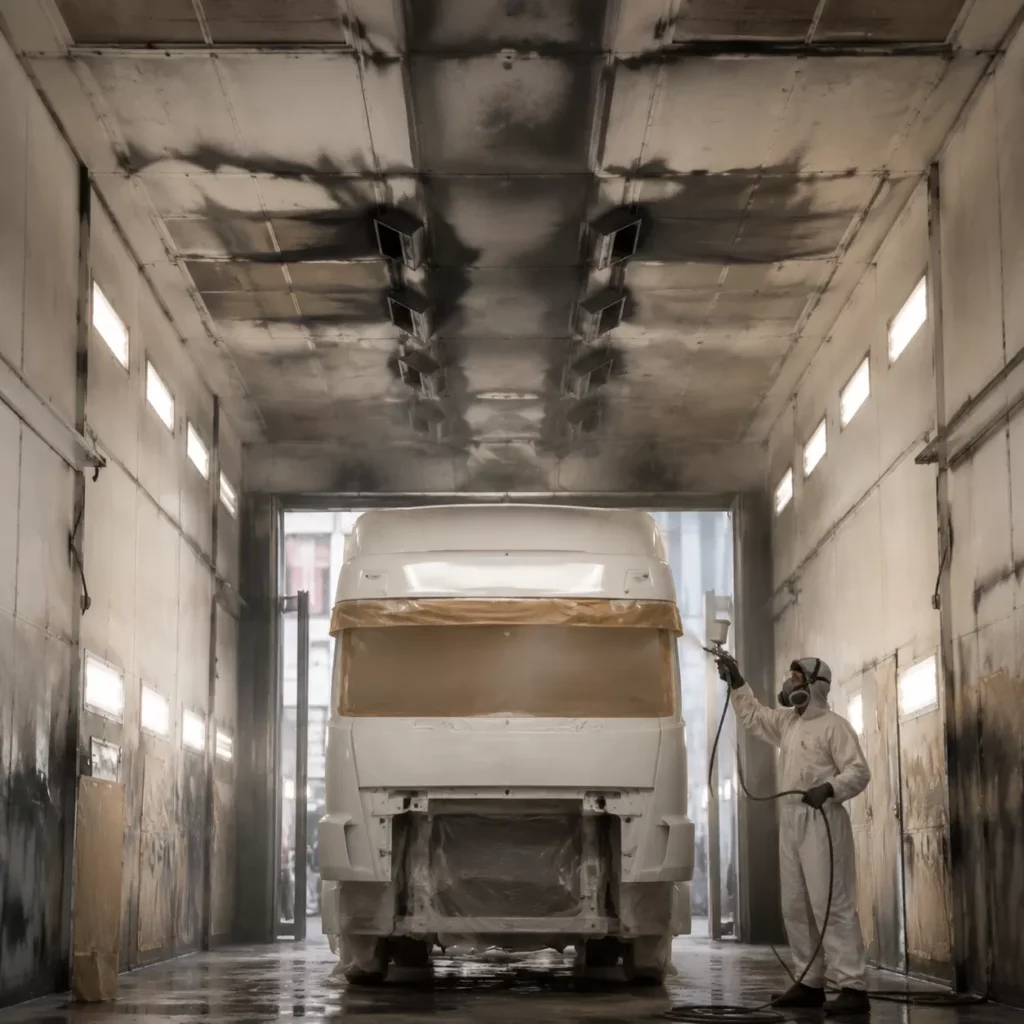
Large Vehicle Spray Booth Ventilation: Why Standard Setups Fall Short
When you test an empty spray booth, the airflow feels perfect. The air moves smoothly, the gauges read exactly where they should, and everything looks ready for a flawless finish. But the moment you pull in a 53-foot semi-trailer or a transit bus, the entire environment changes. This is the “empty vs. loaded” booth trap, and it is the primary reason standard ventilation systems fail in heavy-duty applications.
Page URL: https://sprayboothmanufacturer.com/product/
The Linear Calculation Error
Standard ventilation formulas rely on a simple, flawed assumption: they calculate required Cubic Feet per Minute (CFM) based entirely on an empty room.
$$text{Width} times text{Height} times text{Target Velocity} = text{Required CFM}$$
This linear calculation works fine for passenger cars, but it completely falls apart for heavy equipment. It ignores how a massive vehicle physically alters the space inside the cabin.
The Volume Displacement Factor
A large vehicle acts as a massive aerodynamic block. When a transit bus fills up to 70% to 80% of the booth’s cross-sectional area, the air no longer has a clear, open path to travel.
- Massive Air Volume Displacement: The vehicle displaces thousands of cubic feet of air.
- Choked Air Pathways: The open space around the vehicle narrows drastically, forcing the ventilation system to work under entirely different physics.
- Airflow Compression: The air is squeezed into tight corridors between the vehicle panels and the booth walls.
Velocity Spikes & Static Pressure Drops
Because the air is squeezed into smaller channels, it creates extreme velocity spikes along the sides and top of the vehicle. This high-velocity air rushes past the body panel too fast, which can cause finish defects like dry spray.
Worse look at what happens to the rest of the system:
| Affected Area | System Reaction | Resulting Problem |
|---|---|---|
| Vehicle Clearance Pockets | Extreme velocity spikes | Dry spray and uneven coating thickness |
| Exhaust Plenum | Severe static pressure drop | Exhaust fans starve for air |
| Booth Ends / Corners | Overspray stagnation | Clouds of paint mist settling back onto the wet finish |
When the exhaust plenum is starved for air due to this high static pressure resistance, the entire laminar airflow pattern collapses. Instead of pulling overspray down and out of the cabin, the air begins to swirl, creating turbulent currents that ruin your paint job. Standard setups simply do not have the engineering backbone to handle this massive air volume displacement.
3 Critical Reasons Standard Ventilation Fails in Large-Vehicle Applications
When you try to use standard commercial spray booth setups for heavy equipment refinishing, you run into immediate, costly problems. Standard systems are built for passenger cars, not 55-foot transit buses or semi-trucks. Here is exactly why standard ventilation equipment falls short when handling large fleets.
Chaotic Airflow Dead Zones
Traditional horizontal or crossdraft airflow layouts work fine for small vehicles, but they fail miserably with long vehicle bodies.
- The Problem: Air is forced to travel the entire length of the cabin, dragging overspray across the wet paint of the front or rear sections.
- The Result: The massive physical bulk of the vehicle blocks the air path, creating airflow dead zones—pockets of completely static air where overspray hangs in suspension and eventually settles back onto the fresh coating.
Inadequate Static Pressure Capabilities
Standard exhaust fans simply don’t have the muscle to handle the heavy coatings used in industrial fleet operations.
| Equipment Type | Initial CFM Performance | Performance with Loaded Filters |
|---|---|---|
| Standard Exhaust Fans | High / Optimal | Dramatic CFM Drop (Fails to clear overspray) |
| Heavy-Duty Exhaust Fans | High / Optimal | Stable CFM (Overcomes high static pressure) |
As particulate filtration efficiency does its job, filters quickly face-load with overspray. Standard fans cannot overcome this rising static pressure resistance. Airflow drops instantly, leaving the cabin hazy and unsafe.
Failure of Massive Air Volume Balancing
A large vehicle spray booth demands a massive, perfectly balanced exchange of air. When you use an under-engineered Air Makeup Unit (AMU), the system cannot supply enough fresh air to match what the exhaust fans pull out.
The Risk of Negative Pressure: This imbalance creates a structural negative pressure environment. Instead of maintaining a clean, positive cabin pressure, the booth literally sucks in shop dust, dirt, and unheated air through every door seal and small crevice, destroying your finish quality.
The Cost of Ventilation Compromise in Fleet Operations
Cutting corners on heavy equipment refinishing ventilation always backfires where it hurts most: your bottom line and your shop’s safety record. When a spray booth can’t handle the massive air volume displacement of a commercial vehicle, the financial fallout manifests in ruined finishes, bottlenecked production, and costly regulatory fines.
Finish Defects: The Direct Link to Sluggish Airflow
When your airflow drops below optimal levels, overspray hangs in the air like a cloud, settling right back onto your wet coating. This creates a cascade of expensive finish defects that require hours of unplanned rework:
- Solvent Popping: Sluggish airflow fails to sweep away evaporating solvents, trapping gasses beneath the surface layer as it skins over.
- Orange Peel: Without proper air velocity to help the paint flow out smoothly, the finish cures with an uneven, textured texture.
- Dust Nibs: Weak static pressure resistance allows airborne shop dust to migrate into the cabin, embedding dirt into your clear coat.
Extended Flash & Cure Cycles
Improper air velocity completely disrupts your shop’s throughput. If your Air Makeup Unit (AMU) and exhaust fans aren’t maintaining a proper laminar airflow pattern, the evaporation process stalls.
- Slower Evaporation: Solvent flashing takes twice as long when stagnant air saturated with VOCs blankets the vehicle.
- Inefficient Thermal Curing: Bake cycles drag on because the booth struggles to distribute heat evenly across a 60-foot flat surface, spiking your utility bills.
Compliance and Safety Liabilities
A failing ventilation setup isn’t just a quality issue; it is a major legal liability. If your booth can’t maintain the right overspray clearance rate, you risk serious regulatory pushback:
| Compliance Risk | Impact on Fleet Operations |
|---|---|
| OSHA Guidelines | Poor indoor air quality triggers heavy fines and puts painter health at risk due to chemical exposure. |
| NFPA 33 Standards | Failing to dilute flammable vapor concentrations creates catastrophic fire and explosion hazards. |
| EPA Violations | Inefficient particulate filtration efficiency leads to illegal hazardous air pollutant emissions. |
Engineering the Solution for Large Vehicle Spray Booth Ventilation
Standard setups can’t handle the physics of heavy equipment refinishing. Designing a system that actually works requires commercial-grade engineering built for massive air volume displacement.
Semi-Downdraft and Side-Downdraft Layouts
True downdraft booths require deep, expensive concrete excavation. For heavy fleets, semi-downdraft or side-downdraft configurations offer the ideal alternative.
- Semi-Downdraft: Introduces air through the ceiling and pulls it out the back wall, moving overspray away from the painter.
- Side-Downdraft: Draws air from the ceiling and exhausts it through the lower side walls, delivering a near-laminar airflow pattern around the vehicle without the need for a pit.
VFD Integration for Constant CFM
As exhaust filters face-load with heavy coatings, static pressure resistance spikes, causing standard fans to lose airflow. Integrating Variable Frequency Drives (VFDs) solves this problem. These smart motor controls automatically speed up the heavy-duty exhaust fans as the filters get dirty, maintaining a consistent cubic feet per minute (CFM) rate and ensuring a constant overspray clearance rate throughout the entire job.
Precision AMU Temperature Controls
Heating a 50-to-60-foot cabin evenly is incredibly difficult. Standard heating units often leave cold spots, leading to uneven solvent flashing and popping. Our advanced Air Makeup Unit (AMU) systems utilize precise temperature modulating controls. This keeps the thermal balance uniform from the front bumper to the rear panel, speeding up cure cycles and ensuring an immaculate finish across the entire surface of the vehicle.
Why Fleet Managers Choose AUTOKE Custom Engineering
Standard, off-the-shelf booths simply cannot handle the physics of heavy equipment refinishing. When you park a transit bus or a semi-truck inside a cabin, the entire airflow dynamic changes. At AUTOKE, we engineer custom solutions built specifically for the demanding environment of US fleet operations. We do not guess—we calculate.
The AUTOKE Advantage: Precision Engineering
We design our systems around the actual spray booth air volume displacement of your specific fleet. Our engineering process eliminates the guesswork that leads to airflow dead zones and ruined finishes.
- Custom Spatial Calculations: We analyze your largest vehicles to predict exactly how air will move around them, ensuring a true laminar airflow pattern.
- Static Pressure Modeling: We calculate the exact static pressure resistance your system will face as filters load up, ensuring your fans never starve.
- True CFM Guarantee: We deliver the precise Cubic Feet per Minute (CFM) required to maintain a safe, clean, and productive shop.
Turnkey Systems Built for Heavy-Duty Performance
We build complete, integrated systems designed to maximize your overspray clearance rate and keep your shop in total OSHA & NFPA 33 compliance.
| Component | Features & Engineering Standards | Operational Benefit |
|---|---|---|
| Multi-Stage Filter Arrays | High particulate filtration efficiency; layered target system | Captures heavy coatings; extends life of exhaust system |
| Heavy-Duty Exhaust Fans | Direct-drive tubeaxial fan systems; no belts to slip or break | Maintains consistent positive cabin pressure and velocity |
| Integrated AMU Controls | Smart Air Makeup Unit (AMU) integration | Prevents turbulent air currents and eliminates shop dust pull |
Our custom engineering ensures your team achieves fast solvent flashing and popping prevention without cycling issues. With AUTOKE, you get a rugged, reliable system that keeps your fleet moving through the paint bay.
Large Vehicle Spray Booth Ventilation FAQs
How many CFM do I need for a heavy equipment or truck spray booth?
For large vehicle applications, you cannot rely on standard air changes per hour. We calculate Cubic Feet per Minute (CFM) based on the cross-sectional area of the booth cabin. Industry standards require a minimum air velocity of 100 feet per minute (FPM) across the open face of the painting zone.
To find your baseline CFM, use this formula:
- CFM = Cross-Sectional Width × Height × 100 FPM
Because a massive semi-truck or transit bus causes significant spray booth air volume displacement, we engineer our systems with extra capacity to overcome the high static pressure resistance caused by the vehicle body itself.
Why is my spray booth pulling in shop dust even with new intake filters?
If your booth is pulling in dirty shop air, you are dealing with a negative cabin pressure issue. This happens when your heavy-duty exhaust fans are pulling out more air than your Air Makeup Unit (AMU) is supplying.
| Cause | Impact | Solution |
|---|---|---|
| Improperly Tuned AMU | Exhaust fan overpowers intake fan, creating a vacuum. | Re-balance fan speeds for a slight positive cabin pressure. |
| Clogged Exhaust Filters | High static pressure resistance chokes airflow. | Implement VFD integration to automatically adjust motor speeds. |
| Leaky Door Seals | Vacuum pulls particulate matter through gaps. | Replace worn seals and check structural integrity. |
What is the difference between downdraft and crossdraft airflow patterns for large fleets?
Choosing between downdraft vs. crossdraft setups comes down to your budget, building constraints, and required overspray clearance rate.
- Crossdraft: Air flows from the front doors straight back to the exhaust plenum. While economical to install, the air travels the entire length of the vehicle. This creates turbulent air currents and dangerous airflow dead zones around the backend of long trailers.
- Downdraft: Air enters through the ceiling and pulls straight down into floor pits or side exhaust trenches. This creates a true laminar airflow pattern that pulls overspray away from the painter instantly, completely eliminating the risk of solvent flashing and popping defects on massive fleet bodies.
Related Pages
- Bus Spray Booth Design Guide → https://sprayboothmanufacturer.com/transit-coach-spray-booth-requirements/
- Truck Paint Booth Guide → https://sprayboothmanufacturer.com/truck-paint-booth-semi-truck-spray-booth-specifications-buying-guide/
- Other related products → https://www.autokemanufacture.com/product
- Contact our sales Team → https://sprayboothmanufacturer.com/contact-us/
✅ CE Certified | ✅ ISO 9001:2015 | ✅ Factory Direct | ✅ Ships to 60+ Countries | ✅ 1-Year Warranty | 🔒 HTTPS Secured