Core Engineering Principles: How Metal Substrates Dictate Booth Design
When coating heavy-duty metal substrates, we cannot use a one-size-fits-all approach. Raw iron, structural steel, and aluminum each interact uniquely with temperature, moisture, and chemical coatings. Designing an industrial paint booth requires a deep understanding of these materials to ensure proper adhesion and flawless finishes.
Page URL: https://sprayboothmanufacturer.com/product/
The Physical and Thermal Challenges of Iron, Steel, and Aluminum
Metal parts act as massive heat sinks. Their physical properties create specific challenges during the liquid spray or industrial powder coating booth process:
- Thermal Mass: Heavy iron and steel parts take longer to reach core temperature. If your booth connects to a curing oven, the enclosure must handle extended flash-off times and high heat retention without warping.
- Oxidation and Flash Rust: Raw iron and steel are highly susceptible to moisture. The booth ventilation must maintain strict humidity control to prevent rust from forming between blasting and painting.
- Aluminum Static Charges: Aluminum is lightweight but highly conductive. It attracts airborne dust via static electricity, requiring advanced static electricity grounding systems built directly into the booth structure to eliminate surface contaminants.
Application-Specific Enclosure Choices
To combat these material challenges, standard sheet-metal enclosures will not suffice. We engineer specific structural housings based on the metal parts being processed:
| Substrate Type | Key Challenge | Enclosure Solution |
|---|---|---|
| Heavy Structural Steel | High thermal mass, crane loading requirements | Open-top or crane-slot booths with dual-skin insulated panels to retain heat and allow overhead loading. |
| Aluminum Components | High static attraction, explosive dust hazards | Smooth-wall booths with integrated static electricity grounding and specialized intake filtration to eliminate micro-dust. |
| Cast Iron Parts | Outgassing, heavy overspray | Extended flash-off zones and heavy-duty exhaust chamber design to manage high-volume solvent extraction. |
Selecting the wrong enclosure leads to premature coating failure, uneven curing, and structural wear on the booth itself. We utilize dual-skin insulated panels to ensure thermal efficiency, structural rigidity, and acoustic dampening when processing heavy-gauge metals.
Key Features of a High-Performance Industrial Paint Booth for Metal Parts
To get flawless finishes on heavy-duty metal substrates, your shop needs the right equipment. A high-performance setup requires heavy-duty construction, precise air management, and smart monitoring to keep production moving safely.
Advanced Airflow Patterns and Aerodynamic Configurations
Managing overspray starts with how air moves through the cabin. The right design prevents paint bounce-back on large metal assemblies and pulls fumes away from the painter instantly.
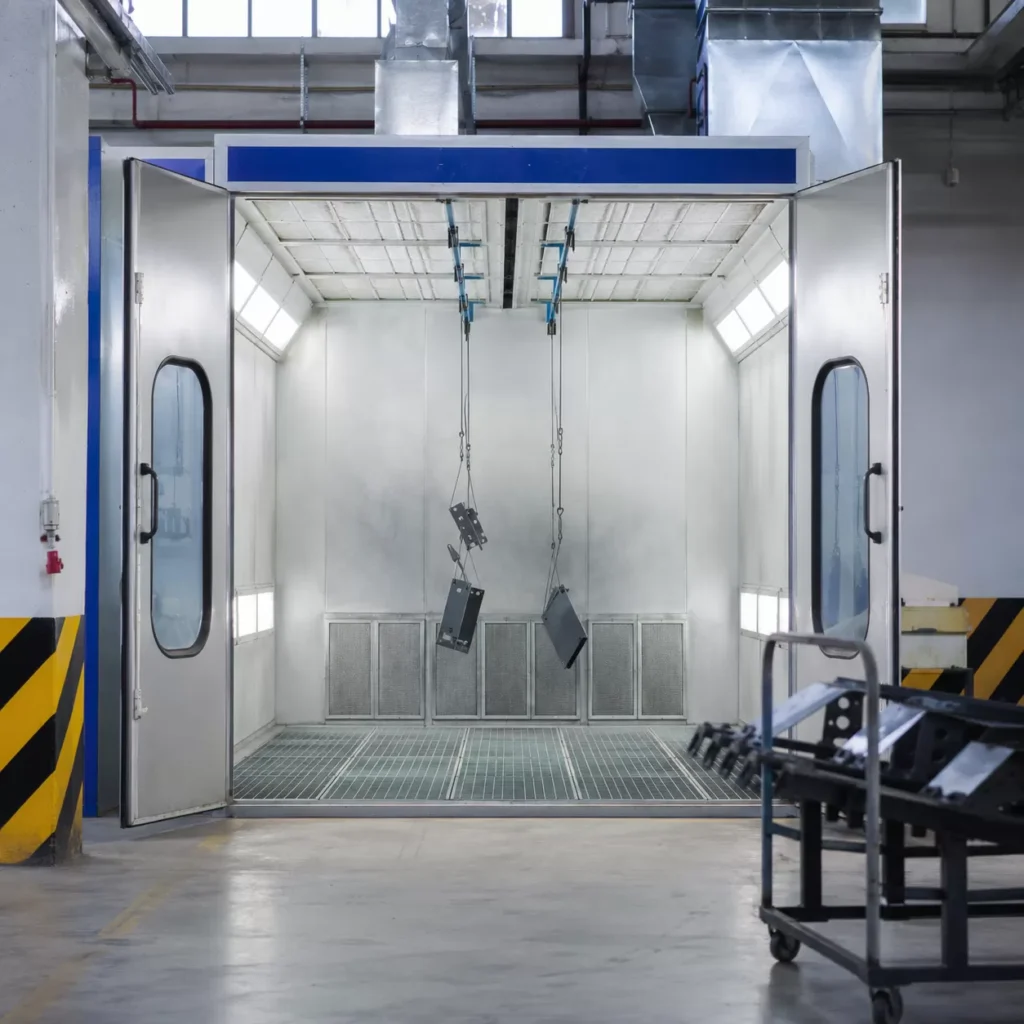
- Downdraft Airflow Pattern: The gold standard for metal finishing. Air comes from the ceiling and goes straight down into a floor pit, pulling overspray away from the part and the operator.
- Semi-Downdraft: Air enters through the ceiling and exits out the back wall, creating a diagonal flow perfect for shops without a pitted concrete floor.
- Crossflow: Air travels horizontally from the front doors directly to the exhaust chamber design at the back of the booth.
Premium Mechanical and Structural Components
Industrial environments demand rugged construction. Thin walls warp over time and leak air, ruining your pressure balance.
- Dual-Skin Insulated Panels: Built with heavy-gauge galvanized steel to contain heat during bake cycles and reduce shop noise.
- Heavy-Duty Doors: Tagged with airtight seals and structural steel frames to prevent dust infiltration.
- Air Makeup Unit (AMU): Delivers clean, temperature-controlled outdoor air to replace the exhausted air, which is critical for consistent paint leveling on cold metal.
Filtration and Pressure Monitoring Infrastructure
Consistent finishes require total control over air cleanliness and booth pressure.
| Feature | Function | Impact on Metal Finishing |
|---|---|---|
| High Overspray Filtration Efficiency | Captures maximum paint particulates before air exits. | Protects exhaust fans and complies with environmental laws. |
| Differential Pressure Manometer | Tracks resistance across the exhaust filters. | Alerts operators exactly when filters are loaded and need changing. |
| Dry Filter vs. Water Wash | Dry filters use fiberglass/paper media; water wash uses a water curtain. | Dry filters work best for standard shops; water wash handles high-volume continuous lines. |
Illumination and Vision Mechanics
You cannot spray what you cannot see. Proper lighting eliminates shadows on complex metal geometries and helps painters spot runs, sags, or thin areas immediately.
- Color-Corrected LED Lighting: Mimics natural sunlight so painters can accurately match colors and check film thickness.
- Explosion-Proof Fixtures: Class I, Division 2 rated housings that flush-mount into the panels to keep the interior sleek and easy to clean.
- Shadowless Placement: Side-wall and ceiling light placement ensures full visibility around bulky metal fabrications.
Industrial Paint Booth for Metal Parts: Key Features and Setup Tips for Compliance
When painting heavy-duty metal substrates, safety isn’t just about checking a box—it’s about protecting your crew, your shop, and your bottom line. Industrial finishing environments inherently involve atomized flammable materials, high-voltage equipment, and chemical exposure. Striking the right balance between high production output and strict regulatory compliance is non-negotiable.
Fire Prevention and Safety Codes
Fire prevention is the absolute baseline of a safe coating operation. When dealing with solvent-based coatings or fine powder overspray, the right containment and suppression systems keep minor sparks from becoming catastrophic events.
- NFPA 33 Compliance: Every industrial paint booth for metal parts must strictly adhere to NFPA 33 standards, which govern spraying operations using flammable and combustible materials.
- Interlocking Controls: The system must feature a pneumatic air solenoid valve that automatically shuts off compressed air to the spray guns if the exhaust fans fail or if a fire is detected.
- Fire Suppression Integration: Booths require dedicated dry chemical or water sprinkler fire suppression systems mapped specifically to the exhaust chamber design and working areas.
Electrical Hazard Mitigation
Metal parts and automated conveyor systems are prime targets for static buildup. Without proper electrical engineering, a tiny spark can ignite volatile organic compounds (VOCs) instantly.
| Hazard Risk | Mitigation Requirement | Industry Standard |
|---|---|---|
| Explosive Vapor Ignition | Explosion-proof, Class I, Division 1 electrical components inside the booth and exhaust path. | NEC Article 500 |
| Static Sparking | Dedicated static electricity grounding systems bonded directly to the metal parts and hangers. | NFPA 77 |
| Overspray Accumulation | Vapor-tight, color-corrected LED lighting fixtures sealed off from the spraying zone. | UL 844 |
Environmental and Workplace Safety Regulations
Local and federal agencies heavily monitor the air inside and outside your shop. Keeping your facility compliant requires high-efficiency filtration and precise air handling to meet strict OSHA ventilation standards and EPA mandates.
- Airflow and Capture Velocity: The ventilation system must maintain a constant, uniform airflow to pull toxic vapors away from the operator’s breathing zone.
- Three-Stage Filtration: High overspray filtration efficiency ensures particulate matter is trapped before air is exhausted outdoors, protecting local air quality.
- Real-Time Monitoring: A differential pressure manometer must be visible to the operator to track filter loading and ensure the booth stays within legal airflow limits.
Industrial Paint Booth for Metal Parts: Setup Tips and Installation Blueprint
Setting up an industrial paint booth for metal parts requires careful planning and precise execution. A successful installation ensures optimal performance, safety compliance, and high-quality finishes for heavy-duty metal substrates.
Pre-Installation Facility Assessment
Before unboxing any equipment, we must evaluate the shop floor to ensure the infrastructure can support a high-performance system.
- Clearance and Spatial Footprint: Measure total height and floor space, leaving at least 3 feet of clearance around the booth perimeter for maintenance and safety.
- Ventilation and Exhaust Routes: Verify that ductwork can run directly to the exterior without excessive bends, maintaining compliance with OSHA ventilation standards.
- Utility Requirements: Ensure the facility has adequate electrical capacity for the exhaust fans and the Air Makeup Unit (AMU), alongside a clean, dry compressed air supply.
Step-by-Step Structural and Mechanical Assembly
Building the booth structure correctly prevents air leaks and structural sagging over time.
| Assembly Stage | Key Focus Areas |
|---|---|
| 1. Floor Prep & Anchoring | Level the concrete floor and mark the blueprint lines. Anchor the base tracks securely to handle heavy metal parts. |
| 2. Panel Construction | Erect the dual-skin insulated panels, ensuring tight tongue-and-groove alignments to seal out dust. |
| 3. Plenum & Exhaust Setup | Install the intake plenum and the exhaust chamber design, securing all fan motors and budget-friendly dry filters. |
| 4. Electrical & Controls | Wire the color-corrected LED lighting and connect the differential pressure manometer to monitor overspray filtration efficiency. |
Integrating Auxiliary Processing Machinery
A complete industrial paint booth for metal parts relies on perfectly timed auxiliary systems to maximize throughput.
- Curing Oven Integration: Align the booth exit directly with the drying or curing oven path to minimize transport contamination.
- Pneumatic Air Solenoid Valve: Install this valve to automatically interlock the spray guns with the exhaust fan, cutting off air if ventilation drops.
- Static Electricity Grounding: Establish a dedicated grounding matrix. Heavy metal parts must be thoroughly grounded to eliminate static charges that repel liquid spray or powder particles.
Commissioning and Calibrating Your Industrial Paint Booth for Metal Parts
Before spraying the first piece of iron or steel, we put every new installation through a strict commissioning process. Proper calibration ensures your system balances air volume perfectly, keeping your finishing quality high and your shop safe.
System Balancing and Testing
We start by verifying that the intake and exhaust systems are perfectly synchronized. This step prevents overspray from escaping into your shop or settling back onto your freshly coated heavy-duty metal substrates.
- Magnehelic Gauge Calibration: We set the differential pressure manometer to zero with the fans off to establish an accurate baseline.
- Airflow Velocity Verification: Using an anemometer, we measure the downdraft airflow pattern at multiple points inside the cabin. We target a consistent 100 feet per minute (FPM) across the work zone.
- Static Pressure Optimization: We adjust the exhaust fan dampers until the booth maintains a slight negative pressure, ensuring total containment.
- Safety Interlock Checks: We test the pneumatic air solenoid valve to ensure it instantly cuts off compressed air to the spray guns if the exhaust fans fail or if the system detects a high-limit temperature spike.
Standard Operating Procedures (SOPs) and Maintenance
A high-performance industrial paint booth for metal parts requires disciplined daily habits and strict preventative maintenance to maintain peak overspray filtration efficiency and extend equipment life.
Filter Management and Replacement Schedules
| Filter Type | Primary Function | Replacement Indicator | Average Lifespan |
|---|---|---|---|
| Prefilters / Intake | Traps ambient shop dust before it hits the metal parts | Visual discoloration or pressure drop | 2 to 4 Weeks |
| Exhaust Filters (Dry Filter) | Captures liquid paint overspray or powder coating particles | Differential pressure reads 0.5″ WC or higher | 50 to 80 Spray Hours |
| AMU / Recirculation | Protects the Air Makeup Unit components | Scheduled annual inspection | 1 Year |
Preventative Maintenance and Longevity Practices
- Daily Grounding Audits: We inspect all static electricity grounding clamps and cables. Any buildup of cured paint or powder coating on the hangers is scraped clean to maintain a direct path to the earth ground, preventing dangerous sparks.
- Wall and Glass Maintenance: Apply a strippable booth coating to the dual-skin insulated panels and color-corrected LED lighting fixtures. This allows technicians to peel away accumulated overspray in minutes, keeping the workspace bright and clean.
- AMU and Burner Tuning: Test the Air Makeup Unit before seasonal weather shifts. Clean burners and properly calibrated air-to-gas ratios ensure stable temperatures during both the spray cycle and the bake cycle when utilizing a curing oven integration.
FAQs: Industrial Paint Booth for Metal Parts Setup and Operations
What is the ideal airflow pattern for heavy metal parts?
A downdraft airflow pattern is the gold standard for painting heavy-duty metal substrates. Because large iron or steel components have significant surface areas, managing overspray is a constant challenge.
A downdraft system pulls air from the ceiling straight down to the floor pits, drawing paint mist away from the part and the operator instantly. This minimizes the risk of overspray settling back onto the freshly coated metal, ensuring a flawless finish. If a full floor pit setup isn’t structurally feasible for your facility, a semi-downdraft configuration is the next best alternative.
How often should we check the static grounding system?
You should test your static electricity grounding system daily before every shift, with a comprehensive inspection performed monthly.
When spraying liquid coatings onto heavy metal parts, static buildup is an invisible fire hazard. If your hooks, racks, or the booth structure lose their ground connection, a single spark can ignite volatile organic compounds (VOCs).
- Daily Check: Use a megohmmeter to verify that resistance to earth ground is less than 1 megohm.
- Maintenance Tip: Regularly burn off or chemically strip paint buildup from racks and hooks, as cured paint acts as an insulator and breaks your ground path.
Can I use the same booth for both liquid spray and powder coating?
While technically possible with a hybrid design, using a standard liquid spray booth for an industrial powder coating booth application is highly inefficient and rarely recommended for high-volume shops.
Liquid and powder systems have fundamentally different mechanical requirements:
| Feature | Liquid Spray Booth | Powder Coating Booth |
|---|---|---|
| Airflow Speed | Higher velocity to clear solvent vapors and meet OSHA ventilation standards. | Lower velocity to prevent blowing powder off the part before it is cured. |
| Filtration | Uses a dry filter vs. water wash system to catch sticky overspray. | Uses advanced cartridge filters or cyclones designed for powder recovery and reclamation. |
| Safety Devices | Uses a pneumatic air solenoid valve to shut off compressed air if ventilation fails. | Requires specialized explosion venting and distinct safety interlocks for dry dust hazards. |
If you must run both, you will need a specialized multi-stage filtration system, dual-speed fan controls, and a dedicated strategy to handle the clean-up required to prevent cross-contamination.
Related Pages
- Bus Spray Booth Design Guide → https://sprayboothmanufacturer.com/transit-coach-spray-booth-requirements/
- Truck Paint Booth Guide → https://sprayboothmanufacturer.com/truck-paint-booth-semi-truck-spray-booth-specifications-buying-guide/
- Other related products → https://www.autokemanufacture.com/product
- Contact our sales Team → https://sprayboothmanufacturer.com/contact-us/
✅ CE Certified | ✅ ISO 9001:2015 | ✅ Factory Direct | ✅ Ships to 60+ Countries | ✅ 1-Year Warranty | 🔒 HTTPS Secured