Upgrading to a downdraft paint booth is the single biggest step you can take to eliminate contamination and scale your shop’s production. But if you are like most first-time buyers, diving into this market feels like stepping into a minefield of hidden variables.
You are probably looking at a massive spread of equipment prices while trying to figure out if you need to tear up your shop floor for a concrete pit excavation, or if you can get away with a pitless raised basement. On top of that, you have to worry about sizing your three-phase electrical load, engineering a massive spray booth ventilation system, and getting local fire marshals to sign off on your NFPA 33 compliance.
The sticker shock is real—and the cost of the booth itself is usually only half the battle.
Make a mistake on your Air Makeup Unit (AMU) sizing or pull the wrong industrial spray booth permits, and you are stuck with an expensive, non-functional metal box sitting in your shop.
This guide is here to prevent that. We are going to break down the exact physics behind downdraft airflow mechanics, map out the infrastructure requirements you need to prepare for, and give you a clear framework to calculate your exact paint booth return on investment.
At AUTOKE, we engineer and manufacture high-performance finishing environments every day. We know exactly where first-time buyers get tripped up by bureaucratic red tape and architectural oversight.
Let’s dive right into what you actually need to know to get this right the first time.
Page URL: https://sprayboothmanufacturer.com/product/
Downdraft Paint Booth Buying Guide for First-Time Buyers
If you want a flawless, mirror-like finish, you need to master your shop’s environment. For high-volume auto body shops and industrial finishers, choosing the right setup is the ultimate game-changer. This guide breaks down the core mechanics so you can make an informed investment.
Understanding Downdraft Airflow Mechanics
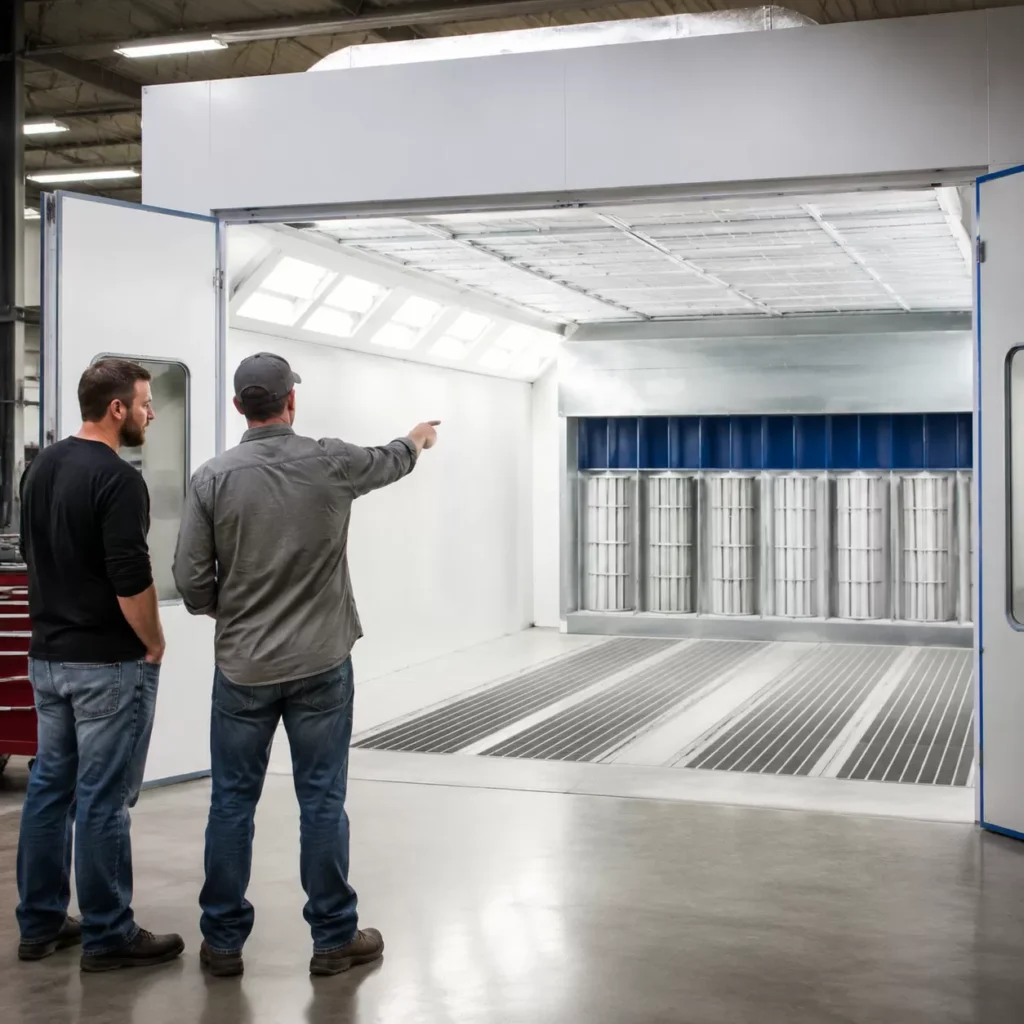
Downdraft airflow mechanics dominate the high-volume finishing industry for one simple reason: gravity-assisted contamination control. In a true downdraft setup, air enters through the ceiling filters and moves straight down to the floor. This vertical draft pulls overspray, dust, and hazardous fumes out of the painter’s line of sight and directly into the exhaust filtration system below.
- Zero Overspray Settling: Drafts pull particulates downward instantly.
- Superior Finish Quality: Dust cannot float horizontally across freshly painted panels.
- Operator Safety: Harmful overspray is pulled away from the painter’s breathing zone.
Comparing Airflow Patterns
Choosing the right spray booth ventilation system depends on your budget, shop layout, and production goals. Here is how the three main airflow patterns stack up:
| Airflow Type | Movement Direction | Pros | Cons |
|---|---|---|---|
| Crossflow | Front to back (Horizontal) | Lowest upfront cost; no pit needed. | High risk of overspray landing on adjacent panels. |
| Semi-Downdraft | Top to back (Diagonal) | Affordable; good for tight shop spaces. | Creates dead zones; inconsistent airflow at the rear. |
| True Downdraft | Top to bottom (Vertical) | Maximum overspray containment; cleanest finishes. | Requires concrete pit excavation or raised basement. |
While crossflow and semi-downdraft setups have lower entry costs, a true downdraft system yields the highest paint booth return on investment by eliminating time-consuming color sanding and buffing.
The Architectural Choice: Concrete Pit Excavation vs. Pitless Raised Basement
When buying a downdraft paint booth buying guide for first-time buyers, your biggest immediate decision isn’t the control panel or the burner—it’s your shop floor. True downdraft airflow requires an exit strategy for the air moving straight down. You have two distinct structural paths to achieve this.
Option A: Traditional Concrete Pit Excavation
A traditional concrete pit excavation involves cutting into your existing shop floor to create an underground trench system covered by heavy-duty floor grates.
- How it Works: The exhaust fan pulls air down through the floor grates into the concrete pit, directing it out through exhaust ductwork engineering.
- The Big Benefits: You get a perfectly flush threshold. Vehicles roll straight into the booth at ground level without any incline, minimizing the risk of scraping low-profile bumper covers or rocking freshly prepped cars. It also saves precious overhead clearance in shops with standard ceiling heights.
- The Catch: Ground prep is expensive and permanent. If you lease your facility, your landlord likely won’t allow a concrete pit excavation. Furthermore, high water tables or thick, reinforced rebar foundations can quickly drive up initial masonry costs.
Option B: Pitless Raised Basement with Drive-Up Ramps
If digging into your shop floor is out of the question, a pitless raised basement is the industry standard alternative.
- How it Works: We build the entire spray booth on a raised steel basement platform, typically elevated 8 to 12 inches off the ground. The exhaust filtration and plenum chambers are housed completely inside this raised basement structure.
- The Big Benefits: Zero concrete demolition required. This setup is highly portable, meaning you can disassemble the booth and take your asset with you if your auto body shop layout changes or you move to a new location down the road.
- The Catch: You must budget for the physical footprint of the external drive-up ramps, which extend your total required shop length. Technicians will also be stepping up and down all day, and moving dead vehicles into the booth requires a bit more muscle or an electric winch setup.
Structural Comparison: Pit vs. Raised Basement
| Evaluation Factor | Concrete Pit Excavation | Pitless Raised Basement |
|---|---|---|
| Upfront Construction Cost | High (Requires masonry & permits) | Low to Moderate (Bolts together) |
| Shop Portability | Permanent asset modification | 100% Relocatable |
| Vehicle Loading Access | Flush entry (Seamless workflow) | Requires drive-up ramps |
| Ceiling Height Needed | Standard clearance | Requires extra 12″ of overhead space |
| Overspray Containment | Excellent floor-level draft | Excellent floor-level draft |
Sizing Your Booth: Interior Working Dimensions vs. External Footprint
Choosing the right size for your Downdraft Paint Booth isn’t just about what fits inside; it’s about how the unit integrates into your shop’s footprint. First-time buyers often confuse internal working dimensions with the total external space required. The interior must accommodate your largest vehicle or part with ample room for the painter to maneuver, while the exterior must account for the plenum, exhaust towers, and mechanical components.
Calculating the Golden Clearance Formula
To ensure proper overspray containment and painter safety, you need a precise CFM airflow calculation based on the cabin’s volume. Never skimp on the workspace clearances.
- Width: Take the widest vehicle you plan to spray, open the doors, and add at least 3 feet of clearance on each side.
- Height: Measure the tallest vehicle (like a high-roof transit van) and add a minimum of 2 feet of overhead clearance.
- Length: Add at least 3 feet of space to both the front and rear bumpers to allow proper air movement and comfortable walking room.
External Shop Space and Clearances
Your auto body shop layout must accommodate more than just the cabin shell. Local building codes and NFPA 33 compliance standards require specific operational clearances around the exterior walls and ceiling.
| Component | Required Clearance | Purpose |
|---|---|---|
| Side & Rear Walls | 3 Feet (Minimum) | Maintenance access and code compliance |
| Ceiling/Roof | 3 Feet to 5 Feet | Intake plenum and ductwork routing |
| Mechanical Side | 4 Feet to 6 Feet | Air Makeup Unit (AMU) and control panel access |
Before finalizing your Downdraft Paint Booth Buying Guide for First-Time Buyers checklist, physically tape off the external footprint on your shop floor. Factor in the vehicle turning radius, staging areas, and proximity to your prep stations to guarantee a smooth, efficient workflow.
Thermal Systems & Curing: Do You Need an Air Makeup Unit (AMU)?
When investing in a downdraft paint booth buying guide for first-time buyers, deciding on a thermal system is your biggest cost driver. A standard unheated booth pulls ambient air from your shop. However, a true downdraft system moves so much air that it will quickly drain your shop’s climate-controlled air, forcing your building’s HVAC system to work overtime. If you want pristine finishes and fast cycle times, adding a dedicated heating system is a necessity.
The Critical Role of a Direct-Fired Air Makeup Unit (AMU)
A direct-fired air makeup unit (AMU) is the engine that keeps your spray booth ventilation system balanced. Instead of pulling seasoned air from your shop, an AMU draws raw outdoor air, heats it directly via a gas burner, and forces it into the booth at a controlled temperature.
This process creates critical operational advantages for US shops:
- Maintains Proper CFM Airflow Calculation: It replaces the exact volume of air being exhausted, preventing dangerous negative pressure zones in your shop.
- Eliminates Contamination: Balanced positive pressure keeps dust, dirt, and shop grime from being sucked under the booth doors and onto your wet paint.
- Consistent Year-Round Environment: Whether it is a freezing Midwest winter or a humid southern summer, the AMU ensures a steady 70°F spraying environment.
Accelerating Output with a Paint Curing Bake Cycle
If your shop handles high-volume work, relying on air-drying will create a massive bottleneck in your auto body shop layout. Upgrading to an AMU with a paint curing bake cycle changes the financial math of your business, drastically increasing your paint booth return on investment.
| Operating Mode | Average Temperature | Purpose & Function |
|---|---|---|
| Spray Mode | 70°F – 75°F | Provides comfortable, safe operator conditions and optimal atomization. |
| Bake Mode | 140°F – 160°F | Bakes the coating, forcing solvents out and curing the paint in 20-30 minutes. |
By switching from spray mode to a heated bake cycle, you cut vehicle drying times from several hours down to under a half-hour. This rapid overspray containment and curing capability allows you to bake multiple vehicles per day, moving cars through your shop faster and maximizing your daily revenue.
The Infrastructure Checklist: Prep Work for Your Downdraft Paint Booth
Buying a downdraft paint booth is a massive milestone for your shop, but the real work starts before the delivery truck arrives. Getting your shop’s infrastructure ready ensures a smooth setup and avoids costly delays.
Power Supply Requirements
A high-performance spray booth ventilation system demands serious power. Most commercial downdraft setups, especially those with heated bake cycles, run on a three-phase electrical load ($208text{V}$, $230text{V}$, or $460text{V}$).
If your shop only has single-phase power, you will need a phase converter or an upgrade from your local utility provider.
| Component | Standard Power Requirement | Notes |
|---|---|---|
| Exhaust & Intake Fans | 3-Phase (usually 5 to 15 HP motors) | Requires dedicated breakers |
| Lighting Fixtures | Single-Phase (120V) | Class I, Division 1 explosion-proof |
| Control Panel | Single or 3-Phase | Must be located outside the spray zone |
Fuel Lines and Exhaust Ductwork Engineering
If you are installing an Air Makeup Unit (AMU) for heated curing, your gas plumbing and ductwork must be spot on.
- Gas Pressure: Direct-fired burners need consistent natural gas or propane pressure. You often need a dedicated high-pressure regulator installed by your gas company.
- Ductwork Runs: Exhaust ducts must go straight up through the roof. Minimize bends to maintain your CFM airflow calculation profiles.
- Roof Penetrations: You will need a professional roofer to install the roof curbs and flashings to prevent leaks and handle the weight of the exhaust stack.
Delivery Logistics: Offloading and Rigging
A downdraft paint booth buying guide for first-time buyers isn’t complete without talking about the day the equipment actually arrives. Heavy sheet metal, massive fans, and AMU burners arrive on flatbeds, and it is your responsibility to get them off the truck.
Pro Tip: Do not rely on a standard pallet jack. You need the right rigging gear ready to go the minute the carrier arrives.
- Forklift Capacity: Ensure you have a forklift rated for at least 5,000 to 8,000 lbs. with extended forks.
- Clear the Floor: Map out your auto body shop layout ahead of time and clear a staging area near the installation site.
- Inspect Immediately: Check all crates for shipping damage before signing the bill of lading so you aren’t stuck with the bill for bent panels.
Navigating Regulatory Compliance and Local Permits
Getting your shop up and running means clearing some major legal hurdles. If you operate a high-volume auto body shop or industrial finishing facility in the United States, you cannot overlook local permits. Buying a downdraft paint booth is only half the battle; ensuring the system complies with federal, state, and local zoning laws is what keeps your doors open.
National Fire Protection Association Standards (NFPA 33)
When it comes to fire safety, NFPA 33 compliance is the gold standard that local fire marshals enforce strictly. Because a spray booth ventilation system handles highly flammable atomized coatings, your setup must minimize fire risks.
- Clearance Requirements: You must maintain a clear space of at least 3 feet from the booth structures to any combustible construction or mechanical equipment.
- Automatic Interlocks: Your downdraft airflow mechanics must link directly to your spraying equipment. If the exhaust fans shut off, the compressed air line to your spray guns must automatically cut out.
- Fire Suppression System Installation: Most local jurisdictions require an integrated dry chemical or wet pipe sprinkler system inside the booth and exhaust plenums before granting an operational permit.
Environmental Protection Agency (EPA 6H) & National Codes
On the environmental front, the EPA regulates hazardous air pollutants (HAPs) through the NESHAP 6H national code. Staying compliant protects your business from crippling federal fines.
| Regulatory Body | Key Requirement | Impact on Your Shop |
|---|---|---|
| EPA Rule 6H | 98% filter efficiency | Requires certified intake and exhaust filtration targeting target HAPs like chromium, lead, and nickel. |
| OSHA | 100 FPM minimum airflow | Dictates continuous CFM airflow calculation monitoring to keep painters safe from toxic fumes. |
| UL / ETL Listing | Component certification | Ensures all electrical panels and controls handle the three-phase electrical load safely in hazardous areas. |
Before finalizing your purchase, always submit the manufacturer’s engineering packets to your local building department to secure your industrial spray booth permits early.
Downdraft Paint Booth Buying Guide for First-Time Buyers: Operational Costs, Maintenance, and Energy Savings
Running a high-efficiency shop means keeping a close eye on your ongoing operational costs. A downdraft paint booth is a major asset, but its long-term return on investment depends heavily on how you manage maintenance, filtration, and power consumption.
Managing the Intake and Exhaust Filtration Cycle
To keep your spray booth ventilation system running at peak performance, you must establish a strict schedule for intake and exhaust filtration changes. Clogged filters restrict CFM airflow calculation metrics, strain your fans, drag down energy efficiency, and compromise overspray containment.
- Exhaust Filters (Pad/Roll Media): Replace every 40 to 60 working hours (or when the draft gauge indicates a pressure drop). Packed filters cause overspray to drift, ruining paint jobs.
- Intake/Ceiling Diffusion Media: Replace every 6 to 12 months depending on shop volume. These filters ensure the downward air remains perfectly clean and free of dust.
- Prefilters: Replace every 3 to 4 weeks to protect the main technical components and extend the lifespan of more expensive ceiling media.
| Filter Type | Typical Lifespan | Impact of Neglect |
|---|---|---|
| Exhaust Filters | 40–60 Hours | Poor overspray containment, fan strain |
| Intake Filters | 6–12 Months | Dust inclusion, disrupted downdraft airflow mechanics |
| Prefilters | 3–4 Weeks | Premature failure of main ceiling media |
Energy Efficiency Innovations
Heating and moving massive amounts of air is the biggest daily expense for any shop layout. Modern industrial spray booth designs use smart technology to cut these utility bills without sacrificing the quality of your finish.
- Variable Frequency Drives (VFDs): VFDs automatically adjust fan motor speeds to maintain balance. Instead of running at 100% capacity all day, they scale down during prep or flash-off periods, saving up to 30% to 40% in electricity costs.
- Economy Mode Switching: When the spray gun stops atomizing paint, the system automatically idles the Air Makeup Unit (AMU). This reduces fuel and electrical loads instantly.
- Recirculation During the Paint Curing Bake Cycle: During the bake cycle, the booth recirculates up to 80% of the heated air. This drastically reduces the gas needed to keep the cabin at curing temperatures, lowering fuel costs per cycle.
Frequently Asked Questions: Downdraft Paint Booth Buying Guide for First-Time Buyers
How much does a concrete pit excavation typically cost?
A standard concrete pit excavation for a automotive spray booth generally runs between $5,000 and $15,000. Your final price tag depends heavily on your shop’s location, soil conditions, concrete thickness, and whether you hit rebar or utility lines. While it requires a higher upfront investment, a pit gives you a seamless, flush-to-the-floor auto body shop layout.
Can I run a heated downdraft booth on single-phase power?
No, running a high-volume heated downdraft booth on single-phase power is highly impractical. The motors required to move massive amounts of air, combined with a direct-fired Air Makeup Unit (AMU), demand a heavy three-phase electrical load (typically 208V, 230V, or 460V). If your shop only has single-phase power, you will need to factor in the cost of a phase converter or a utility upgrade.
What happens if my spray booth ventilation system fails an EPA 6H test?
If your spray booth ventilation system fails an EPA 6H compliance test, you must halt target coating operations immediately to avoid heavy fines.
- The Fix: Check for gaps in your exhaust filters, verify your manometer readings, and ensure your painters are certified.
- The Goal: You must fix the leaks or filtration issues and re-test to maintain NFPA 33 compliance and local environmental permits.
How often do I realistically need to swap out my ceiling diffusion media?
| Filter Type | Replacement Frequency | Impact on Performance |
|---|---|---|
| Intake / Ceiling Diffusion Media | 6 to 12 months (or every 200–300 bake cycles) | Prevents dirt from ruining fresh paint jobs. |
| Exhaust Filters (Floor Mats) | 2 to 4 weeks (or every 40–60 hours of spraying) | Maintains proper CFM airflow calculation and overspray containment. |
Related Pages
- Bus Spray Booth Design Guide → https://sprayboothmanufacturer.com/transit-coach-spray-booth-requirements/
- Truck Paint Booth Guide → https://sprayboothmanufacturer.com/truck-paint-booth-semi-truck-spray-booth-specifications-buying-guide/
- Other related products → https://www.autokemanufacture.com/product
- Contact our sales Team → https://sprayboothmanufacturer.com/contact-us/
✅ CE Certified | ✅ ISO 9001:2015 | ✅ Factory Direct | ✅ Ships to 60+ Countries | ✅ 1-Year Warranty | 🔒 HTTPS Secured