
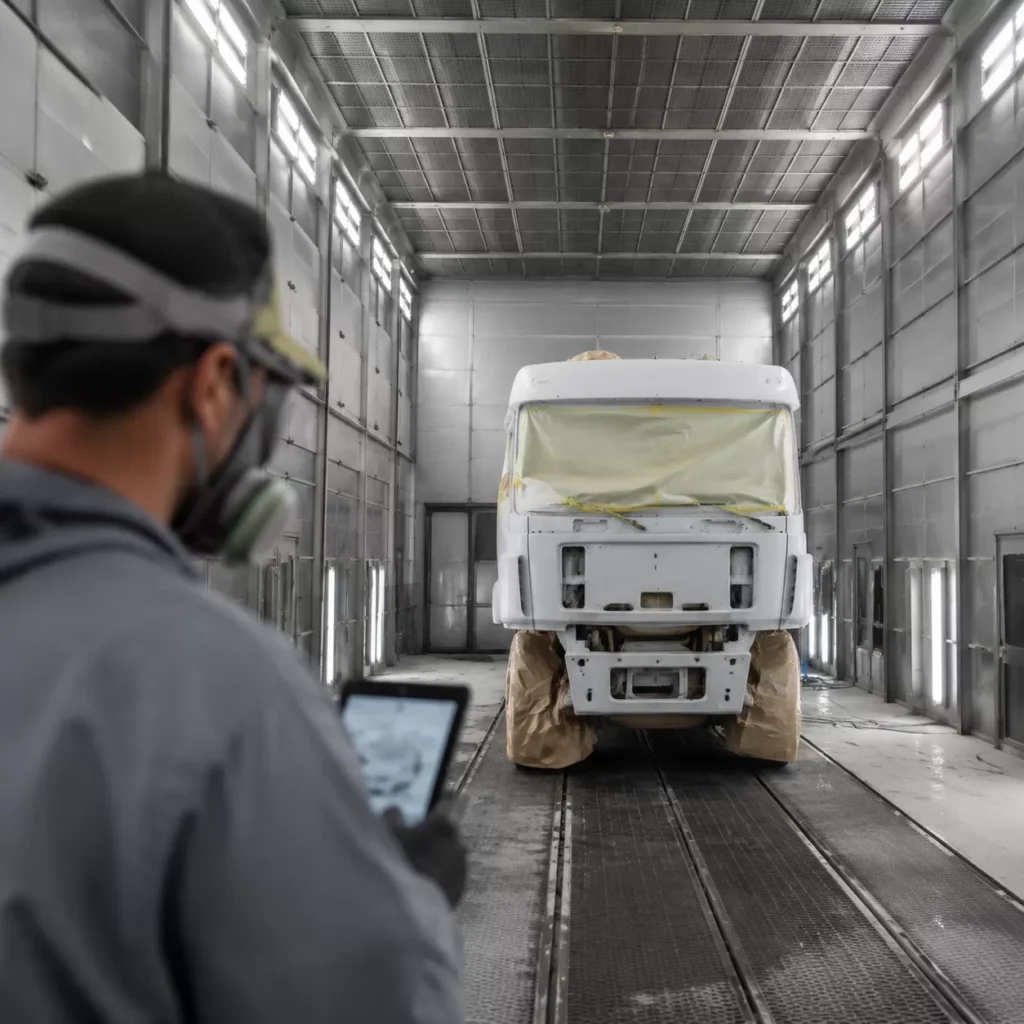
Heavy-Duty Paint Booth Curing Dynamics
Getting a flawless finish on a commercial truck isn’t just about spraying straight; it’s about mastering the science of the bake cycle. When you are managing a heavy-duty paint booth, understanding the physical and chemical shifts happening inside that cabin determines whether a fleet vehicle rolls out with a showroom shine or a ruined, peeling finish.
Page URL: https://sprayboothmanufacturer.com/product/
Chemical Milestones: Evaporation vs. Crosslinking
A successful cure requires two distinct chemical phases to happen in the exact right order.
- Phase 1: Evaporation: The carrier solvents or water must completely exit the paint film. If you ramp up the heat too fast before these liquids escape, you trap them underneath the surface, leading to solvent popping and pinning.
- Phase 2: Crosslinking: Once the solvents are gone, the actual crosslinking temperature must be hit. This is where the molecular chains in a 2K acrylic urethane cure bind together, transforming liquid paint into a durable, chemical-resistant armor.
The Exponential Rule of Thumb
In heavy vehicle refinishing, chemical reaction speeds are tied directly to temperature. For every $10^circtext{C}$ ($18^circtext{F}$) increase in the metal surface temperature, the chemical crosslinking reaction rate roughly doubles.
| Metal Temp | Reaction Rate | Impact on Cure Time |
|---|---|---|
| Below $60^circtext{F}$ | Dormant / Stalled | Cure stops; high risk of runs and moisture traps |
| $70^circtext{F}$–$130^circtext{F}$ | Linear / Slow | Standard flash-off window; slow molecular bonding |
| $140^circtext{F}$–$160^circtext{F}$ | Exponential / Target | Optimal bake cycle optimization range for commercial fleets |
Waterborne vs. Solvent Coatings in Heavy Industry
The coatings you spray dictate how you control your booth’s environment. Heavy industry relies on two distinct chemistries, each requiring a specific climate strategy:
- Waterborne Coatings: These require aggressive air movement to drop humidity levels and accelerate waterborne flash-off time. Without proper downdraft airflow dynamics, water stays trapped in the film, stalling the cure and causing film tracking.
- Solvent-Based Coatings: These are highly sensitive to rapid temperature spikes. They require a gradual, metered temperature ramp-up to ensure steady solvent release, which is the ultimate form of solvent popping prevention.
The Spray-to-Bake Transition Mechanics in a Heavy-Duty Paint Booth
Flipping a heavy-duty paint booth from spray mode to bake mode isn’t as simple as hitting a switch. For large vehicles, this transition dictates the final appearance and durability of the coating. If you rush it, you trap solvents. If you drag it out, you waste fuel and kill your shop’s cycle time. Managing this phase correctly keeps production moving and ensures a flawless finish.
Step 1: The Purge Phase (Flash-Off Window)
Before the temperature climbs, the booth must run through a dedicated purge and waterborne flash-off time. This window allows volatile organic compounds (VOCs) and water to evaporate naturally from the wet film.
- Solvent Popping Prevention: Skipping or shortening this step traps escaping solvents beneath a skimmed-over paint surface, leading to pinholes and blistering.
- Downdraft Airflow Dynamics: High-velocity, clean air must sweep over the vehicle to pull heavy solvent vapors down and out of the cabin.
- The Golden Rule: Never initiate heat until the paint film transitions from a wet sheen to a uniform matte finish.
Step 2: Air Makeup Unit (AMU) Reconfiguration
Once flashing is complete, the Air Makeup Unit (AMU) shifts gears to heat the cabin efficiently.
[Spray Mode: 100% Fresh Air] ──> [Transition: Damper Adjustment] ──> [Bake Mode: Recirculation Mix]
- Recirculation Mode Efficiency: The system adjusts internal dampers to switch from 100% fresh, exhausted air to a heavy recirculation mix (typically 80% recirculated, 20% fresh). This retains the heat already generated, slashing utility costs.
- Variable Frequency Drives (VFD): The system utilizes Variable Frequency Drives (VFD) to back off on fan speeds slightly during the bake cycle, maintaining positive pressure while reducing electrical draw.
Step 3: Achieving the Target Bake Window
The final step is ramping up to the correct crosslinking temperature specified by your coatings manufacturer. For a standard 2K acrylic urethane cure, the air temperature inside the booth must rise rapidly to force the chemistry to bond.
| Phase Element | Target Parameter | Key Focus |
|---|---|---|
| Air Temperature Ramp | $140^circtext{F}$ to $160^circtext{F}$ | Rapid, controlled heat injection via AMU |
| Timing Accuracy | Dependent on Technical Data Sheet (TDS) parameters | Start the bake timer only when the metal hits the target temperature |
| Airflow Balance | Balanced positive pressure | Prevents outside shop dust from entering through door seals |
Achieving bake cycle optimization means managing this three-step dance perfectly on every cycle, ensuring heavy equipment leaves the booth with a factory-quality, durable shield.
Overcoming the Thermal Mass Challenge in Truck Paint Booth Temperature Control
When you are spraying a massive commercial rig, the biggest hurdle isn’t the air temperature—it’s the sheer volume of steel. Heavy vehicles act as giant heat sinks. If your heavy-duty paint booth environment isn’t dialed in to account for this physical reality, your finish will suffer.
Air Temperature vs. Metal Surface Temperature
The biggest mistake we see in bake cycle optimization is trusting the booth’s air temperature sensor over the actual vehicle surface.
- The Delta: Your Air Makeup Unit (AMU) might report a perfect $140^circtext{F}$ ($60^circtext{C}$), but the thick steel frame rails of a semi-truck might still be sitting at $90^circtext{F}$ ($32^circtext{C}$).
- The Cure Risk: If the metal doesn’t reach the specified crosslinking temperature, the paint film won’t cure correctly from the inside out, leading to premature coating failure.
- The Fix: We track the actual metal surface temperature using infrared thermometers or probe sensors to ensure the thermal mass heating phase is actually complete before starting the clock on the bake cycle.
The Multi-Zone Heat Dilemma
Heavy vehicles are not uniform shapes. A single truck features thin fiberglass hoods alongside dense, heavy structural steel chassis components.
| Vehicle Component | Thermal Mass Level | Heating Characteristics |
|---|---|---|
| Fiberglass Hood / Fairings | Low | Heats up rapidly; high risk of solvent popping if blasted with direct heat too fast. |
| Thick Structural Steel Frame | Extremely High | Absorbs massive amounts of energy; requires sustained, targeted heat to reach cure temp. |
| Aluminum Cab Panels | Medium | Moderate heat absorption; requires balanced airflow to avoid uneven expansion. |
Standard single-zone booths end up cooking the top of the cab while leaving the lower frame rail coatings completely under-cured. Managing this requires multi-zone temperature monitoring to direct heat exactly where the thermal mass demands it most.
Stratification Control with Advanced Airflow
Because hot air naturally rises, large commercial booths suffer from severe temperature stratification. Without proper intervention, the air near the booth ceiling can be scorching while the floor remains cold.
To combat this, our systems utilize advanced downdraft airflow dynamics coupled with Variable Frequency Drives (VFD). By shifting the system into an automated recirculation mode efficiency loop, we force the hot air back down across the lowest parts of the vehicle frame. This constant, high-velocity air movement breaks up the heat layers, eliminates cold spots, and delivers an even paint film thickness profile cure from the top roof fairing down to the bottom axle.
The High-Voltage Fleet Variable: Electric Truck Curing Safely
Managing a heavy-duty paint booth means adapting to the changing vehicles on the road. With electric commercial vehicles joining fleets across the United States, managing your truck paint booth temperature control requires a strict focus on battery safety. EV battery packs change the rules for baking finishes, demanding precise control to prevent thermal events.
EV Battery Thermal Limits in the Booth
Lithium-ion battery packs are highly sensitive to extreme heat. While a standard diesel chassis can handle high baking temperatures without issue, an electric truck requires strict limits to protect battery chemistry.
- Maximum Core Temperature: Most commercial EV batteries should not exceed 140°F (60°C).
- The Risk: Exceeding these limits can cause irreversible cell degradation or trigger thermal runaway.
- The Solution: You must monitor the actual battery housing temperature, not just the cabin or ambient air, during the entire bake cycle optimization process.
Quick Reference Framework
Baking electric trucks safely requires balancing the crosslinking temperature of your coatings with the thermal safety limits of the vehicle’s high-voltage system.
| Coating Component | Ideal Bake Temp | Max Safe Duration | Monitoring Focus |
|---|---|---|---|
| 2K acrylic urethane cure | 130°F – 140°F | 40 Minutes | Battery Pack Skin Temp |
| Waterborne flash-off time | 80°F – 90°F | 15 Minutes | Downdraft airflow dynamics |
State of Charge (SOC) Protocols
Before an electric truck ever enters our spray booth, the battery state of charge must be managed. High energy levels in the battery increase volatility under heat.
- Target SOC: Bring the vehicle into the booth with a low State of Charge—ideally between 20% and 30%.
- Never Bake a Fully Charged EV: A battery at 80% or 100% SOC has significantly less thermal headroom and faces a higher risk of overheating.
- Cool Down Integration: Use Variable Frequency Drives (VFD) to transition immediately from the bake cycle into a high-volume ambient air flush, dropping the skin temperature of the vehicle rapidly.
Troubleshooting & Diagnostic Protocols for Temperature Imbalances
When managing a heavy-duty paint booth, time is money. Temperature imbalances can ruin a finish and stall your entire operation. To protect your bottom line, you must systematically diagnose and fix heating issues before they lead to costly reworks.
Root Cause Analysis for Slow Ramp-Up Times (Exceeding 25 Minutes)
If your booth takes longer than 25 minutes to hit its target crosslinking temperature, your throughput plummets. Slow ramp-up times usually point to a few specific mechanical failures in your Air Makeup Unit (AMU):
- Slipping Blower Belts: Worn or loose belts reduce airflow volume, dragging out the time it takes to heat the cabin.
- Burner Misalignment or Clogging: Poor gas pressure or clogged burner jets prevent the system from firing at maximum capacity.
- Malfunctioning Recirculation Dampers: If the dampers fail to switch into recirculation mode efficiency, the system wastes energy constantly heating cold intake air instead of reusing the warm air.
- VFD Setting Mishaps: Incorrectly calibrated Variable Frequency Drives (VFD) can choke down fan speeds too much during the heating phase, stalling heat distribution.
Detecting Hidden Thermal Gaps
Heavy vehicles have complex geometries. A thick steel frame absorbs heat differently than thin body panels, creating hidden thermal gaps. If your paint film thickness profile varies across the vehicle, uneven heating will cause localized curing failures.
| Diagnostic Tool | What It Detects | Action Item |
|---|---|---|
| Infrared Laser Thermometers | Immediate surface temperature spikes | Scan heavy structural frames vs. thin panels |
| Data-Logging Thermocouples | Real-time multi-zone temperature monitoring | Attach probes directly to the lowest vehicle chassis points |
| Anemometers | Disruptions in downdraft airflow dynamics | Check for dead zones around oversized trailers |
To prevent issues like solvent popping prevention failure or wrinkling, you must bridge these gaps. Ensure your air streams are hitting the vehicle evenly, adjusting your booth’s directional baffles to eliminate cold pockets in the lower third of the cabin.
The Crucial Cool-Down Phase
Getting the vehicle hot is only half the battle; how you bring the temperature back down matters just as much. Rushing the cool-down phase can cause thermal shock, leading to cracking or loss of gloss in a fresh 2K acrylic urethane cure.
The booth must utilize controlled, gradual airflow reduction to bring the metal surface temperature down safely. A stable, automated cool-down cycle ensures the paint film solidifies perfectly, locking in the gloss and durability your customers expect.
Maxing Out Commercial Throughput: Truck Paint Booth Temperature Control Best Practices
Running a high-volume shop means you cannot afford bottlenecked bays. To get heavy vehicles through the bake cycle efficiently without sacrificing the finish, we engineered our AUTOKE systems to automate precision temperature tracking. Maximizing your commercial throughput comes down to three non-negotiable operational practices.
The Technical Data Sheet (TDS) Mandate
Every coating system relies on exact chemistry. Guessing the bake time or air temperature creates immediate rework. For proper 2K acrylic urethane cure performance, your crew must program the heavy-duty paint booth strictly by the coating’s Technical Data Sheet (TDS).
- Bake Target: Program the exact crosslinking temperature specified for the metal surface, not just the air temperature.
- Time Tracking: Start the countdown timer only after the heavy vehicle’s frame reaches the target temperature.
- Film Matching: Adjust curing durations based on your specific paint film thickness profile.
Zoned Curing Automation
Heavy vehicles present massive variations in thickness—a dense trailer chassis absorbs heat differently than thin aluminum cab panels. Standard booths waste energy baking the whole cabin uniformly.
Our AUTOKE systems utilize advanced recirculation mode efficiency and zoned curing to direct heat precisely where it is needed, preventing solvent popping on thin panels while fully curing thick steel frames.
| Optimization Feature | Operational Benefit | Equipment Mechanism |
|---|---|---|
| Targeted Heat Zones | Prevents over-baking thin panels while curing heavy chassis sections. | Independent burner modulation via PLC. |
| Airflow Management | Maximizes heat transfer across varying vehicle heights. | Downdraft airflow dynamics adaptation. |
| Speed Control | Reduces electricity consumption during the bake profile. | Automated Variable Frequency Drives (VFD). |
Routine Maintenance Calibration Calendars
Your automated system is only as good as the data it receives. Temperature drift in sensors can quietly ruin a fleet paint job. Preventative maintenance keeps your bake cycle optimization accurate and your throughput predictable.
- Weekly Sensor Checks: Clean and inspect all multi-zone infrared sensors for overspray buildup.
- Monthly Profile Testing: Run a data logger through the booth on a test vehicle to verify that the display temperatures match actual metal surface temperatures.
- Quarterly Intake Tuning: Calibrate the Air Makeup Unit (AMU) dampers to maintain proper pressure balance between the waterborne flash-off time and full bake cycles.
Frequently Asked Questions (FAQs)
Why is my paint wrinkling or popping during the bake cycle?
Paint wrinkling and solvent popping usually happen when the surface of the paint film skins over too fast. If the Air Makeup Unit (AMU) ramps up the heat before the solvent or water has fully evaporated, trapped gasses will burst through the surface as the temperature climbs.
To stop solvent popping and wrinkling, respect the waterborne flash-off time and ensure your downdraft airflow dynamics are pulling air correctly. Skipping a proper flash-off window forces the top layer of a 2K acrylic urethane to trap wet solvents underneath, ruining your finish.
How do I accurately track metal surface temperature on a thick steel frame?
You cannot rely on the air temperature reading of your heavy-duty paint booth when dealing with massive thermal mass heating. The air might hit $140^circtext{F}$ in ten minutes, but a thick steel truck chassis can take twice as long to reach that same temperature.
- Use infrared thermometer guns at multiple points during the cycle.
- Attach magnetic thermocouple probes directly to the thickest sections of the frame.
- Monitor the Technical Data Sheet (TDS) parameters based on metal temperature, not air temperature, to ensure a complete crosslinking temperature is achieved.
Can I bake an electric semi-truck at the same temperature as a diesel truck?
No, baking a high-voltage electric truck requires strict high-voltage fleet safety protocols. Standard diesel trucks can handle aggressive booth temperatures, but electric truck batteries have strict thermal thresholds that cannot be exceeded without risking thermal runaway.
| Truck Type | Safe Bake Temperature | Key Restriction |
|---|---|---|
| Standard Diesel | $140^circtext{F} – 160^circtext{F}$ | Limited only by paint TDS |
| High-Voltage EV | Max $120^circtext{F} – 130^circtext{F}$ | Must monitor battery state of charge (SOC) |
When managing bake cycle optimization for EVs, utilize Variable Frequency Drives (VFD) and advanced multi-zone temperature monitoring to keep the heat uniform and well below the battery’s critical limit.
Related Pages
- Bus Spray Booth Design Guide → https://sprayboothmanufacturer.com/transit-coach-spray-booth-requirements/
- Truck Paint Booth Guide → https://sprayboothmanufacturer.com/truck-paint-booth-semi-truck-spray-booth-specifications-buying-guide/
- Other related products → https://www.autokemanufacture.com/product
- Contact our sales Team → https://sprayboothmanufacturer.com/contact-us/
✅ CE Certified | ✅ ISO 9001:2015 | ✅ Factory Direct | ✅ Ships to 60+ Countries | ✅ 1-Year Warranty | 🔒 HTTPS Secured