
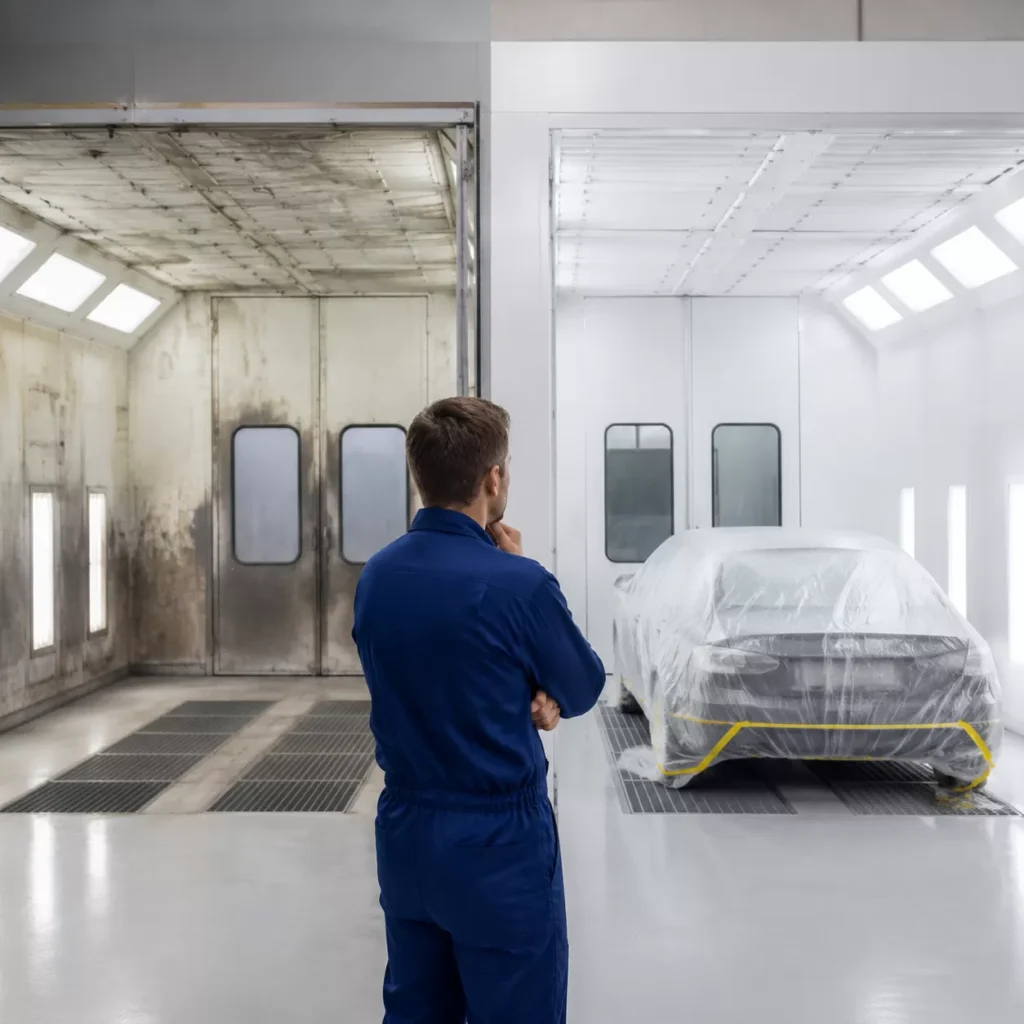
At some point, every shop owner with older equipment faces the same question: fix what you have, or start fresh? Neither answer is automatically right. Replacing a booth that had years of good service left in it wastes capital. Pouring money into one that’s past saving costs you more in the long run than a replacement would. This guide gives you a clear framework for making that call — and covers the upgrades worth doing when a full replacement isn’t the right move yet.
Page URL: https://sprayboothmanufacturer.com/product/
When Repair Is the Right Move
The 10-Year Benchmark
Age is the first thing to look at. A booth under ten years old with a solid structural shell — panels that aren’t warped, seams that still seal, no deep corrosion — almost always has useful life remaining. Targeted maintenance and component replacement on a younger unit delivers a much better return than scrapping it for a new one. The bones are good; the question is just which parts need attention.
Component-Level Failures Are Normal
A booth going down doesn’t mean the whole system is failing. Most breakdowns trace to a single worn part, not a systemic problem. Common fixes that restore full performance without touching the cabin structure include exhaust fan motor replacement, door seal replacement to fix pressure leaks, and drive belt replacement to bring fan speeds back to spec. Each of these is a straightforward repair that costs a fraction of a new installation and can be completed without significant downtime.
Parts Availability
A repair only makes sense if you can source the parts without a long wait or a custom fabrication job. For booths under a decade old, OEM components are generally available. If the parts exist and the price is reasonable, repairing is the financially sound choice.
Cosmetic Problems vs. Real Problems
Overspray buildup makes a lot of older booths look worse than they actually are. A booth that looks like it belongs in a scrap yard might perform perfectly well after a thorough cleaning, fresh filter media, and a coat of peelable booth coating on the walls. Before writing off a booth based on appearance, do the cleaning first and see what’s actually underneath. If the airflow and pressure readings come back to normal after a reset, you have your answer.
| Restoration Method | Effect on Performance |
|---|---|
| Peelable booth coating | Brightens the cabin, traps overspray, protects walls |
| New filter media | Restores correct manometer readings and airflow |
| Deep cleaning | Removes baked-on residue that causes finish defects |
When Replacement Is the Right Move
The 50% Rule
When a major component fails on an older booth, compare the repair cost against the price of a new installation. If the parts and labor exceed 50 percent of what a new unit would cost, the repair is a bad investment. You’d be spending significant money to extend the life of a system that still has all its other aging components — and the next failure is usually not far behind.
Obsolete Electronics
Control panels running on 20-year-old PLC hardware are a serious risk. When those components fail, finding replacements means scouting auction sites for used parts with no warranty. Running a production shop on electronics that can’t be reliably sourced is a downtime risk that grows every year. If the control system is obsolete, that alone is a strong argument for replacement rather than repair.
Structural Failure and Unsealed Leaks
A spray booth depends on a sealed, stable environment. Once the structure itself starts failing, no amount of maintenance recovers it. Warped or buckling panels, deep corrosion eating through the metal, and joint gaps that can’t be reliably sealed are all terminal problems. A booth with compromised structural integrity can’t maintain the pressure balance and laminar airflow that clean finishes require — and it creates real compliance risks around VOC containment and fire safety.
Recurring Finish Defects
If your team is spending more time sanding and buffing rework than spraying new jobs, and the root cause keeps tracing back to the booth — erratic airflow, failing temperature control, bad seals letting in contamination — the equipment is the problem, not the process. At that point, the labor cost of recurring rework outpaces the cost of replacement faster than most shop owners expect.
| Issue Type | When to Repair | When to Replace |
|---|---|---|
| Control panels | Simple relay or fuse swap | Obsolete PLCs with no available parts |
| Booth structure | Minor weatherstripping or caulking | Rusted panels, unsealed leaks throughout |
| Financial cost | Repair under 50% of new unit cost | Repair total exceeds 50% of replacement |
What a Modern Booth Actually Changes
If replacement is the right call, it’s worth understanding what you’re actually gaining — because the difference between a ten-year-old system and a current one goes beyond just having newer parts.
Energy Costs
Older burners run at a fixed output regardless of what the booth actually needs at any given moment. Modern air makeup units with Variable Frequency Drives adjust fan motor speeds based on the current cycle — running at full capacity during spraying and scaling back during flash-off and prep. The monthly savings on gas and electricity are real and add up quickly in a high-production shop.
Compliance
Regulations have tightened over the years. Running a booth that was built to older standards creates exposure to code violations and inspection failures that a current-spec unit avoids entirely. NFPA 33 compliance and EPA 6H requirements for refinishing operations are built into modern booth designs rather than needing to be retrofitted.
Throughput and Finish Quality
Faster, more consistent curing through a properly sized and tuned AMU means more cycles per day. Better filtration and accurate lighting reduce the finish defects that send jobs back for rework. The combination of fewer re-dos and faster cycle times is where the real ROI on a replacement shows up over the first year.
| Feature | Older Systems | Current Equipment |
|---|---|---|
| Burner efficiency | Constant high fuel consumption | Modulating AMU with VFD controls |
| Safety standards | Outdated codes | Full NFPA 33 and EPA 6H compliance |
| Cycle times | Slow bake and flash-off | Faster curing with better temperature control |
Modular Upgrades: A Middle Path
Replacement isn’t always all-or-nothing. If the cabin structure is solid but the mechanical systems are outdated, targeted upgrades can modernize the booth without the cost of a full teardown.
Replacing an aging burner with a current-spec AMU improves temperature control and fuel efficiency without touching the cabin. Adding VFDs to existing fan motors lets the system automatically balance pressure based on the active cycle. Upgrading to a touchscreen PLC panel replaces obsolete controls with programmable bake cycles and real-time monitoring that flags filter changes and airflow restrictions before they affect the finish.
| Smart Upgrade | What It Does |
|---|---|
| VFD fan controls | Adjusts motor speed by cycle, reduces wear and energy draw |
| Modern AMU | Better temperature control, faster heat-up, lower fuel use |
| Touchscreen PLC | Programmable cycles, real-time monitoring, predictive alerts |
This approach makes the most sense when the structural shell is in good shape and the main complaints are around energy cost, slow cycle times, or unreliable temperature control. Swapping the mechanical guts while keeping the cabin avoids the capital expense of a full replacement and delivers most of the performance benefit.
FAQ
How often do filters need to be replaced in an active shop? Intake pre-filters typically need replacement every two to three weeks or every 100 operating hours. Exhaust filters should come out every 50 to 60 operating hours. Ceiling diffusion filters last six to twelve months depending on shop cleanliness and production volume. The most reliable indicator is your manometer — when the pressure reading hits the manufacturer’s limit, change the filter regardless of how long it’s been in.
What are the signs an exhaust fan motor is starting to fail? Airflow that clears overspray more slowly than normal, unusual noise from the exhaust stack such as squealing or grinding, a burning smell or a motor casing that’s hot to the touch, and the booth repeatedly tripping the breaker during startup are all warning signs worth acting on before the motor fails completely mid-job.
Is a cracked heat exchanger worth repairing? Usually not. A cracked heat exchanger leaks carbon monoxide into the cabin, which is a direct OSHA and NFPA 33 violation. The labor and parts cost to swap just the core often approaches the price of a new, more efficient AMU. In most cases, replacing the whole unit makes more financial sense and restores compliance at the same time.
When does a modular upgrade make sense vs. full replacement? If the cabin structure is under ten years old, free of significant rust, and the seals and panels are intact, a modular upgrade to the mechanical systems is usually the better investment. If the cabin itself has structural issues — warped panels, unsealed gaps, deep corrosion — or if the control electronics are obsolete and unsourceable, replacement is the more cost-effective path.
Tell Us What You’re Working With
Share your current booth model, age, the issues you’re seeing, and your production volume. We’ll help determine whether a targeted repair, a modular upgrade, or a full replacement makes the most sense for your operation — and send a detailed quote within 48 hours.
Related Pages
- Bus Spray Booth Design Guide → https://sprayboothmanufacturer.com/transit-coach-spray-booth-requirements/
- Truck Paint Booth Guide → https://sprayboothmanufacturer.com/truck-paint-booth-semi-truck-spray-booth-specifications-buying-guide/
- Other related products → https://www.autokemanufacture.com/product
- Contact our sales Team → https://sprayboothmanufacturer.com/contact-us/
✅ CE Certified | ✅ ISO 9001:2015 | ✅ Factory Direct | ✅ Ships to 60+ Countries | ✅ 1-Year Warranty | 🔒 HTTPS Secured